Tag Archive | Jesus

Reading the Gospels in 2026: (3/23) Luke 4:31-44

A 5-day per week study.

March 23 – Reading Luke 4:31-44

Read and believe in Jesus.

“I must preach the good news of the kingdom of God to the other towns as well, for I was sent for this purpose.” Luke 4:43

.

The Gospel according to Luke 4:31-44

Review – In the last lesson, Jesus announced His ministry and Messiahship by reading and claiming Isaiah 61 in His hometown synagogue.  At first, the men of Nazareth were amazed, but then they remembered that Jesus was “just Joseph’s son” and did not believe Him.  They even tried to kill Jesus, but He escaped.

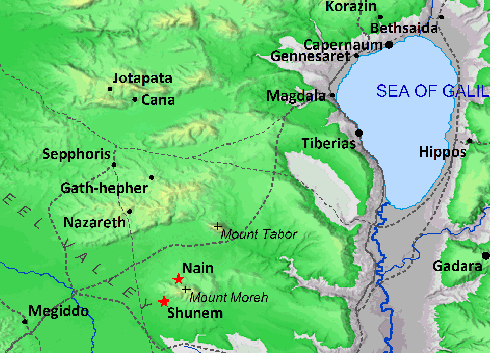
Jesus traveled about 50 miles to Capernaum and established His headquarters there.

.

Vss. 31-37.

On the next Sabbath, Jesus taught in the synagogue in Capernaum. The men were astonished at His teaching, “for His WORD possessed authority.”

While they were there, a man who had the spirit of an unclean demon yelled out, “Ha! What have you to do with us, Jesus of Nazareth?  Have you come to destroy us? I know who you are – the Holy One of God.”

But Jesus rebuked him, saying, “Be silent and come out of him!”  The demon twisted the man and came out of him.

All who were there were amazed and said to one another, “What is this WORD? For with authority and power He commands the unclean spirits, and they come out!”

And reports about Jesus went out into every place in the surrounding region.

(The Words of Jesus were powerful and came with His authority.  Just as the Word of God, our Bible, also has power and authority.  It was “breathed out” by God Himself. (2 Timothy 3:16-17) and can teach, correct, scold, train, and equip us for every good work.  It’s true. We can believe it, trust it, teach it, and share it with confidence.  THANK YOU, Lord, for Your Word!  Oh, let us not neglect so great a gift.)

.

Vss. 38-39.

After attending synagogue, Jesus and a few early followers went to Peter’s home. Peter’s mother-in-law was sick with a “high” fever, and he and his wife appealed to Jesus to heal her.  Jesus stood over her and “rebuked” the fever.  And it left her. (Just like the demon in the man that Jesus rebuked. There is authority in Jesus’ words.)   It was such a complete healing that Peter’s mother-in-law immediately got up and served them a simple Shabbat meal.

(As we study through the Gospel of Luke, watch how Luke describes illnesses and healings.  Matthew and Mark both tell of Peter’s mother-in-law, but only Luke says it was a HIGH (dangerous) fever.  And only Luke tells how Jesus healed her.  Remember, Luke is a doctor.)

.

Vss. 40-41.

When the Sabbath was over (at sundown), “all those who had any who were sick with various diseases brought them to Jesus.  He laid his hands on every one of them and healed them. And demons also came out of many, crying, “You are the Son of God.”  But Jesus would not allow them to speak.”

(Yes, Jesus is the Son of God.  Yes, He is the Christ.  But who needs demons to testify for him?  Let those who are healed, and we, who are saved, be the ones to testify.)

.

Vss. 42.

“When it was day, Jesus departed and went into a desolate place.”

Mark tells us that it was “very early in the morning,” and that Jesus went there “to pray.”

(If the Son of God desired a quiet time with His Father, shouldn’t we, His children, yearn for this too?  Healing power went out from Jesus over and over that last evening.  He spiritually battled demonic spirits many times.  Jesus needed the refreshing, restoring communication with His God. Don’t we?  Jesus wanted to thank and praise God, and pray for direction, all things we can do in prayer, too. 

Lord, wake me “early in the morning” to meet with you. What a privilege.

.

Vss. 43-44.

Peter and some others looked for Jesus and finally found Him. They wanted Jesus to stay in Capernaum to teach, minister, heal, and cast out demons. His audience was growing.  The sick and oppressed needed Him.

But Jesus told them, “I must preach the good news of the kingdom of God to the OTHER towns as well; for I was sent for this purpose.” 

Yep, He had surely received direction from His Father while He prayed.  He was to go to other places too.  And, so He did, preaching in the synagogues.


Reading the Gospels in 2026: (3/20) Luke 4:14-30

A 5-day per week study.

March 20 – Reading Luke 4:14-30

Read and believe in Jesus.

“And Jesus returned in the power of the Spirit to Galilee, and a report about him went through all the surrounding country.”  Luke 4:14

.

The Gospel according to Luke 4:14-30

(Review)  Yesterday, we saw Jesus, after a 40-day fast in the wilderness, battling temptations by the “master tempter,” the devil, by using the powerful Sword of the Spirit, the Word of God.  Jesus’ example means that this is our main weapon against the fleshly desires and temptations we experience, too.  Read, study, and memorize God’s Word!  The Holy Spirit will bring it to your mind when you need it and trust Him for it.

.

Vs. 14.

“And Jesus returned in the power of the Spirit to Galilee, and a report about Him went out through the surrounding country.”

What report?

Luke skips over a period of Jesus’ ministry in Jerusalem, Judea, and Samaria before returning to Galilee.  We’ll study these when we get to John’s gospel, but here are the things that were “reported about Jesus” before He got to Galilee.

  1. He gathered the first few of His disciples from those who followed John the Baptist.
  2. He cleansed the Temple for the first time.
  3. He performed many miraculous signs that left the people in Jerusalem “wowed.”
  4. He met with Nicodemas at night.
  5. He ministered in the Judean Countryside.
  6. Heading north, He met with the Samaritan woman at the Well.
  7. He remained in Samaria for two days, ministering to the people.
  8. Then in Galilee, He healed the Official’s son.

And back to Luke 4, Jesus “taught in their synagogues, being glorified by all.”

.

Vss. 15-20.

The Sabbath came around, and as was His custom all His life growing up in Nazareth, Jesus went to the synagogue.  When the time came for reading that day’s scripture passage, Jesus stood up to read.  The scroll of the prophet Isaiah was given to him.  He unrolled it and found the passage – Isaiah 61:1-2a.

“The Spirit of the Lord is upon me,

because He has anointed me

to proclaim good news to the poor.

He has sent me to proclaim liberty 

to the captives

and recovering of sight to the blind,

to set at liberty those who are 

oppressed,

to proclaim the year of the Lord’s favor.”

Then Jesus rolled up the scroll, gave it back to the attendant, and sat down. And the eyes of all the synagogue were fixed on Him.

(It was customary for a teacher to stand respectfully during the reading of the Scriptures, and to sit humbly to teach.  The men in the synagogue waited for Jesus to speak.)

.

Vs. 21.

“And He began to say to them, ‘Today this scripture has been fulfilled in your hearing.” 

Jesus was claiming to be the Messiah that Isaiah prophesied would come.”  (However, He stopped reading in the middle of verse 2 because the remaining part foretold the SECOND coming of Jesus, bringing judgment and God’s vengeance.)

.

VSs. 22-27.

At first, the listeners were amazed at the gracious words that were coming from his mouth (all the blessed things the Messiah would do when he came), but then they looked again at the man, Jesus.

“Isn’t this Joseph’s son?”   How could this carpenter, whom we’ve known since He returned from Bethlehem as a kid, be … the Messiah??  He’s just one of us.  And … wasn’t there some rumor about His being conceived “out of wedlock?”  WAIT a minute!!

Wouldn’t you know it.  The first opposition came from Jesus’ own neighbors in Nazareth?  The Samaritans had believed Him and rejoiced; the Jews of Nazareth would not.

Jesus said to them, “Doubtless you will quote to me this proverb, ‘Physician, heal yourself.  What we’ve heard you did at Capernaum, do HERE in your hometown as well!’  Truly, no prophet is acceptable in his hometown.”

Then Jesus “rubbed in” their unbelief by reminding them that even in the days of Elijah and Elisha, those great and honored prophets, the people of Israel were not favored with miracles.  These happened to the Gentiles of Zarephath, Sidon, and Syria, to the ones WHO BELIEVED.

.

Vss. 28-30.

When they heard Jesus say that, they were filled with wrath.

They rose up and drove Him out of town.

They brought Him to the edge of a hill so they could throw Him down (and probably stone Him).

But passing through their midst, He went away.”

.

We don’t see Jesus returning to that synagogue, nor doing any miracles in Nazareth.  From then on, His headquarters would be in Capernaum.  He would attend the synagogue there.

.

It’s a warning to us. Don’t miss out on salvation and the Savior … because of unbelief.


Reading the Gospels in 2026: (3/18) Luke 3:21-38

A 5-day per week study.

March 18 – Reading Luke 3:21-38

Read and believe in Jesus.

“The heavens were opened, and the Holy Spirit descended on Him…”  Luke 3:21

No photo description available.

.

The Gospel according to Luke 3:21-38

In the last study, we saw John the Baptist “proclaiming a baptism of repentance for the forgiveness of sins.” Many came to him, were baptized, and with repentant hearts asked how they could bear the fruits of repentance. From religious leaders to tax collectors and soldiers, they came, and John told them.  And while they were there, he preached the good news of the coming Messiah and his own unworthiness.

Before John was arrested by Tetrarch Herod for incest and adultery with Herod’s brother’s wife (and a few other sins), John also (reluctantly, according to Matthew 3:13-15) baptized Jesus “to fulfill all righteousness.”

.

Vss. 21-23a.

At Jesus’ “righteous” baptism, the Holy Spirit descended on Him “in bodily form,” like a dove.  And a Voice (of God) came from Heaven, saying, “You are my beloved Son, with You I am well pleased.”  Jesus heard the voice, an affirmation from His Father.  John saw the dove descending on Jesus and took it as the sign he’d been promised that “this was the Messiah.” He then began pointing to Jesus as “the lamb of God, who takes away the sin of the world.” (John 1:29-34)

This was when Jesus began His ministry.  he was about thirty years of age.

.

Vss. 23b-38

Here, Luke inserts another of his factual reports, a genealogy of Jesus. These are the passages we typically skim through, if at all.  But there are some interesting things to see.

Unlike Matthew’s genealogy, Luke begins and ends with Jesus.  Son of God, AND born of man (Adam).

He starts with “Jesus being the supposed son of Joseph, who was the son of Heli.  It should actually say, son-in-law of Heli, for this is the lineage of Jesus ON MARY’S SIDE.  Her line also leads back through King David, but through his son, Nathan, not Solomon.  This is important because, just before the fall of Jerusalem under the last king of Judah, God said NO MORE KINGS IN THIS LINE would rule Israel (Jeremiah 22:24-30 – read this for yourself.), and yet the Messiah would be King, a descendant of David.  And so the true blood line DOES come down through David (as God promised him), but through a different son.

.

And  so, God the Father proclaimed Jesus His “beloved Son,” and Jesus’ genealogy back to the beginning also proclaims Jesus as “the Son of God.”


Reading the Gospels in 2026: (3/17) Luke 3:1-20

A 5-day per week study.

March 17 – Reading Luke 3:1-20

Read and believe in Jesus.

“…the word of God came to John, the son of Zechariah, in the wilderness.”  Luke 3:2b

.

The Gospel according to Luke 3:1-20

The last we heard of John the Baptist was in Luke 1:80: “And the child grew and became strong in spirit, and he was in the wilderness until the day of his public appearance to Israel.”   Well, that day has come. The Word of God came to him, and John was ready. He immediately obeyed.

.

Vss. 1-6.

Luke sets up the scene in detail for the brief ministries of both John and Jesus, naming the current Caesar (Tiberias), the governor of Judea (Pontius Pilate), the tetrarch of Galilee (Herod), as well as three other rulers in areas around Judea and Galilee. He also tells us that there were two high priests, both of whom would sentence the Savior to death (Annas [the powerful one] and his son-in-law, Caiaphas).

The scene is set. History awaits.

God’s word stirs John, the prophet-like-Elijah, from his recluse (possibly with the Essenes, who might have hidden the complete book of Isaiah in pottery in a cave, known as the Dead Sea Scrolls).

Luke inserts John’s marching orders from Isaiah 40:3-5.  “A voice crying in the wilderness, ‘Prepare the way of the Lord’.”  “…and all flesh shall see the salvation of God.”

And so, John went into all the region around the Jordan, proclaiming a baptism of repentance for the forgiveness of sins.

.

Vss 7-9.

Crowds came out to him to be baptized, and John was not gentle with them.

“You brood of vipers! Who warned you to flee from the wrath to come?” (This he said to the religious leaders, according to Matthew 3:7.)

“Bear fruit in keeping with repentance. And do not BEGIN to say to yourselves, ‘We have Abraham as our father.’ For I tell you, God is able from these stones to raise up children for Abraham!”

“The axe is laid to the root of the trees.  Every tree, therefore, that does not bear good fruit is cut down and thrown into the fire.”

.

Vss. 10-14.

His fiery words put “the fear of God” into his listeners, and they asked him for help.

“What then shall we do?” they begged him. John answered by telling them to love others. “Whoever has two tuics is to share with him who has none, and whoever has food is to do likewise.”

“Teacher, what shall WE do?”  begged the tax collectors when he’d baptised them.  “Collect no more than you are authorized to do. (Tax collectors could collect any amount over the required amount for Rome and keep it for themselves.)

Even Roman soldiers came to John with repentant hearts.  “And we, what shall we do?” John told them not to extort money from anyone by threats or by false accusation, and to be content with their wages.

And so, John’s preaching began to soften the hearts of all kinds of people for the coming of Jesus.  He was indeed preparing the way.

.

Vss. 15-18.

His message was so different from what the people heard in the synagogues that they began to wonder if John wasn’t the Messiah himself.  But he set them right quickly.

“I baptize you with water, but He who is mightier than I is coming, the strap of whose sandals I am not worthy to untie. HE will baptise you with the Holy Spirit and fire.  HE will gather the WHEAT into the barn, but the CHAFF He will burn with unquenchable fire.”

So with these and many other exhortations,  John preached “good news” to the people.

.

Vss. 19-20.

But…..  Herod the tetrarch, who had been reproved by John for marrying Herodias, his brother’s wife, and other wicked things (John wasn’t afraid to hurl scathing reproofs even at a petty king!), locked John in prison. (And later had him killed.)

What a short-lived ministry John had.  But he was a flame for God, a messenger to prepare the way for the coming of the Son of God.  Jesus had great words about him, which we’ll see later.  (Matthew 11:9-15, if you want to take an early peek.)

,


Reading the Gospels in 2026: (3/13) Luke 2:22-40

A 5-day per week study.

March 13 – Reading Luke 2:22-40

Read and believe in Jesus.

“…my eyes have seen Your salvation that You have prepared in the presence of all peoples.”  Luke 2:30

.

The Gospel according to Luke 2:22-40

(Review)  In the last study, we read the familiar story of Jesus’ nativity. Everything pointed to a lowly birth, except for one thing that happened in the middle.  It began with the long trip from Nazareth to Bethlehem, then no room to lodge in the usual places, and finally settling in a stable, where Jesus’ first “crib” was a feed trough.  Afterwards, the group of sheep-smelling men came to ooh and aah over the baby and tell their tale of a vision.

But right in the middle, Heaven couldn’t contain itself.  Jesus, the second person of the Trinity, who sat at the Almighty’s right hand, had made it safely to earth and mankind.  The glorious work of salvation – stolen from man in the Garden of Eden – was about to take place.  And… a Heavenly Host burst out in a song of praise, “Glory to God in the Highest!”

.

Vss. 22-24.

At the end of yesterday’s study, the first “rite” of babyhood took place. At eight days old, Jesus was circumcised (initiated into the Community of Israel) and given His name. (which Gabriel has told Mary)

Now, at about 6 weeks, there were two more Jewish rites written in “the Law of the Lord” that had to be fulfilled.

  1. The Rite of Purification. (Leviticus 12:2-4)  When a woman had a baby boy, she was considered “ceremonially unclean” for 40 days. After that, she was to bring a lamb and a pigeon or dove (or two pigeons or 2 doves, if she was poor) to the priest, who would make an offering for her, and then she would be “ceremonially clean” and able to worship, fellowship, and partake in marital relations.  (Mary and Joseph’s offering was two birds.)
  2. The Dedication (and Redemption) of the Firstborn Son.  (Exodus 13:2, 12-15 and Numbers 18:16)  Because the LORD freed the Israelites from slavery with the death of Egypt’s firstborn sons, He claimed all the firstborn males of Israel to be HIS (man and beast). The animals would be sacrificed, but the baby boys were to be ‘redeemed’ or bought back.  The amount was five silver shekels.

Joseph and Mary faithfully performed these rituals according to “the Law of the Lord.”  Right from His beginning, Jesus fulfilled ALL the Law perfectly – for us – so He would be the perfect “spotless” Lamb of God sacrifice.

.

Vss. 25-35.

Simeon, a special old man (not a priest), who was righteous, devout, and waiting (longing) for “the consolation of Israel” (a messianic title derived from the O.T., like in Isaiah 40:1-2).   The Holy Spirit had revealed to Simeon that he would not die until he saw the Messiah with his own eyes.

(Wow!  Can you imagine a promise like that?)  What hope and expectation he must have had!)

On that day, when Mary and Joseph brought Jesus to the temple to “redeem” Him, Simeon “just happened” to be there. The Spirit of God indicated somehow that THIS BABY was the Messiah Simeon had been looking for.  Simeon walked over to the couple, took baby Jesus up in his arms, and praised God.

“Lord, now you are letting your servant 

depart in peace,

According to Your word;

For my eyes have seen Your salvation

that you have prepared in the Presence

of all peoples;

a Light for revelation to the Gentiles,

and for Glory to your people Israel.”


Mary and Joseph stood there and marveled at what Simeon said about Jesus.  Then this dear old man blessed them.  He also warned Mary that “a sword will pierce through your own soul.”

.

Vss. 36-40.

There was also an eighty-four-year-old prophetess named Anna in the Temple that day.  She had been married only seven years before becoming a widow.  Now, she didn’t leave the Temple area, but worshiped with fasting and prayer night and day.

When she saw the parents and Jesus, she began to give thanks to God and to speak of Him to all who were “waiting for the redemption of Jerusalem.” (Those who looked forward to the Messiah)

.

(What a wonderful thing that God included these two old people early in the life of Jesus.  Yes, God still has a use for seniors.  Just think how grandparents and great-grandparents can have a godly influence on our children today!!  Thank You, Lord!)

.

(NOTE:  Luke omits the visit of the Magi when Jesus was around 2-years old, and the flight to Egypt for a time, and picks up when they are heading back home.  Finally.)

The family travelled to Nazareth after years away.  They were a family now. Did anyone remember when Mary left in disgrace as an unwed mother?  (Well, yes. Some did.)   They settled back into the familiar patterns, and Jesus grew up.  He became strong and filled with wisdom.  And the favor of God was upon Him.

.

Jesus fulfilled everything according to the Law, even when He was an enfant and couldn’t do it Himself.  He did what WE never could do – not sin, EVER.  And all that God required in the Law, it was done. Jesus lived sinless, in perfect harmony with His Father in Heaven.  Then He died – the spotless Lamb of God – to take away the sin of the world.  He paid sin’s debt = death.  For us.  THANK YOU, Jesus.


.

Vss.

Reading the Gospels in 2026: (3/9) Luke 1:39-56

A 5-day per week study.

March 9 – Reading Luke 1:39-56

Read and believe in Jesus.

“My soul magnifies the Lord,” Luke 1:46

.

The Gospel according to Luke 1:39-56

The last scripture we looked at told us how Gabriel’s message to the young betrothed Mary about becoming the mother of the Messiah was accepted with humble grace.   “Let it be to me according to Your word,” although Mary had to know the problems that would arise in explaining her pregnancy to her family, and especially Joseph. (As an unwed mother, she could have been deemed an adulteress and stoned to death!)  The news of Elizabeth’s miracle pregnancy cheered her and assured her that “NOTHING will be impossible with God.”

.

Vss. 39-45.

As soon as it could be arranged – probably as a big help for Elizabeth – Mary travelled in a group south into the hill country of Judea, where Zechariah and Elizabeth lived.

As she entered the house and called out a greeting to Elizabeth, something wonderful happened.  Elizabeth’s unborn baby – John – “leaped in her womb!”  And Elizabeth herself was filled with the Holy Spirit.

Her loud words revealed a knowledge that no one had told her.

“Blessed are you (Mary) among women, and blessed is the fruit of YOUR womb!  Why is it granted to me that the mother of my Lord should come to me?  For behold, when the sound of your greeting came to my ears, the baby in my womb leaped for joy.  Blessed is she who believed that there would be a fulfillment of what was spoken to her from the Lord.”

How wonderful for the Lord to encourage Mary in this way.  If she’d had any doubts (and I don’t think she did), they were gone after Elizabeth’s prophecy.  How comforting to be able to talk it over with this “grandma-type” woman.  Mary had probably not told anyone of the angel Gabriel’s visit.

.

Vss. 46-55.

In response to Elizabeth’s praise, Mary’s own heart soars.  The verses that follow are almost a song.  Can you imagine that?  Her words are full of praise to the Lord, and many Old Testament allusions and quotations.   Even as a woman in Jewish society where only the men studied, she knew the Word of God.  There are allusions to the Law, the Psalms, and the Prophets.  What sweet words to the “ears” of God.

  • “My soul magnifies the Lord,
  • and my spirit rejoices in God my Saviour,
  • for He has looked on the humble
  • estate of his servant.
  • For behold, from now on all generations,
  • will call me blessed;
  • for He who is mighty has done
  • great things for me,
  • and Holy is His Name.
  • And His mercy is for those
  • who fear him.
  • From generation to generation,
  • He has shown strength with His arm.
  • He has scattered the proud 
  • in the thoughts of their hearts;
  • He has brought down the mighty from their thrones
  • and exalted those of humble estate.
  • He has filled the hungry 
  • with good things,
  • and the rich,
  • He has sent away empty.
  • He has helped His servant Israel
  • in remembrance of His mercy,
  • as He spoke to our fathers,
  • to Abraham and to his offspring forever.”


(Perhaps Mary sang songs like this as lullabies to her baby Jesus, too.)

.

Vs. 56.

I wish I knew more about the three months Mary spent with Elizabeth. They must have encouraged each other in the Lord.  Perhaps Elizabeth gave her advice or counsel about her family and Joseph, for when she returned home, “showing” her pregnancy.  Was she there when John was born? Did she hear (when Zecharia could finally speak again) how John would open the way for ministry for her own son, Jesus?

Regardless of our speculation, Mary finally returned to Nazareth “to face the situation.”  WHO would believe her?


Reading the Gospels in 2026: 3/4) Mark 16:1-8

A 5-day per week study.

March 4 – Reading Mark 16:1-8

Read and believe in Jesus.

“He is risen.  He is not here.”  Mark 16:6b

The Gospel according to Mark 16:1-8

Jesus has been crucified and buried (not by His close disciples, but by two members of the elite Sanhedrin). What irony!

It was a cruel death for our Savior and a devastating shock for the disciples.

But it was a victory for the religious leaders.  They had finally (they thought) stopped an imposter and a blasphemer, a real thorn in their side, and a deep prick to the conscience.   For a few days, they did all they could to keep Jesus in the tomb, including setting a Roman guard, bribery, and circulating a slew of false rumors. But….

.

Vss. 1-4.

Remember the women who watched the crucifixion from afar, saw the two men take down Jesus’s body and carry Him away.  They had followed them to Joseph’s tomb, watched them lay Jesus inside, then rolled the great stone over the opening.

NOW, early on Sunday (the first day of the week), as they walked to the tomb, carrying the necessary burial spices, Mary Magdalene, Mary, James’ mother, and Salome wondered who would roll the stone back for them.  Would there be a gardener there, other mourners?

But, miracle of miracles, when they arrived, they saw that the stone had already been rolled back!

.

Vss 5-8.

Maybe they thought Joseph had returned to further anoint Jesus’ body. Anyway, they were not afraid to walk right into the tomb.  Once inside, they were totally alarmed, for sitting there on the right side of the slab where Jesus had been laid, was a young man dressed in a white robe.  WHO???

Seeing their alarm, he quickly spoke. “Do not be alarmed. You seek Jesus of Nazareth, who was crucified. He has risen; He is not here. See the place where they laid him. But go, tell His disciples – AND PETER – that He is going before you to Galilee.  There you will see Him, just as He told you.”

And the women went out and fled from the tomb, for trembling and astonishment had seized them, and they said nothing (NOTHING??) to anyone, for they were afraid.

.

.

And that’s where Mark left off his narrative.

Since the Gospel of Mark was later referred to as “the memoirs of Peter,” and Mark was known as “the disciple and interpreter of Peter,”  perhaps it was Peter who ended the narration of his story there. Citcumstances… Time constraints…  We don’t know.

But it seems that either Mark or someone else picked up the pen and “finished” the story, or, at least, made some notes about what happened later.  Verses 9-20 are not included in many Bibles, but they do appear in my English Standard Bible with that caveat.  So… I decided to write one more post in The Gospel of Mark, as a “bonus” study.  I’ll publish it shortly after this one goes live.

Reading the Gospels in 2026: (2/27) Mark 15:1-20

A 5-day per week study.

February 27– Reading Mark 15:1-20

Read and believe in Jesus.

“Are You King of the Jews?”  Mark 15:2a

.

The Gospel according to Mark 15:1-20

We’ve read how Jesus was arrested, hauled into a mock hearing and trial in front of the High Priest of Israel and the Sanhedrin, who deemed Him worthy of death. He was knocked around a bit (for fun). Now, at dawn, the Sanhedrin “formally convened” and “officially sentenced” Jesus to death.

Problem:  THEY could not execute Jesus.

Under Roman rule, the Jews could not execute someone  (although later, they DID stone Stephen).  Also, to fulfill scripture, Jesus could not be stoned. He had to be “hanged” on a “tree,” and so become “cursed” by God for us.  (See Galatians 3:13, with Deuteronomy 21:23.)

Solution to the problem?

They had to convince the Roman Governor Pilate, who was in Jerusalem for Passover, that Jesus was worthy of Roman capital punishment.  It wouldn’t be simple (as you know, if you read all the Gospel accounts together), but they would succeed!

.

Vss. 1-5.

The Jewish leaders (with the Temple guard) bound Jesus and took Him to the Pretorium, where Pilate judged cases.  The Governor would not have listened to a charge of blasphemy, so they came up with three accusations that were sure to catch Pilate’s attention (See Luke 23:2)

  1. Misleading our nation
  2. Forbidding us to give tribute to Caesar
  3. Saying that He is Christ, a King.

Pilate jumped on that last one, because if Jesus was proclaiming Himself a King, that meant He was a rebel and insurrectionist against Caesar – a crime worthy of execution.

“ARE You a King?”  he asked Jesus.

“You have said so,” He answered.  By saying that, Jesus was indeed agreeing that He was the King of the Jews, but that Pilate had no “earthly” idea of what that meant.  Jesus answered no more questions, and Pilate seriously doubted He was a terrorist.

.

Vss. 6-10.

It was a custom that, during Passover, Roman Governors would sometimes grant amnesty for a prisoner at the people’s request.  Pilate saw this as a possible way to release the harmless Jewish “wannabe king.”  Not a dummy, he KNEW that the Jewish leaders had accused Jesus of such a serious crime, because they were jealous of Him.  Pilate did not want to play up to them.  And … conveniently, he had in his dungeon right then a very vile criminal, who was really guilty of insurrection, as well as murder. His name was Barabbas (which weirdly means “son of the father!!”)

So, when the crowd outside asked him to do as he usually did and release a prisoner, Pilate asked them, “Do you want me to release for you the King of the Jews?

(Remember, just five days earlier, Jesus had ridden triumphantly into Jerusalem to the cries of “Hosannah!” and “Blessed is He who comes in the name of the Lord,” and “Blessed is the coming kingdom of our father David! Hosannah in the highest!”)

But the chief priests went through the crowd, stirring them up so much that they would as for Barabbas instead!

Surprised and confused, Pilate asked, “Then what shall I do with the man you call the King of the Jews?”  He was not ready for their startling and brutal answer.

.

Vss. 11-15 

“Crucify Him!” they shouted, responding to the urging of the Jewish leaders.

“Why?  What evil has He done?” Pilate asked.  He KNEW that crucifixion was “the cruelest and most hideous punishment possible.”

“Crucify Him!  Crucify Him!  Crucify Him!”  The riotist chant was repeated over and over.

.

So Pilate, wishing to satisfy the crowd (and not stir up a complaint against him to Rome),  released Barabbas for them.

(A lucky day for this criminal.  I wonder if he ever considered the Man who actually took his place on the cross … a visual of what Jesus did for each person who would ever believe in Him.)

Pilate then had Jesus scourged and condemned Him to be crucified.

(Scouraging was also a fearful thing.  It was done with a whip of metal-tipped leather thongs, which cut the flesh down to the bone and caused severe bleeding.  This torture would weaken the prisoner (sometimes to death) and intensify the pain for the following ordeal.)

.

.

Oh, Jesus!  Thank You!


Reading the Gospels in 2026: (2/23) Mark 14:1-26

A 5-day per week study.

February 23– Reading Mark 14:1-26.

Read and believe in Jesus.

“I will not drink again of the fruit of the vine until that day when I drink it new in the Kingdom of God.”  Mark 14:25

.

The Gospel according to Mark 14:1-26

Chapter 13 on the destruction of Jerusalem and the “End Times” was sparked by one of the disciples’ comments about the Temple’s magnificent stones.  Jesus told them that not one stone would be left on another, and in 70 A.D., that’s exactly what happened.  This would be proof that Jesus’s other prophecies about the Antichrist, the Great Tribulation, and His glorious second coming in the clouds would also come to pass.

It was a lot to think about, but the disciples probably promptly forgot it for the time (like they had of Jesus’ 3 times predicting his death and resurrection).  They were still thinking that Jesus would soon declare himself KING, and that they would help Him rule the Kingdom.   Alas…

.

Vss. 1-2.

A quick note that even though Jesus had left the city, the religious leaders were still very angry with Him. They were mulling over ways they could arrest Him by stealth, and KILL Him.  But, they thought, not during Passover, because the people would cause a great uproar.  (Ha!  The best laid plans of mice and men!  Little did they know that Jesus would indeed be arrested and then killed on Passover.  And that the crowds would be the ones shouting, “Crucify Him!”)

.

Vs.3.

This is the only time that “Simon the Leper” is named in the Bible.  Although he still carried the title of “the Leper” to distinguish him from other Simons in town, he had been totally cured, probably by Jesus. (No person suffering from leprosy could come near, let alone host a meal for other people.)

Some have thought that Simon was the father of Lazarus, Martha, and Mary, and that this was HIS house, but that he’d been absent on other occasions when Jesus visited because of his disease.  Regardless of this, we do know from John’s account in chapter 12 that the woman there was Mary.

While Jesus and the disciples were reclining at dinner, this young woman (Mary) came in, broke an alabaster jar of very expensive perfume, and anointed Jesus’ head. (John’s account says she also anointed His feet and dried them with her hair.)

This was a total act of love on Mary’s part. She thought nothing of the expense.  Consider:  she had often sat at Jesus’ feet, hearing His teaching;  Jesus had healed her father of leprosy;  and Jesus had raised her brother back to life from the grave.  She had long ago given her heart, soul, and spirit to Him.  What was an heirloom jar of perfume?

.

Vss. 4-9.

What was an heirloom jar of perfume?  Well, it was a year’s wages!! (Think of that amount today for an hourly worker!)  Some of the disciples were indignant.  “Why was this not sold and the money given to the poor?”

Seriously?  The poor?  You KNOW who brought this up.  It was Judas.  He was the group’s treasurer.  He carried the money pouch and paid for expenses (and yes, donated some to the poor).    John 12:6 says of him, “He said this, not because he cared for the poor, but because he was a thief, and having charge of the moneybags, used to help himself to what was put into it.”  Tsk, tsk, tsk.  

Jesus, of course, knew this.  And He swung back hard in defense of Mary.

Leave her alone!  Why do you trouble her? 

She has done a beautiful thing for me.  You will always have the poor, and whenever you want, you can do good for them. But you will not always have Me.  She has done what she could; she has anointed my body beforehand for burial. 

And truly, I say to you, whenever the gospel is proclaimed in the whole world, what she has done will be told in memory of her.”

Of course, what Judas is about to do will also be told of him whenever the gospel is proclaimed throughout the world.

Did you catch Jesus’ statement?  “She has anointed my body beforehand for burial.”  Again, the disciples didn’t seem to notice.  I mean, if Jesus was going to be buried, it meant He was going TO DIE!   But, Mary, sitting and learning at Jesus’ feet all those times, HEARD him.  And she believed.  And she offered her expensive perfume to pre-anoint Jesus’ body for that burial.  It not only proved her love but also her faith.

.

Vss. 10-11.

“Then Judas Iscariot went to the chief priests in order to betray Jesus to them.”

He just could not take it.  Not only the sight of all that money “wasted” on Jesus, but also the fact that Jesus honored the woman and the act… and at his expense.   He could have HAD that money.  Well…..  he knew where he could get some ready cash.  “Just you wait, Jesus!” he might have thought, as he headed back into the darkened city.

.

Vss. 12-15.

It was the first day of Unleavened Bread-Passover, and Jesus sent two of his disciples into the city to prepare the room where they would eat the Passover meal.  How would they know where to go?  Jesus gave them a sign, like finding the donkey and its mother tied up a few days earlier.

This time, they would see a man carrying a jug of water.   You might think that this would be happening all around the city.  But no.  It was a woman’s job to fetch and carry water.  To see a man doing it would be highly irregular.  So HE would be the one they should ask.  That man would show the two where the room was, and they would set about preparing it for that evening’s meal.

.

Vss. 17-21.

(We will learn much more about what happened in that upper room when we study the other Gospels. Mark is very brief.  “Just the facts,” he seems to say. They are: the betrayal announced and the bread and wine.  And that’s that. (Remember, Mark, is probably getting all those facts from Peter’s point of view.)

And so, the disciples reclined around a spread of Passover food and ate.  At one point, Jesus said, “Truly, I say to you, one of you will betray me, one who is eating with me.”

Talk about dropping a bombshell!

They all began to be sorrowful and, one by one, asked him, “Is it I?”   (Isn’t it heartbreaking, that they all believed their hearts could have betrayed Jesus!  We all could, and have.)

Jesus answered, “It is one of the twelve, one who is dipping bread into the dish with me.  The Son of Man goes as it is written of him, but woe to that man by whom the Son of Man is betrayed. It would have been better if he had not been born….”

The other Gospels make it clear in several ways that it was Judas Iscariot. (We’ll study them one by one this year.)  And Judas leaves the room.

.

Vss 22-26.

Then Jesus institutes “The Lord’s Supper.”  This is what is celebrated in churches today, “in remembrance of Jesus” and what He did for us on the cross.

First, Jesus took up the bread and blessed it. He gave it to them and said, “This is my body.”

Next, He took a cup, and when He had given thanks, He gave it to them for all the drink of it.  “This is my blood of the covenant, which is poured out for many.  Truly, I say to you, I will not drink again of the fruit of the vine until that day when I drink it new in the Kingdom of God.”

(Cups of wine and the Matso bread are common in the traditional Passover meal, even today.  The Jews remember their escape from Egypt, when, with the blood of the Passover Lamb painted on the sides and tops of their doors, they stood dressed and ready to travel, eating the lamb for sustenance.  There hadn’t been time for the bread to rise, so they were eating it unleavened.   Soon, they would be delivered from slavery and become a Nation to God!

This is what the Lord Jesus was purchasing for them with his own blood – deliverance from slavery to sin and Satan, and transformation into the true children of God.

.

And when they had sung a hymn, they went out to the Mount of Olives.


Reading the Gospels in 2026: (2/20) Mark 13:1-36

A 5-day per week study.

February 20– Reading Mark 13:1-36.

Read and believe in Jesus.

“Be on guard, keep awake. For you do not know when the time will come.”  Mark 13:33

.

The Gospel according to Mark 13:1-36

Jesus (and His disciples) have been at the Temple Mount in Jerusalem all day. He has been teaching the crowds and confronting the religious leaders. He ends the time with praise for an extremely poor, but generous, widow and her meager offering.

Now, as they leave for the day, one of His disciples exclaims at the grandeur of the Temple buildings, specifically the great huge gleaming white marble stones.

(Some of the foundation stones were 40’x12’x12′.  The ones on the east-facing wall were covered with gold plates that gleamed in the morning sun. This was the Temple that Herod was rebuilding.)

.

Vss. 1-2.

Look, Teacher, what wonderful stones and what wonderful buildings!” said one of the twelve.

Do you see these great buildings?” Jesus asked. “There will not be left here one stone upon another that will not be thrown down.”

That silenced them.  How did that relate to Jesus coming into His Kingdom, since they believed it was about to happen? (Remember His triumphant ride into Jerusalem?)

(What Jesus was talking about was the destruction of Jerusalem and the Temple in 70 A.D., when the Roman general, Titus, invaded.  He built large wooden scaffolds around the temple buildings, piled them high with flammable materials, and set them on fire.  The heat was so intense that the great stones crumbled.  Later, the rubble was sifted to retrieve the melted gold. The remaining ruins were “thrown down” into the Kidron Valley.)  

(Most of the disciples will be martyred before this happens.  We only know for sure that John lived to hear of Jerusalem’s destruction. (It’s believed John died in 100 A.D.)  It’s also possible that Simon the Zealot lived a couple of years after (74 A.D.). But before General Titus came, all the disciples would have left the city to carry the Gospel “to the uttermost parts of the world.”)

.

Vss. 3-8.

Once outside the city, Jesus and the men rested on the Mount of Olives before continuing over and down to Bethany to His friends’ home, where they would stay the night.  From where they sat, the Temple Mount was in clear view. (Today, the Muslim Dome of the Rock stands in that place.)

Jesus’ four closest disciples came near, and one asked Him, “Tell us when these things will be, and what will be the sign when all these things are about to happen.”

Of course, the disciples “thought” that Jesus was about to usher in His Kingdom. They probably thought some huge miracle would happen – like the Temple being gone – to announce the coming Millennial Kingdom of Jesus.

They had a rude awakening.

“See that you are not led astray,” Jesus warned. “Many will come in my name. You will hear of wars and rumors of wars.  Do not be alarmed.  This MUST take place, but the end … is not yet.”

Jesus went on to tell of continuous wars, earthquakes, and famines that would happen.  But THAT was only the beginning (the birth pangs) of the End.

.

Vss. 9-13.

Jesus speaks of persecution and martyrdom, of their witness before kings, and of the gospel first spreading to all nations, and warns, “Be on your guard.”

.

Vss. 14-23.

Then Jesus warns them about “the abomination of desolation standing where he ought not to be.”  (This first happened during the time of the Maccabees when Antiochus Epiphanes sacrificed a pig on the altar. But it would be duplicated in the end times by the Antichrist, who would also set up an image of himself in the Holy place.)

Jesus tells them that those living in Judea at that time should immediately flee to the mountains. (He says, “Let the reader beware, speaking to those who live in the end times, and not to His disciples.)  The tribulation in THOSE days will be worse than ever before, since Creation.  Many will try to duplicate Jesus and deceive people.  But the Lord says again, Be on guard!”

.

Vss. 24-27.

Jesus tells them that after “that” tribulation (the Great Tribulation in the end times), horrific signs will occur in the literal heavens (sun, moon, and stars) and in the spiritual heavens (the “powers” will be shaken).

And THEN, they will see “the Son of Man coming in clouds with great power and glory.”  And He will send out His angels to gather His elect from the ends of the earth.

.

Vss. 28-31.

Jesus seems to return to the disciples’ initial question, “When will this happen, and what is the sign of your coming?”  Perhaps His gaze took in that withered fig tree from a day ago, and He said, “From the fig tree (a healthy one), learn its lesson.  When its branch puts out leaves, you know summer is near. So also when you see these things taking place, you know that He is near, at the very gates.”   

Jesus then says that “THIS generation,” meaning the one who lives in the end times, “will not pass away until all these things take place.”

.

Vss. 32-37.

Then to keep the disciples, and indeed US READERS. from predicting exactly when Jesus will return, He says, “Concerning that day or that hour, NO ONE KNOWS, not even the angels in heaven, NOR THE SON, but only the Father.  Be on guard, keep awake. For YOU do not know when the time will come.”

It’s like a master going away (Jesus says) and leaving his servants to stay awake and watch for his return.  The servants won’t know if he is to return in the evening, at midnight, when the rooster crows, or in the morning.  They are just to stay awake and be ready to open the door and welcome him in.

Jesus concludes with, “What I say to you, I say to all: STAY AWAKE.”

.

.

(NOTE:  Take some time with your Bible and a Bible commentary, and read this again. See where Jesus is talking about the disciples, and when He tells about the times still future to us, when the Antichrist will appear, the Great Tribulation will happen, and Jesus’ glorious second coming in the clouds.

.

Also, realize that these disciples do not know that their world is about to be turned upside down. Jesus is about to be arrested, tried, and crucified in just a matter of days.  All their beliefs of becoming partners in His earthly reign NOW, will be replaced by fear and confusion. Then, the resurrection, the ascension, and the Holy Spirit’s power on them.  They won’t be thinking of beautiful walls falling, or crowns on their heads.  They will begin fulfilling the Great Commission to take the Good News throughout the world.