Archives

Reading the Gospels in 2026 (10/1): Matthew 6:5-18.

Read and Believe in Jesus.

“When you pray, go into your room and shut the door and pray to your Father who is in secret. And your Father who sees in secret will reward you.” Matthew 6:6

.

.

REVIEW – The first of Jesus’ three warnings against hypocrisy in a believer’s life was about charitable giving. Yes, this is a good thing. Many people are needy and poor, and a believer who has been blessed by God with so great a salvation, not to speak of material things, should be willing to bless others with their help and finances.

But the WAY we give is also important. Jesus condemns those who make a show of it, who want people to see and praise them for it. These folks get their reward right then. God’s way is to give secretly and humbly. HE will see this and reward us.

.

.

Matthew 6:5-8.

“When you pray, you must not be like the hypocrites.”

Jesus warns us against hypocrisy in prayer. It’s hard to imagine this sin showing up in such a sacred action as communing with our heavenly Father, but Jesus says “when,” not “if,” it does. We’re sinners, so I guess we should expect our hearts to be tempted in this way. So how can we tell if our hearts are not right, even when we pray?

“They love to stand and pray in the synagogues and at the street corners…”

There’s nothing wrong so far. We can stand to pray in church and Bible study meetings; we can even stand on a street corner and pray. Before the broadcast media we have today, street preachers often prayed and preached on street corners. It’s not the action, but the heart attitude.

“…that they may be ‘seen’ by others.”

Seen by others as ‘pious’. Seen by others as way ‘more righteous’ than any of them. Seen and even praised for their ‘dedication to God’. THIS is what Jesus condemns. This is what will NOT be rewarded.

“But when YOU pray, go into your room and shut the door and pray to your Father who is in secret. And your Father who SEES in secret will reward you.”

Let’s make our prayer time private, between only the Lord and ourselves. Others need not see or hear our groaning, weeping, confessing, or thanking God. Alone with the Lord, we can pour out our hearts’ longings, fears, and disappointments. We can earnestly intercede for a friend or family member. We can also engage in joyous, exuberant praise.

See how honest this is? If we look for man’s praise, we could never speak to God in this way. (And He won’t respond anyway.)

.

.What is the other way that Jesus says we are hypocrites in prayer?

“When you pray, do not “heap up empty phrases” as the Gentiles do, for they think they will be heard (by God) for their “many words.” Do not be like them.”

This is basically being in love with our own words. When we do this, we are really praying to ourselves, admiring how we say it, marveling at our lofty, theological speech, how beautiful and poetic it sounds. And if others hear these “great” words, all the better!

Example: The Pharisee’s prayer in the temple in Luke 18:9-14:

“ The Pharisee, standing by himself, prayed thus: ‘God, I thank you that I am not like other men, extortioners, unjust, adulterers, or even like this tax collector. I fast twice a week; I give tithes of all that I get.’”

This man was praying to himself, and to the people around him, while the “tax collector,” whom he considered a great sinner, prayed off in the corner to God alone. “God, be merciful to me, a sinner.” Whose prayer was “rewarded?” Jesus said it was the tax collector who went home justified.

.

.

Matthew 6:9-13.

Then Jesus teaches His listeners, those who are following Him, His disciples… HOW to pray. “Pray then like this:”

The following words are so familiar to us, we could probably recite them in our sleep. But Jesus says this is the WAY believers are to pray. (NOT the actual same words.)

Notice first, the prayer begins with praise to our Father in Heaven, unlike how that Pharisee began.

“Our Father in heaven, hallowed be your name…” Hallowed means “holy,” set apart. Psalm 111:9b says, “Holy and awesome is His name.”

We might begin our praying with these words. Dear God (or Father in heaven), “Your name is holy and awesome!” Then continue with the praise for Him that wells up in your heart.

If you need help, many of the Psalms praise the Lord beautifully, including more in Psalm 111. “Great and wonderful are Your works.” “Your righteousness endures forever.” “You are gracious and merciful.” “You remember your promises forever.” “Your word is trustworthy.” “You sent redemption to your people (Jesus).”

You could spend an hour this way in praise – in your room, with the door shut, alone with God.

.

“Your kingdom come, your will be done, on earth as it is in heaven.”

Before you put ONE REQUEST into your prayer, acknowledge that you willingly submit to all God’s purposes and plans for your life – for HIS glory.

Remember how Jesus prayed in Gethsemane? “Nevertheless, not MY will, but YOUR will be done.”

Remember also Roman 8:28. Perhaps even pray it: “Father, I know that, because I love You and You have called me according to Your own purposes, all things will work together for my good, even the things I consider trials. I trust You in this and submit to Your perfect will.”

.

NOW that our minds and spirits are willing for God’s will in our lives, we can offer our requests, both for ourselves and for others. We can also confess our sins against Him and others, assured that He will hear and forgive, for He has promised. (1 John 1:9)

“Give us this day our daily bread, and forgive us our debts (sins), as we also have forgiven our debtors.”

See how THIS humble prayer is so opposite the prideful, boasting words of the Pharisee?

“And lead us not into temptation, but deliver us from evil.”

We KNOW, that our holy God does NOT tempt us to do evil. (James 1:13), but He WILL allow situations where evil is present to tempt us, teach us, and strengthen (or humble) us.

Remember Job (Job 2:9 – allowing Satan to hurt Job in every way but death).

Remember Peter. (Luke 22:31 – allowing Satan to “sift Peter like wheat.”)

Of course, we don’t WANT these trials and may pray not to experience them, but God knows what is best for our spiritual growth. He may allow trials that hurt and seem like evil, but KNOW that He is faithful and…

“He will not let you be tempted beyond your ability, but with the temptation He will also provide the way of escape that you may be able to ENDURE it.” And ultimately HE will receive the glory for our growth in holiness.

.

Matthew 6:14-15.

Then it seems, Jesus goes back to expand on one point in that sample prayer. Forgiving others. “Or else… God will not forgive you.”

Yep, that’s a hard one. WE feel hurt, defiled, ridiculed, belittled, etc., etc., etc. WE want revenge. We do NOT want to forgive others (in our natural flesh). Even as believers, who have been washed in the cleansing blood of Jesus, totally forgiven and bound for heaven, even now, we often hold grudges.

Jesus warns against this, saying if we do, God will NOT forgive us.

WHAT? Does He take back our salvation, our assurance of heaven? NO! That eternal forgiveness is sure.

As with Jesus at the last supper with His disciples, they had been “washed” (saved by faith in Him). They needed only the dust of the world cleaned from their feet. DAILY sins need to be confessed. Grudges need to be released. Reconciliation needs to be made. This clears our heart, and God “washes our feet” so to speak.

Oh, and that feels so good. To be clean!

.

.

Matthew 6:16-18

The third Christian duty – fasting – can also be corrupted by our pride.

Like with giving and praying, our fasting from food (or even other things that are important to us) for the sake of spending more time with our Lord, should be NOT visible to others. We shouldn’t go around with a gloomy face, a hungry look, drab clothing … so that people ask whats the matter, or assume we are fasting and praise us for our “holiness.”

This would be disgusting to God, I would think. No, as with the other things, our fasting should be a secret and precious thing shared only with our loving Father.

Self denial is personified in Jesus.

Let us look to Him always, who, “though he was in the form of God, did ot count equality with God a thing to be grasped,but made Himself nothing taking the form of a servant being born in the likeness of man. And being found in human form, He humbled Himself by becoming obedient to the point of death, even death on the cross.” Philippians 2:6-8.
Reading the Gospels in 2026 (8/17): John 17:6-19

Read and believe in Jesus

“I am praying for them. I am not praying for the world but for those whom You have given me, for they are Yours. “ John 17:9

REVIEW – After the Passover meal and a time of intimate teaching with His disciples, Jesus then turned to His Father in prayer. What a priviledge to hear their Master pray like this, as He praised and glorified His Father and spoke of them as chosen of God and given to Jesus, and granted eternal life.

.

.

John 17:6-13

And now, you hear Jesus as He “reports in” to His Father.

“I have manifested (made known) Your name to the people (women too, although they were not present) whom you gave me out of the world.”

“I have given them the words that You gave me, and they have recived them and have come to know in truth that I came from You, and they have believed.”

“I am praying for them. I am not praying for the world but for those whom You have given me, for they are Yours.”

“I have guarded them and not one of them has been lost … except the son of destruction, that the Scripture might be fulfilled.”

(Psalm 41:9, Psalm 109:6-8 fortell Judas’ treachery. And John 13:18 reveals that while Jesus DID choose Judas, He KNEW he would be the betrayer from the beginning. See Matthew 10:4, Mark 3:19, and Luke 6:16.)

“But now, I am coming to You…” (Can you feel His eagerness to be “home”?) And Jesus prays that THEY may have His joy fulfilled in them.

.

.

John 17:14-19. Jesus prays earnestly for the disciples (and the other believers not present in that upper room – including we who believe.)

“I have given them Your word, but the world has hated them because they are not OF the world.”

Jesus acknowledges that the situation for His followers will be hard. The world will hate and abuse them. And so, Jesus prays specifically for them (and us).

“I do not ask that You take them OUT of the world, but that You keep them from the evil one.”

“Sanctify them (cleanse them and make them holy) in the truth; Your WORD is truth. As You sent me into the world, so I have sent them into the world.“

.

(What joy to hear Jesus PRAYING for His disciples – all of us.

Doesn’t that give you comfort when you experience ridicule and persecution for HIS sake?.

Think: Jesus is praying for me right now, as he stands beside the Father. He is also protecting me from the devil, the evil one, who causes others to want to harm me, but also brings doubts inside to my very soul.

In a quiet moment, stop and thank Him for His love and protection, for the truth He’s given us in His word, and for the Joy He has promised as we hear and obey Him.)

Reading the Gospels in 2026 (7/24) John 11:38-44

Read and believe in Jesus

“Did I not tell you that if you believed you would see the glory of God?” John 11:40

The Gospel according to John

REVIEW – Jesus has returned with his disciples to Judea, within a couple of miles of Jerusalem. There is danger here, as we will see in the next few readings. However, in obedience to His Father, Jesus has come to do the greatest of His miracles to bring Glory to His Father and to urge people to believe that God sent Him (He’s the Messiah).

His two friends, Martha and Mary, are sorrowing at the loss of their brother, Lazarus, who has died 4 days earlier. Jesus promises Martha that she will see the Glory of God (in the Resurrection) that day, and comforts Mary as He walks with her to the tomb. Jews who have come to commiserate with the women (or something more sinister) watch and judge Jesus.

.

John 11:38-40.

At the cave where Lazarus is interred, where a large stone lies across the opening, Jesus, the sisters, and the people stop. They wait and watch Jesus. Again He is moved with indignation at the evidence of sin (death) in His creation.

“Take away the stone.”

The stone not only keeps animal scavengers and grave robbers away, but it also keeps the stench of decomposition inside.

“Lord, by this time there will be an odor, for he has been dead four days,” cautions Martha.

Jesus turns to her and says, “Didn’t I tell you that if you believed you would see the glory of God?”

.

.

John 11:41-43.

Martha looks a moment longer at Jesus and perhaps nods. Then, as the crowd around raises their veils and shawls to cover their noses, Martha instructs several men to remove the stone. After some exertion, it is rolled to the side, leaving the dark open cave. Now, their attention is divided between the cave opening and Jesus. When He speaks, they watch Him.

Jesus looks toward heaven in prayer. “Father, I thank You that You have heard Me. I know that You always hear Me, but I said this so the people standing around may believe that You sent Me.” (That I am the Messiah.)

Then Jesus looked towards the tomb and cried out in a loud voice, “LAZARUS, COME OUT.”

(NOTE: Some say that if Jesus had NOT prefaced His command with Lazarus’ name, every dead person in graves would have been resurrected and appeared. What a sight!)

(But you know, that is EXACTLY what will happen at our Lord’s return. [See John 5:25, 28-29, READ it!] See also 1 Thessalonians 4:16-18, when the dead in Christ shall rise.)

.

.

John 11:43-44.

“Lazarus, come out!” shouted Jesus.

(Did the people all gasp and hold their breaths?? Did Martha and Mary? What did they expect to see??)

“And the man who had died came out, his hands and feet bound with linen strips and his face wrapped with a cloth.”

(NOTE: No, not a mummy. The Hebrews did not wrap their loved ones tightly and all together like the Egyptians. Rather, they wrapped strips of linen around arms, legs, and the torso, layering strong spices in the folds to help counteract the smell. Then a separate cloth was wrapped around the head. Lazarus did not have to “hop” out of the cave entrance; his legs were wrapped separately.)

Nevertheless, he was still “bound” with the cords of death.

“Unbind him and let him go,” said Jesus kindly, and perhaps Martha and Mary did it themselves.

Can you imagine what a glad reunion that was? Hugs, weeping, touching warm, living skin, looking into moist, seeing eyes, and hearing that beloved voice again. WHAT a miracle!

And then, maybe questions … “What was it like?” “Where did you go?” “Did you see God?”

And yes, this is what believers will have to look forward to – reunion with loved ones long passed away. OH, WHAT A JOYOUS PROMISE from Jesus!

Reading the Gospels in 2026 (6/17) John 2:13-25

Read and believe in Jesus.

“Take these things away; do not make my Father’s house a house of trade.” John 2:16b

The Gospel according to John

REVIEW – Jesus’ family and disciples are invited to a Wedding. At the week (or so) feast that followed, the wine supply was depleted. Jesus’ mother came to Jesus with the problem, then left Him to do as He would. As His first sign-miracle, Jesus turned six huge jars of fresh water into the best wine they had ever tasted. Surely this points to a new life, changed by Jesus, into one that blesses all around them. Jesus came to seek and save the lost, and bring them into His Kingdom.

.

John 2:13-17.

After the wedding and a brief stop in Capernaum, Jesus (with family and disciples?) did what all devout Jewish men did at that time of the year, as commanded by God. He went “up to Jerusalem” to celebrate Passover. This “feast” commemorates the deliverance of the Jews from slavery in Egypt, when the angel of the LORD “passed over” all who had the lamb’s blood sprinkled on their doorposts, and killed the firstborn of all others.

(This is the first of three Passovers that John mentions in his Gospel.)

At Passover, worshippers came from all over Israel and the Roman Empire. Because it was not feasible to bring all the required animals for the sacrifice over such a distance, merchants saw an opportunity to make a bit of cash by providing them … at exorbitant prices. Also, the annual temple tax was to be paid by every male aged 20 and over. Coins from the countries in the Roman Empire were NOT accepted for this tax, so they needed to be exchanged into the Jewish shekel.

Not only did the animal sellers and moneychangers exploit the situation by charging high fees, but the Sadducees (major rulers of the Temple) also raked off a percentage of their earnings for allowing them to set up tables. And so, this outer court of the temple – a place where Gentiles were supposed to come to worship the LORD – was turned into a loud, chaotic (and filthy) marketplace by greedy merchants.

Jesus was infuriated with righteous indignation and anger. His Father’s holiness and worship were at stake.

He braided together a whip of cords and drove out not only the merchants but also the animals. “Take these things away; do not make my Father’s house a house of trade,” Jesus cried as He swung the whip above His head, and turned over the tables piled high with coins.

Later, after Jesus’ death and resurrection, the disciples remembered the Scripture passage from Psalm 69:9, “Zeal for Your house will consume Me.”

.

John 2:18-22.

It was chaotic, but there was no uproar from the people. Otherwise, the Roman soldiers – on high alert during this Feast – would have been there in an instant. (Eventually, the merchants and travelers continued their bargaining outside the Temple walls.) However, the religious leaders saw their departure as the end of their money-making. They came to Jesus in protest.

“What sign do You show us for doing these things?” They wanted to know who had given Jesus the “authority” to drive out the merchants and animals. They believed that THEY alone had authority over the Temple.

Jesus gave them a sign, alright, but they totally did not understand it. “Destroy this temple, and in three days I will raise it up.”

Jesus’ death and resurrection would show who He was and the authority He had, but even after the event, the religious leaders rejected Him. In fact, this was one of the accusations they used to get a “guilty verdict” at his trial. For who could rebuild the magnificent temple that had taken King Herod 46 years to restore … in THREE DAYS?

Again, Jesus’ disciples would remember His words and understand their meaning. Just as Jesus promised, the Holy Spirit would remind and teach them all the things Jesus had said.

.

John 2:23-25.

“Now when He was in Jerusalem at the Passover Feast, many believed in His name when they saw the signs (miracles) that He was doing.“

This sounds good, right? Many believed! The miracles convinced them. (But what did they believe? And how sincere were they?)

“But Jesus on His part did not entrust Himself to them, because He knew all people and needed no one to bear witness about man.”

Jesus, as God, knew the hearts of people, and if their faith was sincere or not, and what it was based on. If only miracles convinced them, what would happen when He was arrested and crucified? How genuine was that belief?

“He Himself knew what was in man.”

Jesus was looking for true disciples who were genuinely converted. Mere enthusiasm for His miracles would fade in the face of opposition. True faith, and not “wows” at miracles, is needed for a life to be changed. Jesus was looking for whole-hearted commitment in His disciples.

(“Then Jesus told His disciples, ‘If anyone would come after me, let him deny himself and take up his cross and follow me. For whoever would save his life will lose it, but whoever loses his life for my sake will find it.'” Matt. 16:24-25. This challenge remains the same for us today.)

.

Reading the Gospels in 2026: (5/8) Luke 17:1-19

A 5-day per week study.

May 8 – Reading Luke 17:1-19

Read and believe in Jesus.

“Lord, increase our faith!” “If you had faith like a grain of mustard seed…”  Luke 17:5-6a

.

The Gospel according to Luke 

Review: Jesus told the story of the rich man and Lazarus, who both died and had very different fates.  The rich man wanted to warn his brothers about that horrid place, but Father Abraham told him, EVEN IF someone would return from the grave, they would not listen.”  We have such hard hearts!

.

Vss. 17:1-5.

“Temptations to sin are sure to come, but woe to the one through whom they come.”

Jesus states a fact: we will all face many temptations every day. Some will come from within ourselves, from our sinful desires, and should be resisted. But many subtle or even gross temptations to sin will come via the ungodly people around us. It’s a given.

However, what Jesus adamantly forbids here is for a believer to tempt someone to sin.  He’d be better off dead!

We say, “I’d never do that!” But think about it. What about those “innocent” fun activities that escalate into sinful indulgence or gross misconduct?

Jesus then turns the picture around from temptations to your reactions.  “If your brother sins, rebuke him, and if he repents, forgive him.  If he sins against you seven times a day, and turns to you in repentance, YOU MUST forgive him.”

And what was the disciples’ reaction?  “Lord, increase our faith!” They weren’t sure they could do what Jesus said.

.

Vss. 17:6-7.

Jesus reacted by telling them they didn’t need MORE faith. They need to USE their faith, not desire MORE.  What they had already possessed would move trees and mountains elsewhere. No, the faith they had at that moment was sufficient.

.

Vss. 17:8-10.

Next comes a curious example that falls crookedly on our modern-day sensibilities. We have people who work for us, but most of us do not own servants and/or slaves.  We pay our workers for their jobs, and don’t really expect them to go over and beyond what they’ve been hired to do (without negotiating).

So, put your imagination back to Jesus’ day, and see what you can learn about “unworthy servants.”  (Meaning US????  Whoa!!!)

“Will any of you (speaking to a broader audience now)  say to your servant who has been plowing or keeping sheep and has come into the house, ‘Come at once and recline at the table?’”

Can’t you almost hear them laughing at such a notion?

“No, you will rather say, ‘Prepare supper for me. Dress properly and serve me while I eat and drink.  After THAT, YOU will eat and drink.’ Does he then thank the servant for doing what was commanded?”

.

Wow.  Doesn’t this go against our natural inclinations, especially in the U.S.?  Your hardworking man slaves all day in the heat, and THEN he’s supposed to come in, cook your meal, and serve you BEFORE he can take a bite???  Yes.  And he doesn’t even expect a ‘thank you.’

.

So, what was Jesus saying?

The point is that a slave/servant should not expect special reward for doing what his duty in the first place was.

Now recall the standards Jesus set for believers in verses 1-4.

  1. Believers had better not tempt others to sin.
  2. Believers must forgive a repentant brother AS MANY TIMES as he sincerely repents.
  3. Believers should USE the faith they already have rather than ask for more.

The above “duties” are the minimal things that believers are expected to do. No special merit for obedience should be expected.

Whoa.

.

Vss. 17:11-19.

(This incident happened sometime later, maybe after He’d raised Mary and Martha’s brother Lazarus from the dead, and He had retreated into the country to avoid the Jerusalem authorities who wanted to kill Him right then.  Luke 19 tells of Jesus’s triumphal entry at Jerusalem and His subsequent death, at His OWN timing.)

Anyway, when Jesus and His disciples entered a village, they were met by TEN LEPERS who stood at a distance calling.

“Jesus, Master, have mercy on us!”

These men believed Jesus could heal them if only He would.  Jesus saw their faith.

“Go and show yourselves to the priests.” He called to them.

Huh?

A strict law was established for dealing with “healed” lepers.  They had to go to the priest, show them their now clear skin, and do some tests. In a certain time, they’d return, and if they were still healed, the priest would take them through the ceremonial cleansing ritual and then give them a clean bill of health.

These men knew the routine and left, believing Jesus had healed them.

Then, one of the men looked down at his hands and feet and SAW the miracle. Gratitude and worship filled his soul. He turned back, praising God with a loud voice, and fell on his face at Jesus’ feet, giving Him thanks.

He, among the ten, was a Samaritan.

Jesus was amazed that the Samaritan, among the Jews, had returned to thank and praise God.  A foreigner, and one hated by Jews at that.  HE had been “converted,” I am sure.  Not only a “clean body,” he now had a “clean soul” as well.

Jesus looked at him and said, “Rise and go your way, your FAITH has made you well (“saved you” like the woman with the issue of blood. See Mark 5:34).

.

(What a glorious story! “By grace you have been saved through faith, and that not of yourselves, it is the gift of God, not of works, so that no one may boast.? Ephesians 2:8-9.  Others look down on this man with disdain.  A Samaritan, pooh!  But this man received Jesus AND healing: a double miracle.  And he praised and worshiped God.

Wow.  When is the last time I fell to my knees and proclaimed my worship and praise for my Savior and God loudly?)


Reading the Gospels in 2026: (3/23) Luke 4:31-44

A 5-day per week study.

March 23 – Reading Luke 4:31-44

Read and believe in Jesus.

“I must preach the good news of the kingdom of God to the other towns as well, for I was sent for this purpose.” Luke 4:43

.

The Gospel according to Luke 4:31-44

Review – In the last lesson, Jesus announced His ministry and Messiahship by reading and claiming Isaiah 61 in His hometown synagogue.  At first, the men of Nazareth were amazed, but then they remembered that Jesus was “just Joseph’s son” and did not believe Him.  They even tried to kill Jesus, but He escaped.

Jesus traveled about 50 miles to Capernaum and established His headquarters there.

.

Vss. 31-37.

On the next Sabbath, Jesus taught in the synagogue in Capernaum. The men were astonished at His teaching, “for His WORD possessed authority.”

While they were there, a man who had the spirit of an unclean demon yelled out, “Ha! What have you to do with us, Jesus of Nazareth?  Have you come to destroy us? I know who you are – the Holy One of God.”

But Jesus rebuked him, saying, “Be silent and come out of him!”  The demon twisted the man and came out of him.

All who were there were amazed and said to one another, “What is this WORD? For with authority and power He commands the unclean spirits, and they come out!”

And reports about Jesus went out into every place in the surrounding region.

(The Words of Jesus were powerful and came with His authority.  Just as the Word of God, our Bible, also has power and authority.  It was “breathed out” by God Himself. (2 Timothy 3:16-17) and can teach, correct, scold, train, and equip us for every good work.  It’s true. We can believe it, trust it, teach it, and share it with confidence.  THANK YOU, Lord, for Your Word!  Oh, let us not neglect so great a gift.)

.

Vss. 38-39.

After attending synagogue, Jesus and a few early followers went to Peter’s home. Peter’s mother-in-law was sick with a “high” fever, and he and his wife appealed to Jesus to heal her.  Jesus stood over her and “rebuked” the fever.  And it left her. (Just like the demon in the man that Jesus rebuked. There is authority in Jesus’ words.)   It was such a complete healing that Peter’s mother-in-law immediately got up and served them a simple Shabbat meal.

(As we study through the Gospel of Luke, watch how Luke describes illnesses and healings.  Matthew and Mark both tell of Peter’s mother-in-law, but only Luke says it was a HIGH (dangerous) fever.  And only Luke tells how Jesus healed her.  Remember, Luke is a doctor.)

.

Vss. 40-41.

When the Sabbath was over (at sundown), “all those who had any who were sick with various diseases brought them to Jesus.  He laid his hands on every one of them and healed them. And demons also came out of many, crying, “You are the Son of God.”  But Jesus would not allow them to speak.”

(Yes, Jesus is the Son of God.  Yes, He is the Christ.  But who needs demons to testify for him?  Let those who are healed, and we, who are saved, be the ones to testify.)

.

Vss. 42.

“When it was day, Jesus departed and went into a desolate place.”

Mark tells us that it was “very early in the morning,” and that Jesus went there “to pray.”

(If the Son of God desired a quiet time with His Father, shouldn’t we, His children, yearn for this too?  Healing power went out from Jesus over and over that last evening.  He spiritually battled demonic spirits many times.  Jesus needed the refreshing, restoring communication with His God. Don’t we?  Jesus wanted to thank and praise God, and pray for direction, all things we can do in prayer, too. 

Lord, wake me “early in the morning” to meet with you. What a privilege.

.

Vss. 43-44.

Peter and some others looked for Jesus and finally found Him. They wanted Jesus to stay in Capernaum to teach, minister, heal, and cast out demons. His audience was growing.  The sick and oppressed needed Him.

But Jesus told them, “I must preach the good news of the kingdom of God to the OTHER towns as well; for I was sent for this purpose.” 

Yep, He had surely received direction from His Father while He prayed.  He was to go to other places too.  And, so He did, preaching in the synagogues.


Reading the Gospels in 2026: (3/13) Luke 2:22-40

A 5-day per week study.

March 13 – Reading Luke 2:22-40

Read and believe in Jesus.

“…my eyes have seen Your salvation that You have prepared in the presence of all peoples.”  Luke 2:30

.

The Gospel according to Luke 2:22-40

(Review)  In the last study, we read the familiar story of Jesus’ nativity. Everything pointed to a lowly birth, except for one thing that happened in the middle.  It began with the long trip from Nazareth to Bethlehem, then no room to lodge in the usual places, and finally settling in a stable, where Jesus’ first “crib” was a feed trough.  Afterwards, the group of sheep-smelling men came to ooh and aah over the baby and tell their tale of a vision.

But right in the middle, Heaven couldn’t contain itself.  Jesus, the second person of the Trinity, who sat at the Almighty’s right hand, had made it safely to earth and mankind.  The glorious work of salvation – stolen from man in the Garden of Eden – was about to take place.  And… a Heavenly Host burst out in a song of praise, “Glory to God in the Highest!”

.

Vss. 22-24.

At the end of yesterday’s study, the first “rite” of babyhood took place. At eight days old, Jesus was circumcised (initiated into the Community of Israel) and given His name. (which Gabriel has told Mary)

Now, at about 6 weeks, there were two more Jewish rites written in “the Law of the Lord” that had to be fulfilled.

  1. The Rite of Purification. (Leviticus 12:2-4)  When a woman had a baby boy, she was considered “ceremonially unclean” for 40 days. After that, she was to bring a lamb and a pigeon or dove (or two pigeons or 2 doves, if she was poor) to the priest, who would make an offering for her, and then she would be “ceremonially clean” and able to worship, fellowship, and partake in marital relations.  (Mary and Joseph’s offering was two birds.)
  2. The Dedication (and Redemption) of the Firstborn Son.  (Exodus 13:2, 12-15 and Numbers 18:16)  Because the LORD freed the Israelites from slavery with the death of Egypt’s firstborn sons, He claimed all the firstborn males of Israel to be HIS (man and beast). The animals would be sacrificed, but the baby boys were to be ‘redeemed’ or bought back.  The amount was five silver shekels.

Joseph and Mary faithfully performed these rituals according to “the Law of the Lord.”  Right from His beginning, Jesus fulfilled ALL the Law perfectly – for us – so He would be the perfect “spotless” Lamb of God sacrifice.

.

Vss. 25-35.

Simeon, a special old man (not a priest), who was righteous, devout, and waiting (longing) for “the consolation of Israel” (a messianic title derived from the O.T., like in Isaiah 40:1-2).   The Holy Spirit had revealed to Simeon that he would not die until he saw the Messiah with his own eyes.

(Wow!  Can you imagine a promise like that?)  What hope and expectation he must have had!)

On that day, when Mary and Joseph brought Jesus to the temple to “redeem” Him, Simeon “just happened” to be there. The Spirit of God indicated somehow that THIS BABY was the Messiah Simeon had been looking for.  Simeon walked over to the couple, took baby Jesus up in his arms, and praised God.

“Lord, now you are letting your servant 

depart in peace,

According to Your word;

For my eyes have seen Your salvation

that you have prepared in the Presence

of all peoples;

a Light for revelation to the Gentiles,

and for Glory to your people Israel.”


Mary and Joseph stood there and marveled at what Simeon said about Jesus.  Then this dear old man blessed them.  He also warned Mary that “a sword will pierce through your own soul.”

.

Vss. 36-40.

There was also an eighty-four-year-old prophetess named Anna in the Temple that day.  She had been married only seven years before becoming a widow.  Now, she didn’t leave the Temple area, but worshiped with fasting and prayer night and day.

When she saw the parents and Jesus, she began to give thanks to God and to speak of Him to all who were “waiting for the redemption of Jerusalem.” (Those who looked forward to the Messiah)

.

(What a wonderful thing that God included these two old people early in the life of Jesus.  Yes, God still has a use for seniors.  Just think how grandparents and great-grandparents can have a godly influence on our children today!!  Thank You, Lord!)

.

(NOTE:  Luke omits the visit of the Magi when Jesus was around 2-years old, and the flight to Egypt for a time, and picks up when they are heading back home.  Finally.)

The family travelled to Nazareth after years away.  They were a family now. Did anyone remember when Mary left in disgrace as an unwed mother?  (Well, yes. Some did.)   They settled back into the familiar patterns, and Jesus grew up.  He became strong and filled with wisdom.  And the favor of God was upon Him.

.

Jesus fulfilled everything according to the Law, even when He was an enfant and couldn’t do it Himself.  He did what WE never could do – not sin, EVER.  And all that God required in the Law, it was done. Jesus lived sinless, in perfect harmony with His Father in Heaven.  Then He died – the spotless Lamb of God – to take away the sin of the world.  He paid sin’s debt = death.  For us.  THANK YOU, Jesus.


.

Vss.

Reading the Gospels in 2026: (3/12) Luke 2:1-21

A 5-day per week study.

March 12 – Reading Luke 2:1-21

Read and believe in Jesus.

“Behold, I bring you good news of great joy that will be for all people.”  Luke 2:10

.

The Gospel according to Luke 2:1-21

In the last study, we saw the birth and naming of John (the Baptist) and Zechariah’s voice returning. Immediately after confirming his son’s name, the old priest was filled with the Holy Spirit.  He praised God for the salvation He was sending and His great mercy. Zechariah also prophesied his son’s future ministry as a prophet and the herald of the Messiah.

Then we saw John grow and become strong in spirit, and retreat into the wilderness until God would call him to appear in Israel and begin his ministry.

.

Vss. 1-7.

And now we return to Mary and follow the details of Jesus’ birth.

          (This chapter is very familiar to believers. We’ve probably heard it read many, many times at Christmas.  Some can probably recite it by heart.  But let’s read it with “fresh eyes” if we can.)

.

The Roman ruler of the “world” said everyone had to be registered.  This was so Augustus wouldn’t miss anyone when levying taxes.  And at least for the Jews, who kept records of their genealogies, their ancestors’ birthplaces were mostly known to them. For both Mary and Joseph, the place was the same because both were of the “house and lineage of King David.”  And David was born in Bethlehem.

.

(NOTE:  Luke records Jesus’ lineage back from Mary’s line, through King David’s son Nathan (3:31), to Adam.  Matthew records the lineage from Abraham down through King David’s son Solomon (Matt. 1:6) to Joseph, the husband of Mary.  BOTH these lineages were important.

           The line that came through Solomon was eventually cursed because of the last despicable king who reigned until Jerusalem fell. (See Jeremiah 22:30.) Jesus had no genetic connection to this line (other than title) because of His virgin birth.   Jesus, born of Mary, came through the line of Nathan, which had no curse.  Jesus, called the Son of David, would inherit the kingdom from his earthly ancestor David, through the “uncursed” line.)

.

Okay, back to the account of Jesus’ birth.

Even though Mary was due to give birth very soon, she and Joseph were forced to travel to Bethlehem (more than 70 miles).  Were Joseph and Mary remembering Micah 5:2, which says the Messiah would be born in that little town … or were they just concentrating on the grueling trip and Mary’s condition?

They finally made it, and while they were there, she gave birth to Jesus in a lowly stable. (All the inns were full by then.)  She wrapped baby Jesus in swaddling cloths and laid him in an animal’s feed trough.

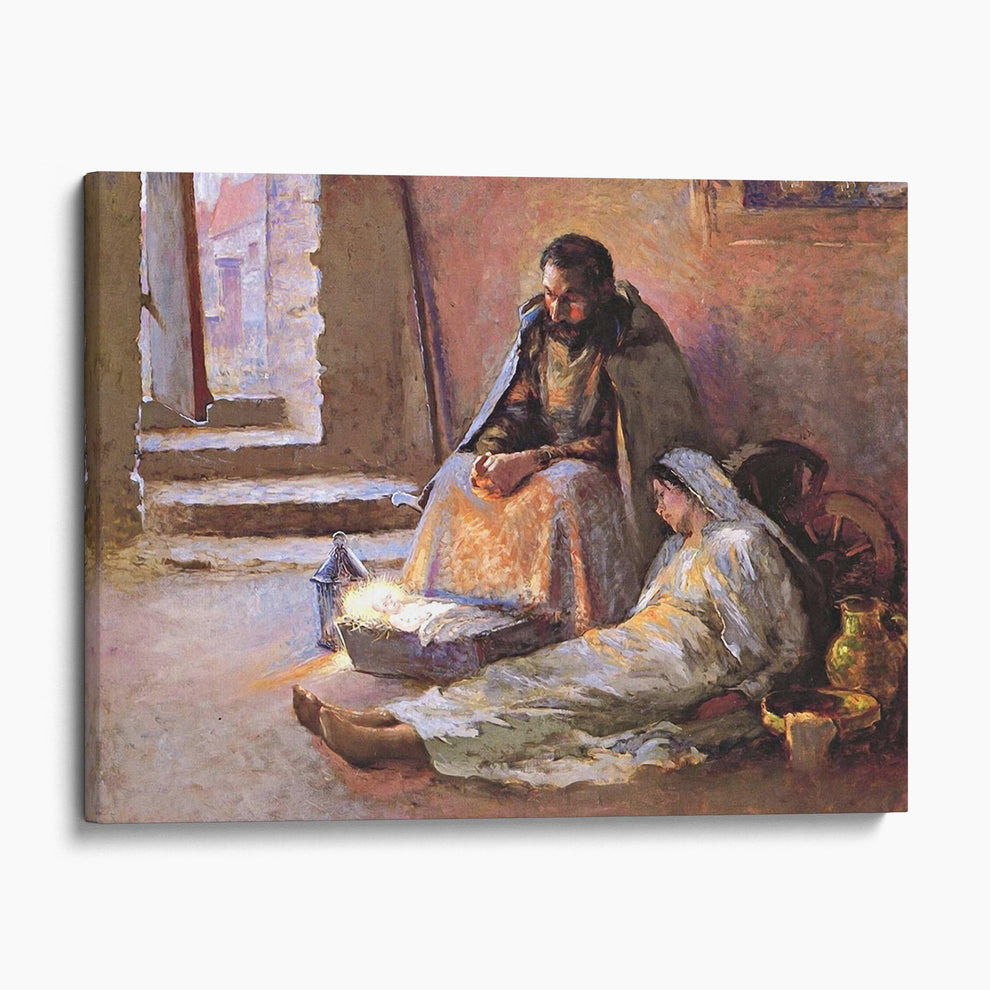
I love this painting by Gari Melchers, which is probably closer to how it was than our traditional nativity scenes…

Vss. 8-20.

Meanwhile, in the hills outside Bethlehem, there was a group of shepherds watching their sheep.  The animals were probably all snuggled down together, sleeping, while the men sat around a campfire that was fast going out.

THEN AN ANGEL APPEARED!

THE GLORY OF THE LORD SHONE AROUND THE SHEPHERDS!

They were VERY afraid.

But the angel (could it have been the messenger, Gabriel?) told them,

  • “Fear not, for behold, I bring you Good News of great joy that will be for all people.  For unto you is born this day in the city of David, a Savior who is Christ the Lord. And THIS will be a sign for you: you will find a baby wrapped in swaddling cloths and lying … in a manger.”

And then, more wonderfully terrifying, a multitude of heavenly hosts appeared, praising God and saying,

  • “Glory to God in the highest, and on earth peace among those with whom He is pleased!”

And then they were gone, and again it was a dark, silent night.

“Let’s go to Bethlehem and see this thing that has happened which the Lord has made known to us!”

And so they did.  They didn’t search inns, but looked for a stable. (After all, the angel said the baby would be in a feed trough.)  And they FOUND Mary and Joseph and the baby … lying in the manger, just as the angel had said.  They told the couple what had happened out on that hillside.  And Mary treasured up all these things, pondering them in her heart.

And then the shepherds returned to their duties, glorifying and praising God for all they’d seen and heard, as it was told to them.  And everybody who heard their story was in wonder about it.

.

Vs. 21.

And at eight days, Jesus was circumcised and officially named JESUS, the name that Gabriel had given to Mary before He was conceived.

.

.

“For God so loved the world that He gave His only begotten Son, that whosoever believed on Him, would not perish but have eternal life.” John 3:16


Reading the Gospels in 2026: (3/11) Luke 1:67-80

A 5-day per week study.

March 11 – Reading Luke 1:67-80

Read and believe in Jesus.

“And you, child, will be called the prophet of the Most High.”  Luke 1:76

.

The Gospel according to Luke 1:67-80

In the last study, we saw Elizabeth giving birth to a baby boy. Since Zechariah was still mute (and possibly deaf), SHE announced his name at the circumcision ceremony.  He would be JOHN.  Of course, the family objected, saying he should be Zechariah Jr.  Nope!

The old priest took a notepad and clearly wrote out “His name will be called John.”  And immediately Zechariah’s speech returned.  Everyone was excited and eagerly listened to his account of all that had happened in the Temple with the angel, Gabriel.

.

Vss. 67-75.

And now, the old priest is filled with the Holy Spirit and begins to speak forth God’s words and prophesy.  (Zech is really happy to be speaking again, I think.)

First, he praises the Lord God of Israel.  He recalls all the promises of God from Abraham onward and tells how God has now fulfilled them.  The LORD God has redeemed His people and raised up a “horn of salvation” in the house of His servant David… just as the prophets foretold.

Then Zecharia looks towards his son, perhaps laying his hand on the baby boy’s head, and by the Holy Spirit says, “And you, child, will be called the prophet of the Most High, for you will go before the Lord to prepare His ways, to give knowledge of salvation to his people in the forgiveness of their sins.”

And then, “The sunrise (Messiah) shall visit us from on high to give Light to those who sit in darkness and in the shadow of death,  and to guide our feet into the way of peace.”

What a benediction!  What a way to end ten months of inability to utter one word!

.

Verse 80.

“And the child (John) grew and became strong in spirit, and he was in the wilderness until the day of his public appearance to Israel.”

Out in the danger and loneliness of the desert, filled with the Holy Spirit from birth, John probably prayed long prayers and recalled the scriptures he’d learned as a youth in a priest’s house. Like Elijah, he was tough and lived on what the desert could supply.

.

How did John know when he would begin his ministry and start baptizing and preparing the people for the Messiah?   

We will get into that in Chapter Three, but if you want to peek, see Luke 3;1-3.


Reading the Gospels in 2026: (1/6) Mark 2:1-12

A 5-day per week study.

January 6 – Reading Mark 2:1-12.

Read and believe in Jesus.

“When Jesus saw their faith, He said to the paralytic, “Son, your sins are forgiven.”  Mark 2:5


The Gospel According to Mark 2:1-12.

Vss 1-2.

Jesus, and a few disciples, had been away preaching and casting out demons throughout all Galilee for several weeks or months. Then, after the glorious healing of the leper, Jesus had gone into seclusion for a bit because of the crowds thronged Him. 

Now, He had returned to Capernaum, to Peter’s house, and after a few days … it was reported that He was back.  Immediately many came to hear and be healed. They pushed into Peter’s house till it was packed like sardines, and they crowded around the door to try and hear Him. 

In that crowd, were some Scribes who had mananged to come inside. They were “sitting” and watching Jesus with hawk eyes.  And Jesus preached “the word.”  (The Gospel of grace, faith, and forgiveness.)

.

Vss 3-5.

In Capernaum, there lived a man who was paralyzed in his legs. We aren’t told if this was an injury or a birth defect.  But this man was very fortunate. He had four friends, perhaps former co-workers, who cared about him deeply. They heard that Jesus, the miracle-healer, was back in town.  They got a stretcher for their friend and jogged (double-time) to Peter’s house. 

But before they got close enough to even hear Jesus speaking inside, they saw the crowds straining and pushing around the door. 

Perhaps they stopped, took in the situation, speaking among themselves. What to do?  Should they wait outside till Jesus came out?  Did the paralytic tell them to just take him home, that maybe later….

But no!  One had spied the steps leading to the roof of Peter’s house. (It was a flat place where the family could sit or sleep when it got too hot inside.)  The friends nodded. They went around the house and carefully carried their friend up the steps.  Once there, they began removing the roofing material, surely laying it aside neatly so they could later repair it.

Inside, Jesus was aware of their efforts.  Soon everyone was, as an opening appeared in the ceiling. Gasps? Dismay? Outrage? 

But Jesus saw something else.  He saw THEIR FAITH.  And as they let down the paralyzed man, Jesus said to him, “Son, your sins are forgiven.” 

(Was there joy on the man’s face?  Was THIS his main problem, the one that haunted him even more than his useless legs? What joy he must have felt!) 

.

Vss 6-9.

Ah, but those Jewish scribes.  What were they thinking?  You could tell by their faces they weren’t happy. 

One was thinking, “Why does this man speak like this?“

The second one, “He is blaspheming!”

The third one, “Who can forgive sins but GOD alone??”

Just like Jesus could see into the paralytic’s heart, he saw the darkness in these men’s hearts.

“Why do you question these things in your hearts? Which is easier to say to the paralytic, ‘Your sins are forgiven,’ or to say, ‘Rise, take up your bed and walk?’  But, that you man KNOW that the Son of Man has authority on earth to forgive sins…” Jesus turned to the paralyzed man and said, “I say to you, rise, pick up your bed, and go home.”

The man, whose sins were forgiven, rose and immediately, picked up his bed, and went out before them all.  The parting crowd was amazed and they glorified God.  They said, “We never saw anything like this!’“


(And of course, the friends of the man ran down the steps two at at time. The embraced him and joined in glorifying God. 

Yes, I think later they returned and repaired the roof.)

###

.

(Back to the question Jesus asked the Scribes.  “Which is easier TO SAY?”  This is different from, “Which is easier TO DO?”  Anyone could say anything, but did that make it true?   Jesus had backed up His words with actions. The Scribes didn’t believe their EARS, but they had to believe their EYES.

The paralyzed man of course believed his ears at both things Jesus said. And so did his friends.  He was forgiven.  He was healed.   And he had acted on both. He got up and went home, a forgiven man.

Oh, Lord! for FAITH to believe ALL You say to us in Your Word! Like You said to Thomas, ‘Blessed are those who don’t see and yet believe!’)