Archives

Reading the Gospels in 2026 (9/30): Matthew 6:1-4.

Read and Believe in Jesus.

“Beware of practicing your righteous deeds before other people in order to be seen by them…” Matthew 6:1

.

.

REVIEW – Jesus has been teaching the crowd on the mountainside that those in HIS kingdom are righteous. They carry their obedience to the Law beyond the “letter” (the actual words) to the very heart of the Law and their God. Don’t do the least you can to obey the Law; instead, go beyond what you can to show love for your Father in heaven and to all people.

.

.

Matthew 6:1-2.

“Beware of practicing your righteousness before other people in order to be seen by them.”

Remember, Jesus is not saying these people were righteous. Even the uber-righteous-acting Pharisees fell FAR short of what God required. See Matthew 5:20. Jesus is talking here about righteous acts, the things they did, and WE do, that make us “feel” like we’re not so bad after all.

In this section (6:1-21), Jesus talks about giving to the poor, prayer, and fasting. Any or all of these can become a way to pump up our pride. Beware, because our “righteousness” comes only from the Lord.

.

“Thus when you give…” Yes, we are to give to the needy. God WANTS us to do this.

Deuteronomy 15:11 “For there will never cease to be poor in the land. Therefore I command you, ‘You shall open wide your hand to your brother, to the needy and to the poor, in your land.’“

It’s not THAT we give our money, but HOW we do it, that Jesus calls attention to.

“…sound no trumpet before you, as the hypocrites do in the synagogues (Can you imagine that?) and in the streets, that they may be praised by others.”

Jesus condemns giving our “alms” blatantly, boastfully, drawing attention to ourselves when we drop a dollar (or a hundred) in the offering plate or hand a coin (or a five) to a homeless man. Do we make sure someone is watching first? Do we wave our offering about so people look our way?

Beware, Jesus says, for you have your reward right there in the moment. No “treasure” is stored up for you in heaven for this selfish, prideful act. If man sees and approves of your actions, God usually does not.

So how ARE we to give to the poor, to missions, to the work of our church?

In secret.

.

.

Matthew 6:3-4.

Jesus says, when you give, don’t let “your left hand know what your right hand is doing.”

What does that mean? Are we talking about husband and wife here? No, giving is actually something that a married couple should share.

Jesus implies you should give so discreetly that you don’t even mentally congratulate yourself or dwell on your own generosity. Keep your giving to the needy, or tithing to your church, a secret. (Okay, your church treasurer knows how much, but that’s another discussion.)

If you do this, YOU will feel better (guaranteed), and your heavenly Father (the One who really counts) will reward you. He SEES either way you give, but when you give “for His sake alone,” He will reward you.

.

What kind of reward? You won’t know. OR…maybe you will. We have found that when we are faithful to the Lord in giving – in obedience and to please Him – He blesses us in so many ways we can’t keep up.

Read Malachi 3:10. Really! Do it right now!

And if you have time, read Philippians 4:14-19 too.

Reading the Gospels in 2026 (9/25): Matthew 5:27-32.

Read and Believe in Jesus.

“But I say to you….” Matthew 5:28a

.

.

REVIEW – Last time, Jesus began a series of “heart understandings” about the Law. The overt action may be murder, but in the heart and the mouth is where it begins. Anger, insults, and degrading name calling is just the beginning. Jesus said these are just as worthy of judgment as the final act of murder.

HIS followers are to go and reconcile with the offended person before doing anything else. Only then can the law “clean” us to worship our holy God. He warned if we don’t come to terms with the other fellow (or gal), things will get very, very bad.

.

.

Matthew 5:27-30.

As before, Jesus first calls their attention to the Law. “You have heard that it was said…” reminding them of the 8th commandment. (Exodus 20:14) “You shall not commit adultery.”

That’s pretty clear.

But once again, Jesus tells them, that this gross sin begins inside of us with the eyes and the mind (imagination). Inside, where no one else can see or condemn… except God.

“But I say to you… everyone who LOOKS at a woman (or man) (and this could also include pornography) with LUSTFUL INTENT has already committed adultery in his heart.”

A look, an imagining of sexual delight…or violence…and the sin is committed. The thought, the continual contemplating and adding to the scenario, is as the deed. Wow. And the longer it goes on, the worse it gets. Yes, you know it. Eventually the deed WILL be done, or at least attempted (with that person, or another one).

How serious does Jesus take this?

VERY!

He says if you find yourself looking with lustful delight, causing you to sin … gouge out your eye!!!

Now that is serious!

(And, if it keeps happening with the other eye, I think He might say, gouge that one out too!) What is being blind compared to being separated from the Holy God?

SIN IS SERIOUS. It is an affront to God. ESPECIALLY for a believer, a follower of Jesus.

“Flee from sexual immorality. Every other sin a person commits is outside the body, but the sexually immoral person sins against his own body. Or do you not know that your body is a temple of the Holy Spirit within you, whom you have from God? You are not your own, for you were bought with a price. So glorify God in your body.“ 1 Corinthians 6:18-20.

Jesus carries the remedy further with, “And if your right (dominant) hand causes you to sin, cut it off and throw it away. It’s better to lose your members than your whole body … and go into hell.”

I believe Jesus could also mean by your ‘right hand’, that you are to eliminate every sinful deed you are prone to do or accomplish. It’s not just a leud man patting or pinching a woman’s bottom at the office. The “right” or dominate hand represents your strength. Cut it off if it causes you to sin!

.

.

.

Matthew 5:31-32.

“It was also said,” (Jesus continues) “whoever divorces his wife, let him give her a certificate of divorce.”

God gave this provision to Israel for the welfare of women.

Husbands who no longer wanted their wives – for some little thing they did or didn’t do, or because the man had lusted after another, younger, prettier woman – could just kick them out to manage on their own. Often their father would not accept them back into the family house, and without resources, they would eventually die or become a prostitute.

To save them from this, Moses required unhappy husbands to write their wives a certificate of divorce. That way, she could legally become the wife of another man. It was a concession, and NOT God’s perfect plan. But it rescued the unwanted wives.

But notice Jesus’s heart-understanding of this concession. “But I say to you, that every man who divorces his wife – except on the ground of sexual immorality – makes her commit adultery.” (either by prostitution or marrying another man while still married to the unhappy one). A man was not to simply “divorce” his wife for every little thing that bothered him, or even something big. Reconciliation is always the first step.

It’s God’s way. After man sinned in the garden of Eden, God could have thrown us away and created a new world. But no, He provided a way (Jesus’ death) that we could be reconciled to Him.

Our Lord is so kind. For women (or men) today, this means that if divorce occurs because of unreconciled unfaithfulness (the first option is always to seek reconciliation, as with the first of Jesus’ saying about someone offending you), the divorced one is free to marry again.

It’s NOT God’s perfect way. There will be complications with possessions, finances, and the children (who are often hurt most). But God’s heart of love, SO loves His children, that He allows this, though I believe every divorce grieves Him.

.

.Do you wonder, like me, how the people on the hillside received Jesus’ words. Were they confused, perplexed? Did the more learned of them go back in their minds to see the Torah’s writing, and nod at this new wisdom? Was there fear, or joy, in their heart? Did they now long for the kingdom of heaven this Jesus was preaching?

Or was that first stirring of disappointment rising. Reconciling? Sexual purity? What did that have to do with the Messiah freeing them from Rome?

.

.

.

.(NOTE: for those who read my closing thought yesterday, yes I did go to my husband, confess my offense, and ask forgiveness. And he gladly, quickly, forgave me. What a relief! And my prayers to God came so much easier afterward! Thank You, Jesus. Your heart-teaching is what we need every day.)

Reading the Gospels in 2026 (9/16): Matthew 4:1-11.

Read and Believe in Jesus.

“Then Jesus was led up by the Spirit into the wilderness to be tempted by the devil.” Matthew 4:1

.

.

REVIEW – Last time, it seemed Jesus heard John’s announcement, ‘the Kingdom of Heaven is at hand,’ and knew it was the call for Him to begin the ministry for which He had been born. We saw Him leave Galilee and go down to the Jordan River, where John was baptizing.

Late in the day, when most of the crowd had returned home, Jesus came to John to be baptized. John at first declined, but at Jesus’ words, he consented. Down Jesus went under the water and then up out of it. Immediately the heavens opened and the Holy Spirit, like a dove, descended on him – the power for ministry – and God spoke. “This is my beloved Son, in whom I am well pleased.”

It’s amazing how we saw the whole Trinity here at the beginning of Jesus’ great work of salvation. Father, Son, and Holy Spirit, together in agreement.

.

.

Matthew 4:1-3.

Up from the water and up from the Jordan, Jesus ascended. Still dripping wet, He began to walk, led (“driven,” Mark says) by the Spirit of God within him. Deep into the dry and barren wilderness, full of rocks and wild beasts, Jesus walked.

It was like Israel leaving Egypt, crossing the Red Sea and entering the barren desert. A time of testing for them. A time of testing for Jesus too.

Night came. Then day. Night, day, night, for forty days. Alone without shelter or food. And then a voice came. A whisper behind Him. Or in His mind. Malevolent and persistent. Questioning the very voice of His Father that came while He stood in the Jordan River.

“IF You ARE the Son of God … command these stones to become loaves of bread,” said the devil.

.

Matthew 4:4

Jesus was the Son of God; there was no question. And perhaps that glorious voice from heaven echoed in His mind right then. “Beloved Son … well-pleased.”

.

And when we are tempted to doubt our position as a child of God, we can “preach the Gospel to ourselves.” Keep those verses fresh in your mind!

.

But Jesus was also hungry. He knew He had the power to do what the devil suggested. A year later, He would take five small rolls and divide them to feed 5000 men, plus women and children. Yes, Jesus was tempted to feed Himself, but He overcame by the word of God. He used that mighty two-edged sword that we also have access to, to defeat the enemy’s temptation. (See Ephesians 6:17 and Hebrews 4:12).

Jesus quoted Deuteronomy 8:3. “It is written, ‘Man shall not live by bread alone, but by every word that comes from the mouth of God.'”

.

.

Matthew 4:5-7.

Then in His spirit or mind, the devil “took” Jesus to Jerusalem, the holy city, and set Him on the pinnacle of the temple.

.

(NOTE: It was a long way up!! From the top to the bottom of the Kidron Valley, if He was facing eastward, there was a 450-foot drop, like a 45-story building. If He faced into the temple courtyard, there was still a 164-foot drop, or 15 stories.)

.

Again, the devil tested Jesus’ confidence in who He was.

“IF you ARE the Son of God … throw yourself down from here, for it is written, (and now the devil quotes scripture too, but he twists it.)

“He will command His angels concerning you,” and “On their hands they will bear You up, lest You strike your foot against a stone.” See, Jesus, You won’t get hurt. Trust me. This will show Your power, and everyone will believe in You. No cross! No suffering!

The devil quoted Psalm 91:11 and 12, about TRUSTING God. But he – as the devil often does with us – twisted it to justify TESTING God.

Jesus responded with the severe warning from Deuteronomy 6:16. “It is written, ‘You shall not put the Lord your God to the test.”

.

.

Matthew 4:8-10.

As he did with Adam and Eve, and as he does with us, the devil brought out his third temptation, common to all mankind. This time, he took Jesus in spirit, or in His mind, to a very high mountain.

.

Perhaps this was Mount Hermon at the very northern tip of Israel, which is 9,000+ feet tall. Or perhaps it was Mt. Everest in Tibet (29,000+ feet tall. Wherever it was, the wily devil showed Jesus all the kingdoms of the world – both then and (I believe) in the future.

.

“All these I will give you, if you will fall down and worship ME.”

Yes, the devil was the Prince of the Power of the Air over Earth. Perhaps this WAS a legit offer. But it was also deadly.

The devil was desperate to prevent Jesus from going to the cross, for he knew that would be the death toll for him, as God said in Genesis 3:15-16.

Jesus would accomplish salvation for all who believed. Jesus would return and rule on earth OVER ALL THESE KINGDOMS for 1,000 years, and then for eternity.

But IF the devil could persuade Him to take “the shortcut” to glory – no suffering, no cross, no humiliating death – then He could never claim ANY, let alone ALL, the kingdoms of the earth.

.

But Jesus had had enough. “It is written, ‘You shall worship the LORD your God, and HIM only shall you serve.” Deuteronomy 6:13-14.

.

.

Matthew 4:11.

I can imagine the devil growling to himself and walking away from the Son of God with his fists clenched. He had failed … but there would be another time. He had three years. Surely Jesus would fall before He got to the … cross.

And then, perhaps the devil looked back and then raged at what he glimpsed. “Angels came and were ministering to Jesus!” Grrrrr.

Reading the Gospels in 2026: (5/4) Luke 15:1-10

A 5-day per week study.

May 4 – Reading Luke 15:1-10

Read and believe in Jesus.

“…there is joy before the angels of God over one sinner who repents.”  Luke 15:10

.

The Gospel according to Luke 

Review – Jesus & the parable of the Master filling his banquet with the unloved and Gentiles instead of those who were FIRST invited but made excuses not to come. Jesus then explains the COST of discipleship. And uses the example of true salt vs. undesirable salt, noting that the latter is contaminated with minerals.

Jesus & the parable of the Master filling up his banquet with the unloved and Gentiles instead of those who were FIRST invited but made excuses. He then tells the COST of discipleship. And uses the example of true salt, and that found contaminated with minerals.

.

Vss.

15:1-3.

Here, we see Jesus with two groups of people: tax collectors and sinners, and Pharisees and scribes. Polar opposites. One group is considered the lowest of sinners; the other group, the uber righteous.

The Pharisees grumbled that Jesus was receiving and eating with sinners. (Ahem, may we remind them of Jesus recently eating at a Pharisee’s house with all his “upper crust” friends?)

So… Jesus tells them a pair of parables.

(Although one parable features a lowly shepherd and the other a woman, both teach the value or cost of something lost. This would perhaps appeal to the wealth-conscious Pharisees.)

.

Vss. 15:4-7

A shepherd had 100 sheep. One, perhaps an ornery lamb, ran off and got separated from the flock. Maybe it wasn’t even the first time this little guy had done this.

Jesus asked the Jewish leaders what they would do: forget about the one and care for the 99, or leave the 99 and go after the little lost one.

Would not a good shepherd (picturing the God of Israel) search high and low for the lost one?  And when he finds it, would he not tenderly carry it back to the flock?  And wouldn’t he then gather friends and have them rejoice with him for the ONE LOST LAMB that was found?

(Jesus viewed the tax collectors and sinners as the little lost lamb. Each one was worth a search-and-rescue. Hadn’t He already done so with Matthew/Levi?)

“I tell you, there will be more joy in heaven over the sinner who repents than over ninety-nine ‘righteous’ persons who think they need no repentance.”

.

Vss. 15:8-10.

In the second parable, a woman had ten silver coins, perhaps her dowry. (Sometimes these coins were worn in a band across the forehead.) While working around the house, one of these coins became detached and was lost.

Oh, no! This was HER money; her safety in case something happened to her husband.  Oh, where was it??

Jesus looks at the Pharisees, who were perhaps calculating the value of the silver coin, and suggested, “Does she not light a lamp and sweep the house and seek diligently until she finds it?

Nods all around.

And wouldn’t you, Pharisees, like the woman, call together your friends and neighbors to “Rejoice with her, for she had found the coin that was lost?”

Perhaps more nods.

Just so, I tell you, there is joy before the angels of God over one sinner who repents.”

(One sinner who acknowledges his sin and turns to God is welcomed back with rejoicing, over these self-righteous, hard-hearted ones who thought they needed no forgiveness.)

.

(Tomorrow is the last in this trio of “lost things” parables that Jesus tells. It will really hit home with those religious leaders!  Tomorrow, there will be no nods of agreement, only outrage.)


Reading the Gospels in 2026: (4/22) Luke 12:1-21

A 5-day per week study.

April 22 – Reading Luke 12:1-21

Read and believe in Jesus.

“Take care, and be on your guard against all covetousness…”  Luke 12:15a

.

The Gospel according to Luke 

Review –

Jesus confronted the arrogant religious leaders and spoke SIX WOES on them for their greed, pride, and self-righteousness, and their neglect of justice and the love of God.  They respond with renewed energy to “catch Him” in something.

.

Vss. 12:1-3.

Even though there were “many thousands of people gathered together around Jesus, so many that they were trampling one another,” Jesus spoke to his disciples first about the disgruntled Pharisees and scribes they’d just left.

He said, “Beware of the leaven of the Pharisees, which is hypocrisy.”

(The hypocrisy or ‘teaching’ of the Pharisees was their over-concern about externals and ceremonies and what people saw and thought of them, but not matters of the heart.)

.

Vss. 12:4-12.

Jesus also warns them about persecution by the religious hypocrites, thinking perhaps of His own upcoming death.  “Don’t fear those who can kill the body and have nothing more they can do.  Fear Him who, after He has killed, has the authority to cast into hell.”

Jesus continues to “His friends” with a gentle, “Not a single near-worthless sparrow is forgotten by God, so you are not to fear.  Are you not of more value than many sparrows?”

And again, when any of His own are persecuted by rulers in the synagogues and by other authorities, they are not to be anxious or try to defend themselves. “For the Holy Spirit will teach you in that very hour what you shall say.”

.

Vss. 12:13-15.

Then, right in the middle of Jesus’s teaching, and changing the subject completely, a man calls out loudly,

“Teacher, tell my brother to divide the inheritance with me!”

Okay, someone in this family has died, and there is a dispute over the inheritance. (No sorrow or grief about the loss is noted at all.) The money, lands, and goods are all that fill these two brothers’ hearts.


First, Jesus says, “Man, who made ME a judge or arbitrator?” 

Then, probably seeing the greed and covetousness in the man’s heart, Jesus continues with a warning, a parable, and a startling truth to ponder.

.

The warning:

“Take care and be on your guard against all covetousness, for one’s life does not consist in the abundance of his possessions.”

.

The parable:

“The LAND of a rich man produced plentifully.”

The man thought to himself, “What shall I do, for I have nowhere to store MY crops?”

Then he snapped his fingers. “I will do this: I will tear down my barns and build larger ones, and there I will store all MY grain and MY goods.”

Pleased with the plan, he leaned back and said to himself, “Soul, you have ample goods laid up for many years; relax, eat, drink, be merry!”

But God said to him that very night, “Fool!  This night your soul is required of you, and the things you have prepared … whose will they be?”

(Obviously argued over by his descendants!)

.

The truth to ponder:

“So is the one who lays up treasure for HIMSELF, and is not rich toward God.”

.

.

Jesus will continue on the topic of wealth and anxiety in the next study.


Reading the Gospels in 2026: (3/19) Luke 4:1-13

A 5-day per week study.

March 19 – Reading Luke 4:1-13

Read and believe in Jesus.

“Jesus, full of the Holy Spirit … was led by the Spirit into the wilderness…and Jesus returned in the power of the Spirit to Galilee…”  Luke 4:1 and 14

.

The Gospel according to Luke 4:1-13

Review:  Jesus – the Son of God – testified to by the descent of the Holy Spirit on Him, and God’s voice, and by His own genealogy.  Totally God and totally man with that genealogy leading clear back to Adam, who was formed of the dust by God’s own hands and received the breath of life from He Who IS life.  No wonder Paul calls Jesus “the Last Adam.” (Check out 1 Corinthians 15:45-49)

Today we will see Jesus tested by the same”Snake” that tempted the first of mankind.  But Jesus succeeds in resisting that old serpent again & again by using the two-edged sword, which are the words that God spoke.

.

Vss. 1-4.

In a desert wilderness with wild animals and reptiles.  No food.  Hungry.  Tempted constantly by Satan in all the ways WE are.  (1 John 2:15-17)

#1 – the lust of the flesh

Satan: “IF you ARE the Son of God, command this stone to become bread…”   (‘You ARE hungry, Jesus. I know it. Maybe even starving.  You don’t want to die … now … do you?  You deserve some food.  You have the power.  USE it to satisfy your hunger.  God will understand…’)

JESUS: “It is written, ‘Man shall not live by bread alone.”

.

Vss. 5-8.

#2 – the lust of the eyes

The devil took Jesus up and showed Him all the kingdoms of the world in a moment of time (Persia, Greece, Rome, Great Britain, America), and said to Him,

Satan: “To you I will give all this authority and their glory, for it has been delivered to me, and I give it to whom I will. If YOU, then, will worship ME, it will ALL BE … YOURS.”   (You are God’s SON.  You deserve to have authority and glory… NOW.  You don’t have to go through all that ridiculous suffering.  Merely bow a knee – just one – to ME, and it will be yours NOW.  God WANTS this for You…’)

JESUS: “It is written, ‘You shall worship the LORD your GOD, and HIM ONLY shall you serve.”

.

Vss. 9-12.

#3 – the pride of life

And the devil took Him to Jerusalem and set Him on the pinnacle of the temple and said to Him,

Satan: “IF you ARE the Son of God, throw yourself down from here!  FOR IT IS WRITTEN,  ‘He will command his angels concerning you, to guard you,’  and  ‘On their hands they will bear you up, lest you strike  your foot against a stone.'”  (See, Jesus, I know the scriptures too. Here’s a couple you can claim.  Just think, how amazed the people will be to see you walking on angels’ wings!  This is the sign they need!  They will see you as … THE MESSIAH!  Do it!  God is waiting to send His angels…)

JESUS: “It is said, ‘You shall NOT put the Lord your God to the test!'”

.

And when the devil had ended every temptation, he departed from Him … until an opportune time.

.

.

1 John 2:17 – “The world is passing away along with its desires, but whoever does the will of God abides forever.”

1 Peter 2:9 and 11 – “But you are a chosen race, a royal priesthood, a holy nation, a people for His own possession, that you may proclaim the excellencies of Him who called you out of darkness into His marvelous light.”  “Beloved, I URGE you … abstain from the passions of the flesh, which wage war against your soul.”

James 4:7-8a – “Submit yourselves therefore to God. RESIST THE DEVIL, AND HE WILL FLEE FROM YOU. Draw near to God, and he will draw near to you.”


Reading the Gospels in 2026: (2/23) Mark 14:1-26

A 5-day per week study.

February 23– Reading Mark 14:1-26.

Read and believe in Jesus.

“I will not drink again of the fruit of the vine until that day when I drink it new in the Kingdom of God.”  Mark 14:25

.

The Gospel according to Mark 14:1-26

Chapter 13 on the destruction of Jerusalem and the “End Times” was sparked by one of the disciples’ comments about the Temple’s magnificent stones.  Jesus told them that not one stone would be left on another, and in 70 A.D., that’s exactly what happened.  This would be proof that Jesus’s other prophecies about the Antichrist, the Great Tribulation, and His glorious second coming in the clouds would also come to pass.

It was a lot to think about, but the disciples probably promptly forgot it for the time (like they had of Jesus’ 3 times predicting his death and resurrection).  They were still thinking that Jesus would soon declare himself KING, and that they would help Him rule the Kingdom.   Alas…

.

Vss. 1-2.

A quick note that even though Jesus had left the city, the religious leaders were still very angry with Him. They were mulling over ways they could arrest Him by stealth, and KILL Him.  But, they thought, not during Passover, because the people would cause a great uproar.  (Ha!  The best laid plans of mice and men!  Little did they know that Jesus would indeed be arrested and then killed on Passover.  And that the crowds would be the ones shouting, “Crucify Him!”)

.

Vs.3.

This is the only time that “Simon the Leper” is named in the Bible.  Although he still carried the title of “the Leper” to distinguish him from other Simons in town, he had been totally cured, probably by Jesus. (No person suffering from leprosy could come near, let alone host a meal for other people.)

Some have thought that Simon was the father of Lazarus, Martha, and Mary, and that this was HIS house, but that he’d been absent on other occasions when Jesus visited because of his disease.  Regardless of this, we do know from John’s account in chapter 12 that the woman there was Mary.

While Jesus and the disciples were reclining at dinner, this young woman (Mary) came in, broke an alabaster jar of very expensive perfume, and anointed Jesus’ head. (John’s account says she also anointed His feet and dried them with her hair.)

This was a total act of love on Mary’s part. She thought nothing of the expense.  Consider:  she had often sat at Jesus’ feet, hearing His teaching;  Jesus had healed her father of leprosy;  and Jesus had raised her brother back to life from the grave.  She had long ago given her heart, soul, and spirit to Him.  What was an heirloom jar of perfume?

.

Vss. 4-9.

What was an heirloom jar of perfume?  Well, it was a year’s wages!! (Think of that amount today for an hourly worker!)  Some of the disciples were indignant.  “Why was this not sold and the money given to the poor?”

Seriously?  The poor?  You KNOW who brought this up.  It was Judas.  He was the group’s treasurer.  He carried the money pouch and paid for expenses (and yes, donated some to the poor).    John 12:6 says of him, “He said this, not because he cared for the poor, but because he was a thief, and having charge of the moneybags, used to help himself to what was put into it.”  Tsk, tsk, tsk.  

Jesus, of course, knew this.  And He swung back hard in defense of Mary.

“Leave her alone!  Why do you trouble her? 

She has done a beautiful thing for me.  You will always have the poor, and whenever you want, you can do good for them. But you will not always have Me.  She has done what she could; she has anointed my body beforehand for burial. 

And truly, I say to you, whenever the gospel is proclaimed in the whole world, what she has done will be told in memory of her.”

Of course, what Judas is about to do will also be told of him whenever the gospel is proclaimed throughout the world.

Did you catch Jesus’ statement?  “She has anointed my body beforehand for burial.”  Again, the disciples didn’t seem to notice.  I mean, if Jesus was going to be buried, it meant He was going TO DIE!   But, Mary, sitting and learning at Jesus’ feet all those times, HEARD him.  And she believed.  And she offered her expensive perfume to pre-anoint Jesus’ body for that burial.  It not only proved her love but also her faith.

.

Vss. 10-11.

“Then Judas Iscariot went to the chief priests in order to betray Jesus to them.”

He just could not take it.  Not only the sight of all that money “wasted” on Jesus, but also the fact that Jesus honored the woman and the act… and at his expense.   He could have HAD that money.  Well…..  he knew where he could get some ready cash.  “Just you wait, Jesus!” he might have thought, as he headed back into the darkened city.

.

Vss. 12-15.

It was the first day of Unleavened Bread-Passover, and Jesus sent two of his disciples into the city to prepare the room where they would eat the Passover meal.  How would they know where to go?  Jesus gave them a sign, like finding the donkey and its mother tied up a few days earlier.

This time, they would see a man carrying a jug of water.   You might think that this would be happening all around the city.  But no.  It was a woman’s job to fetch and carry water.  To see a man doing it would be highly irregular.  So HE would be the one they should ask.  That man would show the two where the room was, and they would set about preparing it for that evening’s meal.

.

Vss. 17-21.

(We will learn much more about what happened in that upper room when we study the other Gospels. Mark is very brief.  “Just the facts,” he seems to say. They are: the betrayal announced and the bread and wine.  And that’s that. (Remember, Mark, is probably getting all those facts from Peter’s point of view.)

And so, the disciples reclined around a spread of Passover food and ate.  At one point, Jesus said, “Truly, I say to you, one of you will betray me, one who is eating with me.”

Talk about dropping a bombshell!

They all began to be sorrowful and, one by one, asked him, “Is it I?”   (Isn’t it heartbreaking, that they all believed their hearts could have betrayed Jesus!  We all could, and have.)

Jesus answered, “It is one of the twelve, one who is dipping bread into the dish with me.  The Son of Man goes as it is written of him, but woe to that man by whom the Son of Man is betrayed. It would have been better if he had not been born….”

The other Gospels make it clear in several ways that it was Judas Iscariot. (We’ll study them one by one this year.)  And Judas leaves the room.

.

Vss 22-26.

Then Jesus institutes “The Lord’s Supper.”  This is what is celebrated in churches today, “in remembrance of Jesus” and what He did for us on the cross.

First, Jesus took up the bread and blessed it. He gave it to them and said, “This is my body.”

Next, He took a cup, and when He had given thanks, He gave it to them for all the drink of it.  “This is my blood of the covenant, which is poured out for many.  Truly, I say to you, I will not drink again of the fruit of the vine until that day when I drink it new in the Kingdom of God.”

(Cups of wine and the Matso bread are common in the traditional Passover meal, even today.  The Jews remember their escape from Egypt, when, with the blood of the Passover Lamb painted on the sides and tops of their doors, they stood dressed and ready to travel, eating the lamb for sustenance.  There hadn’t been time for the bread to rise, so they were eating it unleavened.   Soon, they would be delivered from slavery and become a Nation to God!

This is what the Lord Jesus was purchasing for them with his own blood – deliverance from slavery to sin and Satan, and transformation into the true children of God.

.

“And when they had sung a hymn, they went out to the Mount of Olives.



Journaling through the Bible Chronologically in 2025, Day 340

The LAST Month of 2025’s Reading!

Day 340 – Reading – 2 Corinthians 10 – 13

Read and believe in Jesus!

 2 Corinthians 10-13

Chapters 10-13 have a somewhat different tone as Paul prepares the Corinthians for his promised 3rd visit.  In these chapters, he defends his ministry (as opposed to those “super-apostles” trying to turn them away); he “boasts” some about his travails; mentions that amazing vision of Heaven and subsequent “thorn in the flesh;” and gives his final exhortation to them to examine their own hearts.

2 Corinthians 10.

Paul agrees with his accusers that when he is away from the Corinthians, he’s bold in his rebukes, but when he is with them, he’s like a lamb.  It’s because he loves them and want’s sweet fellowship with them when he is there. 

He admits that they are all walking in their “fleshly” bodies, but the war for their sanctification is waged spiritually.

  • “The weapons of our warfare are not of the flesh but have divine power to destroy strongholds. We destroy arguments and every lofty opinion raised against the knowledge of God. We take every thought captive to obey Christ, being ready to punish every disobedience, when your obedience is complete.”

Paul says he doesn’t want to appear frightening to them with his boasts of the authority, but the Lord gave him such authority so to reach them. 

.

2 Corinthians 11.

Paul is stern with them because he is divinely jealous of them, as a husband to a wife. He’s afraid they will be led astray from a “sincere and pure devotion to Christ.”  Let any who proclaim another Gospel be accursed.

“Even if I am unskilled in speaking, I am not unskilled in knowledge. I am not in the least inferior to those “super-apostles” who attempt to sway them. THEY are deceitful workmen, disguising themselves as apostles of Christ.  And no wonder!  Satan disguises himself as an angel of light, so no surprise that his servants make themselves appear righteous!

Paul’s embarrassed to boast of his credentials, but he feels the Corinthians need it. 

  • He, too, is a Hebrew and Israelite, a son of Abraham, and a better servant of Christ. 
  • He’s done far greater labors, far more imprisonments, countless beatings, and often near death.
  • Five times he received the 39 whips from the Jews, three times he was beaten with rods. Once, he was stoned. Three times he was shipwrecked (with 24 hours adrift in the sea)
  • On frequent journeys, in danger from rivers, robbers, his own people, Gentiles, in the city, in the wilderness, at sea, and from false brothers.
  • In toil and hardships, through many sleepless nights, hungry and thirsty, often without food, in cold and exposure.
  • AND … apart from that, there is the daily pressure on him of the anxiety for all the churches.
  • And once – this seems to be the most humiliating of all to Paul – he was let down in a basket through a window in the wall of Damascus to escape the governor!!!

WOW!! How much have “I” suffered for Christ and the ministry?  Nada.

.

2 Corinthians 12.

And then Paul tells of the most amazing happening of all.  He uses the 3rd person to avoid self-aggrandizement. 

  • “Fourteen years ago, ‘this man’ was caught up into Heaven (God’s dwelling place), whether in the body or not, he couldn’t tell. ‘This man’ was in Paradise, and he heard things that cannot be told, which man may not utter. On behalf of ‘this man I will boast, but on my own behalf I will NOT boast, except on my weaknesses. I refrain from boasting SO THAT no one will think more highly of him than he should.
  • “So… to keep me from becoming conceited because of the surpassing greatness of the revelations, a thorn was given to me in the flesh, a messenger of Satan to harass me, to keep me from becoming conceited. ****
  • “Three times I pleaded with the LORD about this, that it should leave me.  But He said, “My grace is sufficient for you, for My power is made perfect in weakness.”  Therefore, I will boast all the more gladly of my weaknesses, so that the power of Christ may rest on me.  For the sake of Christ, then, I am content with weaknesses, insults, hardships, persecutions, and calamities. For when I am weak … then I am strong.”

Then Paul says he’s been a fool, but they forced him to do it.  THEY should have commended him, but he had to do it himself to show he was not inferior to those super-apostles. 

Paul did among them the signs of a TRUE APOSTLE – signs and wonders and mighty works.

Like a parent (which he was to them), he was glad to spend and be spent for their souls.  He LOVED them.

.

2 Corinthians 13.

And so, before his third visit, Paul gives them final warnings. He would not “spare” those he’d warned before if they had not repented.

They are to “Examine themselves, to see whether they are IN THE FAITH.  They should test themselves to see if Jesus Christ is IN them.   “We pray to God that you may not do wrong, that you may have met the test and are doing what is right.”

THIS IS WHY he was writing to them.  Their restoration is what he prays for.  He doesn’t want to be so severe when he comes, using the authority the Lord gave him to build up the churches.

  • “And so, rejoice!  Aim for restoration, comfort one another, agree with one another, live in peace;  and the God of love and peace will be with you.”

.

**** NOTE:  There have been many speculations as to what that “thorn in the flesh” was.  Yes, it was “a messenger of Satan,” but it was GOD who sent it.  Like Job, God allowed Satan to afflict Paul’s body in some way to keep him humble.

Some believe it was a continual eye problem, a gradual blindness, perhaps.  Paul mentions that the Galatian churches would have gladly gouged out their own eyes and given them to him. (Galatians 4:15)

Some believe this “thorn” was a demonized person, a demon indwelling the ringleader of the Corinthian conspiracy, the leader of those “false apostles.”  Paul says the “thorn” was sent to “harass” him. “Harass” always refers to ill-treatment from other people. And in the O.T., Israel’s opponents are described “thorns.”

However you view Paul’s thorn, I think the identity was kept vague, so that we, too, might see an evil person, a condition, or an experience as a warning from God or a way to keep us humble.  AND to be assured that God’s GRACE is sufficient in whatever situation.  We can trust Him.


Journaling through the Bible Chronologically in 2025, Day 179

Day 179.  Reading 1 Kings 20-21

 
Read today’s Scriptures.

1 Kings 20….

…tells a surprisingly good story about the wicked King Ahab.  Until the last part, that is.

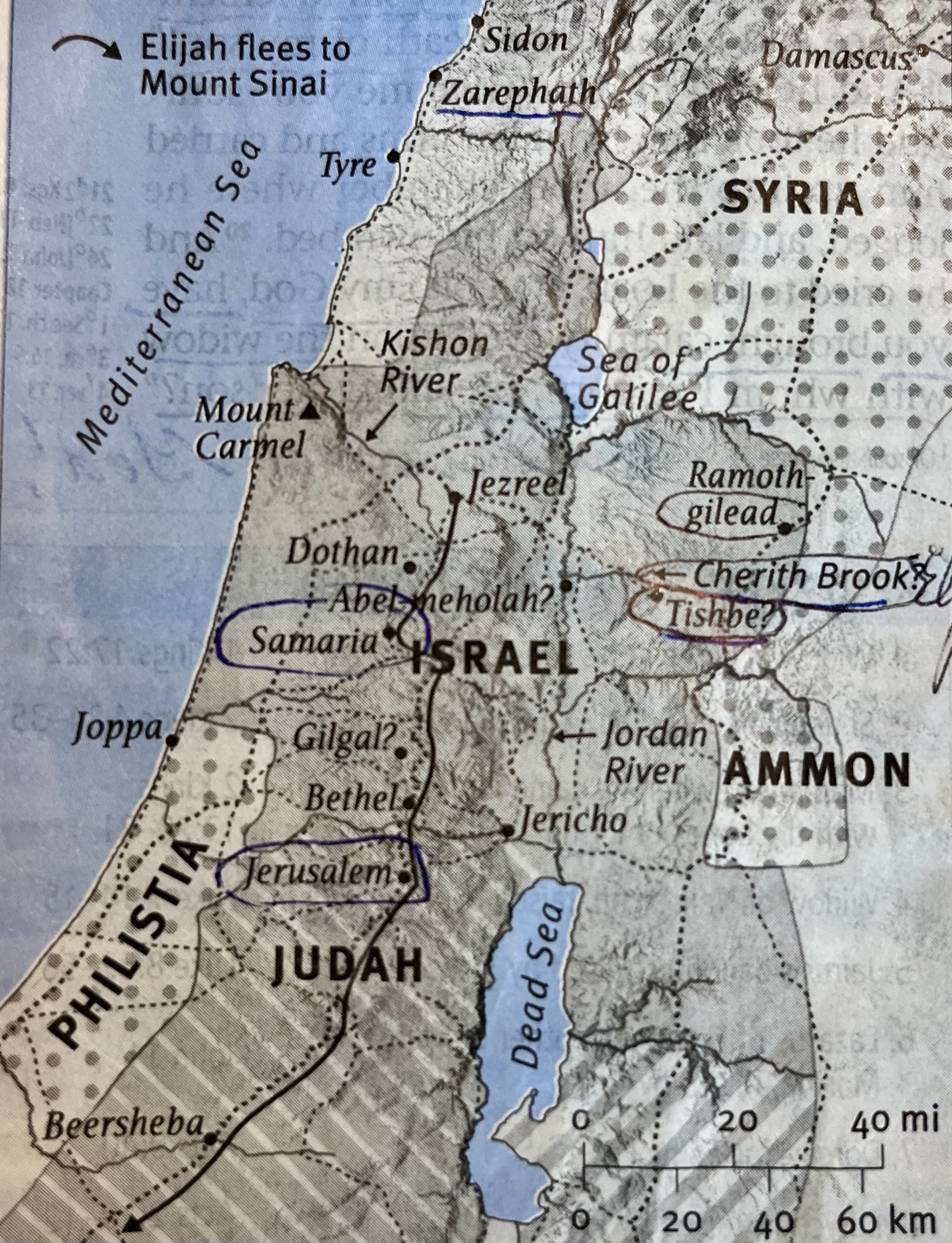
We see King Ben-Hadad, king of Syria, again in this chapter. (Syria is the country just north-east of Israel, with Damascus as the capital.) (This map also shows the two places Elijah stayed during the drought, and Mt. Carmel, where the great “showdown” happened. Samaria is the capital of Israel, where Ahab lives.) 


Remember, in Chapter 15, King Asa (south) had paid Ben-Hadad a large amount of gold and silver from the temple, to harass King Basha (north) so he’d stop fortifying the border. The Syrian King had agreed. Now, it seems, Ben-Hadad was sure King Ahab could also be easily defeated.

“Hey, King Ahab, give me your silver and gold and the best of your wives and children.” 

“Okay, sure,” said Ahab.

Then Ben-Hadad got greedy. “I will send my servants to you tomorrow, and they will search your house and take whatever pleases them.”

“Um, no! The gold and silver and best wives and kids I will do, but NOT THAT,” sent back King Ahab.

“Okay, then. It’s war!”

“Make my day!” replied Ahab.

Now, here is the strange part.  A prophet of God came to Ahab and told him that he would get the victory, “So you will know that I am the LORD.”  Ahab got some military instructions from the prophet, and at noon they went out to confront King Ben-Hadad’s army.

The Syrian king was drunk, however, and commanded, “If they come in peace, TAKE THEM ALIVE!  But if they come out for war …. TAKE THEM ALIVE!”  (Huh?)

Ben-Hadad didn’t have the chance to do either, because King Ahab struck his forces a “very great blow!” The Syrians fled and Ben-hadad escaped on a horse.

The prophet of God told King Ahab to rest up, for in the Spring the king of Syria would be back.  (Now, the Syrians believed that Israel’s God was only a god of the hills. That’s why they were defeated.  Next time they would bring lots of chariots and fight on the plains.  The Jewish God would be defeated there.)

Oh, Syria.  You’ve a lot to learn!!

So, in the spring Ben-Hadad mustered the Syrians and went up to fight against Israel … in the plains. The army of Israel that encamped before them was as “two little flocks of goats” compared to the Syrians who filled the country.  (Hahaha. Oh, Ben-Hadad, did you never hear of David and Goliath??)

The prophet of God came to Ahab and said, “BECAUSE the Syrians claim the LORD is only a god of the hills, I will give all this great multitude into your hand, and YOU SHALL KNOW that I am the LORD.”

And the people of Israel struck down of the Syrians 100K foot soldiers in one day.  When the rest fled to a town, the wall fell on them and 27K more were killed.  Ben-Hadad hid deep in the town and sent a message to King Ahab, “Please let me live.“

AND HERE IS WHERE KING AHAB WENT WRONG.  God had “devoted the Syrian king to destruction,” meaning he was to be killed.  But King Ahab thought it would be cool not to kill him.

“He’s alive? He’s “my brother!” he said.

“Yes! Your brother, Ben-Hadad!”

“Go, bring him out.”

When the Syrian king was brought out, King Ahab invited him up into his own chariot. And the two kings made a trade deal between their countries. And …. Ahab let him go.

LATER…

The prophet of God came to King Ahab with a bit of play-acting, but then told him.  “Because you have let go the man whom I had devoted to destruction, therefore YOUR life shall be for HIS life, and YOUR people for HIS people.”  Dire news indeed.  Instead of the Syrians and their king under this law, now Ahab and Israel would be “devoted to destruction.”

Ahab, went home, vexed and sullen.  

.

1 Kings 21.

King Ahab’s boredom caused him to sin.  He saw a lovely vineyard that he coveted for himself. It belonged to another, but he WANTED it, and the obsession grew. 

(Oh, my goodness, this reminds me of our favorite King David. 

Idleness is a TERRIBLE sin.

It leads to much worse sin. 

Desire and lust and a flame in the belly, which James 1:14-15  says leads to death.

Watch out for it!!)

Ahab at first proposed to Naboth, the vineyard’s owner, that he give it to the king, in exchange for a “better vineyard.”  Or… he could sell it to Ahab, who would give him the vineyard’s value in money.” 

Reasonable, right?  NOT!

What Ahab neglected to realize in his coveting, is that the men of Israel had their land as a divine allotment from God.  They were not to sell/give it to someone outside their tribe.  He said “The LORD forbid that I should give you the inheritance of my fathers.”

Ahab “lay down on his bed and turned away his face and would eat no food.”  

Really??  What a spoiled-brat!!

Enter his wicked wife, Jezebel.  “Hey, Hubby.  What’s wrong?”

“Naboth won’t give me his vineyard!”

“ARE YOU NOT THE KING OF ISRAEL!” she said.  “Get up, eat some bread, be happy!  I’ll get the vineyard for you!’

And the wicked Jezebel set into motion her wicked plan.  She defamed Naboth before of the town council, and tricked them into condemning the innocent vineyard owner. They killed him and sent a sweet note to the Queen.

“Naboth has been stoned. He is dead.”

And so, she skipped into King Ahab’s room with the news, “Arise, take possession of the vineyard for Naboth is not alive, but dead.”   And quickly, without any questions, Ahab got dressed and went down and took possession of it.

Sick!  And after all God had done for the king!

And God sent His top man, Elijah, to condemn the king.  “Arise, Elijah, go down and meet Ahab king of Israel in the vineyard of Naboth.

With this gruesome prophecy.

  • “Thus says the LORD: ‘In the place where dogs liked up the blood of Naboth, shall dogs lick up YOUR blood.”

“Oh, my enemy!  You have found me!” said Ahab to Elijah.

And the LORD’s message continued.

  • “I have found you because you have sold yourself to do what is evil in the sight of the LORD.
  • I will bring disaster upon you. I will utterly burn you up, and will cut off from Ahab EVERY MALE, bond or free in Israel.   
  • And….. of Jezebel, the dogs shall eat Jezebel within the walls of Jezreel.
  • Anyone belonging to Ahab who dies in the city, the dogs shall eat, and anyone of his who dies in the country the birds of the heavens shall eat.”   

(And oh, wow, you will read about this happening in 2 Kings 9:10, 30-37.)

(“There was none who sold himself to do what was evil in the sight of the LORD like Ahab, whom Jezebel his wife incited.  He acted very abominably in going after idols.”)

And here’s another VERY INTERESTING DEVELOPMENT. Ahab tore his clothes, put on sackcloth and fasted. (This was not his usual pouting.)  In the Old Testament, this is a sign of REPENTANCE.  Was it sincere? 

God saw this evil, weak, man’s heart. “Because he has humbled himself before me,” said the LORD. “I will not bring this disaster in his days, but in his son’s days I will bring the disaster on his house.”

.

(Wow. There is hope for you and me.  God sees a person’s heart. He knows if repentance is real. He knows if we truly will humble ourselves before Him.  O, my heart, fall on your knees before the all wise, living God. He is merciful to save.)


Journaling through the Bible Chronologically in 2025, Days 166 & 167

Sundays and Mondays studies are posted together on Mondays

Day 166. Reading Psalm 134, 146, 147, 148, 149, and 150.

Day 167.  Reading 1 Kings 9,  2 Chronicles 8

Read Today’s Scriptures.
What insight or comfort do you receive?
 

Day 166 – Psalm 134 – 150.

What a wonderful psalm to remind us of Solomon’s dedication of the Temple.

  • Come, bless the LORD, all you servants of the LORD who stand by night in the house of the LORD!
  • Life up your hands to the holy place and bless the LORD!
  • May the LORD bless you from Zion, he who made heaven and earth!

Oh, DO READ the rest of these Psalms to 150.  These are the songs the people sang as they “sent up to Jerusalem” for the feasts of the Lord. They are psalms of praise!

Here’s just a verse or two from each.

  • Psalm 146.  “Praise the LORD! Praise the LORD, O my soul! I will praise the LORD as long as I live; I will sing praises to my God while I have being.”
  • Psalm 147. “Praise the LORD! For it is good to sing praises to our God; for it is pleasant, and a song of praise is fitting.”  “Sing to the LORD with thanksgiving, made melody to our God on the lyre.”
  • Psalm 148. “Praise the LORD! Praise the LORD from the heavens, praise Him in the heights! Praise Him all his angels, praise Him, all His hosts!  Praise Him, sun and moon, praise Him, all you shining stars! Praise Him, you highest heavens, and you waters above the heavens.”
  • Psalm 149. “Praise the LORD! Sing to the LORD a new song, His praise in the assembly of the godly!”
  • Psalm 150. “Praise the LORD!”   “Let everything that has breath praise the LORD! PRAISE THE LORD!”


###


Day 167 – 1 Kings 9a.

The first part of this chapter repeats God’s “If-Then” blessings and warnings to Solomon and Israel.

IF Solomon will walk in the ways of David with integrity of heart and uprightness, keeping God’s statutes and rules … THEN God will establish his royal throne over Israel forever.

But IF Solomon and Israel do NOT keep God’s commandments and statutes but serve other gods and worship them … THEN God will cut off Israel from the land and make it a byword and a proverb among the peoples. And the “house” (Temple) will become a pile of ruins.

Dire warnings, indeed!

1 Kings 9b and 2 Chronicles 8.

It took Solomon twenty years to build the Temple, his own palace, and the palace of his queen. The queen’s “house” was outside Jerusalem, away from the temple, because she was the daughter of Pharaoh, a pagan, and Solomon did not want her living near the Ark of the Covenant.  

(You wonder why Solomon’s first wife (of Song of Solomon?) was a pagan Egyptian, the very people from whom God had rescued Israel. It was breaking God’s specific law about a King’s marrying.  Yes, it was a political deal, and Pharaoh had killed a bunch of Canaanites and given a city to Solomon as part of the dowery for his daughter, but still …  

  • Deuteronomy 7:3-4. “You shall not intermarry with them (pagans) giving your daughters to their sons or taking their daughters for your sons, for they would turn away your sons from following me, to serve other gods…”
  • 1 Kings 11:1-4. “Now King Solomon loved many foreign women, along with the daughter of Pharaoh …. “Solomon clung to these in love …. “And his wives turned away his heart. For when Solomon was old, his wives turned away his heart after other gods, and his heart was not wholly true to the LORD his God as was the heart of David, his father.” 

There go God’s promises.

But meanwhile, Solomon got busy building cities.  He gave twenty of them in Galilee to King Hiram in appreciation for all the help and material he had supplied. But Hiram didn’t like them and gave them back. (What??)

Solomon used forced labor (slaves) for all his building projects, much like his father-in-law, the Pharaoh, had done.  But since God’s law forbade any Jewish people from being enslaved, Solomon used the Canaanites, which they had captured, to do the work and oversee the projects.

Solomon filled in the land depression between the city of David and the temple/palace, built the wall of Jerusalem, and the military outposts of Hazor, Megiddo, Gezer, and others, as well as grain storage cities (also like Pharaoh), and cities for stabling his horses and chariots.  He also built a fleet of ships at Ezion-Geber on the shore of the Red Sea for international trading. (Gold from Ophir, etc.) (King Hiram sent ship-builders and seamen to teach Solomon’s workers the trade.)

“And whatever Solomon desired to build in Jerusalem, Lebanon, and in all the land of his dominion, he built.”

It’s interesting that in Ecclesiastes, Solomon bemoans all this grandeur and wealth as “vanity,” worthless to his soul. (We’ll get there soon.)

##

  • 1 Timothy 6:6-10.  “Now there is great gain in godliness with contentment, for we brought nothing into the world, and we cannot take anything out of the world. But if we have food and clothing, with these, we will be content. But those who desire to be rich fall into temptation, into a snare, into many senseless and harmful desires that plunge people into ruin and destruction.  For the love of money is the root of all evils. It is through this craving that some have wandered away from the faith…”


  • Hebrews 13:5.  “Keep your life free from love of money, and be content with what you have, for he has said, “I will never leave you nor forsake you.”

Oh, Father, keep me from greed and a desire for riches and the abundance of “things.”  Help me see the so much greater value of knowing YOU. Help me to be content with what I have.