Tag Archive | salvation

Journaling through the Bible Chronologically in 2025, Day 267

Day 267 – Reading – Esther 6 – 10

Yesterday, we began the story of Queen Esther. 

A lot of intrigue and emotions have happened. (Read it HERE if you haven’t already.)  We left off after Esther invited the King and Haman to a second banquet.  Haman felt on top of the world UNTIL he passed by Mordecai sitting at the gate. The old Jew did not acknowledge the Prime Minister in any way, and that really infuriated Haman.  At home, he told his friends about the second invite and about Mordecai.  They suggested he get rid of Mordecai so he could enjoy the Queen’s party.  The master villain quickly built a 75-foot-tall gallows.

The next day, Haman would get the King to okay THE JEW’S HANGING!  Then he could go to the Queen’s party as a happy man. Haman went to bed and slept soundly.

.

Esther 6.

But … that night, the king could not sleep.  He ordered some chronicles of the kingdom to be read and put him to sleep. The servant brought him the records from many months earlier. A passage recounted the incident where Mordecai had saved the King’s life by exposing an assassination plot.

Was this man ever rewarded for saving my life?” the king wanted to know.

“No, my lord.

At that moment, the king heard the determined footfalls of a man approaching across the marble tiles. “Who is in the court?” he asked.

When the King heard it was his Prime Minister, he called him to approach.  “Haman, what should be done to the man whom the king delights to honor?”

Thinking the king was speaking about honoring HIM, Haman gazed into the distance and said, “Let royal robes be brought, which the king has worn, and the horse that the king has ridden, and on whose head a royal crown is set. And let the robes and the horse be handed over to one of the king’s most noble officials.  Let them dress the man and let them lead him on the horse through the square of the city, proclaiming, “Thus shall it be done to the man whom the king delights to honor.” 

(Me thinks Haman had visions of becoming king himself!)

While Haman was in that dreamland, the king said, “Hurry, take the robes and the horse, as you have said, and do so to Mordecai the Jew, who sits at the king’s gate. Leave out nothing that you have mentioned.”

MORDECAI???  (Gag, choke)

Haman obeyed the king’s orders, cringing and fuming all the way.  Afterward, he hurried home with his head covered and told what had happened. This time, his friends shook their heads at the “karma” and said, “If this Mordecai – before whom you have begun to fall – is a Jew, you will not overcome him, but will surely fall before him.”

At that moment, the king’s coach came for Haman to take him to Esther’s banquet. 

.

Esther 7.

Maybe by the third round of wine, Haman began to forget the humiliation of the day.  The food was great, and the Queen was beautiful. Perhaps it would work out… 

While they were sitting around, the King again asked Esther, “What is your wish? What is your request?  It shall be granted to you. Even to half my kingdom, it shall be fulfilled.”

“If I have found favor in your sight, O king,” began Queen Esther, “and if it please the king, (a strengthening breath), let my life be granted me for my wish, and my people for my request. For we have been SOLD, I and my people, “to be destroyed, to be killed, and to be annihilated.”  (the very words of the decree)

WHAT!! Who is he, and where is he, who has dared to do this?  roared the king. 

The Queen turns to Haman.  “A foe and enemy!” she says, and points. “This wicked Haman!”

The Agagite is horror-stricken and speechless!

The enraged and half-drunk king charges out into the palace garden for air.

Haman stays to beg for his life, trips and falls onto Queen Esther on the couch.

The king returns and sees Haman on top of his wife and roars, “Will he even assault the queen in my presence, in my own house??”

The attending eunuchs step forward and cover Haman’s face.  Before leading him away, the eunuch named Harbona says, “Moreover, the gallows that Haman had prepared for Mordecai — whose word saved the king — is standing at Haman’s house.”

HANG HIM ON THAT,” decreed the king.

So they hanged Haman on the gallows he had prepared for Mordecai.  And on that day, King Ahasuerus gave to Queen Esther the house of Haman, the enemy of the Jews. 


King Saul, a Benjamite, failed to annihilate the Amalekites, and their King Agag and his family, as God commanded. 

Deuteronomy 25:17-19

Centuries later, a descendant of that evil king, Haman, the Agagite, coerced a Persian King into signing a decree to kill, destroy, and annihilate all the Jews.

Queen Esther, a woman also from the line of Benjamin, succeeded in obeying God’s command. 

Who knows if the beautiful Hadassah had not been placed into the kingdom, for just that purpose?


King Ahasuerus also made Mordecai his new Prime Minister and gave him the royal signet ring.  He had work to do.  Something had to be done to save all the Jews!

.

Esther 8.

Again, Queen Esther braved the King’s courtroom and received the raised golden scepter.   “If it please the king and I have found favor in his sight… and if the thing seems right before the king… and I am pleasing to  his eyes… let an order be written to revoke the letters sent to destroy the Jews in all the provinces!”

The King answered her (and Mordecai too). “It can’t be done. A king’s decree in Persia cannot be revoked.  BUT…. you may write anything you wish – in my name using my seal – to the provinces about the Jews.”

So Mordecai wrote an edict (translated into Persian by the king’s scribes) to the 127 provinces from India to Ethiopia, and sent it by swift, mounted couriers in the king’s service.

It said that the king allowed the Jews to gather and defend their lives… and to kill, destroy, and annihilate any armed force of any people that might attack them … and to plunder THEIR goods. This could happen on ONE day (which Haman had chosen for the attack by using lots (Purim). 

Mordecai went out – in fine royal robes and a crown – to announce it to the Jews in Susa.  And the city rejoiced. The Jews had light and gladness and joy and honor, a feast and a holiday.

.

Esther 9.

The day came, and the Jews defended their lives, families, and homes.  A strange fear of them came upon all the people who would have been killing and plundering them.  

The Jews struck all their enemies with the sword, killing and destroying them, and did as they pleased to those who hated them.  In Susa alone, they killed 500 men, plus the ten sons of Haman, the enemy of the Jews.  But they did NOT plunder them.

Mordecai recorded these things and ordered that the month and days be kept as a holiday, a day of feasting and gladness and sending gifts of food to one another and to the poor.  And they called these days Purim, after the casting of Pur (cast lots).  And Queen Esther confirmed the practices of Purim. 

.

Esther 10.

Mordecai the Jew was second in rank to King Ahasuerus, and he was great among the Jews and popular with the multitude of his brothers… for he sought the welfare of his people and spoke peace to all his people.

.

NOTE: Purim became one of the two festivals given “outside the Mosaic law”  to be celebrated in Israel. (Hanukkah, or the Festival of Lights, is the other. see John 10:22) 


(****LORD, thank You, for Your sovereignty and providence in the lives of Your people. We KNOW you are at work in all things, for our good, and for Your glory. We honor and praise You!)


2024GOAL – Reading Through The Bible Chronologically, day 346

   Day 346—We are in the LAST month of Bible reading for the year, studying the ACTS of the Apostles, and the LETTERS of the Apostles.

Day 346 – Acts 20 – 23 (Paul seeing to details & farewells on the way to Jerusalem, warnings, riots & arrests, testimony, escape to Caesarea)

Acts 20.

After those riots in Ephesus, Paul went to Macedonia (Philippi, Thessalonica, Berea) Then, he headed down to Greece (Corinth), where he spent 3 months (and wrote the letter to the Romans). He planned to check in at Syria (Ephesus) on the way to Jerusalem, but he heard of a plot to kill him, so he sailed back to Macedonia instead. 

From Philippi, he sailed to Troas and spent seven days. Remember, Paul had earlier been in Troas, where “a door was opened for me in the Lord to preach the gospel,” but he had been so concerned about the Corinthian church that he left. (2 Corinthians 2:12-13)  Now, it seems he took that opportunity to preach in Troas for many hours! 

On Sunday, he was preached until midnight and had no plans to stop.  But, in the room, it was hot and stuffy with many people and lamps, and the listeners were getting tired. A young man, Eutychus, sitting on the window sill to get some cool air, fell asleep and plunged down three stories to his death. Paul said not to worry and raised him from the dead by the power of the Lord Jesus.  After a bite to eat, they all returned upstairs, their minds alert, and listened to Paul until the sunrise. 

Then, having preached the Gospel in Troas (finally), Paul and company caught a ship for Assos, then to Mytilene, and the next day to Chios, then Samos and Miletus (near Ephesus). He didn’t want to go into that great city, so he sent a message to the elders of Ephesus to meet him on the beach. They had a great time of exhortation, fellowship, and weeping, for they all knew he would not return to them. Paul told them he was ready to die for the Lord!  Then he knelt and prayed with them all. 

Acts 21.

From there, Paul and company sailed to Cos, Rhodes, and Patara and headed toward Phoenicia, past Cyprus to Tyre. Paul spent another seven days there encouraging believers. They also warned him of trouble in Jerusalem. Before boarding another ship, Paul knelt in the sand with them, prayed, and wished them a final farewell.

Paul next arrived at Ptolemais (Acco) to greet the believers. The next day, he sailed to Caesarea where Peter had first introduced the Gospel to the Gentiles at the Centurion, Cornelius’s home. Paul stayed with Philip there. (Remember him and his evangelism from Acts 6:5-6 and 8:4-40) Philip’s four daughters, plus Agabus, a Judean prophet, all said he would be arrested in Jerusalem. 

Paul told them, “What are you doing, weeping and breaking my heart? For I am ready not only to be imprisoned but even to die in Jerusalem for the name of the Lord Jesus!”

Finally, Paul and company went up to Jerusalem, along with some disciples from Caesarea. The brothers there gladly received Paul and his collected offering and listened to him relating, one by one, all the things God had done among the Gentiles through his ministry.  And they all glorified God.

Then, they warned Paul of a conspiracy by the religious Jews to kill him. Those men believed that Paul was preaching to the JEWS that they – and not only the Gentiles – did not have to observe the Jewish traditions. The brothers offered a solution for Paul. Join a group of four men to fulfill a vow in the temple. His enemies would see he was observant. 

But it backfired, and a riot broke out. Paul was being beaten almost to death when a Roman Tribune rescued/arrested him and brought him to the barracks. The Tribune thought Paul was the infamous Egyptian who was causing trouble in Jerusalem. But when he discovered Paul was a citizen of Tarsus in Cilicia, he let him speak again before the crowd.

As he began in Hebrew, there was a great hush….

Acts 22.

Paul began telling his testimony, starting when he was a staunch Pharisee, trained under the great Gamaliel in the strict manner of the law of Moses. He’d been zealous, persecuting, arresting, and seeing to the death people of the “Way.” Then, one day, on the road to Damascus, he saw a vision of Jesus. After being led, blind, into Damascus, he was visited by Ananias, who said God had appointed Paul to be a “witness to everyone.” After his sight returned and he was baptized, God spoke to Paul, “Go, for I will send you far away to the Gentiles.”

At this, the crowd screamed, “AWAY WITH HIM! He should not be allowed to live!” 

The Tribune took Paul inside to be interviewed “by torture,” but after learning he was a Roman Citizen (Eeek!!!), he released him.  But, wanting to know more about Paul, he commanded the chief priests and all the council to meet. He then brought Paul down to be formally accused by them.

Acts 23.

Paul looked intently at the council (the Sanhedrin, before whom Jesus had also faced condemnation) and spoke. He said his life before God had been lived in good conscience. But (also like with Jesus), he was struck in the face.

UNLIKE Jesus, Paul fired back at the man, “God is going to strike YOU, you whitewashed wall! Are you sitting to judge me according to the law, and yet contrary to the law, you order me to be stuck??”   (Remember, Paul had been trained by the best lawyer on ALL the points of the law.)

Whoa! they said. “Would you revile God’s high priest??”

Paul immediately apologized and “practiced what he had preached” in Romans 13, where he wrote to give respect where respect was due to those in authority over you. “I did not know, brothers, that he was the high priest, for it is written, ‘You shall not speak evil of a ruler of your people’.”

Then Paul realized that the Sanhedrin was made up of both Pharisees (like he was) and Sadducees (who did NOT believe in the resurrection from the dead).  “Brothers, it is concerning the hope and the resurrection of the dead that I am on trial………..”  

Immediately, a great dissension arose in the “hallowed halls” of the Council.  The louder Pharisees proclaimed, “WE FIND NOTHING WRONG IN THIS MAN!”  Violence ensued, so the Tribune had to intervene and take him away. 

That night, God came to Paul in a vision. Take courage, for as you have testified to the facts about Me in Jerusalem, so you must also testify in ROME.”

Forty Jews plotted the next day and vowed a hunger strike if, in the next 40 days, they did not KILL Paul.  The plot was made known to the Tribune via a boy (Paul’s nephew), and immediately, that very night, he whisked Paul off to Caesarea with an armed guard of 400 Roman soldiers and horsemen.  He sent a message with Paul to Governor Felix, describing all that had happened so far and emphasizing that Paul was a ROMAN CITIZEN.

At Caesarea, after discovering what province Paul was from (Cilicia), Governor Felix said he would give him a hearing as soon as his accusers arrived.

TO BE CONTINUED tomorrow….. 

2024GOAL – Reading Through The Bible Chronologically, day 341

   Day 341—We are in the LAST month of Bible reading for the year and studying The ACTS of the Apostles with the LETTERS of the Apostles.

Day 341 – Romans 1 – 3 (Paul writes, the doctrine of salvation by faith alone, all are guilty sinners, God’s righteous judgment, justification through Christ)

Paul writes this letter to the Roman church while still in Corinth, waiting to collect their offering for Jerusalem. He’s always wanted to visit Rome, but it’s been impossible so far, so he writes this meaty letter.

He wrote to teach the great truths of the gospel of grace to believers who had never received apostolic instruction. His letter to the Romans also introduced him to them when God eventually allowed him to visit. 

Romans 1.

In the first (very long) sentence, Paul identifies himself and his ministry, capsulizes the gospel, and includes the church at Rome as those called to belong to Jesus Christ.

He thanks God for them because “all the world” has heard about their faith. They have been in his prayers, and Paul has been asking God to allow him to come to them. He wants to be mutually encouraged by them. He’s also eager to preach the Gospel to them.

His statement of faith is very familiar. “For I am not ashamed of the gospel, for it is the power of God for salvation to everyone who believes, to the Jew first and also to the Greek.”

He talks about the wrath of God against all ungodliness and unrighteousness of men who suppress the truth.  All are without excuse, for God’s invisible attributes have been clearly perceived in the world since creation.  Yes, all knew God, but they did not honor Him as God or give Him thanks. So God darkened their understanding and gave them up to impurity and dishonorable passions. The list of these passions is long, twenty-one in all. (Verses 29-31) They would be good for each of “us” to consider, too.

And not only did ungodly men DO these things, but they approved and applauded others doing them.

Romans 2.

Paul then knuckles down about God’s righteous judgment on men like these, who have hardened and unrepentant hearts. Each will receive according to their deeds. Those who seek to honor God He will give eternal life. Those who are self-seeking and disobedient will receive God’s wrath and fury.  And it doesn’t matter whether a person is Jew or Gentile. 

Don’t depend on being “instructed in The Law,” for some Gentiles obey God’s laws without even knowing them.  You Jews, be sure you practice what you teach. 

Romans 3.

Paul continues, “Yes, there are advantages of being a Jew. To begin with, God entrusted Jews with His Word and His directions on how to live righteously.  But are Jews better off than Gentiles?  Not at all!  Jews and Gentiles alike are ALL under sin and need to be saved by God’s grace.

NONE is righteous, no, not ONE; no one understands; no one seeks for God. ALL have turned aside; TOGETHER they have become worthless; no one does good, not even ONE.” (Psalm 14:1-3 and 53:1-3)about 

So, whether under the law (Jews) or outside the law (Gentiles), none are justified in themselves. However, NOW, God’s righteousness has been revealed apart from the law through faith in Jesus Christ.

All have sinned and fall short of the glory of God, and are justified by His GRACE as a gift, through the redemption that is in Christ Jesus. God put Him forward as a propitiation (an appeasement) by His blood, to be received by faith.”  

This clearly shows that God is JUST in punishing sin while JUSTIFYING the sinner who has faith in Jesus. And so, no one can boast about themselves.


2024GOAL – Reading Through The Bible Chronologically, day 318

     Day 318—We are in the ELEVENTH month of Bible reading and studying the New Testament Gospels.

Day 318 – Matthew 28, Mark 16 (Jesus resurrected, guards bribed, Mary Magdalene & women, messages of the angels, Peter & John)

Today’s reading of the resurrection and the following events is similar to tomorrow’s, with different details. Some overlap.

.

Early Sunday morning, Mary Magdalene and some other women went to Jesus’ tomb. Their plan was to add spices to the burial garments that Joseph and Nicodemus had hurriedly prepared three days earlier and to anoint the body of Jesus. They discussed who they could get to roll the stone away. (They probably didn’t know about the seal and Roman guard stationed at the tomb.)

However, before they arrived, there was a great earthquake and an angel of the Lord came down and rolled the stone back.  The 16 soldiers “guarding” the site fainted for fear and lay as “dead men.”  When they got up and saw the stone had been moved away, they panicked and went straight to the chief priests in the city. The priests assembled the elders, discussed the problem, and gave the soldiers a sufficient amount of money to spread a false tale – that the disciples had come and stole the body of Jesus. (Right! From 16 trained Roman soldiers!!)  The elders told them they would make it right with Pilate (more bribes), and the soldiers did as they were told.

Meanwhile, the women–also terrified–got instructions from the angel(s). “Don’t be afraid. I know you seek Jesus. He is not here, for He is risen as He said. Come and see the place where he lay. Then QUICKLY, go, tell the disciples–AND PETER–that He is risen.”  So, with both fear and joy, the women ran to where the disciples stayed. Jesus met the ladies on the way with “Greetings!” They fell at his feet to worship Him.

It seems that Mary Magdalene had lingered at the tomb (maybe inside it), so when she saw a man through her tears, she assumed He was the gardener. “Where have you taken my Lord?” she asked.  “Mary…” came Jesus’ voice with love, and she instantly recognized Him and fell at his feet in worship.

Meanwhile, the other women told the disciples what they had seen and heard at the tomb, but the men did not believe. However, John and Peter decided to investigate and ran off to see.  John arrived first, bent down at the door, and peered in. Peter, who arrived seconds later, plunged inside and gazed at the empty shelf where Jesus’s body should have been. Only His folded linen burial clothes were there. John then came inside, and instantly, he believed Jesus had risen.

As they told the other disciples, still waiting in the room in fear, the despondent Thomas said, “Unless I see in His hands the mark of the nails, and place my finger into the mark of the nails, and place my hand into His side, I will never believe.”  All ten yet-to-be-courageous men waited in fear, doors locked to see what would happen.

Two others decided to return home to Emmaus.

.

Continued tomorrow…

2024GOAL – Reading Through The Bible Chronologically, day 306

     Day 306—We are in the ELEVENTH month of Bible reading and studying the New Testament Gospels.

Day 306 – Luke 19 (Zacchaeus, ten minas, [Jerusalem])

Luke 19 backs up a little on the timeline and tells about another happening in Jericho besides the healing of blind Bartimaeus. (From a poor blind beggar to a hated, wealthy tax collector.)

Zacchaeus was not a regular tax collector but the chief tax collector in Jericho. He had cheated and stolen so much that Luke says he was RICH. He heard about Jesus coming to town (maybe news about Bartimaeus reached him), and he was curious to see this healer.  BUT this hated. Roman-collaborator was a shortie.  He couldn’t see Jesus because of the crowd surrounding Him. So Z climbed a nearby sycamore tree to get a better look. But the one who sought to see was seen instead. 

Jesus came to the place, looked up, and said his name. “Zacchaeus, hurry and come down, for I must stay at your house today.”  Wow, and Whoa!

Z hurried down from the tree and received Jesus joyfully into his home. (The crowd grumbled about Jesus dining in the house of a sinner!)

Jesus’ visit (and no doubt conversation) changed the heart of this diminutive Publican. He repented of his cheating and scheming, greediness and pride.  “Behold, Lord, the half of my goods I give to the poor. And if I have defrauded anyone of anything, I restore it fourfold.”  Willingly, Z gave to the poor far beyond what was required in the law for charitable giving.  Only one-fifth of restitution (20%) was required by law to pay back someone defrauded.  Z pledged more, saying he was no better than a common robber.

Unlike the “rich, young ruler” whose money meant more to him than eternal life, Z showed he had found incalculable spiritual riches in knowing Jesus, the Messiah.  “Today salvation has come to this house,” Jesus said, “since he also is a son of Abraham. For the Son of Man came to seek and to save the lost.”  (How this must have cheered Jesus as his death drew closer.)

.

Amazed by what happened in Zacchaeus’ house, Jesus’ disciples and the crowd needed some clarification. (Wicked sinners coming to salvation, while self-righteous Jews being turned away.) 

So, Jesus told the parable of the Ten Minas (Greek form of money, about a 60th of a talent). It symbolized the work that He would entrust to His servants while He went away and the hatred of the citizens who told Him they did NOT want Him to reign over them.

A nobleman went into a far country to receive for himself a kingdom and then to return. (This pictures Jesus going to Heaven to receive His Kingdom and then returning.) The nobleman left his servants in charge of his business. He gave them each one mina to manage for their master (equal gifts). When the nobleman returned, he rewarded each servant for what they had gained. The one who did nothing with what his master gave him was rewarded nothing. Indeed, the one mina was taken from him. 

And for those citizens who did NOT want the nobleman to reign over them…they were all slaughtered.  This was directed towards the Jews who actively opposed Jesus, and it “could” depict the destruction of Jerusalem in 70 AD…or the final wrath of God in the end times.

.

Then Jesus arrives at Jerusalem, rides into the city on a donkey, weeps for it, and cleanses the Temple. We’ll look at that more tomorrow. 


2024GOAL – Reading Through The Bible Chronologically, days 210 & 111

    Days 210 & 211—We are in the SEVENTH month of Bible reading, continuing in the book of Isaiah.

(Note: SUNDAY’s and MONDAY’s readings are combined.)

    Day 210 – Isaiah 49 – 53. (This section contains the glorious chapter about the Messiah/Servant and His work of salvation on the cross. Some Jewish leaders even forbid chapter 53 to be read in their synagogues.) 

Chapter 49 begins the section on “the suffering servant” and shows the Lamb of God who was slain to redeem god’s elect.  (“Coastlands and peoples from afar” generally refer to all the gentile nations of the world.) These are called to recognize that the Messiah/Servant will be both human-born and virgin-born.  “I will make you as a light for the nations, that my salvation may reach to the end of the earth.

God also promises the restoration of his chosen people, Israel. “Can a woman forget her nursing child, that she should have no compassion on the son of her womb? Even THESE may forget, yet I will not forget you. Behold, I have engraved you on the palms of my hands.”

Chapter 50 tells of Israel’s iniquities and transgressions against God and the utter obedience of the Messiah/Servant.  “The Lord GOD has opened my ear, and I was not rebellious; I turned not backward. I gave my back to those who strike and my cheeks to those who pull out the beard; I hid not my face from disgrace and spitting.  But the LORD GOD helps me; therefore I have not been disgraced; therefore I have set my face like a flint…”

.Chapter 51 offers hope and comfort to the wandering Jews. “Joy and gladness will be found in her, thanksgiving and the voice of song.”    “And the ransomed of the LORD shall return and come to Zion with singing;  everlasting joy shall be upon their heads; they shall obtain gladness and joy, and sorrow and signing shall flee away. I, I am he who comforts you;”  

Chapter 52. The LORD’s coming salvation is announced in surprising ways. “For thus says the LORD: ‘You were sold for nothing, and you shall be redeemed without money.”  “How beautiful upon the mountains are the feet of him who brings good news, who publishes peace, who brings good news of happiness, who publishes salvation, who says to ion, ‘Your God reigns.”

“Behold, my servant shall act wisely, he shall be high and lifted up, and shall be exalted. As many were astonished at you–his appearance was so marred, beyond human semblance, and his form beyond that of the children of mankind–so shall he sprinkle many nations…

And Chapter 53. Those glorious but terrible words about the atrocities and suffering of Jesus the Messiah that bought our so great a salvation when we were lost and bound for hell because of our sin.

He was despised and rejected by men;
a man of sorrows, and acquainted with grief,
and as one from whom men hide their faces
he was despised, and we esteemed him not.

Surely, he has borne our griefs
and carried our sorrows;
yet we esteemed him stricken,
smitten by God, and afflicted.

But he was wounded for our transgressions;
he was crushed for our iniquities;
upon him was the chastisement that brought us peace,
and with his stripes, we are healed.


All we, like sheep, have gone astray;
we have turned, everyone to his own way;
and the LORD has laid on him
the iniquity of us all.

He was oppressed, and he was afflicted,
yet he opened not his mouth;
like a lamb that is led to the slaughter,
and like a sheep that before its shearers is silent,
so he opened not his mouth."

Yet it was the will of the LORD to crush him,
he has put him to grief;
when his soul makes an offering for guilt,
he shall see his offspring;
he shall prolong his days;
the will of the LORD shall prosper in his hand.

Out of the anguish of his soul shall he see
and be satisfied;
by his knowledge shall the righteous one,
my servant,
make many to be accounted righteous,
and he shall bear their iniquities."


Halleluia!


  Day 211 – Isaiah 54 – 58. (More comfort & encouragement for Israel, God’s compassion & salvation, contrite hearts & true fasting)

Chapter 54. To Israel in exile, God says, “Sing, O barren one, who did not bear; break forth into singing and cry aloud, you who have not been in labor! For the children of the desolate one will be more than the children of her who is married, says the LORD. Enlarge the place of your tent, and let the curtains of your habitation be stretched out.

“O afflicted one, storm-tossed and not comforted, behold, I will set your stones in jewels, and lay your foundations with sapphires.”

“In righteousness, you will be established…

Chapter 55 reveals God’s compassion.

“Come, everyone who thirsts, come to the waters; and he who has no money, come, buy and eat! Come, buy wine and milk without money and without price.”

“Incline your ear, and come to me; hear, that your soul may live; and I will make with you an everlasting covenant, my steadfast, sure love for David.”

“Seek the LORD while He may be found; call upon Him while He is near; let the wicked forsake his way, and the unrighteous man his thoughts; and let him return to the LORD, that he may have compassion on him, and to our God, for he will abundantly pardon.”

Chapter 56 speaks of salvation to foreigners and the outcasts.

“And the foreigners who join themselves to the LORD, to minister to Him, to love the name of the LORD, and to be His servants, EVERYONE who keeps the Sabbath and does not profane it, and holds fast my covenant — these I will bring to my holy mountain, and make them joyful in my house of prayer…..for my house shall be called a house of prayer for all peoples.”

Chapter 57. 

"For thus says the One who is high and lifted up,
who inhabits eternity, whose name is Holy;
I dwell in the high and holy place,
and also with him who is of a contrite and lowly spirit,
to revive the spirit of the lowly,
and to revive the heart of the contrite.
For I will not contend forever,
nor will I always be angry."

Chapter 58. Good and bad fasting.

Why have we fasted, and you see it not?  Why have we humbled ourselves, and you take no knowledge of it?

Behold, in the day of your fast you see your own pleasure and oppress all your workers. Behold, you fast only to quarrel and to fight and to hit with a wicked fist. Fasting like YOURS this day will not make your voice heard on high.

“Is such the fast that I choose, a day for a person to humble himself?  Is it to bow down his head like a reed, and to spread sackcloth and ashes under him?

“Is not THIS the fast that I choose; to loose the bonds of wickedness, to undo the straps of the yoke, to let the oppressed go free, and to break every yoke?   Is it not to share your bread with the hungry and bring the homeless poor into your house; when you see the naked, to cover him, and not to hide yourself from your own flesh.

THEN shall your light break forth like the dawn, and your healing shall spring up speedily; and your righteousness shall go before you; the glory of the LORD shall be your rear guard.

THEN you shall call, and the LORD will answer; you shall cry and He will say, Here I am. 

If you pour yourself out for the hungry and satisfy the desire of the afflicted…

THEN shall your light rise in darkness and your gloom be as the noonday. And the LORD will guide you continually and satisfy your desire in scorched places and make your bones strong; and you shall be like a watered garden, like a spring of water whose waters do not fail.  

If you turn back your foot from the Sabbath, and from doing YOUR pleasure on my holy day, and call the Sabbath a delight and the holy day of the LORD honorable;

If you honor it, not going YOUR OWN ways, or seeking YOUR OWN pleasure, or talking idly,

THEN you shall take delight in the LORD and I will make you ride on the heights of the earth.”


2024GOAL – Reading Through The Bible Chronologically, day 147 & 148

    Day 147 & 148—We are in our FIFTH month of Bible reading and today we finis the 12th book!   What insights have you gained about God and yourself through reading so far?  Share in the comments section.

(Note: SUNDAY’s and MONDAY’s readings are combined.)

    Day 147 – 2 Chronicles 26 – 29, Psalms 127 (David appoints all who will be in charge of the kingdom as it passes to Solomon.)

Chapter 26. David continues to assign specific work in the Kingdom to men and groups who can handle it. Here, he assigns Gatekeepers, the first line of defense for the City of David. He also assigns men in charge of the treasuries of the house of God, and dedicated gifts.

Interestingly, he assigned “men of great ability” to oversee the tribes east of the Jordan in everything pertaining to God and the king’s affairs.  

Chapter 27. Here, David assigned a standing army of 24,000 for each month, rotating throughout the year (total: 288,000). He also appointed one man to oversee each of the tribes. As for his own property, he appointed men over the treasuries in the country, cities, villages, and towers. Chosen men who oversaw the farms, vineyards, wine cellars, olive & sycamore trees, stores of oil, herds of cattle, camels, donkeys, and flocks of sheep. David also appointed men to “oversee” all his sons (for the LORD had given him many.)  

Lastly, Joab stands as the commander of the king’s army. (David didn’t like him because he killed Absalom and tried to replace him, but the army leader persisted, obeyed the king in everything (even when the king sinned), and was a great military leader.)

Chapter 28.  David assembled all the officials of Israel at Jerusalem.  He tells them how it was in his heart to build a House for the LORD, but that God had given that task to Solomon. He tells how God allowed him to amass all the materials and make the plans.  He also tells them again that young SOLOMON will be the next king of Israel, chosen by GOD! 

David charges Solomon with the task and with obedience to God and then gives him the plans. He reminds him (and the assembled officials there) that “the people will be wholly at your command.”

Chapter 29. David challenges the assembly that the task of building the Temple is great and Solomon is young. He tells of the huge offerings he himself has given and asks, “Who then will offer willingly, consecrating himself today to the LORD?”   As one, they come forward with huge offerings for the treasury for the House of the LORD.  Then everyone REJOICES greatly.

David blesses the LORD in their presence. “Yours, O LORD, is the greatness and power and the glory and the victory and the majesty, for all that is in the heavens, and in the earth is yours. YOURS IS THE KINGDOM, O LORD, and You are exalted as head above all. Both riches and honor come from You, and You rule over all. In Your hand are power and might, and in Your hand, it is to make great and to give strength to all.  And now we thank You, our God, and praise YOUR GLORIOUS NAME.”

“O LORD, our God, all this abundance that we have provided for building You a house for Your holy name comes from Your hand and is all Your own.”     “Grant to Solomon my son a whole heart that he may keep your commandments, your testimonies, and your statutes, performing all, and that he may build the palace for which I have made provision.”

Then the whole congregation made Solomon, the son of David, king a second time, and they appointed him as Prince for the LORD.

Psalm 127 is a psalm written by Solomon.  “Unless the LORD builds the house, those who build it labor in vain.  Unless the LORD watches over the city, the watchman stays awake in vain.” 

King David’s death is mentioned at the end of 2 Chronicles, but we’ll see a little more of him in 1 Kings.

.

    Day 148 – Psalms 111 – 118 (Psalms of assents and praise written by others)

111. “I will give thanks to the LORD with my whole heart.”    “Holy and awesome is His name! The fear of the LORD is the beginning of wisdom: all who practice it have a good understanding.”

112.  “Blessed be the man who fears the LORD, who greatly delights in His commandments!    “It is well with the man who deals generously and lends; who conducts his affairs with justice.”

113. “Blessed be the name of the LORD from this time forth and forevermore! From the rising of the sun to its setting, the name of the LORD is to be praised.”

The above reminds me of the modern song “10,000 Reasons” by Matt Redman —

Verse 1
The sun comes up, it’s a new day dawning;
It’s time to sing Your song again.
Whatever may pass and whatever lies before me,
Let me be singing when the evening comes.

Chorus
Bless the Lord, O my soul,
O my soul, worship His holy Name.
Sing like never before, O my soul.
I’ll worship Your holy Name.

114. “Tremble, O earth, at the presence of the Lord, at the presence of the God of Jacob, who turns the rock into a pool of water, the flint into a spring of water.”

115.  “Not to us, O LORD, not to us, but to Your name give glory for the sake of your mercy and your faithfulness.”    “Our God is in the heavens; He does all that He pleases.”    

116. “I love the LORD because He has heard my voice and my pleas for mercy, because He inclined His ear to me, therefore I will call on Him as long as I live. The snares of death encompassed me; the pangs of Sheol laid hold on me; I suffered distress and anguish. Then I called on the name of the LORD; ‘O LORD, I pray, deliver my soul!’ Gracious is the LORD, and righteous; our God is merciful.”

“For You have delivered my soul from death, my eyes from tears, my feet from stumbling;…”    “What shall I render to the LORD for all his benefits to me?”

Precious in the sight of the LORD is the death of His saints…

117. “Praise the LORD, all nations! Extol Him, all peoples!”

118. “Out of my distress, I called on the LORD; the LORD answered me and set me free. The LORD is on my side; I will not fear. What can man do to me?  The LORD is on my side as my helper; I shall look in triumph on those who hate me.”    The LORD is my strength and my song; He has become my salvation..”

“I shall not die, but I shall live and recount the deeds of the LORD. The LORD has disciplined me severely, but He has not given me over to death.”   “I thank You that You have answered me and have become my salvation.”

The stone that the builders rejected has become the cornerstone. This is the LORD’s doing; it is marvelous in our eyes. This is the day that the LORD has made; let us rejoice and be glad in it.”

“Charlie” & Lazarus, a parable

lazarus-01Jesus told this story to men who were lovers of money, who ridiculed Him on His teaching about using money for the Kingdom of God, about being faithful to use what what they had, and about not being able to serve BOTH God AND money.


“You either hate one and love the other, or are devoted to one and despise the other. God knows your hearts. What men value highly is detestable in God’s sight.”

“There were two men……

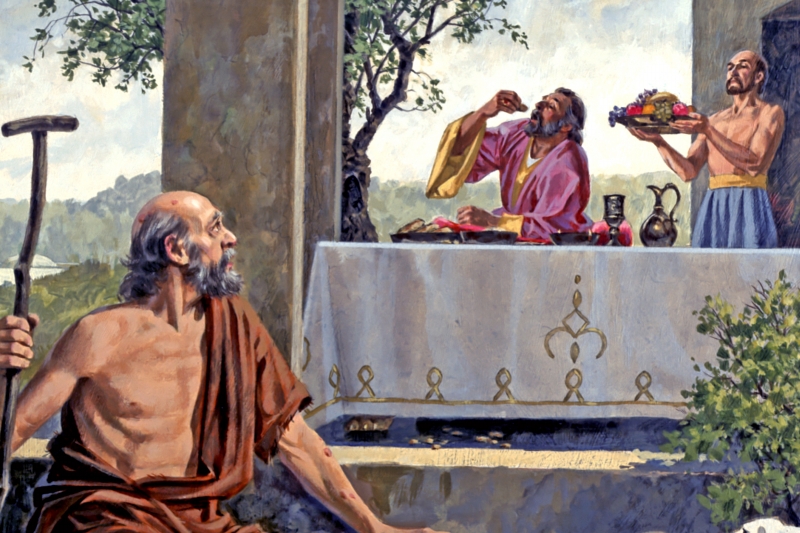
A rich man (we will call him Charlie) and a very poor man named Lazarus.

Charlie lived in a fine house in a gated community.

Lazarus lived on the cold sidewalk outside the gate.

Charlie was clothed in purple and fine linen.

Lazarus was “clothed” in sores.

Charlie feasted sumptuously, every day.

Lazarus begged for just a few… crumbs.

While Charlie was probably pampered by a dozen slaves, Lazarus had his sores licked by dogs.

Then….both men died.

Charlie was buried (a grand funeral, no doubt, laid out in silken robes with flowery wreathes).  He went straight to Hades, and was in torment, in anguish, in flames.

Lazarus was carried by angels to Abraham’s side where he was comforted and had access to refreshing cool water.

Charlie: “Oh, please, Father Abraham, send Lazarus with a cool drop of water for the tip of my tongue, for it is burning beyond what I can bear!”

Abraham: “Lazarus can neither hear you nor see you.  He is being comforted and healed from all the abuse and misuse he suffered on earth.  Sorry, Charlie… it’s not going to happen!  Your days of ordering slaves and servants to meet your every need are over.  Besides… there is this huge chasm between where YOU are, and where WE are.”

Charlie: “Then…. I beg you, Abraham, send Lazarus to my five brothers to warn them about this place!”

Abraham: “No, Charlie. Your five brothers have Moses & the Prophets (the Bible).  Let them listen to them!”

Charlie: “No, they do not read the Bible. They don’t know any of that. But… if you would send someone from the dead (Lazarus), they would believe him, I know!”

Abraham, with a sigh: “If they do not believe Moses and the Prophets, they will not be convinced if Someone (Jesus) was raised from the dead.”

~~~ from Luke 16.


Romans 10:17 “Faith comes by hearing, and hearing by the Word of God.”

After Jesus’ resurrection, He joined two disciples walking to Emmaus, and beginning with Moses and all the Prophets, he explained to them what was said in all the Scriptures concerning himself.”

Later, to his own close disciples, Jesus said, This is what I told you while I was still with you: Everything must be fulfilled that is written about me in the Law of Moses, the Prophets and the Psalms.” Then He opened their minds so they could understand the Scriptures. He told them,“This is what is written: The Messiah will suffer and rise from the dead on the third day, and repentance for the forgiveness of sins will be preached in His name to all nations, beginning at Jerusalem.”

***

Oh, be prepared for your last day! Read, listen to, meditate on, believe, and obey all God says in His Word about Jesus and the gift of faith and salvation. His Word is truth. Search the scriptures, for they testify of Jesus Christ, and in them you will find  eternal life. Be a “doer” of that Word and not only a superficial “hearer.”

Using My Bible’s Concordance to Pray

HAVE YOU EVER USED YOUR BIBLE’S CONCORDANCE as a source of Bible Study or Devotional?

I don’t mean to find a particular scripture you need, but to choose A WORD, then go down the list of references on that word in your Bible – one-by-one – and consider what God might say to you about your subject… for that day or week.

(You can also use a Topical Bible, such as Nave’s if you have one.)

Recently, I’ve been wanting my prayer life to be stronger, meatier. I’ve read a few books on how to do that and heard a few sermons. Then I decided to go to the Book of Books and see how God would instruct me there.

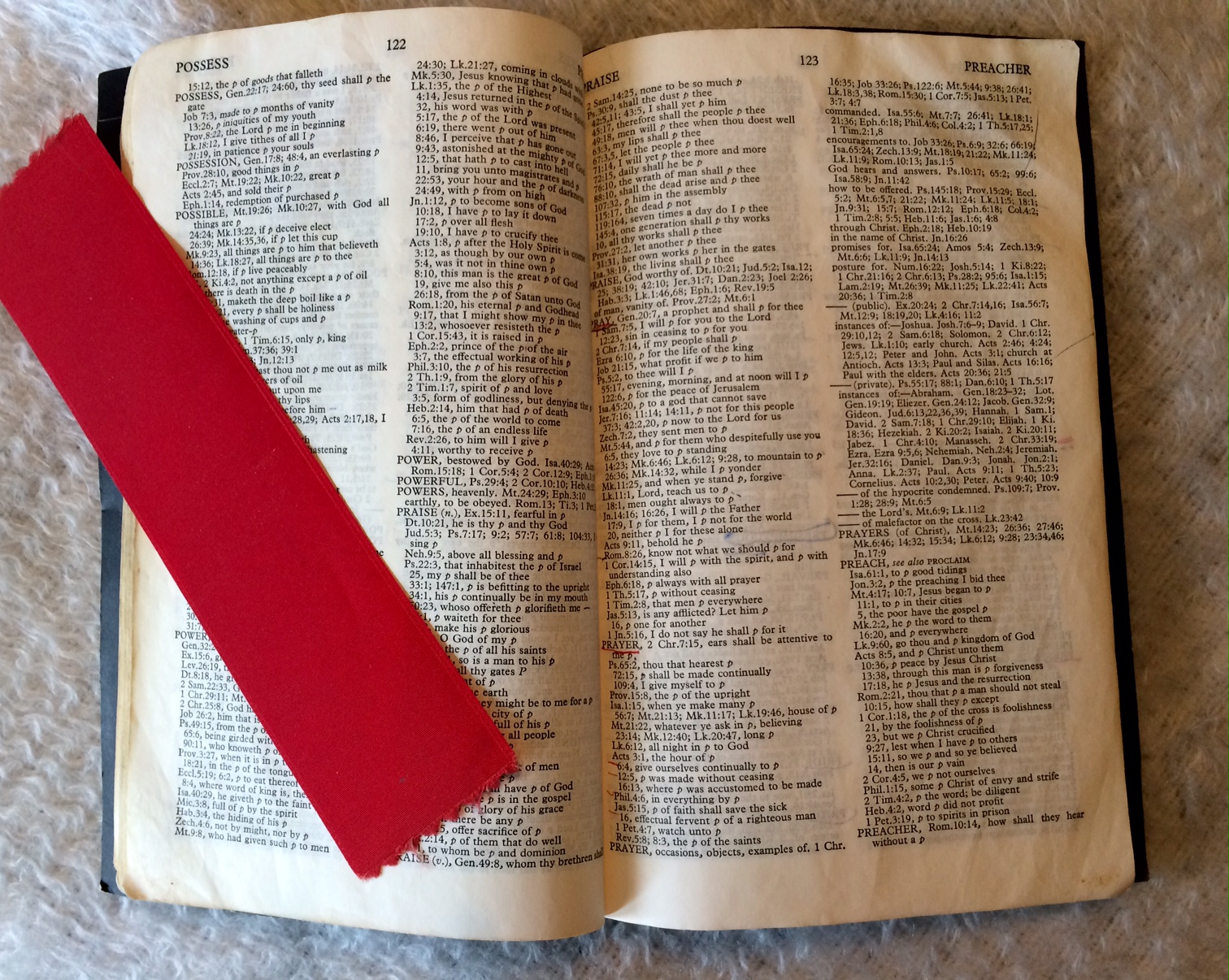
BibleConcordanceUsing the concordance on my old KJV (which has many more references to subjects than the ESV version I read), I looked up the word PRAY, and beginning at the first one in the Old Testament, I read the referenced verse, then the surrounding verses in the passage.

I am amazed each time I do this to discover how and for what God wants me to pray. Thus far in the last couple weeks ( from Genesis, 1 Samuel, 2 Chronicles & Ezra), I’ve found:

1. pray for “good” people who need salvation (I listed a few friends who came mind.)

2. pray for believers struggling with sin in their lives (a few more listed – including myself)

3. pray for those who willfully sin and need discipline

4. pray for our country (America specifically) and the repentance and seeking God that needs to happen…beginning with believers.

5. pray for “the king & his sons” which I took to mean our president and his family. (I admit this is a hard one for me, but when I wrote down all their names, it got easier.) I begin by praying another verse from 3 John for them; “I pray that all may go well with you and that you may be in good health, as it goes well with your soul.”

I’m looking forward to what is next on the list – in a few days.

Does this sound like something YOU might like to do with prayer or perhaps with other subjects?  I’d love to hear your journey.

My Testimony

girl-praying2

When I was about 9 years old, I asked Jesus into my heart at an evangelistic meeting at our youth camp at Hume Lake. I confessed that I was a sinner, thanked Jesus for dying on the cross for my sins, and told Him that I wanted to live for him.

Did I understand all that that meant at age nine? No. Was I sincere? Yes. Did I believe I was saved? Yes. WAS I saved? Later, I questioned that very thing.

*****

Already plugged into an evangelical, Bible-teaching, missionary-minded church, I went to Sunday School, morning and evening services, and Wednesday Night prayer meeting with my mom. I prayed to God during those young years – simple, childish requests – and believed that He would answer them. And He did.

I was a part of the monthly missions emphasis in the elementary grades, junior high, and on into the Women’s Missionary Assoc. I learned about our mission fields and missionaries, supported, and later hosted them in my home. At the beginning it was mainly Sierra Leone, West Africa, but later we had missionaries in Hong Kong, Macau, Honduras, Nicaragua, Jamaica, and eventually India.

I never dreamed then that I would ever get to see any of those places, but God has been so gracious to allow me to go to Africa twice since we moved down to OC and came to FBC. How good he is!!

(The old timers that I grew up with in missions at that church are the ones who faithfully supported me through prayer and giving when I went to Malawi.)

I met my husband at church when he moved here from Oregon and was living with his aunt and uncle, who attended. After we were married, we got involved in different ministries in that church, including leading the older youth group for a while, some Sunday School teaching, and the building program.

Sadly in the several years that followed, I strayed from my love and commitment to the Lord. Family trials after we adopted a son (and the bitterness that sprung from them), outside interests (including immersion in Musical Theatre that helped me escape from the anxieties at home – after all, they had romance, carefree songs, and happy endings!), resentments and bitterness (from things not turning out as I’d hoped), rebellion, and unconfessed sin left me feeling distant from God. I continued in superficial service, but my heart was far from Him.

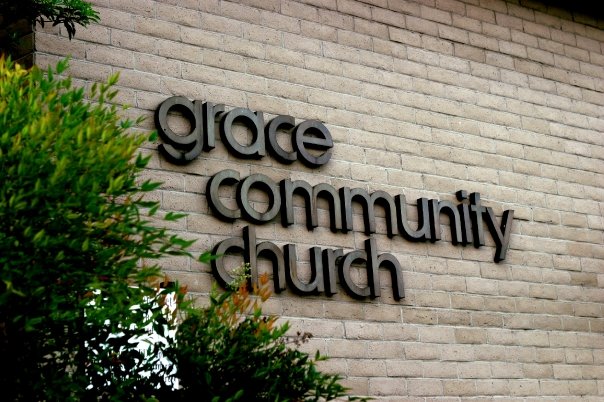
GCCMeanwhile, our little congregation disbanded and sold the church building to a growing Hispanic congregation, and we started going to Grace Community Church. I was faithful in attendance, but only to Sunday School. (The worship services with the huge, multi-voice choir and full orchestra reminded me too much of Theatre, and I’d finally gotten out of that deceptive “world.”) My heart remained cold and withdrawn. I knew I needed to “get right” with God, but I stupidly resisted.

As I listened to the messages each Sunday, I realized that our former church’s doctrine about how a person gets saved was different from Grace.   (Arminism & Calvanism)

I had grown up believing that you heard the Gospel and through the Spirit’s “wooing,” you made a decision for Christ. But under the teaching of John MacArthur and Don Green, I began hearing that Jesus’ atonement was not for the whole world as I’d learned in John 3:16, but that God foreknew and chose and called “some” (His elect) for salvation before the world even began.

  • For those whom he foreknew, he also predestined to be conformed to the image of His Son, in order that He might be the firstborn among many brothers. And those whom He predestined, he also called, and those who me called he also justified, and those whom He justified he also glorified. (Romans 8:29-30)

Suddenly I began to doubt my salvation. What if I wasn’t one of His elect? How would I know? I hadn’t had a huge night-day conversion like some had. I’d simply asked Jesus into my heart and believed that I was saved.  It was true that I had grown in the knowledge of God and love for Him over the years, but what if I was just deceiving myself?  What if I hadn’t been “chosen” by God to be saved?

The current rebellion and coldness of my heart made me fear even more.

open Bible pen & glassesI went up and down with this issue as FIRST I heard the teaching about God’s sovereignty, and THEN reviewed the details of my life over the past decades.  That feeling of distance from God at the time didn’t help. Was I saved or not? I asked Pastor Green how you could KNOW if you were God’s elect. He referred me to passages in I John, which we were studying.

By this we know we have eternal life….

  • If we walk in the light (1:7)…
  • keep/obey His commandments (2:3, )…
  • walk as Jesus walked (2:6)…
  • does the will of God (2:17)…
  • practice righteousness (2:26)…
  • don’t practice sinning (3:10)…
  • love and sacrifice for fellow believers (3:16-18, 4:7)…
  • believe in the name of Jesus (3:23)…
  • the witness of the Spirit (3:24, 4:13)…
  • believe that Jesus is the promised savior (5:1) and the Son of God (5:13)…
  • and love the Father (5:2).

I tortured myself asking how I measured up to all those “by this we know” verses.

I was still anxious and confused inside (okay, I was DOUBTING) when we moved to south Orange County and began attending Faith Bible Church. One of the first sermons I heard was Pastor Koh quoting John Piper asking if we would be satisfied in heaven if Jesus was not there. My heart answer scared me. Did I truly love Jesus supremely? If not, was I truly saved? Sometimes I just wished I’d led a horrible life of debauchery before, so I could see a huge difference at my conversion.

Sunday sermons kept hammering on the question of true salvation, urging us to examine our hearts to make sure we weren’t just living a “good Christian life” without truly knowing the Savior.

Gradually, during my quiet times (Yes, I had begun them again) I began to see the resentment, rebellion, and sin in my heart that I needed to deal with. I confessed those sins and more as God brought them to my mind, pleading his mercy, and receiving His forgiveness. Like the prodigal son I was coming home, but that big “election” issue still remained unsettled.

I knew Jesus had “died for my sins,” but I hadn’t then grasped the awesome truth of what that meant.

I prayed that God would just settle this question for me. To somehow SHOW me I was a Christian. Couldn’t I just see His “stamp of approval” on me – you know, instead of the Antichrist’s “666” on my hand or forehead, a “777” just so I could be SURE!

Then one morning when I was praying, begging, for some sign, I suddenly realized what a great sin I was committing. I was asking God Almighty, Creator of the universe, to single me out and show me special treatment just so I could believe, that I was one of his chosen.

I was like the Pharisees – having Jesus in their very presence, preaching and doing miracles, they had the gall to ask Him for some “sign” to prove to them who he was, before they would believe.

I was asking God to prove something to me too instead of just believing His Word!!

woman-kneelingWhen God showed me my heart – revealed this great sin of unbelief – I was horrified and I crumpled before Him. Such audacity! Such great pride! I couldn’t get low enough before Him even if I fell through the floor and kept going.

Oh, my God! I cried. I’m so sorry! How could I not just believe what You’ve said your Word instead of putting You to the test? Oh, what sin!  What a sinner I am!  Oh, God, please forgive me!

And with His great love and grace, He showed me the complete forgiveness of my sins. All had been paid for on the cross. He’d said it in His Word, but my sin, and doubt had blinded me.

Suddenly the gospel scriptures I’d read had fresh meaning.

  • In this the love of God is made manifest among us, that God sent his only son into the world, so that we might live through him. In this is love, not that we have loved God but that He loved us and sent his Son to be the propitiation (accepted punishment) for our sins.  1 John 4:9-10
  • But God shows His love for us, in that while we were still sinners, Christ died for us. Romans 5:8
  • There is therefore now no condemnation for those who are in Christ Jesus. For the law of the Spirit of life has set you free in Christ Jesus from the law of sin and death. (Romans 8:1-2). 
  • But God, being rich in mercy, because of the great love with which He loved us, even when we were dead in our trespasses, made us alive together with Christ – by grace you have been saved. (Ephesians 2:4-5).
  • And you, who were dead in your trespasses and the uncircumcision of your flesh, God made alive together with Him, having forgiven us all our trespasses by canceling the record of debt that stood against us with its legal demands. This he set aside, nailing it to the cross(Colossians 2:13-14
  • For our sake He (God) made Him (Jesus)to be sin, who knew no sin, so that in Him we might become the righteousness of God. 2 Corinthians 5:21

What a glorious moment of assurance. Despite being a prideful, arrogant sinner, one who had strayed disgracefully away from Him, I was His child. He knew me, loved me, chose me, and sent his Son to save me.

All God’s righteous wrath was poured out on His innocent Son because of my sin. Jesus stood in for me and took the punishment I deserved. Then God raised Him up to prove that He was sinless in Himself.

God sees me through the blood of His Son – which blots out all my sin – and sees only righteousness. I don’t know how that can be, but God said it, and I now totally believe it.

I still need to read the gospel verses over and over to remind me of my position in Him, especially when I’ve allowed sin and distractions to take my eyes off Him. And I still struggle with pride, self-righteousness, conceit, love of glory, disobedience, and stubbornness.

*****

reading_bibleRecently I’ve been asking God to show me how to kill these sins in life, and He reminded me that the Holy Spirit uses His Word (the “sword” of the Spirit, Ephesians 6:17) to do that, so I’ve been reading the Bible more, with more thought. I’ve also asked Him to teach me to obey quickly, to submit to Him and to other authority, and to humble myself before Him.

It’s a tough learning process, and I’ve only begun. And sometimes He’s had to take me through some dark places. But it is WORTH IT.

“Therefore be imitators of God, as beloved children. And walk in love, as Christ loved us and gave himself up for us, a fragrant offering and sacrifice to God.” Ephesians 5:1-2