Archives

Journaling through the Bible Chronologically in 2025, Day 189

Day 189 – Reading – 2 Kings 15, and 2 Chronicles 26

Read today’s scriptures. Refer to “Kings” chart to keep the names straight!

2 Kings 15.

In the middle of Jeroboam II’s reign in Israel (north), Azariah/Uzziah became king in Judah (south).  (We will call him Uzziah, because that how Isaiah refers to him.)

  • He was 16 when he began to reign.
  • He reigned 52 years.
  • He did what was right in the eyes of the LORD (until right at the very end).   (Verse 5 says that the LORD touched him with leprosy at the end of his life.  Don’t worry, we will read the details in 2 Chronicles!)

At the end of Uzziah’s life and after after he died, his son Jotham reigned in his place. (More in 2 Chronicles.)

.

Meanwhile in Israel (north), Jeroboam II died and his son Zechariah became king … for six months.  Shallum (the son of nobody” according to the Assyrians), killed Zechariah and took his crown. 

And that was THE END OF THE PROMISE THAT GOD GAVE TO JEHU FOR HIS HUMOUNGUS BLOODY WORK OF ANNILIATING THE HOUSE OF AHAB. (Read 2 Kings 10:30 for that promise that 4 of his sons would reign as king).

Shallum (Mr. Nobody) reigned for ONE MONTH.  Menahem, the military commander under Zechariah, came and killed Shallum, and took the crown of Israel. (This guy did some horrible things because some cities did not accept him. Menachem reigned ten years.

During his reign, Pul, the new, evil, and growing in power, king of Assyria (form Nineveh – remember Jonah?) came down on Israel.  Menachem assessed 50 talents of silver from all the rich men and gave it to Pul, and the King of Assyria went home …… for a time. 

After ten years, Menachem’s son, Pekahiah became king. (Uzziah was still king in Judah to the south).

Pekahiah reigned two years.  Pekah (no not his son, but the son of his army captain), along with 50 men conspired against king Pekahiah and killed him in Samaria, in the citadel of the king’s house. 

And so, Pekah became king in Israel in the last year of Judah’s king (Uzziah)’s reign.  Pekah reigned twenty years, and did evil in God’s sight.  During his 20-year reign, another King of Assyria, Tiglath-Pileser, stronger and crueler than Pul, came and captured a northern chunk of Israel, including all of the territory of Naphtali, Gilead, and Galilee.   He carried all the people there away into captivity … they did not return.  

Then the Assyrian king made this area into three provinces of Assyria.  The Assyrian king was probably involved in the conspiracy of Hoshea that ended in Pekah’s death.

Israel’s LAST KING, Hoshea, killed Pekah and became king in his place. HIS DAYS WERE NUMBERED!  

We will see the sad final end of Hoshea and ISRAEL, in our study NEXT TUESDAY.

Meanwhile, back to the South………

.

2 Chronicles 26.

Ah, the beginning of the mostly good King Uzziah, crowed by the people of Judah at age 16, he — 

  • “set himself to seek God in the days of Zechariah (an unknown prophet) who instructed him in the fear of God. As long as he sought the LORD, God made him to prosper.”
  • God helped him in the war against the Philistines, and the Arabians, and the Ammonites.
  • His fame spread even to the border of Egypt because he became very strong.
  • He built and fortified towers in Jerusalem and in the wilderness.
  • He built cisterns for his many herds.
  • He had a huge army, fit for war, and made shields, spears, helmets, coats of mail, bows, and slings for them.
  • He made “engines” invented by skillful men to be on the towers to shoot arrows and great stones.
  • He became STRONG.

BUT … WHEN he was strong, he grew proud, to his destruction.  (He was unfaithful to the LORD his God  and “entered the temple of the LORD to burn incense on the altar of incense.”)   WHAT!!!

Oh, such a warning to me and to you!

Of course, the priests stopped him before he could do it, but he had the censor IN HIS HAND!  

(Oh, my goodness, remember Aaron’s sons who tried to do that?  A blast of fire from God’s holiness consumed them!!)

The priests – all eighty of them – managed to get King Uzziah OUT of the Temple. But the KING WAS VERY ANGRY and struggled.  And the LORD struck him with LEPROSY.  The priests could see it on his forehead, but it could have been elsewhere too.

And King Uzziah was a leper to the day of his death. He lived in a separate house and was excluded from the House of the LORD.  (Oh, my! and after all the good he did!)

His son, Jotham took over governing the people.  When Uzziah died he was buried outside the city in the field belonging to the kings.  And Jotham then reigned as king.

.

Isaiah prophesied during the time of Uzziah, Jotham, (and Ahaz and Hezekiah), kings of Judah. Isaiah 1:1

He had an amazing vision, recorded in chapter 6.  Isaiah 6:1 – “In the year that King Uzziah died, I saw the LORD sitting upon a throne, high and lifted up, and His GLORY filled the temple………..”  WOW! 

We will see what Isaiah’s reaction was to this – so different from Uzziah’s pride.


Journaling through the Bible Chronologically in 2025, Days 180 & 181

Sundays and Mondays studies are posted together on Mondays

Day 180. Reading 1 Kings 22 and 2 Chronicles 18

Day 181.  Reading 2 Chronicles 19 – 23

Read Today’s Scriptures.
What insight or comfort do you receive?
 

Day 180 – 1 Kings 22.

After that ill-advised truce between King Ahab’s Israel (north) and King Ben-Hadad’s Syria (farther north), there were three years without war. Each country was trading in the other’s bazaars.  

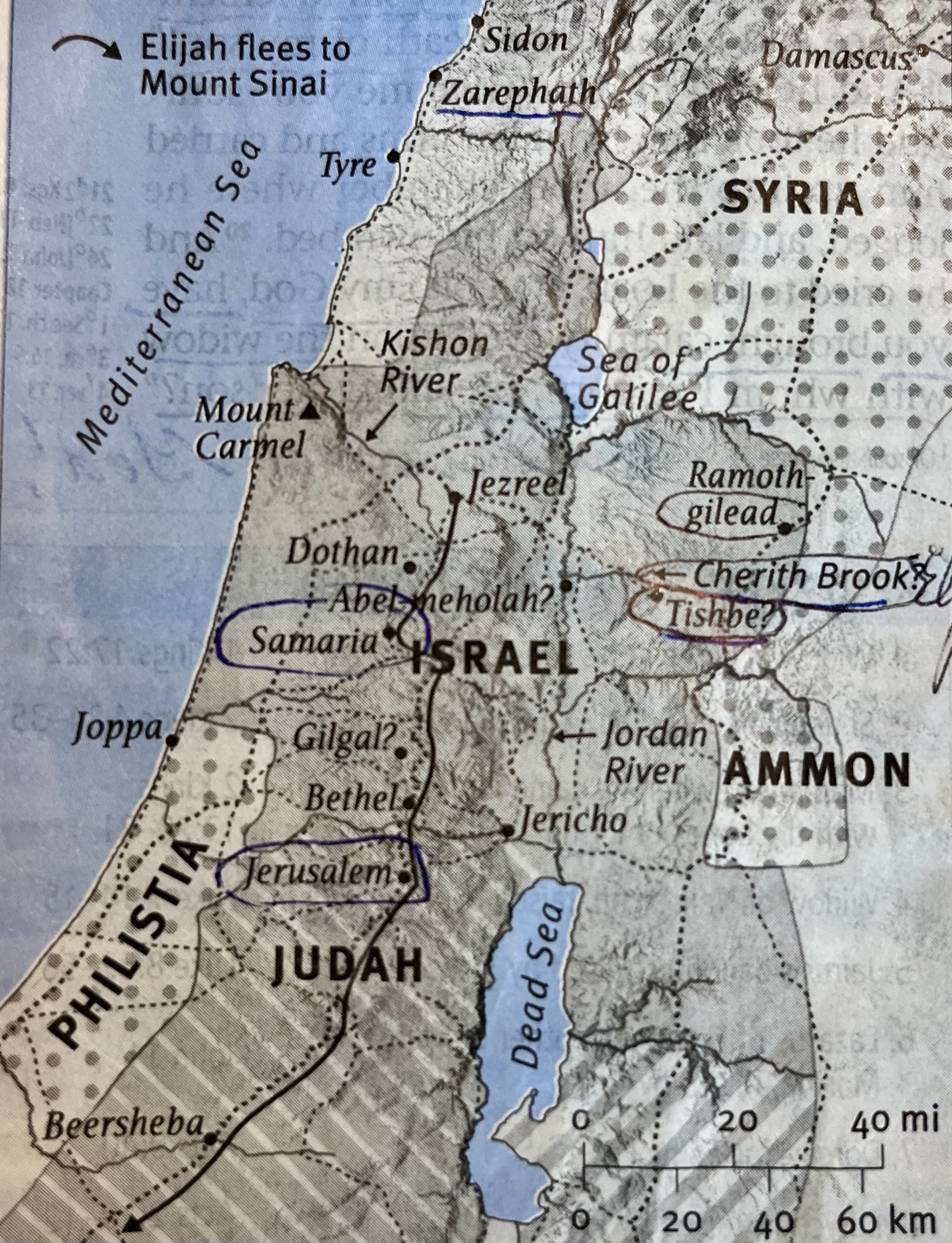
But, there was a sore spot between the two kings. It was the town of Ramoth-Gilead.  Officially, it was in Israel’s territory, way east, across the Jordan River and right up next to Syria. (See map on yesterday’s post.) Syria was gradually “taking” the town, and Ahab didn’t like it.

So… when King Jehoshaphat of Judah (south) came to visit Ahab, Ahab asked him if he would go with him and battle for it and try to settle the dispute with Syria.

“Sure,” Jehoshaphat said. “My people are yours and my horses are yours. But … hey, let’s inquire of the the LORD first.”

King Ahab gathered his 400 prophets and inquired if they should go up against Syria at Ramoth-Gilead.

They ALL said, “Go up, for the LORD will give it into your hand.”

This seemed a little fishy to King Jehoshaphat, and he asked if there was ANOTHER prophet of the LORD that they could ask.

King Ahab grumbled, but finally said, yes, there was ONE, but Ahab didn’t like him because he ALWAYS prophesied against him.  Jehoshaphat pressed him, and Micaiah was called.  After a bit of messing around this real prophet of God said, “I saw all Israel scattered on the mountains, as sheep that have no shepherd.

“SEE!!! I told you.  He never says anything nice about me!” bemoaned Ahab.  And Ahab promptly put Micaiah in prison with meager food rations.

But, the Word of the LORD which Micaiah spoke came true.  The two Jewish kings went up to battle with the king of Syria, who had told his men to “fight with neither small or great, but with the King of Israel (Ahab) only.”

King Jehoshaphat (Judah) rode out in his chariot in regal clothing and a crown on his head.  But wily King Ahab disguised himself as a lowly soldier.  The Syrians of course, went after Jehoshaphat, who cried out to the LORD for help.  When the Syrian captains saw that he was not King Ahab they turned away.  

Then ,,, a random soldier drew his bow and randomly shot an arrow into the air.  “Oops!” That deadly missile flew right to the disguised King Ahab and entered his body through the crack separating his breastplate from his chain mail.  A scream.  And, “TURN AROUND AND CARRY ME OUT OF THE BATTLE FOR … I … AM … WOUNDED!  And troops fled every man to his city.

In the evening, King Ahab died.  His blood flowed into the bottom of the chariot. His body was brought to Samaria and buried.  

“And they washed the chariot by the pool of Samaria, and the dogs liked up his blood.”  Just as Elijah had prophesied.

Ahaziah, his son reigned in his place. He did what was evil in the sight of the LORD and walked in the way of his father, King Ahab, and in the way of his mother, Queen Jezebel. He served Baal and worshiped the pagan gods. He provoked the LORD, the God of Israel to anger in every way that his father did.

.

Meanwhile, in the south, King Jehoshaphat continued to reign over Judah. (We’ll learn some good things about him tomorrow from 2 Chronicles 19-23.  He continued to clean up the pagan worship that his father King Asa had begun.)

Jehoshaphat eventually died and HIS son, Jehoram reigned in his place. Jehoram was exceedingly wicked, and you will find out why (below) and how (tomorrow’s reading).  

.

2 Chronicles 18.

Here are a few interesting details on the story above about King Ahab in the north, and King Jehoshaphat in the south going to battle together for Ramoth-Gilead.

Jehoshaphat had GREAT RICHES and honor.  He – STUPIDLY!!! – made a marriage alliance with king Ahab.  (Ah ha! … now we see why the southern king was willing to go to war with Ahab against the Syrians.)  Jehoshaphat had arranged for his son, Jehoram, to marry Athaliah, the daughter of Ahab & Jezebel.

And the fall out of this union nearly wiped out the godly line of David through whom the Messiah Jesus would come!!! We’ll see that tomorrow.

.

###

.

Day 181 – 2 Chronicles 19.

When King Jehoshaphat returned to Judah after that narrow escape with the Syrians and the death of Ahab, he was met by Hanani, a prophet of God, for a thorough scolding

Should you help the wicked and love those who hate the LORD?”  (Yes, it did seem strange that he would help the wicked King Ahab fight the Syrians … until we learned that his son had married Ahab’s daughter.  There was a political obligation there.)

Hanani told the king of Judah that he SHOULD be punished … but that, “some” good had been found in him. He’d gotten rid of the pagan Asherah poles, and … MORE IMPORTANTLY, Jehoshaphat had “set his heart to seek the LORD.”  After that …

  • He went out to the people in his land and “brought them back to the LORD, the God of their Fathers”.
  • He appointed judges in all the fortified cities and reminded them that the LORD was watching them. They should make sure there was no injustice or bribery.
  • He appointed special Levites in Jerusalem to decide disputed cases.

.

2 Chronicles 20.

And then, a threat of war came to Judah (south). The descendants of Israel’s old relatives: (Moab & Ammon, both from Abraham’s nephew Lot) and Edom (descended from Jacob’s twin, Esau) joined together. They came around the south end of the Dead Sea, with the plan to de-throne Jehoshaphat.

Thankfully, the king did not call on the wicked kings in the north to help him, but “set his face to seek the LORD.” He proclaimed a fast for all his people. And prayed this prayer;

  • “O LORD, God of our fathers, are You not God in heaven?  You rule over all the kingdoms of the nations. In your hand are power and might, so that none is able to withstand You.  Did You not, our God, drive out the in habitants of this land before Your people Israel, and give it forever to the descendants of Abraham, Your friend?
  • “And they have lived in it, and have built in it a sanctuary for Your Name, saying, “If disaster comes upon us (the sword, judgment, pestilence, or famine), we will stand before this house and before You (for Your Name is in this house) and cry out to you in our affliction, You will hear and save!
  • And now behold, the men of AMMON, MOAB, and MOUNT SEIR, whom Your would not let Israel invade when we came up from Egypt – Behold, they “reward us” by coming to drive us out of Your possession.
  • O our God, will you not execute judgment on them?  For WE ARE POWERLESS AGAINST THIS GREAT HORDE that is coming against us. “WE DO NOT KNOW WHAT TO DO!  But our eyes are on You.”

**** (Oh, my goodness, what a prayer!  What if WE should pray this way, with such dependence on God!  What if modern Israel would pray this way, in total dependance on the LORD, their God! How would YOU respond, O LORD our God?)

As all Israel, with the little children and women, stood before the LORD, the Spirit of the LORD came on Jahazel, a descendent of Asaph, the Levite. And he said,

  • “LISTEN, all Judah, inhabitants of Jerusalem, and king Jehoshaphat. Thus says the LORD. “Do not be afraid and do not be dismayed at this great horde, FOR THE BATTLE IS NOT YOURS BUT GOD’S.”
  • “Tomorrow go down against them.  YOU WILL NOT NEED TO FIGHT IN THIS BATTLE.  Stand firm, hold your position, and see the salvation of the LORD, on YOUR behalf, O Judah and Jerusalem.
  • “DO NOT BE AFRAID AND DO NOT BE DISMAYED.  Tomorrow go out against them, and the LORD will be with you!”

Jehoshaphat, all Judah and Jerusalem fell down before the LORD, worshiping Him. They praised the LORD, the God of Israel with a very loud voice.

And they arose early in the morning and went out to meet the horde. Jehoshaphat stood and encouraged them. “Hear me, Judah and Jerusalem! Believe in the LORD your God, an you will be established. Believe the prophet and you will succeed.

AND THEN … Jehoshaphat appointed singers to sing and praise the LORD, as the went before the army.

Give thanks to the LORD, FOR His steadfast love endures forever.”

And when they BEGAN to sing and praise, the LORD set an ambush against the men of Ammon, Moab, and Mount Seir, so that they were routed.  They each destroyed one another!!!!!  Dead bodies all around. None escaped.

WOW!

Jehoshaphat and the people came to take the spoil and found GREAT NUMBERS of goods, clothing, precious things – which they took for themselves until they could carry no more.

They returned to Jerusalem with GREAT JOY for the LORD had made them rejoice over their enemies. 

And the fear of God came on all the kingdoms of the countries when they heard that the LORD had fought against the enemies of Israel.  So the realm of Jehoshaphat was quiet … for his God gave him rest all around.

.

At the end of his life, King Jehoshaphat joined in a venture to build a shipping fleet to Tarshish – with Israel’s wicked King Ahaziah (north).  But God destroyed all the ships because of this ungodly alignment.

Eventually Jehoshaphat died and was buried in the City of David (the southern part of Jerusalem, below the Temple Mount and palace).

.

2 Chronicles 21.

Jehoshaphat’s first-born son, Jehoram (the one he’d arranged a marriage with wicked Ahab/Jezebel’s daughter, Athaliah), ascended the throne.  HE WAS NOTHING LIKE HIS GODLY FATHER!  Immediately, he killed all his brothers, six in all, plus some of the princes of Israel (north), to assure his place in the kingdom.  (These men, were the lineage of “the house of David” through whom God had promised the reigning Messiah. Jehoram killed them all!) 

And yet God did not destroy him, even though he did what was totally evil in His sight, for God was not willing to destroy the house of David because of the Covenant He’d made with David. God had promised “a lamp to him and to his sons forever.”  But what about this totally evil man of darkness???

Do not fear. God is Sovereign over all.

But meanwhile Jehoram grew worse. He made high places for pagan worship. He led Judah into whoredom and made them go astray.

Elijah the prophet sent him a letter from the north. “Because you have walked in the ways of the kings of Israel (north) and have enticed Judah into whoredom, and killed your brothers, I, the LORD, will bring a great plague on your people, children, wives, possessions and YOU YOURSELF will have a severe sickness of your bowels, until them come out of your body.”

WHOA! (Leave it to Elijah to terrify!)

God stirred up the Philistines against Jehoram, and the Arabians, and they came and invaded Judah and carried away Jehoram’s possessions, his sons, and his wives. (Only Jehoahaz, his youngest son remained.)

Then God struck him with that dreaded bowel disease, an incurable disease.  In two years’ time all his bowels came out and Jehoram died IN GREAT AGONY. 

No one regretted his departure. He was buried in the city of David, BUT NOT IN THE TOMBS OF THE KINGS.

.

2 Chronicles 22.

So, Ahaziah/Jehoahaz, Jehoram’s youngest son reigned. He walked in the ways of his grandfather, King Ahab (north), for his mother was his counselor in doing wickedness. 

God ordained his downfall through His appointed Jehu, whom God had appointed to destroy the house of Ahab. (Remember, that was one responsibility the old prophet, Elijah had, to anoint Jehu.)  And Jehu did that – he killed Ahaziah/Jehoahaz and all the remaining princes of Ahab.

Now, there was no one able to rule the Kingdom of Judah.  

Why?  Because the wicked mother (daughter of Ahab) destroyed all the royal family of Judah. She proclaimed herself queen – but nobody took her reign seriously.

WAS JUDAH WIPED OUT?

WAS THERE TO BE NO SEED OF DAVID LEFT TO COME AS MESSIAH?

WHAT ABOUT GOD’S PROMISES?

But … there was a woman named Jehoshabeath, the daughter of the king, and the wife of the priest, Jehoiada.  She went into the “nursery” and carried away the very youngest son of the king, less than 1-year-old Josiah, AND HID HIM FROM HIS WICKED GRANDMOTHER. 

Josiah, the SEED OF DAVID, the “lamp of Israel,” lay hidden in a cradle. He stayed with the godly couple for six years, while Athaliah “reigned” over the land.   

****(Doesn’t this remind you of how God kept the baby Jesus safe from King Herod when he sent Joseph and Mary to Egypt?)

.

2 Chronicles 23.

Finally the time had come.

Josiah was seven years old.

He’d been trained by the priest, who now took courage.

Jehoida gathered the commanders of the army. They went through Judah and gathered the Levites from all their cities, as well as the fathers of the houses of Israel.

Jehoida showed them the boy-king, Josiah and said, “Behold, the king’s son! Let him reign as the LORD spoke concerning the sons of David.”

Then Jehoida revealed his carefully-though-out plan.  All the Levites and priests who had come off duty were divided into thirds and placed around the House of the Lord at the gates. “NO ONE MAY ENTER EXCEPT THE MINISTERING PRIESTS.” 

“Surround the king, each with his weapon in his hand.  Anyone approaching shall be killed.  Be with the king at all times.”

THEN, he brought out Josiah, the king’s son and placed the crown on his head.  “Long live the king!”

.

YIKES!  When Queen Athaliah heard the noise, she went to see what was happening and saw the young king. 

She tore her clothes and cried, “TREASON! TREASON!”

Jehoida commanded the captains to seize her. “Take her out of the court of the House of the Lord, and kill her!”  They led her through the horse gate of the king’s house and… did the deed.  The end of that wicked Ahab/Jezebel line … except for Josiah, whom the LORD had chosen to carry David’s seed.  WHEW!

.

Jehoida made a covenant between himself, the people, and the young king, that they ‘should be the LORD’s people.   He saw to it that the altars and images of Baal were destroyed. He reinstituted the sacrifices and offerings that Moses wrote about in the LAW.

Then he took the young boy king from the house of the LORD to the king’s house.  They set him on the ROYAL THRONE.  All the people rejoiced, and the city was quiet after Athaliah had been killed.

.

****(WOW. What a long tale of evil and good.  God is ALWAYS in control. HE is sovereign. He will fight for His people.  He will see that not a word of his prophecy EVER fails. His covenants are sure. HE IS GOD, and KING, and the LORD of Hosts forever and ever. Glory be to His name!)


Journaling through the Bible Chronologically in 2025, Day 179

Day 179.  Reading 1 Kings 20-21

 
Read today’s Scriptures.

1 Kings 20….

…tells a surprisingly good story about the wicked King Ahab.  Until the last part, that is.

We see King Ben-Hadad, king of Syria, again in this chapter. (Syria is the country just north-east of Israel, with Damascus as the capital.) (This map also shows the two places Elijah stayed during the drought, and Mt. Carmel, where the great “showdown” happened. Samaria is the capital of Israel, where Ahab lives.) 


Remember, in Chapter 15, King Asa (south) had paid Ben-Hadad a large amount of gold and silver from the temple, to harass King Basha (north) so he’d stop fortifying the border. The Syrian King had agreed. Now, it seems, Ben-Hadad was sure King Ahab could also be easily defeated.

Hey, King Ahab, give me your silver and gold and the best of your wives and children.” 

“Okay, sure,” said Ahab.

Then Ben-Hadad got greedy. “I will send my servants to you tomorrow, and they will search your house and take whatever pleases them.”

Um, no! The gold and silver and best wives and kids I will do, but NOT THAT,” sent back King Ahab.

Okay, then. It’s war!”

“Make my day!” replied Ahab.

Now, here is the strange part.  A prophet of God came to Ahab and told him that he would get the victory, “So you will know that I am the LORD.”  Ahab got some military instructions from the prophet, and at noon they went out to confront King Ben-Hadad’s army.

The Syrian king was drunk, however, and commanded, “If they come in peace, TAKE THEM ALIVE!  But if they come out for war …. TAKE THEM ALIVE!”  (Huh?)

Ben-Hadad didn’t have the chance to do either, because King Ahab struck his forces a “very great blow!” The Syrians fled and Ben-hadad escaped on a horse.

The prophet of God told King Ahab to rest up, for in the Spring the king of Syria would be back.  (Now, the Syrians believed that Israel’s God was only a god of the hills. That’s why they were defeated.  Next time they would bring lots of chariots and fight on the plains.  The Jewish God would be defeated there.)

Oh, Syria.  You’ve a lot to learn!!

So, in the spring Ben-Hadad mustered the Syrians and went up to fight against Israel … in the plains. The army of Israel that encamped before them was as “two little flocks of goats” compared to the Syrians who filled the country.  (Hahaha. Oh, Ben-Hadad, did you never hear of David and Goliath??)

The prophet of God came to Ahab and said, “BECAUSE the Syrians claim the LORD is only a god of the hills, I will give all this great multitude into your hand, and YOU SHALL KNOW that I am the LORD.”

And the people of Israel struck down of the Syrians 100K foot soldiers in one day.  When the rest fled to a town, the wall fell on them and 27K more were killed.  Ben-Hadad hid deep in the town and sent a message to King Ahab, “Please let me live.

AND HERE IS WHERE KING AHAB WENT WRONG.  God had “devoted the Syrian king to destruction,” meaning he was to be killed.  But King Ahab thought it would be cool not to kill him.

He’s alive? He’s “my brother!” he said.

Yes! Your brother, Ben-Hadad!”

Go, bring him out.”

When the Syrian king was brought out, King Ahab invited him up into his own chariot. And the two kings made a trade deal between their countries. And …. Ahab let him go.

LATER…

The prophet of God came to King Ahab with a bit of play-acting, but then told him.  “Because you have let go the man whom I had devoted to destruction, therefore YOUR life shall be for HIS life, and YOUR people for HIS people.”  Dire news indeed.  Instead of the Syrians and their king under this law, now Ahab and Israel would be “devoted to destruction.”

Ahab, went home, vexed and sullen.  

.

1 Kings 21.

King Ahab’s boredom caused him to sin.  He saw a lovely vineyard that he coveted for himself. It belonged to another, but he WANTED it, and the obsession grew. 

(Oh, my goodness, this reminds me of our favorite King David. 

Idleness is a TERRIBLE sin.

It leads to much worse sin. 

Desire and lust and a flame in the belly, which James 1:14-15  says leads to death.

Watch out for it!!)

Ahab at first proposed to Naboth, the vineyard’s owner, that he give it to the king, in exchange for a “better vineyard.”  Or… he could sell it to Ahab, who would give him the vineyard’s value in money.” 

Reasonable, right?  NOT!

What Ahab neglected to realize in his coveting, is that the men of Israel had their land as a divine allotment from God.  They were not to sell/give it to someone outside their tribe.  He said “The LORD forbid that I should give you the inheritance of my fathers.”

Ahab “lay down on his bed and turned away his face and would eat no food.”  

Really??  What a spoiled-brat!!

Enter his wicked wife, Jezebel.  “Hey, Hubby.  What’s wrong?”

“Naboth won’t give me his vineyard!”

“ARE YOU NOT THE KING OF ISRAEL!” she said.  “Get up, eat some bread, be happy!  I’ll get the vineyard for you!’

And the wicked Jezebel set into motion her wicked plan.  She defamed Naboth before of the town council, and tricked them into condemning the innocent vineyard owner. They killed him and sent a sweet note to the Queen.

Naboth has been stoned. He is dead.”

And so, she skipped into King Ahab’s room with the news, “Arise, take possession of the vineyard for Naboth is not alive, but dead.”   And quickly, without any questions, Ahab got dressed and went down and took possession of it.

Sick!  And after all God had done for the king!

And God sent His top man, Elijah, to condemn the king.  “Arise, Elijah, go down and meet Ahab king of Israel in the vineyard of Naboth.

With this gruesome prophecy.

  • Thus says the LORD: ‘In the place where dogs liked up the blood of Naboth, shall dogs lick up YOUR blood.”

Oh, my enemy!  You have found me!” said Ahab to Elijah.

And the LORD’s message continued.

  • I have found you because you have sold yourself to do what is evil in the sight of the LORD.
  • I will bring disaster upon you. I will utterly burn you up, and will cut off from Ahab EVERY MALE, bond or free in Israel.   
  • And….. of Jezebel, the dogs shall eat Jezebel within the walls of Jezreel.
  • Anyone belonging to Ahab who dies in the city, the dogs shall eat, and anyone of his who dies in the country the birds of the heavens shall eat.”   

(And oh, wow, you will read about this happening in 2 Kings 9:10, 30-37.)

(“There was none who sold himself to do what was evil in the sight of the LORD like Ahab, whom Jezebel his wife incited.  He acted very abominably in going after idols.”)

And here’s another VERY INTERESTING DEVELOPMENT. Ahab tore his clothes, put on sackcloth and fasted. (This was not his usual pouting.)  In the Old Testament, this is a sign of REPENTANCE.  Was it sincere? 

God saw this evil, weak, man’s heart. “Because he has humbled himself before me,” said the LORD. “I will not bring this disaster in his days, but in his son’s days I will bring the disaster on his house.”

.

(Wow. There is hope for you and me.  God sees a person’s heart. He knows if repentance is real. He knows if we truly will humble ourselves before Him.  O, my heart, fall on your knees before the all wise, living God. He is merciful to save.)


Journaling through the Bible Chronologically in 2025, Day 177

Day 177.  Reading 1 Kings 16 and 2 Chronicles 17.

 
Read the Scriptures.
What are you discovering about the Kings of Israel/Judah?
How can you pray for your own country with these sins?

1 Kings 16.

I skipped a brief reign of Nadab, Jeroboam’s son in 1 Kings 15 yesterday. In the second year of King Asa in Judah (south), Nadab reigned in Israel (north). He did EVIL in the sight of God, just like Jeroboam had.  A man named Basha (house of Issachar), conspired against him and killed him in Philistine territory where they’d been fighting.

Basha then reigned in his place. And, as per prophecy (1 Kings14:9-11), he killed all the house of Jeroboam, leaving “none that breathed.”

King Basha (north) then reigned 24 years, and did EVIL in God’s sight.

Now, to chapter 16.

Because of his evilness, King Basha (north) also had a prophecy of utter destruction against him.  And so, King Basha died, and Elah his son reigned in his place.  In the 26th hear of the southern King Asa’s reign, King Elah (north) began to reign.  He made it two years,  But the Zimri, commander of half of his chariots, conspired against him.  When Elah was at a friend’s house, drunk as a skunk, Zimri came in and killed him.  Zimri then became the new (northern) king.  He also then killed all the remaining relatives of the house of Basha – as prophesied because of Basha’s and Elah’s sin.

King Zimri (north) reigned seven DAYS.  The troops still down in Philistine territory heard this, and made Omri  their “commander-in-chief.  When Zimri heard about it he went into the king’s house, set aflame and died inside.  WHOA!

So, after a power struggle with one Tibni, Omri became the new northern King. (King Asa still was reigning in Judah (south).)  King Omri reigned in the north for twelve years.  Halfway through his reign, he moved the capital to Samaria.  He also “did what was EVIL” in God’s sight.  He died and …. AHAB, his son, reigned in his place in the northern kingdom.

King Ahab reigned 22 years, and did “evil in the sight of the LORD, more than all who were before him. And as if it had been a light thing for him to walk in the sins of Jeroboam, he took his wife, JEZEBEL, the daughter of the Sidonian king (and priest of Baal) and worshiped him. Ahab erected an altar to Baal in Samaria, and made an Asherah (female version of Baal).  HE DID THOSE THINGS TO PROVOKE THE LORD, THE GOD OF ISRAEL TO ANGER, more than all the kings of Israel before him.

And, interestingly, during Ahab’s reign, a man named Hiel REBUILT JERICHO. If you remember in Joshua 6:29, Joshua cursed anyone who rebuilt that city, saying that it would be at the cost of the man’s first born and youngest sons.  That prophecy was fulfilled, but Jericho was rebuilt.

.

2 Chronicles 17.

Meanwhile in the south, remember the long-reigning King Asa of Judah finally died from that stinky feet disease.  His son, Jehoshaphat reigned in his place.  The LORD was with King Jehoshaphat because he walked in the earlier ways of his father David.  He did not seek Baals, but sought the God of his father and walked in his commandments.  THEREFORE, God established the kingdom in his hand.

He fortified the cities along the Judah-Israel boarder in Ephraim that his father had captured.

More significantly, in his third year of reign, he sent his officials, and with them the Levites, into the cities of Judah to teach them the Book of the Law of the LORD.  And the fear of the LORD fell upon all the kingdoms of the land – that were AROUND Judah – and they made no war against King Jehoshaphat.

Some of the Philistines even came to King Jehoshaphat with gifts of silver, and the Arabians brought rams and goats as tribute. 

(This reminds me of Proverbs 16:7, that says, “If a man’s ways please the LORD, even his enemies are at peace with him.”)

Jehoshaphat built garrisons and store cities. His army was great and full of mighty men of valor.

(Why, oh why, don’t we always seek to please and honor and glorify the LORD.  What benefits!)

.

(Jehoshaphat DOES make a major mistake, however, which we’ll cover on Sunday.)


List of north/south kings:


Journaling through the Bible Chronologically in 2025, Day 175

(NOTE:  This is a continuation from Day 174, which I didn’t cover yesterday.  OOPS!   I’ll do it here.) (Day 174 (missing = 1 Kings 13-14) 

Day 175.  Reading 2 Chronicles 10 – 12

 
Read Both Days’ Scriptures.
(Note what causes the declines of the Northern & Southern Kingdoms.)
###
 
NORTH — (Jeroboam built two GOLDEN CALVES and put one each in Bethel (only 12 miles from Jerusalem) and Dan. He made temples for these idols and appointed priests to serve them.)

“Behold your gods, O Israel, who brought you up out of the land of Egypt.”

And the people of Israel went up to the altars to make their offerings.  And they sealed their fate.,,,

.

1 Kings 13. (This is a crazy-weird chapter!)

A “man of God” from Judah went to Bethel by the Word of the Lord.  He prophesied to the northern king, Jeroboam, who was standing there, about to make an offering to one of his golden calf idols, about a future king of the southern kingdom who would come and sacrifice THE FALSE PRIESTS on it.

Jeroboam stretched out his hand against the “man of God” to seize him. BUT HIS HAND FROZE IN THAT POSITION!  Jeroboam pleaded for him to pray to the LORD to restore his hand. He did, and God answered his prayer.

Jeroboam was so grateful that he invited the “man of God” to his home for some refreshment.

“Not on your life, for God has commanded me saying neither to “eat bread nor drink water in that place, NOR even to return the way I’ve come.”  And off this unnamed “man of God” goes …

So far, so good.

But then the STRANGE PART:  An “old prophet” lived nearby. His sons told him about the happenings at the idolatrous altar at Bethel and what “the man of God” had said.  He sent his sons off to meet the man on his return to Judah. The “man of God” repeated his instructions from God … BUT this (false) prophet counteracted God’s word and lied to him.  He said that he could get some refreshment.

The “man of God” believed this false prophet’s son OVER God’s word to him. (Hey, does God’s Word ever change?)  Sinfully, he returned to the “old prophet’s” house and had some bread and water. 

As he was sitting at the table, perhaps a piece of bread heading toward his mouth … the WORD OF GOD came to him. “You have disobeyed, Now will soon die.

The “man of God” immediately left, and a lion killed him on the way home, then stood by his body (not eating him). The “old prophet” heard about it, went to the body, took it home with him, and buried it.  He mourned. He told his sons that when HE died, they were to open this man’s grave and bury him there too. (???)

He also admitted, ‘Surely the Word of the LORD against this altar in Bethel will come to pass.”  (It did in 2 Kings 23:15-20 with Josiah.)

The Old Prophet repented and believed, but Jeroboam did not. He appointed fresh false priests (anyone who wanted to be) and continued to cause Israel to sin.

.

1 Kings 14.

Then another prophecy came to Jeroboam when his son, the crown prince, got very sick.  Jeroboam told his wife to go to the prophet of God, Ahijah, the one who had told him he would become king, and ask if their son would get better.

His wife obeyed, but the prophet identified her right away, despite being blind, because God alerted him..  Bad news. Yes, the son would die as soon as she returned home.  And here is why.

  • “I exalted you, Jeroboam, from among your people and tore the kingdom away from the house of David and gave it to you. Yet you have NOT been like my servant David, who followed me with all his heart.
  • You have done evil. You made for yourself other gods and metal images and have cast Me behind your back. 
  • Therefore, I will bring harm upon the house of Jeroboam and cut off every male. I will burn up the house of Jeroboam until it is all gone.

AND, this dire prophecy as well …

  • And the LORD will strike Israel as a reed is shaken in the water, and root up Israel out of this good land, and scatter them beyond the Euphrates, because they have made their Asherim, provoking the LORD to anger. And He will give Israel up because of the sins of Jeroboam, which he made Israel to sin.

Yep, the boy died as soon as his mother came to the doorway of the house. All Israel mourned for him. He would be the ONLY one of Jeroboam to be buried and mourned, BECAUSE THERE WAS FOUND SOMETHING PLEASING TO THE LORD IN HIM.

Jeroboam reigned 22 years and died. His next son, Nadab, reigned in his place.

.

###

TODAY’S READING:

2 Chronicles 10.

This chapter retells the split of the Kingdom of Israel, after King Rehoboam’s foolish decision to be even harsher to the people than his father, Solomon, had been.

.

2 Chronicles 11.

After the LORD forbade Rehoboam from warring against the people of the ten northern tribes, the king turned to Judah/Benjamin, the remaining tribes under his rule, and BUILT UP THE CITIES and FORTIFIED THEM HEAVILY.

It’s interesting that the priests and Levites who lived in all Israel moved south and presented themselves to King Rehoboam. They had left their land and holdings (cities) in Israel and came to Judah and Jerusalem.

Those who had set their hearts to seek the LORD God of Israel came after them from all the tribes of Israel, to Jerusalem to sacrifice to the LORD, the God of their fathers. They “strengthened” the kingdom of Judah … for they walked in the way of David and Solomon.

**** (And this saved their progeny.  For after the Babylonian Captivity, only the people of the southern kingdom of Judah returned to rebuild and live in the Land again.)

Rehoboam followed his father’s example and took a lot of wives and concubines (only 78, as compared to Solomon’s 1,000!)  But his “fave” wife was the daughter of Absalom!  Seriously??  And her son, Abijah, is the one he appointed to be king after him.  (Remember, Rehoboam was the son of one of Solomon’s foreign wives, Naamah, the Ammonite.)

.

2 Chronicles 12.

So, after Rehoboam strengthened all his cities, sent his many sons to rule them, and welcomed the people and religious leaders from the north….. guess what?  He abandoned the law of the LORD, and Israel with him. (sigh)

And so … Shishak, king of Egypt, came up against Jerusalem with 1,200 chariots and 60,000 horsemen, and people without number, including some from Libya and Ethiopia.  (He actually made it all the way to the Sea of Galilee!!)

He was unable to conquer both Israel and Judah, but he destroyed cities in Judah, took many of the gold treasures Solomon had amassed, and gained some control of the trade routes.

The princes of and the king humbled themselves and said, “The LORD is righteous.”

When God saw this, he sent His prophet, Shemaiah, with the message…

  • I will not destroy them, and I will grant them “some” deliverance, and my wrath shall not be poured out on Jerusalem by the hand of Shishak. NEVERTHELESS, they shall be servants to him, that they may know My service … and the service of the kingdoms of the countries.”

****(This was the first major military encounter with Egypt since the Exodus.  A taste of being enslaved again was bitter. God’s message was clear.  Forsake the worship of God, and they would lose His protection and blessing.)

And so ,,,

Rehoboam reigned seventeen years (five years less than Jeroboam) in Jerusalem, the city that the LORD had chosen out of all of Israel to put His Name..  And although he did “humble himself before God” when the Egyptians came, he will go down in Jewish history as ….

“He did evil, for he did not set his heart to seek the LORD.”

So Rehoboam died and was buried in the City of David.

His son, Abijah, reigned in his place.

Journaling through the Bible Chronologically in 2025, Days 173 & 174

Sundays and Mondays studies are posted together on Mondays

Day 173. Reading Proverbs 30 – 31

Day 174.  Reading 1 Kings 12

Read Today’s Scriptures.
What challenge, insight, or comfort do you find?

Day 173 – Proverbs 30.

Words of Agur, son of Jakeh.

Who in the world is Agur?

He is an unknown sage or oracle, possibly a student of wisdom at the time of Solomon.  1 Kings 4:30-31 mentions other “wise men” of the time from the East (Mesopotamia) and from Egypt, like Ethan, Heman, Calcol, And Darda.  (Who knew?)

Agur seems more humble than Solomon, with a heart towards God.  He confesses to “stupidity” and no “learned wisdom.” He confesses no knowledge of “the Holy one,” and yet he describes God well.

  • Who has ascended to heaven and come down?  Who has gathered the wind in His fists?  Who has wrapped up the waters in a garment? Who has established all the ends of the earth?  What is His Name, and what is His Son’s name?  Surely you know!”
  • And, “Every word of God proves true; He is a shield to those who take refuged in Him. Do not add to His Words, lest He rebuke you and you be found a liar.”

Agur writes an interesting series of “four things” that he’s grouped together in wonder.  1) Things never satisfied,  2) amazing things to ponder, 3) things the earth trembles at, and 4) things that are stately in their stride.

And he includes this prayer, “Two things I ask of You; deny them not to me before I die. Remove far from me falsehood and lying; give me neither poverty nor riches.  Feed me the food that is needful for me, lest I be full and deny You, and say, “Who is the LORD?” or lest I be poor and steal and profane the Name of my God.”

I would pray such a prayer as well.

.

Proverbs 31.

The Words of King Lemuel. An oracle that his mother taught him.  Who in the world is King Lemuel? And who is his mother?

Jewish tradition identifies King Lemuel as King Solomon himself.  And his “godly mother” must be none other than Bathsheba.  She taught him about being a wise king (verses 2-9) and what an “excellent wife” looks like (verses 10-31).  (Too bad he didn’t stick with one such wife.)

Wow, does she ever scold the king!  I can almost see her grabbing his ear and pulling him away.

  • What are you doing, my son? What are you doing, son of my womb? What are you doing, son of my vows? DO NOT GIVE YOUR STRENGTH TO WOMEN, YOUR WAYS TO THOSE WHO DESTROY KINGS!”
  • And “It is NOT FOR KINGS, O Lemuel, it is not for kings to drink wine, or for rulers to take strong drink, lest they drink and forget what has been decreed and pervert the rights of all.
  • Give strong drink to the perishing, wine to those in distress. 
  • But “Open YOUR mouth for the mute…  Open YOUR mouth to judge righteously and defend the rights of the poor and needy.

And then the grown-wise mother tells her son the RIGHT kind of woman to marry.  Did she come to him too late?  Was he already involved in politics and power-machinations when he took Pharaoh’s daughter as his first wife?  Did her words fall on deaf ears?

An excellent wife who can find?  She is far more precious than jewels……”

Read these verses slowly.

Some aspects are rooted in the agrarian culture of that day (perhaps you can transfer them to duties of a present-day wife/woman), but consider the ATTITUDES this woman displays. Surely her heart is full of the LORD.

  • She does her husband good all the days of her life.
  • She opens her hand to the poor; she reaches out her hands to the needy.
  • She opens her mouth with wisdom, and the teaching of kindness is on her tongue.
  • A woman who fears the LORD….

Truly, her children and husband should rise up and praise her, calling her blessed.

.

###
.
Day 174 – 1 Kings 12.

And so the Kingdom of David’s Israel rips apart, from pride and arrogance, and the decree of God.

North and South; “Israel” and “Judah.” King Jeroboam (the “Jerk”), son of a servant, friend of Pharaoh, and King Rehoboam (the “Royal”), son of Solomon, grandson of King David.  Both kingdoms start down a slippery slope of sin and idolatry.  It takes Judah longer (God is faithful to David), but both will end up in captivity; one will remain permanently there.

Oh, Solomon!  Why did you let your heart become divided with the glory, gold, and girls of the world, and forsake the Living God who gave you everything???

.

After his father died, Rehoboam went to Shechem to be crowned king of all Israel.  Jeroboam rushed from Egypt to Shechem as well (on standby).  The people stood between the two kingly candidates and presented an ultimatum to Solomon’s son.

  • Your father made our yoke heavy. Now lighten the hard service of your father and his heavy yoke on us, and we will serve you.”

And what did Rehoboam say?  “Um, I’ll get back to you in three days.”  WHAT???  Grab the kingdom, you worthless fool!

But Crown Prince Rehoboam wanted to “take an opinion poll.”

He asked his father’s advisors, old men, what he should do.

  • “Speak good words to them when you answer them, and they will be your servants forever.”

Then he asked counsel of the young men who had grown up with him (and probably hoped to be appointed to good positions).

  • “Tell them you will ADD to the heavy yoke of your father, and discipline them not with whips, but with ‘scorpions!’  (He liked their advice best.)

He returned and told the people all this. They rebelled and deserted Rehoboam. “We have no part in David, no inheritance in the son of Jesse. To your tents, O Israel!”  

  • This was a turn of affairs brought about by the LORD that He might fulfill His Word, which He spoke by the prophet to Jeroboam, the son of Nebat.”

Rehoboam sent his chief tax collector and head of forced labor to the north, but all Israel stoned him to death.  And Rehoboam got into his chariot and fled to Jerusalem.

So Israel has been in rebellion against the house of David to this day.  When they heard that Jeroboam had returned from Egypt, they called him and made him KING over all Israel.

Only the tribe of Judah followed the house of David. (And Benjamin, next to them.)

So, Rehoboam rallied 180K chosen warriors to fight against the house of Israel, to restore the kingdom to the son of Solomon.

  • BUT God sent his prophet Shemaiah to say, “Thus says the LORD. You shall NOT go up or fight against your relatives, the people of Israel. Every man, return to his home, for this thing is from ME.”

.

And so, the end begins for the Northern Kingdom.  Jeroboam (the Jerk) built up Shechem and lived there. Then, fearful that the people would go back to the king of Judah when they went to Jerusalem to worship, he decided to build worship centers in Bethel and Dan.

And… having just come from Egypt… he built two GOLDEN CALVES and put one each in Bethel and Dan. He made temples for them and appointed priests to serve them.

“Behold your gods, O Israel, who brought you up out of the land of Egypt.”

And the people of Israel went up to the altars to make offerings.  And sealed their fate.

.

Journaling through the Bible Chronologically in 2025, Day 172

Day 172.  Reading 1 Kings 10 – 11 and 2 Chronicles 9

 
Read Today’s Scriptures.
What can we apply to our lives from reading about King Solomon?
 

1 Kings 10-11.

The queen of Sheba.

She heard about Solomon’s wisdom from far off Sheba (modern Ethiopia or Yemen), and came to “TEST him with hard questions. 

Solomon ANSWERED all her questions. There was nothing he could not explain to her. Wow.

And when the queen of Sheba had seen all the wisdom of Solomon, the house that he had built, the food of his table, the seating of his officials, and the attendance of his servants, their clothing, his cupbearers, and the burnt offerings he offered at the house of the LORD, there was no more breath in her.”

She said, “I did not believe the reports until I came and my own eyes had seen it. And behold, the half was not told me. Your wisdom and prosperity surpass the report.”  “BLESSED be the LORD your God, who has delighted in you and set you on the throne of Israel.”

And King Solomon gave to the queen of Sheba ALL that she desired, whatever she asked beside what was give her by the bounty of King Solomon.”  And she went back home.

.

***** Before reading the rest of 10 and 11, Let’s read something that God said about any king that would reign over Israel, from Deuteronomy 17:14-20, and Deuteronomy 7:1-5

“You may indeed set a king over you, whom the LORD your God will choose.

  1. “He must not acquire many horses for himself or cause the people to return to Egypt to buy horses.
  2. “He shall not acquire many wives for himself, lest his heart turn away.
  3. “He shall not acquire for himself excessive silver and gold. 
  4. (Foreign nations) “You shall not intermarry with them… for they would turn you away from following God to serve other Gods.

Sadly, we will see that Solomon disobeyed God in all four points (unlike King David, his father).

  1. 1 Kings 10:14-15, 21.  “The weight of GOLD that came to Solomon in one year was 666 talents of gold (25 tons). Beside that which came from the explorers and from the business of merchants.  And the king made silver as common in Jerusalem as stone.
  2. And Solomon gathered together chariots and horsemen. He had 1,400 chariots, 4,000 horses, and 12,000 horsemen.  And Solomon’s import of horses was from Egypt….”
  3. 1 Kings 11:1-8.  “Now King Solomon loved many foreign women besides the daughter of Pharaoh: Moabite, Ammonite, Edomite, Sidonian, and Hittite women from the nations the LORD had said you should not marry. Solomon clung to these in love. He had 700 wives and 300 concubines. 
  4.  And his wives turned away his heart after other gods.  His heart was not wholly true to the Lord his God, as was the heart of David his father.  And Solomon went after Ashtoreth, Milcom, Chemosh, and Molech.  He did what was EVIL in the sight of the LORD. He made offerings and sacrificed to these gods.

And (suitably!) the LORD was angry with Solomon.

He said to Solomon, “Since this has been your practice and you have not kept my covenant and my statutes, I will surely TEAR THE KINGDOM FROM YOU AND GIVE IT TO YOUR SERVANT.

Wow!

A servant, Jeroboam, was very industrious in Solomon’s building projects, and Solomon gave him charge over all the forced labor in the house of Joseph (Ephraim)  One day, a prophet stopped Jeroboam in the open country, and prophesied that the LORD God of Israel was about to “tear the kingdom from the hand of Solomon and give ten tribes to Jeroboam.”   (God would leave two tribes and Jerusalem in the line of David.)  Jeroboam would be king over the Ten northern tribes of Israel.

Solomon got wind of this and sought to kill Jeroboam, but he fled to … yep, you got it… he fled to Egypt and was there until Solomon died.  (Oh, what pagan worship he learned there!)

Solomon reigned over Israel forty years and died. He was buried in the city of David.  Rehoboam, his son reigned in his place.

.

2 Chronicles 9.

This chapter basically covers what is in 1 Kings 10-11.  It does mention another building wonder, that glorified Solomon, of course.

The king also made a great ivory throne and overlaid it with pure gold. The throne had six steps and a footstool of gold, which were attached to the throne, and on each side of the seat were armrests and two lions standing beside the armrests, while twelve lions stood there, one on each end of the step on the six steps. NOTHING like it was ever made for any kingdom.  Thus King Solomon excelled all the kings of the earth in riches and in wisdom.

.

And he died, just like he said everybody would, in his words of Ecclesiastes.

.

( O, LORD, we are all sinners. Solomon sinned in disobedience, and so do we. He did not wholly follow and love You, and often we do not also.  Please take my heart and make it totally yours. Man I seek Your glory only and not my own.  And I may I use the gifts you give me for your glory alone. You are worthy!)


Journaling through the Bible Chronologically in 2025, Day 100


Read today’s scripture.

How do you see God’s faithfulness today?

1 Samuel 9.

This sounds like the beginning of a fairy tale.

There was a man of Benjamin, whose name was Kish … a man of wealth. And he had a son whose name was Saul, a handsome young man. There was not a man among the people of Israel more handsome than he. From his shoulders upward he was taller than any of the people.”

A fine candidate for a king! Maybe that’s what Samuel thought as well.  And God told the prophet just that. “Tomorrow about this time I will send you a man from the land of Benjamin, and you shall anoint him to be prince over my people Israel. He shall save my people from the hand of the Philistines.”

All we need is a damsel in distress!  Or a nation.

Turns out, the problem is a few lost donkeys. Saul’s father sent him (and a servant) to find them.  They looked everywhere, and when they ran out of food, finally decided to go back home. Saul was worried that his father would now be more concerned about him being lost than the animals.  But the servant suggested one last try before turning around.

There’s a man of God in this city. I hear that all he says comes true. Maybe he can tell us where the donkeys are.” The servant had a silver quarter to offer to the “seer,” so Saul agreed.  They met some young women with water pots and asked for directions.  They told Saul that the seer was in town for a special sacrifice, and if they hurried they’d meet him just ahead.

They saw Samuel coming out of the city, and Saul said, “Where’s the house of the seer?”

“I’m the seer,” Samuel said. “Today you are going to eat with me and I’m going to tell you all that’s on your mind.  Oh, and as for the donkeys you lost three days ago, they have been found.”

Samuel went on to tell Saul that he and his father’s house had been chosen for a special task. Saul demurred. “I’m a Benjamite, the humblest of the tribes. Why are you talking to me this way?” 

Samuel said nothing more but led them to the feast. He called for the special portion of meat he’d laid aside earlier and the cook brought it to Saul. Afterward, Samuel took Saul to a bed ready for him, and the tall, dark, handsome (but bewildered) man lay down and slept. 

At dawn, he woke Saul up and took him to the edge of the city. “Send you servant on, but you stay here. I have a word of God for you.”

1 Samuel 10.

Alone with Saul, Samuel took a flask of oil and poured it on Saul’s head. “The LORD has anointed you to be prince over His people Israel. You shall reign over the people of the LORD and you will save them from the hand of their surrounding enemies.”

  • Saul was shocked to silence and disbelieving. So Samuel said, “This shall be a sign that the LORD indeed has anointed you. 1) You will meet two men on your way home, by Rachel’s tomb. They will tell you that the donkeys have been found and that your father is now worried about you.”
  • Samuel continued with two more signs. 2)After that, at the oak of Tabor, you’ll meet three men going up to Bethel. One is carrying three young goats, another is carrying three loaves of bread, and the third has a skin of wine.  They will give you two loaves of bread.”
  • 3) When you come to Gibeath-elohim where there is a garrison of Philistines, you will meet a group of prophets with a harp, tambourine, flute, and lyre, prophesying. God’s Spirit will come on YOU and YOU will also prophesy.  With these three signs, YOU WILL KNOW GOD IS WITH YOU.”
  • Then you are to go to Gilgal and wait for me seven days.  I’ll come and show you what you shall do.”

Those were some pretty specific signs, and Saul had to believe.  When Saul turned his back to leave Samuel, GOD GAVE HIM ANOTHER HEART.  And all the signs came to pass.

Samuel called the people together to the LORD and told them that the LORD their God had faithfully brought them out of Egypt, given them the land, and fought their enemies.  But that “Today you have rejected your God, who saves you from all your calamities and your distresses, and you have said to Him, “Set a king over us.”  Now therefore present yourselves before the LORD.”

Then by lot, the tribe of Benjamin was chosen, the clan of the Matrites, and finally Saul the son of Kish was chosen by lot.  

But where was he?

Hiding behind the baggage,” the LORD said. And they brought him out.

Do you see him, the man the LORD has chosen?” said Samuel proudly.

Long live the king!” shouted the people.

Samuel read the rights and duties of the kingship and wrote it all up before the LORD.  And everybody went home. (Anti-climax?)

1 Samuel 11.

Then came the new king’s first test.  The Ammonites besieged Jabish-Gilead and offered a peace deal with some awful provisions.   “Help!” cried the people and sent a message to Saul. God’s Spirit rushed upon him and he was greatly angered.

Saul killed a yoke of oxen and cut them into pieces.  He sent pieces throughout Israel, threatening whoever did not come to help would end up like the oxen. Well, 300K men showed up. They tricked the Ammonites into passivity and at dawn attacked. Thousands were killed and all others fled away in terror.

And Samuel took the people to Gilgal and there “renewed the kingdom.” There they made Saul king before the LORD. And Saul and all the men of Israel rejoiced greatly.

Saul passed his first test.

1 Samuel 12.

Now Samuel gives a farewell address to Israel (although he will be around for a while longer).

And now, behold, the king walks before you and I am old and gray; and behold my sons are with you. I have walked before you from my youth until this day. Here I am. Testify against me before the LORD if I have done anything wrong to you.”

Then Samuel preaches a VERY LONG sermon, beginning with, “The Lord is witness…”

After preaching about the goodness and care of God for them, he brings them to their demand for a king

Now behold the king whom you have chosen, for whom you have asked; behold, the LORD has set a king over you.  IF both you and the king who reigns over you will follow the LORD your God, THEN it will be well. But IF you will not obey the voice of the LORD, but rebel against the commandment of the LORD, THEN the hand of the LORD will be AGAINST you and your king.”

Pray for us to the LORD your God ...” the people cried to Samuel.

Far be it from me that I should sin against the LORD by ceasing to pray for you, and I will instruct you in the good and right way.  Only … fear the LORD and serve him faithfully with all your heart. For consider what great things He has done for you.”


  • O LORD, help me too to fear and love and serve YOU faithfully with all my heart. For indeed, you have done so much for me! 

Journaling through the Bible Chronologically in 2025, Day 98


Read today’s scripture.

How was God faithful to Israel in these chapters?

1 Samuel 1.

A sweet and sad love story. 

Hannah was deeply loved by her husband Elkanah (a member of the Kohathite clan of the tribe of Levi), but she had no children. He married a second wife, Peninnah, to produce an inheritance, but he loved Hannah and treated her very well. 

Each year they would go to Shiloh where the Tabernacle was, to worship God as all men were required to. (This was probably the Feast of Tabernacles.)  This year, Hannah went to the gate of the Tabernacle and silently poured out her heart to the LORD. She promised that if God would give her a son, she would give him back to the LORD all the days of his life. 

Eli (a corrupt priest, with corrupt sons, as we shall see), thought she was drunk, and rebuked her.  Hannah said she was praying, and Eli probably felt rebuked himself and blessed her, “Go in peace, and the God of Israel grant your petition.”

Back at home, she conceived and bore a son. She named him Samuel, which means “heard of God.”

(So far, this kind of sounds like Samson’s story. Samuel would also “judge Israel” all his life, but how differently!)

For three years Hannah and baby Samuel stayed home when the others went to Shiloh. (Elkanah agreed with her vow to give the boy to the LORD. As her husband, he “could” have annulled it.)  I know that she prayed for her son and filled him with songs and truths about God as he grew, and perhaps of his destiny in the service of God.  At 3 years old, after she weaned him, she took him to Shiloh when the family went to worship.  

And she fulfilled her promise to give him to the LORD.  It must have been doubly hard because the priest, Eli was so lax in raising and disciplining his own sons. But she left Samuel there, as she had vowed.  Did her heart break???

1 Samuel 2.

Hannah’s prayer is nothing but praise to God!

  • My heart exults in the LORD; my strength is exalted in the LORD…
  • I rejoice in Your salvation.
  • There is none holy like the LORD; there is none besides You; there is no rock like our God.
  • He raises up the poor from the dust; He lifts the needy from the ash heap to make them sit with princes and inherit a seat of honor.
  • The pillars of the earth are the LORD’s, and on them, He has set the world. 

Elkanah and Hanna went back home.  And the boy, Samuel, ministered to the LORD in the presence of Eli the priest.   But the sons of Eli were worthless men. They did not know the LORD. They stole the LORD’s portion. They extorted meat from the worshippers, treating the LORD’s offering with contempt for their own gratification.

But the boy Samuel ministered before the LORD, wearing a tiny linen ephod.  Hannah made and brought him a new robe each year when they came for the yearly sacrifice. And Eli would bless her and Elkanah.

And, indeed the LORD blessed them. Hannah conceived and bore THREE more sons and TWO daughters!!

The young man Samuel grew in the presence of the LORD.

But the very old Eli did nothing to stop his own priest-sons from grossly sinning. They even had sex with the women ministering at the gate of the Tabernacle.  Eli did scold them, but they didn’t listen.

HOWEVER, the young man, Samuel, continued to grow both in stature and in favor with the LORD and man. (It truly must have been a miracle of God for him to do this, living in such corruption of the priesthood.)  

One day a prophet of God came to Eli and told him the LORD’s will. “Why do you scorn my sacrifices and my offerings that I commanded, and honor your sons above me by fattening yourselves on the choicest part of every offering of my people Israel??”  “Behold the days are coming when I will cut off your strength and the strength of your father’s house so that there will not be an old man in your house.”  “And Hopni and Phinehas, your two sons, shall both die on the same day.”

1 Samuel 3.

Meanwhile, Samuel ministered to the LORD under Eli, whose eyesight was fading.  It seems that Samuel was sleeping in the Holy place of the Tabernacle (??) where the Golden Candlestick burned, in front of the veil which hid the Ark of the Covenant.

Samuel!” the young man heard and ran to Eli. 

“Here I am, for you called me.”  

“I didn’t call you, go lie down.”

Samuel!” the LORD called again. Samuel went to Eli.

“Here I am, for you called me.”

“I did not call you, my son, lie down again.”

Samuel!the LORD called a third time, and off Samuel went to Eli.

“Here I am, for you called me.” 

Hmm, though Eli. Could it be?  “Go, lie down, and if He calls you, you shall say, ‘Speak, LORD, for your servant hears’.”

And God did call Samuel again. “Samuel! Samuel!”

Speak, for your servant hears.” 

Then the LORD gave him a message that was very hard to hear. “I will fulfill against Eli all that I have spoken concerning his house, from beginning to end. I am about to punish his house forever, for the iniquity that he knew, because his sons were blaspheming God and he did not restrain them. Therefore I swear to the house of Eli that the iniquity of his house shall not be atoned for by sacrifice or offering forever.”

Wow. 

Samuel lay there until morning.  He was afraid to tell the vision to Eli, but the old priest said, “What was it that He told you?  Do not hide it from me.”

So Samuel told him everything.  (Like a prophet has to do, speaking the hard things of the LORD to a people who need to hear them.)

“It is the LORD. Let Him do what seems good to Him,” said Eli.

After that, the LORD was with Samuel and let none of his words “fall to the ground.”  From Dan to Beersheba, all Israel knew that Samuel was established as a prophet of the LORD.

Journaling through the Bible Chronologically in 2025, Day 64


Read today’s scripture.

What do you learn about God’s goodness?

Who can you share that with today?

Numbers 23.

The story of Balaam continues.

So far, Balaam has inquired of the LORD twice if he can go curse Israel for the Moabite King, Balak. After all, a lot of cash and honor is involved. The LORD says No, and then Yes, IF YOU SAY EXACTLY WHAT I TELL YOU.  Of course God knows what’s in Balaam’s greedy heart, and stops him by sending a fierce angel and scaring his donkey so much that it ACTUALLY SPEAKS to Balaam.  

Yesterday we saw Balaam with King Balak on a hill overlooking part of Israel’s camp.

So… Balaam (for show???) offers seven bulls and seven rams on seven altars. Then he walks over to a high cliff, looks down on the Israelites.  But the word of the LORD to him is, “You sent me to curse this people, but how can I curse what God has blessed?  Let my own end be like Israel’s.”

Yes, Balak is furious. He takes Balaam to a different spot and says to try again to curse this people.

And again with the seven offerings of bulls and rams on altars. Balaam again goes to the cliff overlooking the people and returns to Balak with this message….

  • “God is not man, that He should lie, or the son of man, that He should change His mind. Has He said, and will He not do it? or has He spoken, and will He not fulfill it? Behold, I received a command to bless, H e has blessed, and I cannot revoke it.  He has not beheld misfortune in Jacob, nor has He seen trouble in Israel. The LORD their God is with them.

No, no, no!  Do not curse them at all, and do not bless them at all!” cried King Balak.  And then he took Balaam to a third spot to view Israel. Again with the three bulls and rams on altars.

Numbers 24.

This time, when Balaam looked out, he saw each of Israel’s tribes camped in order.  How lovely are your tents, O Jacob, your encampments, O Israel!  Blessed are those who bless you. Cursed are those who curse you.”

King Balak is FURIOUS!  “I called you to curse my enemies, and you have blessed them three times. Go home now. I will NOT HONOR you.

But Balaam has one last prophecy concerning Israel and Moab, Edom, Amalek, the Kenites (Midian), and even Assyria. “King Balak, Come, I will let you know what THIS people will do to YOUR peoples in the latter days.” He pronounces his last scary “oracle” before he goes home.

Numbers 25.

Ah, but Israel, does not recognize, appreciate, or return the love of their God back to Him.

(Peek ahead to Numbers 31:16 to see that it was Balaam who suggested the following.)

These Moabites invited the people to sacrifices of their gods, and soon Israeli men were eating with them and bowing to their idol Baal. 

God was horrifically angry and told Moses to have the judges of Israel round up all the men “who had yoked themselves to Baal” and kill them. He sent a plague of His fury through the camp. But to show the people’s utter arrogance in the matter, one Israeli man brought a Midianite woman right into the camp, and in front of them all, went into the tent and had sex with her.

Phinehas, the son of the high priest Eleazar, burned with indignation for the LORD.  He took a spear, went into the man’s tent and ran the spear clear through both their bellies … in the very act.  The plague stopped, but not before killing 24,000 of Israel.   The LORD told Moses that it was the zeal of Phinehas that had turned back His wrath, and that his house would have a perpetual priesthood. 

God then told Moses to “harass” the Midianites and strike them down, because of the “wiles, with which they beguiled Israel in this matter.”

.

Has the old generation finally all died? Tomorrow a Census of the NEW GENERATION is taken.