Archives

Journaling through the Bible Chronologically in 2025, Day 270

Day 270 – Reading –  Nehemiah  6 – 7

Nehemiah 6. 

THIRD OPPOSITION:  When those three conspirators – Sanballat, Tobiah, the Ammonite, and Geshem, the Arab – saw that the wall was built (but still had no gates), they invited Nehemiah to lunch.  HA!  Our boy knew they meant to harm him and declined. “I’m working and can’t stop.”

FOUR TIMES they sent him this invite and four times he declined. (Seems they should have gotten the message.)

Next, Sanballat sent an open letter via his servant accusing Nehemiah and the Jews of rebellion, saying they planned to make him King, in opposition to the one in Persia.  Then Artaxerxes will come and make war. 

Nehemiah’s response was stinging. “Seriously?? You are inventing things to frighten us, thinking we will drop the work and not finish!  Go you way, I’m not frightened!” 

Nehemiah didn’t stew about this threat, he prayed. “But now, O God, strengthen my hands.”

FOURTH OPPOSITION: Next they hired a false prophet, to try and lure Nehemiah into the Temple and escape a murder threat. “Let us meet together in the house of God, within the Temple. Let us close the doors of the temple, for they are coming to kill you by night.”

Nehemiah held up his hand to halt the fellow. “Should such a man as I run away?  And what man such as I (not a priest) could go into the temple and live? i will NOT go in.”  With that, Nehemiah understood that this was not a prophet of God, but a man from Tobiah and Sanballat. 

And again Nehemiah prayed, “Remember Tobiah and Sanballat, O my God, according to theses things that they did, and also the prophetess Noadiah and the rest of the prophets who wanted to make me afraid.” (Ezekiel 13:17-18)

And so, despite all the opposition, the wall was finished.  It took 52 days under Nehemiah’s stead leadership and resistance to opposition … and prayer.   “And when all our enemies heard of it, all nations around us were afraid and fell greatly in their own esteem, for they perceived that this work had been accomplished with the help of our God.”

However, Tobiah continued to send letters to try to make Nehemiah afraid.  (What a jerk!)

.

Nehemiah 7.

When Nehemiah had finally finished the doors, and the gatekeepers, singers, and Levites had been appointed, he gave his brother Hanani, and Hananiah, the governor of the castle,** charge over Jerusalem, for the governor was “a more faithful and God-fearing man than many.” 

**The “castle” was the “Tower of Hananel” set on the NW corner of the wall.  It was used as protection for the Temple. (See the map of gates in yesterday’s post.) When Herod rebuilt the temple area, he made this “fortress,” the Antonia, where the Roman guard was housed in Jesus’ time.

Nehemiah’s instructions to Hananiah and his brother were to “Let not the gates of Jerusalem be opened until the sun is hot. And while they are still standing guard, let them shut and bar the doors.”   Nehemiah called for this to prevent looting and sabotage by their enemies, for “Jerusalem was wide and large, but the people within it were few. None of the houses had been rebuilt.”  (Such a smart leader!)

Then God put it in Nehemiah’s heart to enroll the nobles, officials, and people by genealogy.  He found the original book of the people who had returned in the first wave under Zerubbabel.  In that book, it was written,

These were the people of the province who came up out of the captivity of those exiles whom Nebuchadnezzar the king of Babylon had carried into exile. They returned to Jerusalem and Judah, each to his town. They came with Zerubbabel, Jeshua…. etc.”

Nehemiah updated this record.


Journaling through the Bible Chronologically in 2025, Day 269

Day 269 – Reading – Nehemiah  1 – 5

Next in the 3rd book of the exile history is Nehemiah.

It begins in the 20th year of King Artaxerxes’ reign in the Persian capital of Susa. Nehemiah, born into Jewish exile, was neither a prophet, priest, nor descendant in the royal line. He was a working man in a high and trusted position of “cup-bearer” to the king.

It was his duty to personally serve the King’s wine, even to first swallow some if there was a concern about poison.  It was a lucrative position.  Nehemiah had gained personal wealth as mentioned in Neh. 8:5, 10, 14, & 17.

Nehemiah was also a man of prayer. This book records TWELVE of his prayers. Several of them are very short, “arrow” prayers, showing that Nehemiah knew God, had a close relationship with Him, and could send brief, urgent requests as the need arose, confident that the LORD  would hear and answer.

The book of Nehemiah was written by Ezra.

.

Nehemiah 1.

One day, Nehemiah’s brother, Hanani, visited him, having just arrived from Judah. Nehemiah quizzed him about what was happening, and the brother spoke of bad news. The remnant there was in “great trouble and shame.” The walls and gates of Jerusalem, which King Nebuchadnezzar had destroyed and burned nearly 200 years before, were still in a state of rubble.  The Holy City, the Temple, and the people were defenseless. 

This broke Nehemiah’s heart, and he began fasting and praying to the God of Heaven. (1:5-11) 

  1. He acknowledged that the people of Israel had sinned greatly in God’s sight. 
  2. He confessed that this is the reason they were scattered among the nations. 
  3. He reminded God of his promise to gather them back to the land … which He had.
  4. Then Nehemiah asked that God would give him good success when he put a request before the king that day.

.

Nehemiah 2.

The scene is now in the dinner hall of the palace. Nehemiah is waiting upon the king. He pours a wine glass and gives it to Artaxerxes.

The king looks up into Nehemiah’s face, expecting to see a calm, assured smile. (It was against the law to have a sad or mad face in the presence of royalty.)

Why is your face sad? he asked. “You’re not sick, are you? (e.g. Did you drink poison???)  Then the king looks closer, sits back, and says to his butler knowingly, “This is nothing but sadness of the heart.”

Nehemiah gulps and says, “Let the king live forever! But why should not my face be sad, when the city, the place of my fathers’ graves, lies in ruins, and its gates have been destroyed by fire.”

Putting his fingertips together and raising an eyebrow, Artaxerxes asks, “What are you requesting?”

Here is one of Nehemiah’s “arrow” prayers.  All that’s said is, “So I prayed to the God of heaven.”  Then he states his request. 

If it pleases the king, and if your servant has found favor in your sight … that you send me to Judah, to the city of my father’s graves, that I may rebuild it.

The king glances at the queen, who is sitting beside him, then asks, “How long will you be gone, and when will you return?”   (It would be 12 years before his return. see Neh. 5:14)

Boldly, Nehemiah asked the king for letters, 1.) to the governors of the “province Beyond the River” that would let him pass through, 2.) to the keepers of the forest to get timber for the gates and the house he would live in.  The king granted him all … “because the good hand of my God was upon me.”

.

Nehemiah arrived and was there three days before anyone knew it.  He wanted to see the situation with his own eyes, so at night he tried to ride around the city. He looked at the rubble, especially the destroyed gates, making plans as he went, until he reached a point that was impassable, and returned. (The Valley Gate, Dung Gate, Fountain Gate, and the King’s Pool.)

Then he approached the city officials and the people, and told them how God had been with him, and how the king had okayed the project. “Let us rise up and build!”

FIRST OPPOSITION:  When the neighboring governors (Sanballat, Tobiah, and Geshem the Arab) heard it, they jeered and protested. “What?? Are you rebelling against the king?”  they cried.

“The God of heaven will make us prosper, and we his servants will arise and build, but you, YOU, have no portion or right or claim in Jerusalem!” responded Nehemiah.

.

Nehemiah 3.

Read this chapter as you follow the map. It lists the Gates and portions of the wall that each group worked on, starting at the top.

Beginning with the High Priest and other priests at the Sheep Gate, the Tower of the Hundred, and the Tower of Hananel, these worked nearest to the Temple of God.   

Another group of priests worked on the Fish Gate and the Gate of Yeshanah.

Others worked all the way down the western side to the Dung Gate, the King’s Garden, and the Pool. 

More workers repaired on the ascent, or Eastern side at the Water Gate, Horse Gate,  Muster Gate, and the Corner Tower and Gate of the Guard. They closed the gap at the Sheep Gate again.  

.

Nehemiah 4.

SECOND OPPOSITION:  Sanballat came again, angry and jeering. He said in the presence of the army of Samaria, “What are these feeble Jews doing?  Will they restore it for themselves?  Will they sacrifice?  Will they finish up in a day? Will they revive the stones out of the heaps of rubbish?”

Tobiah, beside him, said, “Yes, they are building.  But if a fox goes upon it, he will break down their stone wall.”

Nehemiah doesn’t fight with shouts and fist-waving.  He prays to God,  “Hear, O our God, for we are despised. Turn back their taunt on their own heads and give them up to be plundered in a land where they are captives. Do not cover their guilt, and let not their sin be blotted out from Your sight, for they have provoked You to anger in the presence of the builders.”

When Sanballat and Tobiah, along with the Arabs and the Ammonites, and the Ashdodites heard that the repairing of the walls was going well, and the breaches were getting closed, they were VERY ANGRY.  They all plotted together to come, and fight, and cause confusion.

But what did Nehemiah do?  And we prayed to our God and set a guard day and night.”

But a quiet unease began to spread among the workers.

  • Our strength is failing.
  • There is too much rubble. 
  • By ourselves, we won’t be able to rebuild the wall. 
  • Our families are telling us to come home.
  • Our enemies said they would come in and kill us.”

So, Nehemiah, in the lowest parts of the wall, stationed the people by clans with swords, spears, and bows. 

And he encouraged them with, “Do not be afraid of them, Remember the LORD, who is great and awesome, and fight for your brothers, your sons, your daughters, your wives, and your homes.”

And from that day on, half of his servants worked on the construction, and half held the spears, shields, bows, and coats of mail.  And the laborers worked with one hand on a tool and one hand on a weapon.  And he told everyone, if they heard the sound of a trumpet, they were to rally to the spot and help.

All of Nehemiah’s own brothers, servants, and guards did not take off their clothes, but stayed inside the wall all night, with a weapon in hand.

.

Nehemiah 5.

Another problem arose about the lack of food and supplies, and families going hungry.  Just like in Jerusalem in the days before the fall, the wealthier people were mistreating the poor.  Sons and daughters were being sold as laborers/slaves to pay for food. Vineyards, fields, and houses were being taken for taxes.

“WHAT IS THIS??” An angry Nehemiah wanted to know. He was very angry, and as governor, he brought charges against the nobles and officials. “You ought to walk in the fear of our God.   My brothers and I are lending them grain and money. Let us abandon this exacting of interest.  Return this very day, their fields, vineyards, olive orchards, and houses.  AND return the percentage of money, grain, wine, and oil that you took!

Meekly, the elders and officials said, “We will restore and require nothing further. We will do as you say.”  And the people DID as they said.  (WOW!)

Nehemiah adds that in all the 12 years he and his brothers were there, they did NOT TAKE THE GOVERNOR’S ALLOWANCE.   Also, he bought no land and fed many at his own expense.  He and his servants were there to work… to the glory of his God.

And he prayed,Remember for my good, O my God, all that I have done for this people”


Journaling through the Bible Chronologically in 2025, Day 266

Day 266 – Reading – Esther 1 – 5

Have you ever read the book of Esther straight through?

Jews read it (and sometimes play-act it) every spring on the holiday of Purim.  There are costumes, cheering and “booing,” ironic twists, and high drama. And special yummy foods to munch while you listen or watch.  Read it, and you will see why it’s a fun, but important, celebration.  And notice… the mention of God is no where seen in the pages. Hmmm.

Esther 1.

This Book takes place in Susa, the winter capital of Persia, sometime after Cyrus said the Jews could return to Israel to rebuild their Temple.  Thousands returned, but many did not. They continued to live in the 127 provinces.

This story takes place during the time of King Ahasuerus (or Xerxes in Greek) who followed King Cyrus.

The first section tells about his great party – 180 days long!!! (That’s six months!)  He showed off all his riches, royal glory, splendor, and pomp of his greatness. 

Take a look at the furnishings of the palace: white cotton curtains and violet hangings fastened with cords of purple to silver rods. There were marble pillars, couches of gold and silver on a mosaic pavement of marble, mother-of-pearl, and precious stones. Drinks were served in golden vessels of many kinds, although no one was required to drink. (Huh!) 

One thing remained for the king to show off – his uber beautiful Queen Vashti in her royal crown (and nothing else?).  She was giving a party for the women, and for probably many reasons she did not want to visit the king’s celebration.  She said, “no.”

WHAT!!  No one said “no” to the king of Persia.  After talking to the men (who now feared all their wives would begin to say “no” to them), it was decided that Vashti would be “fired” as Queen.  That would teach her, right?

But now, King Ahasuerus…. missed her.

.

Esther 2.

So… he held a beauty contest. He gathered all the beautiful young virgins to his harem in Susa.  He had them prepared with treatments (diets?), and beauty agents FOR A YEAR!  Then he would “try them out” to see which one pleased him most.  That one would become the next Queen.

Now in Susa, there was a Benjamite Jew named Mordecai, who had been carried away captive from Jerusalem in the second deportation (same as Ezekiel) and he had an orphan niece he was caring for.  Her name was Hadassah, and she was beautiful.  She was taken in the king’s “cattle call” for lovely young virgins. Mordecai told his niece to “keep secret” the fact that she was Jewish.  No use having one strike against her.

The man in charge of the women took a liking to Esther (her Persian name) and gave her special treatments and instructions.  And so, when it was time for her to “see the king,” Ahasuerus was “wowed” by her and took her as his next Queen.

He gave another great feast, and even gave a remission of taxes, so all the people would be sure to rejoice with him over his new queen. (He did not make a mistake of inviting Esther to make an appearance in only her crown!) 

Oh, and as an aside, there was a small incident where two of the king’s eunuchs became angry with the king (wanted more pay or recognition??), and attempted to assassinate him. Mordecai heard of it, and warned the king.  The two were caught and hung.  The incident was recorded in “the book of the chronicles of Persia”  in the presence of the king. And then forgotten.

(Put a pin in that incident.)

.

Esther 3.

Things settle down, and Esther gets used to living in the harem and only occasionally seeing the king. Meanwhile, we meet a man in the court that the king liked. He promoted him to second highest in the kingdom. (Think of Joseph with Pharaoh, or even Daniel with Nebuchadnezzar.)  He was a pompous, egotistical man.  His name was Haman (Boo-o-o-o!).  He was an Agagite.  (So what? you say, but oh, there is a reason his heritage is mentioned.)

You see, way back in the history of Israel when Saul was king, God gave him the task of KILLING ALL the Amalekites. (The reason why, is told way back when the Israelites were still in the wilderness. Check it out in Deuteronomy 25:17-19).  Saul’s army killed most of them, but he “kept” King Agag”(and probably some of the royal family) as a “prize for the LORD.” 

The prophet Samuel was furious with him, and ended up hacking King Agag to pieces himself. And the kingdom was torn from Saul’s lineage.  HAMAN (Boo-o-o) was a descendant of that Agag. So, the serious problem the Jews were going to have now in Persia – a chance to be wiped out – was because of Saul’s disobedience.

ANYWAY, when Haman (Boo-o-o) walked or rode through the streets of Susa, old Mordecai, who sat by the gate, in case any news came from Esther, sat on his bottom as he passed.  Mordecai (a Benjamite like King Saul) refused to acknowledge the Agagite.  This made Haman FURIOUS. He decided to kill NOT ONLY Mordecai, but ALL his people – the Jews – as well.  

Haman (Boo-o-o) drew lots to determine the day it would happen (“pur” means one lot, “purim” means lots).  Then he went to the king and set it all up, even offering to put 10,000 talents of his own silver in the King’s coffer to pay for the “destroying, killing and annihilating” of all Jews, young and old, women and children …. and plundering of all their goods.

Wow. This sounds like those plans to kill Shadrach, Meshach, & Abednego, as well as Daniel by decree because jealous provincial governors hated them.

WELL, as you might expect, the city of Susa was thrown into confusion.  The king and Haman? Well, they sat back with a drink and waited.  

.

Esther 4.

Mordecai, with his ear always to the news of Susa, heard the king’s decree.  He tore his clothes, put on sackcloth and ashes (a sign of great distress and mourning).  He joined all the Jews in every province with loud and bitter cries.

Deep in the palace, Esther’s young servants and the eunuchs told her about Mordecai.  She sent clothes for him so he could take off the sackcloth and ashes.  He would not. Then she sent one of the eunuchs to go to Mordecai and find out why he was doing this.

Mordecai told the eunuch what had happened and the exact amount of money that Haman (Boo-o-o) had promised the king for the destruction of the Jews.  Mordecai also gave the eunuch a copy of the decree to take back to Esther.  And he commanded Esther to go to the king and beg his favor on behalf of the Jews.

The eunuch reported what Mordecai said and showed her the edict.

Oh!” she cried and sent back this message.  “All the king’s servants and people in the provinces KNOW that no one goes before the king without being called, except the one to whom the king holds out his golden scepter.  Or else… that person will DIE.   And as for me… he has not called me to come in the last 30 days!”

Mordecai sternly told Esther, “Do not think that in the king’s palace you will escape any more than all the other Jews.  For if you keep silent at this time, relief and deliverance will rise for the Jews from another place, but you and your father’s house will perish.  And who knows WHETHER YOU HAVE NOT COME TO THE KINGDOM FOR SUCH A TIME AS THIS.”

Esther sent back a message for Mordecai to gather all the Jews in Susa. “Hold a fast on my behalf for three days (I and my servants will too). Then I will go to the king, though it is against the law, and if I perish, I perish.” 

Mordecai did all she asked.

.

Esther 5.

After three days, Esther put on her royal robes and stood in the inner court of the king’s palace, in front of the king’s quarters, while he was sitting on his royal throne in the throne room, opposite the entrance. 

She stood silent.  The king raised his eyes. And …. he smiled. He raised the scepter that was in his hand.  Esther went close and touched the tip of the scepter.

What is it, Queen Esther?  What is your request? It shall be given to you, even to half my kingdom.”

It it please the king, let the king and Haman come today to a feast that I have prepared for the king.”

Bring Haman quickly, so that we may do as Esther has asked.”

Wow.

So, the king and Haman came to the feast that Esther had prepared.  As they were drinking wine after the feast, the king said to Esther, “What is your wish? It shall be granted to you. And what is your request? Even to the half of my kingdom, it shall be fulfilled.”

Esther answered, “My wish and my request is…. if I have found favor in the sight of the king, and if it please the king, let the King and Haman come to the feast that I will prepare for them, and tomorrow I will do as the king said. (reveal her wish).”

So it was arranged.

And Haman (Boo-o-o) went out “joyful and glad of heart.” 

BUT… when he saw Mordecai at the king’s gate, neither rising nor trembling before him, he was filled with wrath against Mordecai.   But… he restrained himself, thinking of the Queen’s private party that night, and another the next night.  At home, he bragged about it to all his friends. 

But his friends saw the bitter cloud over him. “Grrr, yet all this is worth nothing to me, so long as I see Mordecai the Jew sitting at the king’s gate.”

Then his wife and friends suggested he play “hangman.” 

Build a gallows 50 cubits high (75 feet), and in the morning tell the king to have Mordecai hanged on it. Then you can go to the Queen’s feast without a worry.”

Haman (Boo-o-o) had the gallows made.

.

TO BE CONTINUED TOMORROW.  Can you wait?


Journaling through the Bible Chronologically in 2025, Day 263

Day 263 – Reading – Zechariah 1 – 4.

Read the Scriptures first. Do you like reading prophetic visions?  

Today begins three days in the book of Zechariah.  Remember in Ezra 5:1-2, God sent two prophets, Haggai and Zechariah, to get the Jews off their recliners and back to work to finish rebuilding the Temple. He was in a priestly line, born in Babylon and raised by his priest-grandfather, Iddo. He’s described as a “young man” in Zechariah 2:4, so he was probably younger than Haggai and hadn’t begun his priestly duties (age 30).  According to Matthew 23:35, he was murdered between the temple and the altar!

Not only did Zechariah challenge the Jews to complete the Temple rebuild, but he went on to encourage them concerning their Messiah and His glorious kingdom and new Temple in the future. 

In each of his three main prophesies, Zechariah begins with the present situation in Judah and goes forward to the exaltation of the Messiah’s reign.  It is sometimes called “the apocalypse of the Old Testament.”

God used Zechariah to bring an outburst of promise for the future to sustain the faithful remnant through the coming 400 “silent years” when no word from God was heard until John the Baptist’s words announcing “the Lamb of God.”

(I think it’s cool that Israel was in Egypt for 400 years, until they killed the Passover Lamb.  And soon there would be another 400 dark years until they heard the announcement of (and killed) Jesus, “the Lamb of God.”  See Mark 1:1-11)

.

Zechariah 1.

“‘Return to me, and I will return to you,’ says the LORD.” were Zechariah’s first words. And the people repented. Then Zechariah gave these two visions for the comfort of the exiles.

  • 1.)  In the night, Zechariah “saw” a Man/angel among the myrtle trees, and 3 other riders of colored horses.  These men on horses patrolled the earth, and discovered all the nations (Gentiles) were at ease/rest, while Jerusalem & Zion lay in disaster.
  • The Man/angel then told Zechariah and the Jews these gracious and comforting words from the LORD.
  • I have returned to Jerusalem with mercy; my house shall be built in it, and the measuring line shall be stretched out over Jerusalem (the walls were finished 75 years later).  My cities shall again overflow with prosperity, and the LORD will again comfort Zion and again “choose Jerusalem.” (during the Millennial Kingdom.)


  • 2.) Next, Zechariah “saw” four horns! He asked what they represented. 
  • The angel said they were the horns (or powers) that scattered Judah, Israel, and Jerusalem.” (Maybe the four who attacked Israel: Egypt, Assyria, Babylon, and Persia, but most likely the four world empires of Daniel 2:7: Babylon, Persia, Greece & Rome.)
  • Then Zechariah “saw” four craftsmen (“hammers”), and asked the angel/man what these were coming to do.
  • The angel said, “These have come to terrify the “horns” that scattered Judah. The craftsmen will terrify them and cast them down.

.

Zechariah 2.

  • 3.)  Next, the prophet “sees” a man with a measuring line, and he asks the man where he’s going and what he’s planning to do.
  • To measure Jerusalem, to see what is its width and length.”  The angel/man then sends a runner after the measuring man to tell him that the future Jerusalem will have NO WALL. The LORD will be a “wall of fire” all around the city, AND He will also be the Glory in her midst.

Then Zechariah comes back to the present with a message to the Jews still remaining in Babylon.  “Up! Up! Flee from the land of the north, declares the LORD.  Up! Escape to Zion, you who dwell with the daughter of Babylon, who plundered you.  For he who touches you touches the apple of His (God’s) eye. I will shake my hand over them, and they (captors) shall become the plunder for those who served them.”

  • Then Zechariah again resorts to the distant future when the LORD will dwell in Zion, and many nations shall join themselves to the LORD and also be His people.  He will dwell in their midst, in “the holy land.”  He will again “choose Jerusalem.”  So, “Sing and rejoice, O daughter of Zion!”

.

Zechariah 3.

This next vision reveals the need for Israel’s cleansing and restoration as a priestly nation.

  • 4.)  The LORD showed Zechariah the High Priest Jeshua, standing before the angel of the LORD, and Satan standing at his right hand (God’s or Jeshua’s?) to ACCUSE HIM.  This is symbolic. Jeshua stands in for Israel as a whole. Will he be rejected or accepted? 
  • The LORD rebukes Satan for his accusation. He tells the enemy that He has snatched him (Jeshua/Israel) out of the fire of destruction/exile, like a stick about to burn. 
  • Satan fires back, pointing out Jeshua’s filthy garments (Israel’s sin). 
  • The LORD commands that the filthy garments be removed from Jeshua. Then He says to the priest representing all of Israel, “Behold, I have taken your iniquity away from you, and I will clothe you with pure vestments.”

(This is righteousness imputed, as God does to those who believe in Jesus, the Christ.  Nothing that they/we do can make us clean. God changes our filthiness to purity and glory, and the ability now to serve Him.)

  • Then, Zechariah joins the scene and reminds them to put a clean turban on Jeshua’s head.  The priestly turban, inscribed “Holy to the LORD,” is placed on Jeshua’s head.
  • The LORD of Hosts then charges Jeshua, “If you will walk in my ways and keep my charge, then you shall rule my house and have charge of my courts, and I will give you the right of access with those who stand here.” (Access to God’s throne room through offerings and prayer.)  “And behold, I will bring my servant, “the Branch.” (Jeremiah 23:5-6)  I will remove the iniquity of this land in a single day. “

.

Zechariah 4.

  • 5.) The angel/man came again to Zechariah and showed him a lampstand, all of gold. It had a bowl on top and seven lamps.  There were two olive trees by it, on the right and left, which supplied a continual flow of oil to burn.
  • Then the angel/man gave a message from the LORD to Zerubbabel. “Not by might, nor by power, but by my Spirit, says the LORD of hosts.” He was speaking of the task of finishing the rebuilding of the Temple. 
  • Who are you, O great mountain? Before Zerubbabel you shall become a plain.  And he shall bring forward the “top stone” (finishing stone of the temple) amid shouts of “Grace, grace to it!” The hands of Zerubbabel have laid the foundation of this house; his hands shall complete it!”

(And it WAS completed 6 years later.)

  • Zechariah asked about the two olive trees on either side of the lampstand with pipes to pour in the oil.
  • “Do you know what these represent?” asked the angel/man.
  • “No, my lord,” said Zechariah.
  • “These are the “anointed ones” who stand by the LORD of the whole earth.” 

Who were anointed to serve in Israel?  The king and the priest.  Representing these two offices (for the returned exiles) through which the blessing of God would flow were Zerubbabel, descended from the royal line, and Jeshua, from the priestly line.  Both together foreshadowed the Messiah, as priest and king.

.

****LORD, thank you for all the imagery in this section, especially the courtroom scene where Jeshua stood before You, clothed in filthy garments.  This is like all the people of the world, sinners in need of cleansing.  Then YOU took off the dirty clothes and put on clean ones. YOU, not Jeshua. And you gave him access to YOU! 

 This is such a beautiful picture of what Jesus did for all who believe in Him.  Just like 2 Corinthians 5:21 says. “For our sake, He made Him to be sin who knew no sin, so that in Him, we might become the righteousness of God.”  Thank you, oh, thank you!

Journaling through the Bible Chronologically in 2025, Day 213

A NEW MONTH!

Day 213 – Reading – Isaiah 64 – 66.

Read today’s Scriptures … ANYWHERE you find yourself this summer. Stay in the WORD!

Isaiah 64.

We finish the wonderful and challenging book of Isaiah today. 

Isaiah continues to pray for mercy.  Remember, his prophecy is of Israel in exile, while they have not actually been captured yet. He is looking toward those dreadful times. “Oh, do the things You used to do!” he prays. 

  • When you did awesome things that we did not look for, you came down, the mountains quaked at your presence. From of old no one has heard or perceived by the ear, no eye has seen a God beside you, who acts for those who wait for him.
  • You meet him who joyfully works righteousness, those who remember you in your ways.”

But God’s people turned from him, and Isaiah mourns.

  • We sinned; in our sins we have been a long time, and shall we be saved?
  • We have all become like one who is unclean, and all our righteous deeds are like a polluted garment.
  • There is no one who calls upon your Name, who rouses himself to take hold of you;  for you have hidden your face from us, ad made us to melt in the hand of our iniquities.
  • O LORD, you are our Father; we are the clay, and You are the potter; we are all the work of your hand. 
  • BE NOT SO TERRIBLY ANGRY, O LORD, and remember not iniquity forever.

Can you hear Isaiah pleading for the people and for what they lost because of their sin?

  • Please look, we are all your people.
  • Your holy cities have become a wilderness; Zion has become a wilderness,
  • JERUSALEM is a desolation.
  • OUR HOLY AND BEAUTIFUL HOUSE, where our fathers praised You, has been burned by fire….

And a desperate cry…

  • Will you keep silent, and afflict us so terribly?

.

Isaiah 65.

The LORD answers, repeating His warnings of judgment.  It’s harsh, but oh, did Israel deserve it.

  • “I was ready to be sought by those who did not ask for me; I was ready to be found by those who did not seek me. I said, ‘Here am I, here am I.’ to a nation that was NOT called by My name. 
  • I spread out my hands all the day to a rebellious people, who walk in a way that is not good, following their own devices; 
  • …a people who provoke me to my face continually, sacrificing in gardens and making offerings on bricks;
  • …who sit in tombs, and spend the night in secret places;
  • …who eat pig’s flesh, and broth of tainted meat is in their vessels;
  • …who say, ‘Keep to Yourself, do not come near me, for I am too holy for You.’
  • THESE ARE SMOKE IN MY NOSTRILS….

How, oh how, and a chosen people treat their God in such evil ways.  (Indeed, how can we do it??)  But then God shows mercy on a remnant, a small “cluster.”

  • I will bring forth offspring from Jacob, and from Judah possessors of my mountains; my chosen shall posses it and my servants shall dwell there.

And even greater and more wondrous!

  • Behold, I create new heavens and a new earth, and the former things shall not be remembered or come into mind….. I create Jerusalem to be a joy…. I will rejoice in Jerusalem…. no more shall be heard in it the sound of weeping and the cry of distress. 

And Isaiah goes on to describe more of the wonderful things of the Messiah’s Kingdom on earth.

.

Isaiah 66.

The LORD reminds Isaiah and Israel (and us), that He is not looking for a Temple made of stone to dwell in, but a heart, a special kind of heart.   

  • This is the one to whom I will look (with favor); he who is humble and contrite in spirit and trembles at my word.

David knew this as well, as he cried, “Create in me a clean heart, O God, and renew a right spirit within me.”   And, “The sacrifices of God are a broken spirit, a broken and contrite heart, O God, you will not despise.”

And Isaiah continues with the final judgment and wrath of God on an unbelieving, grossly sinning people.  “For behold, the LORD will come in fire… to render His anger in fury, and His rebuke with flames of fire.  for I know their works and their thoughts and the time is coming.”

And then to the remnant of Israel, the survivors, “For as the new heavens and the new earth that I make shall remain before me, says the LORD, so shall your offspring and your name remain.”

Halleluia!


Journaling through the Bible Chronologically in 2025, Day 212

Day 212 – Reading – Isaiah 59 – 63.

Read today’s Scriptures.  

Isaiah 59.

A little good news.

  • Behold, the LORD’s hand is not shortened, that it cannot save, or His ear dull, that it cannot hear…

A lot of bad news.

  • But YOUR iniquities have made a separation between you and your God, and YOUR sins have hidden His face from you so He does not hear.
  • YOUR hands are defiled with blood, YOUR fingers with iniquity; YOUR lips have spoken lies; YOUR tongue mutters wickedness. 
  • Their works are works of iniquity, and deeds of violence are in their hands.  Their feet run to evil, and they are swift to shed innocent blood; their thoughts are thoughts of iniquity; desolation and destruction are in their highways. The way of peace they do not know, and their is no justice in their paths.
  • Our transgressions are multiplied before you, and our sins testify against us: for our transgressions are with us, and we know our iniquities; transgressing and denying the LORD, and turning back from following our God.

Israel (and we) cannot save ourselves.  So God took it upon Himself to step in.

  • The LORD saw it, and it displeased Him that there was no justice. He saw that there was no man, and wondered that there was NO ONE TO INTERCEDE.
  • Then HIS OWN ARM brought Him salvation, and HIS righteousness upheld him.
  • AND A REDEEMER WILL COME to Zion, to those in Jacob who turn from transgression, declares the LORD.

.

Isaiah 60.

The future glories of Israel in the Millennial Kingdom of Christ.

  • Arise, shine, for your light has come, and the glory of the LORD has risen upon you.  And nations shall come to your light, and kings to the brightness of your rising.  They shall bring gold and frankincense, and shall bring good news, the praises of the LORD.

Isaiah continues to list all the glories that will come to the restored Zion and Israel in those 1,000 years.

  • And… Who are these that fly like a cloud, and like doves to their windows?  For the coastlands (Gentile nations) shall hope for me, the ships of Tarshish first TO BRING YOUR CHILDREN FROM AFAR,  their silver and gold with them for the name of the LORD your God, and for the HOLY ONE of Israel, BECAUSE He has made you beautiful!
  • Whereas you (Jerusalem), have been forsaken and hated, with no one passing through, I will make you majestic forever, a joy from age to age. They shall call you the City of the LORD, and Zion, the Holy One of Israel.  And you shall KNOW that I, the LORD, am your Savior and your Redeemer…”  “you shall call your walls, Salvation, and your gates, Praise.
  • I AM the LORD; in its time I will  hasten it.

.

Isaiah 61.

And here is the section of scripture (verses 1-2) that Jesus read and identified with in the synagogue in Nazareth at the beginning of His ministry. (Luke 4:18-19)  He did NOT read the rest of the chapter, for that speaks of his SECOND COMING.

  • The Spirit of the Lord God is upon me, because the LORD has anointed me to bring Good News to the poor, He has sent me to bind up the broken hearted, to proclaim liberty to the captives, and the opening of the prison to those who are bound….”

.

Isaiah 62.

These are more promises of God for Jerusalem’s glory and the salvation and restoration of His people, Israel.

  • Say to the daughter of Zion, “Behold, your salvation comes; behold, His reward is with Him, and His recompense before Him.”  And they shall be called The Holy People, The Redeemed of the LORD; and you (Jerusalem) shall be called Sought Out, a City NOT Forsaken.

.

Isaiah 63.

The LORD is depicted as an avenging conqueror of Israel’s enemies, with clothes red and resembling having been drenched with wine. 

  • I have trodden the winepress alone… I trod them in My anger, and trampled them in My wrath.  For the day of vengeance was in My heart.  I trampled down the peoples (represented by Edom) in My anger; I made them drunk in My wrath, and I poured out their lifeblood on the earth.

Um… wow!

Isaiah then prays for Israel, confessing sin and praying for restoration.

  • “I will recount the steadfast love of the LORD, the praises of the LORD, according to all the LORD has granted us, and the great goodness to the house of Israel that He has granted them according to His compassion, according to the abundance of His steadfast love…”
  • But they rebelled and grieved His Holy Spirit; therefore He turned to be their enemy and Himself fought against them. 
  • LOOK DOWN from heaven and see; from your holy and beautiful habitation.
  • O LORD, why do you make us wander from Your ways and harden our heart, so that we fear you not:  RETURN for the sake of your servants, the tribes of your heritage.
  • “Oh that You would rend the heavens and COME DOWN….

.

O LORD, these passages go back and forth from joyful pictures of glory, back to sin and sorrow and judgment. We confess we are sinners. And You sent your Savior-Redeemer to rescue us. Now, my heart pleads, like Isaiah, for you to RETURN, to rend the heavens and COME DOWN!


Journaling through the Bible Chronologically in 2025, Day 178

Day 178.  Reading 1 Kings 17-19

Read the Scripture chapters.
The mighty prophet, Elijah: How does he illustrate trust in God?
 

1 Kings 17.

Here’s a refresher on this wicked king.

Yesterday, we learned a little about King Ahab (north) and his wife Queen Jezebel.  Ahab did EVIL in the sight of the LORD, MORE THAN ALL WHO WERE BEFORE HIM. He took Jezebel, the daughter of Ethbaal, king (and priest of Baal) in Sidon. Ahab served Baal and worshiped him, and erected an altar for him in Samaria. AHAB DID MORE TO PROVOKE THE LORD, THE GOD OF ISRAEL, TO ANGER THAN ALL THE KINGS OF ISRAEL BEFORE HIM. 

And today…

Enter the prophet Elijah, from Tishbe.  Boldly, he approached the evil king, “As the LORD, the God of Israel, lives, before whom I stand, there shall be neither dew nor rain these years, except by my word.”

Not good news. 

“Get out of town, now,” is basically what God said to Elijah.  Where? “Depart from here (Samaria) and turn eastward and hide yourself by the brook Cherith, which is east of the Jordan.”  (about 25 miles away)  Elijah would have water from the brook (until it dried up), and the Ravens would feed him bread and meat each morning and evening.

(Ever wonder what kind of bread? Or meat? A raven might bring?  I just read a story about a Raven in England that became a pest to tourists, for it would snatch food from their hands, pacifiers from babies’ mouths, or grab toys, iPhones, small cameras, or golf balls and fly off with them.  Imagine now some pita-type bread cooling on a ledge, dried fish in a basket, fried locusts on a plate….  NOTHING non-Kosher, of course.)

Anyway, Elijah hid and ate these gifts as the rest of Israel began to swelter and thirst.  Crops withered, ponds and drinking holes dried up. Cattle & sheep began to die.   AHAB IS GETTING VERY ANGRY!

Meanwhile, the Cherith Brook also dried up, and God sent Elijah north to the Mediterranean coast to the town of Zarephath, right near (get this) Sidon, Jezebel’s own family territory.  God led him to a Gentile widow living there with her son, and possibly some household staff. 

He asked her to bring him some water. (Reminds me of Jesus and the woman at the well.)   She agreed, and as she was going, Elijah called after her, “Oh, and bring me a morsel of bread to eat as well.”

Can you imagine her look as she turned back to him?  “Are you kidding?  I have only a mere handful of flour and a drop of oil in this jug.  I was going to make a tiny morsel for my son and me to eat, and THEN WE ARE GOING TO DIE!”

Elijah: “Don’t be afraid. FIRST, make me a little cake to eat, THEN something for your son and yourself.   (There’s a lesson here. Do you see it? Did she?)  I imagine the woman standing there with her mouth agape.

And Elijah continues, “For thus says the LORD, the God of ISRAEL. “The jar of flour shall not be spent, and the jug of oil shall not be empty, until the day that the LORD sends rain on the earth.”   I imagine the woman still standing a minute longer, taking in his words, perhaps glancing at the bag and jar.  Then, turning and doing what Elijah asked.  And she and her household ate for MANY days.  WOW!

Faith and obedience work miracles, even for a Gentile woman living in a pagan land.  And can you imagine her testimony?  AND, the MIRACLE that was soon to happen?  

****(Jesus mentions this woman and her story to the men in the Nazareth synagogue in Luke 4:24-26. (Read it!)

Oh, the miracle?  The widow’s son got sick and died.  She brought his body down to Elijah and asked (much like we would), “Is this what I get for believing your words of Israel’s God and taking care of you?  My son has died!”

But Elijah – the prophet of that great God – took the boy, earnestly prayed for him, and life returned to his body!! Joy again was in that household!

James 5:16. “Confess your sins to one another and PRAY for one another, that you may be healed. The prayer of a righteous person has great power and is working.”

And the thrilled, relieved, thankful widow said, “Now I know that you are a man of God, and that the word of the LORD in your mouth is true.”

.

1 Kings 18.

A new message from God, three years into the drought.  “Elijah, Go, show yourself to King Ahab, and I will send rain on the earth.”

Elijah obeyed.

Meanwhile, Ahab was very angry at Elijah. His wife, Jezebel, was killing all the prophets of God in an attempt to get Elijah.  A godly man in their household, one Obadiah, took 100 of the prophets and hid them in caves.  He fed them bread and water (from the king’s house??)

Ahab and Obadiah went out on a search for some springs and grass for the king’s horses and mules, one each way.  As Obadiah went, Elijah met him. 

“Is that YOU, my lord?” Obadiah asked.

“It is I.” said Elijah. “Go tell your lord, ‘Behold Elijah is here.”

“WHAT???  Do you want me dead??  There has been no nation or kingdom where my lord has not sent to seek you, to no avail.  And NOW, you say, Go tell him that Elijah is here.  As soon as I go, the Spirit of the LORD will whisk you away, and he will kill me!”

“Calm down, brother,” Elijah said. “I will surely show myself to him today.”

Obadiah found and told Ahab.

Ahab met Elijah. “Is that you, you troubler of Israel?”

I HAVE NOT TROUBLED ISRAEL, BUT YOU HAVE…BECAUSE YOU HAVE ABANDONED THE COMMANDMENTS OF THE LORD AND FOLLOWED BAALS” answered Elijah in Godly anger.

“Now, send and gather all of Israel to me at Mount Carmel… AND the 450 prophets of Baal, and the 400 prophets at Asherah, who sit at Jezebel’s table.”

(And Ahad did.)

Elijah to the people:  HOW long will halt between God and Baal.  Follow God, or follow Baal. 

Silence from the people.

Elijah: “I, even I only, am left a prophet of the LORD, but you have 450 men of Baal.  Let’s have a contest.  And the God who answers with FIRE, He is God.” 

“Good idea,” said the people. 

And so the contest ensues. You know the details, two bulls were prepared on the altars. The prophets of Baal wailed and wept and called and prayed and cut themselves for hours and hours. (Perhaps he was going to the bathroom and couldn’t hear! haha)

NOTHING.

When it was Elijah’s turn, he drenched the bull and wood with four jars of water, THREE TIMES. (This, in a time of scarcity of water!)   

Then, no shouting or cutting himself, or dancing around. Just a prayer for God’s glory. “O LORD, God of Abraham, Isaac, and Israel, let it be known this day that YOU are God in Israel.”  

THEN THE FIRE OF THE LORD FELL and consumed the burnt offering and the wood and the stones and the dust and licked up the water in the trench. 

And the people fell on their faces, “The LORD, he is God!”

Then ….. Elijah had them seize all the prophets of Baal, and he slaughtered them, down by the brook Kishon.   Jezebel had killed the prophets of God (Verse 13), now Elijah killed her prophets.

Then, “Hey, Ahab, you better go up, eat and drink, for there is the sound of a rushing rain.  Get home before it hits full force!”  THEN ELIJAH PRAYED FOR RAIN.

James 5:17-18. “Elijah was a man with a nature like ours, and he prayed fervently that it might not rain, and for three and a half years it did not rain on the earth.  Then he prayed again, and heaven gave rain, and the earth bore its fruit.”

Ahab drove his chariot furiously to Jezreel. (before the wheels could get mired in mud).

The hand of the LORD was on Elijah and he out ran Ahab to the entrance of Jezreel.

.

1 Kings 19.

And, oh boy, was Jezebel mad!!  “I will kill Elijah by tomorrow, or may the gods kill me!”

And… our mighty, fearless, Elijah … WAS AFRAID!  What?  He got up and ran for his life, all the way to Beersheba. (about 100 miles!!!!)  And then a day’s journey into the wilderness. 

He prayed that God would kill him. 

He slept, then and angel woke him and fed him some food and water.

Then he fell back to sleep.

Later the angel woke him and fed him more food and water.  (On the strength of THAT food, Elijah went forty days and nights, all the way to Mt. Horeb (Sinai), the Mount of God.)  SERIOUSLY??

And God spoke to him, encouraged him. A fierce wind, a rough earthquake, and a fire came, “but God was not in them.  INSTEAD, God spoked to Elijah with a low whisper.  BUT ELIJAH HEARD IT.

(Another lesson here, if we could find it.)

God encouraged him by saying he wasn’t alone – there 7,000 more in God’s service in Israel.

God encouraged him by giving him more work to do.

  • He had to anoint Hazael in Damascus as king over Syria.
  • He had to anoint Jehu as king over Israel.
  • He had to take on Elisha as his apprentice to take over when he was gone.

Encouraged, refreshed, and empowered, Elijah left there and found Elisha.  Elijah threw his cloak on Elisha, and after offering sacrifices, Elisha arose, went with Elijah, and assisted him.

A new life for Elijah.

  • At first hidden away, ministering to a single woman
  • Then a great, grand exhibition of God’s power over evil.
  • And the execution of hundreds of false prophets
  • A fast run, a terrified run, and a very long walk to meet God at Sinai
  • Refreshment, newly commissioned
  • Ready to serve again.

.

****(Yes, I wrote this out in story form. It’s longer, but I hope you, like me, got to know Elijah more deeply.  And I pray we have learned the lessons that he, and those around him, did.)


Journaling through the Bible Chronologically in 2025, Day 165

Day 165.  Reading 2 Chronicles 6-7, Psalm 136

 
Read Today’s Scriptures.
*What truth about God stays in your mind?
 
Today’s reading is similar to yesterday’s verses in 1 Kings, about Solomon’s blessing the people of Israel and his prayer of dedication of the Temple.

2 Chronicles 6 and 2 Chronicles 7a.

Verses of note:

  • Blessed be the LORD, the God of Israel, who with His hand has fulfilled what he promised with his mouth to David, my father.”
  • Now the LORD has fulfilled His promise that He made.”

God’s word is ever true, and we can be sure He will “fulfill what he promises.”

  • O LORD, God of Israel, there is no God like You, in heaven or on earth, keeping covenant and showing steadfast love to Your servants who walk before you with all their hearts.”
  • Behold, heaven and the highest heaven cannot contain You, how much less this house that I have built.”

Then Solomon prays for all the “if-then” times when Israel will fail and sin, and God will bring disaster on them … that if they turn, repent, and pray, that God will indeed HEAR and FORGIVE.

  • “…then hear from heaven your dwelling place and forgive and render to each whose heart You know, according to all his ways, for You, You only, know the hearts of the children of mankind.”

Even when Israel is taken into captivity for their sin, perversion, and wickedness (wow, prophecy for sure!), but they REPENT with all their mind and with all their heart and pray toward their land and this house…. Solomon prays that God would HEAR and FORGIVE.

And when Solomon’s prayer was finished, “fire came down from heaven and consumed the burn offering and the sacrifices ... and the glory of the LORD filled the temple.  And everyone – Solomon, the priests, and the people – bowed down with their faces to the ground on the pavement and WORSHIPPED and GAVE THANKS to the LORD, saying, “for He is good, for His steadfast love endures forever.”

King Solomon offered sacrifice before the LORD = 22K oxen and 120K sheep (wow!).  The Levites stood at their posts with instruments playing music to the LORD that King David had written for giving thanks, “for His steadfast love endures forever.”

Psalm 136.

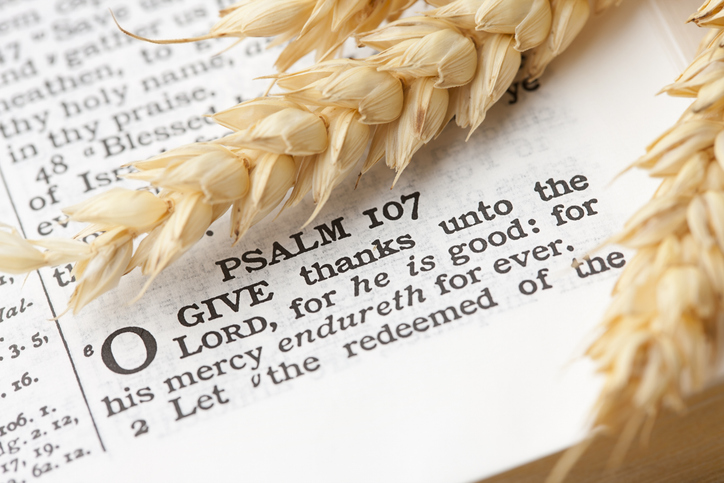
David wrote: “Give thanks to the LORD, for He is good.”  “Give thanks to the God of gods.”  “Give thanks to the Lord of lords.”  “For His Steadfast Love (mercy) endures forever.”  

In this psalm, David repeats that concluding phrase after every element of praise he states about the awesome God of Israel…. 25 TIMES!   For His Steadfast Love endures forever.  

Read all those praise phrases!  If you ever find your heart stingy and grumpy.  Read all these beginning praise praises. How awesome is our God. He does such wonderous things for His own people. He is strong and mighty.  He is tender and kind. 

SERIOUSLY!! Read them and praise Him.  

WHY is He so good to His own people???  For (because) his everlasting love and mercy towards us …. endures…. forever!  (FOREVER!  THINK ON THAT.)

(And then, after you read those praise phrases in Psalm 136, make a list of your own.  I’ll start…

  • Lord, You searched me out and found me – Why? Your love endures forever.
  • You saved me and gave me new life – Why? Your love endures forever.
  • You help me walk in righteousness – Why? Your love endures forever.
  • You forgive and restore me when I sin and repent – Why? Your love endures forever.
  • You supply all I need – Why? Your love endures forever.
  • You give me joy in sorrow and suffering – Why? Your love endures forever.
  • Your presence is with me, even in death – Why? Your love endures forever.
  • You have promised me eternal life with YOU – Why? Your love endures forever. 

And on, and on, and on…….

.

2 Chronicles 7b.

After all the celebration, glory, and praise, God appeared to Solomon in the cool, dark, silence of the night.

  • I have heard your prayer and have chosen this place for myself as a house of sacrifice.”  “My eyes will be open and my ears attentive to the prayer that is made in this place. For now I have chosen and consecrated this house that my Name may be there forever. My eyes and my heart will be there for all time.”

And then that verse we know so well, and often maybe mistakenly pray for our own countries.  God says about Israel, 

  • If my people who are called by name humble themselves, and pray and seek my face and turn from their wicked ways, then I will hear from heaven and will forgive their sin and heal their land.”
  • If you (Solomon) will walk before me as David your father walked, doing according to all that I have commanded you and keeping my statutes and rules, then I will establish your throne, as I covenanted with David your father, saying ‘You shall not lack a man to rule Israel.”

Such glorious promises!!

But there is a dire warning as well.  Sadly, this one comes to pass…. 

  • “BUT IF…. you turn aside and forsake my statutes and my commandments that I have set before you, and go and serve other gods and worship them, THEN….I will pluck you up from my land that I have given you, and THIS HOUSE THAT I HAVE CONSECRATED FOR MY NAME, I will cast out of my sight, and I will make it a proverb and a byword among all peoples.
  • And THIS HOUSE, WHICH WAS EXALTED, everyone passing by will be astonished and say, ‘Why has the LORD done thus to this land and this house?’
  • Then they will say, ‘Because they abandoned the LORD, the God of their fathers who brought them out of the land of Egypt and laid hold on OTHER gods and worshiped them and served them. Therefore He has brought all this disaster on them”

Solomon’s dream/vision turned into a nightmare of warning.  Will it keep his heart wholly for the LORD???

.

*As for the truth(s) about God that stays in my mind after this reading?  It is His utter, enduring, amazing grace and love that He has for His people …. until they raise a fist in His face, turn their backs on Him, and seek to fulfill their own sinful and prideful cravings away from Him.  EVEN THEN, He is willing to forgive and restore if they repent and return to Him.  SUCH MERCY and STEADFAST LOVE!


Journaling through the Bible Chronologically in 2025, Day 150

 
Read Today’s Scriptures.
 
Psalm 119.

God’s Word is precious and good for any problem, joy, need, and instruction. 

This psalm reminds me of Paul’s words to Timothy in 2 Timothy 3:16 (“All scripture is breathed out by God and profitable for teaching, for reproof, for correction, and for training in righteousness, that the man (or woman) of God may be competent, equipped for every good work.”) 

READ ALL 176 VERSES OF THIS WONDERFUL “ACCROSTIC” PSALM AND BE BLESSED. The verses in each alphabetical section begin with that letter in Hebrew.

Here are a few of my “fave” verses from each alphabetical section.

ALEPH, “A” verses 1-8

  • Oh, that my ways may be steadfast in keeping Your statutes!

BET, “B” verses 9-16

  • I have stored up Your word in my heart, that I might not sin against You.

GIMEL, “G” verses 17-24.

  • Open my eyes, that I may behold wondrous things out of Your law.

DALET, “D” verses 25-32

  • I have chosen the way of righteousness; I set your rules before me.

HE, (hay) “H” verses 33-40

  • Incline my heart to your testimonies and not to selfish gain!

VAV, “V” verses 41-48

  • I find my delight in Your commandments, which I love.

ZAYIN, “Z” verses 49-56

  • I remember Your Name in the night, O LORD, and keep your law.

CHET, “CH” (like clearing your throat) verses 57-64

  • At midnight, I rise to praise You because of your righteous rules.

TET, “T” verses 65-72

  • Before I was afflicted, I went astray, but now I keep Your word.

YOD, (yood) “Y” verses 73-80

  • I know, O LORD, that your rules are righteous, and that in faithfulness you have afflicted me.

KAPH, “K” verses 81-88

  • My soul longs for Your salvation; I hope in Your word.

LAMED, “L” verses 89-96

  • If Your law had not been my delight, I would have perished in my affliction.

MEM, “M” verses 97-104

  • How sweet are Your words to my taste, sweeter than honey to my mouth.

NUN (noon), “N” verses 105-112

  • Your word is a lamp to my feet and a light to my path.

SAMECH, (guttural) “S” verses 113-120

  • You are my hiding place and my shield; I hope in Your word.

AYIN, (guttural) “AYE” verses 121-128

  • Therefore, I love Your commandments above gold, above fine gold.

PE, (pay) “P” verses 129-136

  • The unfolding of Your words gives light; it imparts understanding to the simple.

TSADHE, “TS” verses 137-144

  • Your promise is well-tried, and your servant loves it.

QOPH, (koof) “Q” verses 145-152

  • My eyes are awake before the watches of the night, that I may meditate on your promise.

RESH, “R” verses 153-160

  • The sum of Your word is truth, and every one of Your righteous rules endures forever.

SHIN, (sheen) “SH” or “S” verses 161-168

  • Great peace have those who love Your law; nothing can make them stumble.

TAV, “T” verses 169-176

  • My tongue will sing of Your word, for all Your commandments are right.

.##

.There are so many more that are my favorites. How about you?  Which have you memorized? or held dear?

How David must have enjoyed composing this Psalm!  Can YOU try it?  Write one praise to God or His Word from each letter of your alphabet!


Journaling through the Bible Chronologically in 2025, Day 149


Read Today’s Scriptures.


1 Kings 1.

Today, I say goodbye to King David, my favorite Bible character after the Lord Jesus

He has been many things:  a shepherd boy, giant killer, court musician, psalm/songwriter, lover of God, soldier, compassionate leader, architect for the Temple, humble, honorable, repentant, promise-keeper, “the sweet psalmist of Israel,” “a man after God’s heart,” “the lamp (hope) of Israel“, and a loyal lover of God and His Word.

He was also a great sinner. He did not discipline any of his sons (and paid the price); he lied; he lusted and committed adultery; he committed selfish murder.

But, unlike any king of Israel that followed him, he never EVER looked to or worshiped any god but the LORD God. He built no idols, poles, or temples to pagan gods.  Yes, a sinner, but never apostate. And God loved him dearly. He promised David that “His Messiah” would come through his line, the King of kings!

Hebrews 11:32-34 lists David as a man of faith, “who (with others) conquered kingdoms, enforced justice, obtained promises, escaped the edge of the sword, became mighty in war, and put foreign armies to flight. 

WOW.  My man!

.

1 Kings 1.

David’s old age, last deeds, and his death.

The book begins with a natural state of advanced age.  David’s muscles were wasted; he was thin and “cold all the time.”  Even a pile of blankets couldn’t warm him in a Jerusalem winter. And so, a beautiful young woman named Abishag was brought to him to look after him and lay beside him when he was cold.  Abishag’s own body heat would warm him.  And NO, there was no sex involved. (verse 4)  Kind of pitiful, right?  But there were no electric blankets.

Then we read of the final coup.

We’ve read how both the LORD and David had declared and planned for Solomon to be David’s successor. David organized the building materials and plans so Solomon could build the House for God. He organized all the priests, gatekeepers, Levites, musicians, “providers and protectors” for the Temple and when/how they would serve.  All for Solomon. 

  • (Do you get the feeling that Solomon was VERY young, both in age and in readiness to rule the nation? He definitely was NOT a military man, and he didn’t seem to be aware of any danger to himself or the kingdom.)   Solomon was a man of peace, a builder, and a wise judge and author.  He indulged himself and amassed huge mountains of wealth, women, and praise.  The very opposite of his father.)

Anyway, while he sat at home doing — what? —, his older brother Adonijah decided HE would be king in place of David. He attempted a coup. David knew nothing about it either.  But it was told to Bathsheba and the prophet, Nathan.  They approached King David in a sneaky way and got some action.  David rose to the occasion, instructed Nathan, Zadok the priest, and Benaiah (head of his personal bodyguard) to Take Solomon to the public square, make sacrifices to God, and officially anoint and crown him king in his father’s place.

They did, and the new king sat on David’s throne.

Adonijah and his followers (including the priest Abiathar and Commander Joab) were afraid. Solomon’s brother came to him and asked for mercy, which the peaceful Solomon granted.  However, he told him, “Bro, you have to straighten up and fly right. Any misdemeanor, and your toast!” Adonijah agreed.

But, after David died, he came to Bathsheba and requested Abishag (body warmer of the king, also considered his concubine) as his own wife.  Um, NOPE!  Solomon recognized just what it was, an attempt to steal the kingdom by “sleeping with the former king’s concubine.”  So…. “off with his head.”

.

1 Kings 2.

David finally realized he was about to die, and like all the patriarchs before him, he summoned his son to his bed for a final blessing.  He charged and encouraged Solomon to stay true to God and to walk in all His ways, statutes, commandments, rules and testimonies as written in the “Law of Moses.”  In doing that, Solomon would be blessed, and his son’s after him too, if they did the same.

You can picture young Solomon nodding.

Then, I think because David knew Solomon was not street-wise in the ways of politics, he commanded the young man to “clean house.”  

  • “You know, Joab, Commander of the Army?  Do not let his gray head go down to the grave in peace.” (kill him)
  1. “You’ve heard about how Shimei cursed me and threw stones at me all the way to the Jordan when I was escaping from Absalom?  You know what you ought to do to him. You shall bring his gray head down with blood to the grave.”
  • “About Barzillai, he showed me much loyalty when I was escaping.  You deal loyally with his sons; let them eat at your table.”

(David did not instruct Solomon about the priest Abiathar, who had sided with Adonijah “because the priest had carried the Ark of the Lord GOD and because he had helped David when he had to escape Absalom.  Solomon later just expelled him from Jerusalem and service as priest.) 

And then the Prince of Israel died.  He had reigned over Israel for forty years.  They buried him in Jerusalem, “the city of David.”  Solomon sat on the throne of his father, and his kingdom was firmly established.

Then, Solomon took care of business just like David had instructed.  Joab was killed, and Chief Bodyguard Benaiah, was made Commander of the Army.  Abiathar was sent home.  Shimei was given house arrest, and lived as long as he stayed home.  When he ventured out, he was killed. 

Done and Dusted.

.

Psalm 37.

  • Fret not yourself because of evildoers; be not envious of wrongdoers! They will soon fade like the grass and wither like the green herb.
  • Trust in the LORD, and do good; dwell in the land and befriend faithfulness. Delight yourself in the LORD, and He will give you the desires of your heart.  Commit your way to the LORD; trust in HIM, and He will act. He will bring forth your righteousness as the light and your justice as the noonday.

Can’t you hear David saying this to Solomon?  And the rest of the Psalm as well.

.

Psalm 71.

  • My mouth is filled with Your praise, and with Your glory all the day.  Do not cast me off in the time of old age; forsake me not when my strength is spent.
  • O God, from my youth you have taught me, and I still proclaim your wondrous deeds.  So even to old age and gray hairs, O God, do not forsake me, until I proclaim your might to another generation, Your power to all those to come.
  • O Holy One of Israel, My lips will shout for joy, when I sing praises to You; my soul also, which You have redeemed.

We’ve seen David’s old age, still praising his God.

.

Psalm 94.

  • Blessed is the man whom You discipline, O LORD, and whom You teach out of your law. to give him rest from days of trouble, until a pit is dug for the wicked.  For the LORD will not forsake His people; he will not abandon His heritage.