Archives

Journaling through the Bible Chronologically in 2025, Days 229 & 230

NOTE: Sunday and Monday studies are posted on Mondays.

Day 229 – Reading – Jeremiah 35 – 37

Day 230 – Reading – Jeremiah 38 – 40 and Psalm 74, 79

Read today’s Scriptures … ANYWHERE you find yourself this summer. Stay in the WORD!

Day 229 – Jeremiah 35.

This chapter again goes back in time more than 20 years, during the reign of King Jehoiakim, soon after the good King Josiah died, and the evil King Jehoahaz was taken to Egypt. 

In contrast to the Jews’ absolute disobedience toward the LORD their God, these Rechabites showed remarkable obedience to their ancestor for over 400 years!  These non-Jews, related to Moses’s father-in-law, had made a vow not ever to drink wine, to own no land, and to dwell in tents all their lives.  They were nomads living in Israel, peaceably.

But when Nebuchadnezzar first came to Judah, they decided to come up and dwell close to Jerusalem (for protection? Or, to be identified as God’s people?)

When Jeremiah told them to come up to the Temple and have some wine, they refused and told their story. 

The LORD told Jeremiah to remonstrate with Judah in the face of this loyalty, and challenge the Jews to listen and amend their ways … and not go after other gods, but incline their ears to their God.

As for these Rechabites, God told them they would never “lack a man to stand before Him.”  In other words, there would always be a remnant from that family to serve God.  (In Nehemiah 3:14, we see just such a man, working along with the returned Jews, repairing the wall of Jerusalem.)

.

Jeremiah 36.

A few years after the above story of the Rechabites’ faithfulness, the LORD told Jeremiah to write down ALL THE WORDS that He had given to him, so far. (Think: the first 35 chapters of this book!  WOW, that’s a lot!  This was done, so the “house of Judah” would be reminded of all the disaster God had planned for them … SO THEY WOUD TURN FROM EVIL, AND GOD MIGHT FORGIVE THEM.

(Doesn’t it twist your heart to see how much God cared for His people, and tried again and again to bring them back to Himself?  He does this today too.  He is slow to anger, “not wishing that any should perish, but that all would come to repentance.” See 2 Peter 3:9 & Exodus 343:6)

Jeremiah called Baruch, his secretary, and dictated all the words of the LORD, while the man wrote it on a scroll. It took about a year.   Then Baruch, at the command of Jeremiah, read the scroll in the Temple. 

Micaiah, the grandson of the secretary, heard all these words and went to the king’s house and into the secretary’s chamber.  All the officials were there, and Micaiah told them the words he had heard when Baruch read the scroll. 

They sent for Baruch and commanded that he “sit down and read it” to them.   When they’d heard the whole thing, they turned to each other in fear.  “We must report all these words to the king!”

They asked Baruch if HE had written the words, or if they had been dictated to him. Baruch answered, “He (Jeremiah) dictated all these words to me, while I wrote them with ink on the scroll.”

“Go and hide,” they said, “you and Jeremiah, and let no one know where you are.”  Then they took the scroll to the secretary of the king, and he read it to Jehoiakim in the presence of all the officials..  It was during the winter, and the king had a fire going.  As the scroll was read … King Jehoiakim cut off a section of the scroll and threw it into the fire until the whole thing was read … and destroyed. 

And neither the officials nor the king were afraid, sorrowful, or repentant.  WOW.

So God told Jeremiah to WRITE THE SCROLL AGAIN. 

And concerning the king, his future was dreadful, and he would not have a single descendant to sit on the throne of David.  

.

Jeremiah 37.

Jeremiah jumps ahead to the kingship of Zedekiah, another son of Josiah, whom King Nebuchadnezzar had put in place when he took the 3-month reigning King Jehoiachin to Babylon. 

This was before Jeremiah had been put into prison.  It was when the Babylonian army had temporarily ended the siege of Jerusalem to deal with an invading Egyptian army. (They would soon return and destroy Jerusalem.)

Zedekiah had (surprisingly) sent for Jeremiah to pray for him and the people.  But no words of comfort came from Jeremiah. Instead, the LORD said that the Babylonians would return, fight against the city, capture it, and burn it with fire.  WHOA!

Interestingly, while the Babylonians had withdrawn, Jeremiah thought he would go out and visit his hometown in Benjamin.  But at the gate of the city, a sentry seized Jeremiah, accusing him of “deserting to the Chaldeans.” 

Jeremiah denied it, but the guard would not listen to the prophet.  The city officials were enraged.  The beat Jeremiah and imprisoned him in the house of Jonathan, the secretary, for it had been made a prison.  He was thrown into the dungeon and remained there MANY days. 

Then King Zedekiah sent for him secretly, asking if there had been any new word from the LORD…. 

“Nope,” said Jeremiah.  You WILL be delivered into the hands of the king of Babylon.” Then Jeremiah asked, “What wrong have I done that you have put me in prison? Please don’t send me back to the dungeon in the house of Jonathan.”

Surprisingly, the king agreed and gave orders for Jeremiah to be held at the court of the guard. AND, that a loaf of bread be given to him daily … until all the bread in the city was gone.

.

###

Day 230 – Jeremiah 38.

Jeremiah kept telling the people the LORD’s compassionate words.  “This says the LORD, ‘He who stays in this city shall die by the sword, by famine, and by pestilence … BUT, he who goes out to the Chaldeans shall live. He shall have his life as a prize of war, and live. (Surrender and live.) This city shall surely be given into the hand of the army of the king of Babylon and be taken.”

But the city officials said to the king, “LET THIS MAN BE PUT TO DEATH, for he is weakening the hands of the soldiers who are left in this city, and the hands of all the people by speaking such words to them.”

Behold, he is in your hands,” said the king.

So they took Jeremiah and cast him into the cistern of the king’s son, which was in the court of the guard, letting Jeremiah down by ropes.  There was no water in the cistern, only mud. Jeremiah sank into the mud.

When the Ethiopian eunuch, who was in the king’s palace, heard of that, he went to the king and said, “My lord the king, these men have done evil in all that they did to Jeremiah the prophet by casting him into the cistern. He will die there of hunger.”

Take 30 men with you and lift Jeremiah out of the cistern before he dies,” said the king.

The Ethiopian took rags and clothes and let them down into the cistern to Jeremiah.  “Put these rags between your armpits and the ropes.”  

Jeremiah did that, and they lifted him out of the cistern and kept him in the court of the guard.  Later, King Zedekiah called for Jeremiah and said to him, “If I ask you a question, hide nothing from me.

Jeremiah: “If I tell you, will you not put me to death. And if I counsel you, you won’t listen.

I will listen,” promised the King, “and not put you to death.”

Jeremiah:  ‘If you will surrender to the officials of the king of Babylon, then your life shall be spared, and this city shall not be burned with fire, and you and your house will live.”  “But if you do not surrender, then this city shall be given into the hand of the Chaldeans, and they will burn it with fire, and you will not escape from their hand.”

Zedekiah: “I’m afraid of the Judeans who have deserted already, let they hand me over and deal cruelly with me.

Jeremiah:  “You shall not be given to them. OBEY NOW the voice of the LORD in what I say to you, and it shall be well with you, and your life will be spared.   But if not…. oh boy will you regret it!!”

Zedekiah:  “Let no one know of these words, or you shall die.

Jeremiah obeyed and remained in the court of the guard …. until the day that Jerusalem was taken.

(I guess the king did not surrender.)

.

Jeremiah 39.

No, the king did not surrender.  He tried slipping out a narrow gate and running for Jericho! (Seriously!)

Jerusalem – the City of Gold, the City of the LORD God, the Holy City where God had put His name – fell to the Chaldeans on the ninth day of the fourth month of the eleventh (and last) year of Zedekiah’s reign.  And the officials of the Chaldean army came flooding in. 

When Zedekiah saw it, he and his close soldiers slipped out the narrow gate in the king’s garden and ran for their lives toward Jericho that night.   He was heading towards the Arabah wilderness on the other side of the Dead Sea, where David had hid from King Saul those many years ago.

But the Chaldean army pursued and captured him before he got to Jericho.  They took him to Riblah, 230 miles north of Jerusalem, where King Nebuchadnezzar had his headquarters.  And so, Jeremiah’s prophecy came true. King Zedekiah saw the Babylonian king face-to-face and eye-to-eye.

Remember, when the Babylonians took King Jehoiachin off to Babylon (he’d surrendered)? King Nebuchadnezzar had made Zedekiah king of Judah in his place. Zedekiah promised to send tribute to Babylon and did so for a few years. Then he broke his vow and stopped it. 

So, now, Nebuchadnezzar saw him as a traitor, and treated him like one. The Babylonian King killed all of Zedekiah’s sons before his eyes (Oh, what a horrible sight!).  Then the Babylonian put out Zedekiah’s eyes, so the last thing he saw was his sons being massacred. Then he was hauled off to Babylon in chains.

Oh, if only he’d listened to Jeremiah.  But this was God’s plan.

Back in Jerusalem, the Chaldeans set the king’s house afire, and burned the House of the people (the Temple). They broke down the walls of Jerusalem, leaving the city in ruins.  Only the very poor remained to care for the vineyards and fields.

About Jeremiah…. King Nebuchadnezzar told his army captain, “Take him, look after him well, and do him no harm, but deal with him as he tells you.”  So the Captain took Jeremiah from prison and sent him home to live among his people.

God also took care of that Ethiopian who’d rescued Jeremiah. “I will deliver him on that day, declares the LORD.  He shall not be given into the hand of the men of whom he is afraid. For I will deliver him on the day the city falls.  I will save him, and he shall not fall by the sword… because he has put his trust in the LORD.”

.

Jeremiah 40.

A few more details about Jeremiah’s release are listed here.  The Captain of the guard gave him three choices….

  1. If it seems good to you to come with me to Babylon, come, and I will look after you well.
  2. “Or, if not, the whole world is before you; go wherever you want.
  3. “Or you can return to Gedaliah and dwell among your people.

Jeremiah chose option #3, and after receiving an allowance of food and a present, went to live under Gedaliah’s leadership. 

When the captains of the scattered forces of Judah, who had escaped and dwelled in the wild, heard that Gedaliah was governor, they met with him. The governor assured them everything would be okay. “Live on your land, gather the fruits of the field and vine. As long as we serve (pay tribute) to the Babylonian king, all will be well.”

One of the captains later came to Gedaliah, saying the king of the Ammonites had sent Ishmael, his warrior, to kill the governor.  But Gedaliah did NOT believe him, and forbade the captain from going to “taking care of” Ishmael.

(Stubborn Gedaliah! We’ll see tomorrow that Ismael does come … and kill him. (Sigh.)

.

Psalm 74. 

Wow, this psalm tells of the destruction of Jerusalem and the temple by Nebuchadnezzar. 

  • “Remember Your congregation, which You have purchased of old, which You have redeemed to be the tribe of Your heritage!
  • Remember Mount Zion, where You have dwelt.
  • Direct Your steps to the perpetual ruins; the enemy has destroyed everything in the sanctuary!”
  • All its carved wood they broke down with hatchets and hammers.
  • They set Your sanctuary on fire; they profaned the dwelling place of Your Name, bringing it down to the ground. 
  • They burned all the meeting places of God in the land.

.

Psalm 79.

This psalm also tells of that time.

  • “O God, the nations have come into Your inheritance; they have defiled Your holy temple; they have laid Jerusalem in ruins.
  • They have given the bodies of your servants to the birds of the heavens for food, the flesh of your faithful to the beasts of the earth.
  • They have poured out their blood like water all around Jerusalem…. and there was no one to bury them.
  • “Help us, O God of our salvation, for the glory of Your name deliver us and atone for our sins, for Your name’s sake!

Journaling through the Bible Chronologically in 2025, Day 206

Day 206 – Reading – Isaiah 37 – 39 and Psalm 76.

Read today’s Scriptures.  

Isaiah 37.

This chapter continues the story from yesterday.  Sennacherib, king of Assyria, has come up against Jerusalem. He’s sent his Commander/spokesman, Rabshakeh, to harass the people on the wall and King Hezekiah.  He called to them all sorts of things to intimidate them and cause them to give up.  Hezekiah’s spokesman told him to speak in Aramaic instead of Hebrew so the people wouldn’t understand, but the man refused and laughed.  They need to know! 

Then Rabshakeh continued to tell the people that NO PEOPLE OR GOD has prevailed against the Assyrians so far. And the God of Israel is no exception.

The people answer zero, as per Hezekiah’s instructions.  Eliakim, took the horrible news to Hezekiah.

As soon as King Hezekiah heard the words, he tore his clothes (grief, repentance) and went to the Temple. He then sent Eliakim to Isaiah, telling him how the man mocked the living God and asking him to “PRAY for the remnant that is left.”

Isaiah encouraged him by saying Sennacherib would hear a rumor (from God) to return to his own land, and there he would be killed. But before that rumor hit his ears, the Assyrian King summarized the vile things that Rabshakeh said about the Living God and sent it in a letter to Hezekiah. “Do YOU think you shall be delivered???”

After Hezekiah got the letter and read it, he went back to the Temple and spread it out before the LORD. And he prayed. 

  • “O LORD of hosts, God of Israel, enthroned above the cherubim, you are the God, YOU ALONE, of all the kingdoms of the earth; You have made heaven and earth.  Incline your ear, O LORD, and hear; open You eyes, O LORD, and see; all the words of Sennacherib, which he has sent TO MOCK the Living God.
  • “Truly, O LORD, the kings of Assyria have laid waste all the nations and lands (around us) and their gods made by the work of men’s hands, wood and stone. And they were destroyed.
  • “So now, O LORD our God, save us from his hand, THAT ALL THE KINGDOMS OF THE EARTH MAY KNOW THAT YOU ALONE ARE THE LORD.”

Isaiah sent to Hezekiah, “because you have prayed to me concerning Sennacherib… this is the what the LORD has spoken concerning him…..

Isaiah then proclaims in poetic form the fallacies and the destruction of the king of Assyria. Verses 22-29. Then…   “Because you have raged against Me and your complacency has come to My ears, I will put my hook in your nose and my bit in your mouth, and I will turn you back on the way by which you came.”

He shall NOT come into this city or (even) shoot an arrow there …. ” declares the LORD. “For I will defend this city to save it, for my own sake and for the sake of my servant David.”

And then!!!  WOW!!!  “The angel of the LORD went out and struck down a hundred and eighty-five thousand in the camp of the Assyrians.  And when the people (of Jerusalem) arose early in the morning, behold, these were all dead bodies.

Then Sennacherib, king of Assyria departed and returned home to Nineveh. (As the LORD said.)  And while he was worshiping his god, his two sons struck him down with the sword and escaped into the land of Ararat. And another of his sons reigned in his place.  (All according to the LORD’s words to Isaiah.)

.

Isaiah 38.

Then comes Hezekiah’s “less great days.”

He became sick, and Isaiah told him to get his house in order because he was going to die.

Hezekiah prayed to the LORD, “Please, O LORD, remember how I have walked before you in faithfulness, and with a whole heart, and have done what is good in your sight.”  And he wept bitterly.

So Isaiah returned to Hezekiah with a new message from God. “I have heard your prayer; I have seen your tears. Behold, I will add fifteen years to your life.”  WHOA!

Then he gave Hezekiah a sign to “prove” the LORD would do it.  He made the shadow on the sundial move BACKWARDS (!!) ten degrees. 

(This was like turning back time several hours!  Something like in Joshua’s days when the LORD made time stand still so Joshua could win the battle. Joshua 10:12-13  Hey, God created the sun and time. He can do anything!)

The rest of the chapter is Hezekiah telling his story in poetic form – about being consigned to die, praying, and then the LORD answering. And then his thanking God.

.

Isaiah 39.

Ah-oh……  Here comes Hezekiah’s big mistake. (From arrogance or foolishness. Had the extra years or age made him diminished?)

The son of the king of Babylon sent “get well cards and a present” to Hezekiah because he’d heard Judah’s king was seriously ill, but recovered.  Hezekiah welcomed the envoy, showed them his treasure house, the silver, gold, spices, precious oil, his whole armory, and all that was in his storehouses.”

SERIOUSLY, HEZEKIAH!!!!  Was that hospitality, or stupidity, or…. arrogance?

Isaiah came to Hezekiah in anger. “What did these men say?  Where are they from?”

Hezekiah answered, “Oh, they are from some far country … Babylon.”

Isaiah, “What have they seen in your house?

Hezekiah, “Everything. There’s nothing I did not show them.”

Isaiah, angry, “Hear the word of the LORD of hosts: Behold the days are coming when ALL that is in your house … shall be carried to Babylon. NOTHING shall be left, says the LORD.  And furthermore, some of your own sons shall be taken away and made eunuchs in the palace of the king of Babylon.”

Hezekiah:  “Oh, well, at least there will be peace and security in my days.”

REALLY, HEZEKIAH??  Maybe those last 15 years weren’t so good after all………

.

Psalm 76.

Written by Asaph in David’s time, this psalm almost seems to point to the glorious salvation from the Assyrians in Hezekiah’s time.

In Judah, God is known: His name is great in Israel.
His abode has been established in (Jeru)Salem,
His dwelling place is in Zion.

There, He broke the flashing arrows,
the shield, the sword, and the weapons of war.
Glorious are You, more majestic
than the mountains of prey.

The stout-hearted were stripped of their spoil;
they sank into sleep; all the men of war
were unable to use their hands.
At Your rebuke, O God of Jacob,
both rider and horse lay stunned.

But You, You are to be feared!
Who can stand before You
when once your anger is roused?

LORD, truly You are to be feared, worshipped, honored, and obeyed. Your power and majesty are to be praised. You see, You hear, You answer prayer. You do marvelous things for us, even when we are weak … or foolish.  Thank You for being in utmost control, O Sovereign LORD.

Journaling through the Bible Chronologically in 2025, Day 198

Day 198 – Reading – Isaiah 18 – 22

Read today’s Scriptures.  Do you see connections?

Isaiah 18.

Cush (Ethiopia), a nation, tall and smooth, to a people feared near and far, a nation mighty and conquering, whose land the rivers divide. (The Nile River and its tributaries extend south through Ethiopia.)  

At that time (Messiah’s Kingdom) tribute will be brought to the LORD of hosts from a people tall and smooth, from a people feared near and far, a nation mighty and conquering, whose land the rivers divide …. to Mount Zion, the place of the Name of the LORD of hosts.”

.

Isaiah 19.

Behold the LORD is riding on a swift cloud and comes to Egypt (to execute judgment); and the idols of Egypt will tremble at his presence, and the heart of the Egyptians will melt within them.

I will confound their counsel; and they will inquire of the idols and sorcerers, and the mediums and the necromancers; and I will give over the Egyptians into the hand of a hard master, and a fierce king (Assyria) will rule over them,declares the LORD GOD of hosts. 

‘And the river will be dry and parched, and its canals will become foul, and the branches of Egypt’s Nile will diminish and dry up, reeds and rushes will rot away…..

  • And the fishermen, who cast hooks and spread nets will mourn and lament…
  • The workers in combed flax and weavers of white cotton will be crushed and grieved….
  • And there will be nothing for Egypt to do.

Nevertheless, “in THAT Day” (Messiah’s Kingdom)….

  • there will be five cities in the land of Egypt that speak the language of Canaan and swear allegiance to the LORD of hosts…. 
  • And there will be an altar to the LORD in the midst of Egypt…
  • And the LORD will make Himself known to the Egyptians…
  • And the Egyptians will know the LORD in that day and worship….
  • They will return to the LORD and He will listen… and heal them.

IN THAT DAY, there will be a highway from Egypt to Assyria (through Israel), and the Egyptians will worship (the LORD) with the Assyrians. 

IN THAT DAY, Israel will be the third with Egypt and Assyria, a blessing in the midst of the earth whom the LORD has blessed.  “Blessed be EGYPT my people, and ASSYRIA the work of my hands, and ISRAEL, my inheritance.

.

Isaiah 20.

But, BEFORE the Day of the LORD comes, Egypt and Ethiopia will be shamed and conquered by Assyria, and taken captive.

The LORD told Isaiah to strip off his clothes and sandals and walk about naked. WHAT??  Often the prophets of God did things to “symbolize” what they were also speaking.  This nakedness was to show the shame of Egypt and Ethiopia being conquered and taken away.

.

Isaiah 21.

Then suddenly, we go past Babylon’s conquest of Jerusalem and captivity of the Jews, to a time IN PROPHECY, that Babylon itself will be conquered by the Medes 

Isaiah says, “A stern vision is told to me; the traitor betrays, and the destroyer destroys.  Go up, O Elam (Persia); lay siege, O Media; all the sighing she (Babylon) has caused I will bring to an end.

Then God reveals to Isaiah the wicked feast of Belshazzar (Daniel 5), “They prepare the table, they spread the rugs, they eat, they drink…” when amid the celebration the call to fight the attacking enemy invading the city came. (Remember the writing on the wall?)

Fallen, fallen is Babylon…”

Isaiah finishes the chapter with Oracles against other smaller nations.

Isaiah 22.

And then… Isaiah circles back to Israel, and JERUSALEM.  He portrays a picture of destruction (without a sword, for Babylon starved the people of Jerusalem) and of capture. But all the while Jerusalem is celebrating with wild parties.  THEY SHOULD HAVE BEEN IN SACKCLOTH, REPENTING!!

Judah is shown trying to withstand the enemy by their own methods (which will surely fail) instead of looking to God for help.

The LORD:  Weep and mourn, shave your heads and wear sackcloth (evidence of repentance).

The people of JUDAH:  Joy and gladness, killing oxen and slaughtering sheep, eating flesh and drinking wine, saying, “Let us eat and drink, for tomorrow we die.”
The LORD:  Surely this iniquity will NOT BE ATONED FOR YOU until you die.”

.

From Egypt and Cush in the south, to Assyria, to Babylon’s fall, and the refusal to repent in Jerusalem, Isaiah proclaims the truth of God, hard as it may be (or as embarrassing as when he’s naked). 

God had asked for a servant to proclaim His message, even they wouldn’t listen,  Isaiah had said, “Send ME!”  Now God was using this faithful prophet to predict His purposes. 

(And Isaiah would one day pay for his faithfulness with martyrdom.

He would be sawed in half by a wooden saw under wicked King Manasseh.)


Journaling through the Bible Chronologically in 2025, Days 194 & 195

NOTE: Sunday’s and Monday’s studies are posted together on MONDAY.

Day 194 – Reading – 2 Chronicles 27 and Isaiah 9 – 12

Day 195 – Reading – Micah 1- 7

Read today’s Scriptures.  Do you see connections?

Day 194 – 2 Chronicles 27.

We step back from the prophets for a chapter in history, looking at the southern kingdom of Judah.  Uzziah has died, and his son Jotham, who has been managing things for his father since God gave Uzziah leprosy and they put him in isolation.  Now, Jotham becomes king in his own right. He was 25 and he reigned until he was 41.  He did what was RIGHT IN THE EYES OF THE LORD, as Uzziah had done in the early part of his reign. 

Jotham did a lot of building and fortifying of cities. He warred and won with the Ammonites and so received a lot of tribute from them for Judah.   Jotham became mighty, because he ordered his ways before the LORD his God.  

Jotham was buried in the City of David, and his son Ahaz reigned. Ahaz was a nasty, idol worshiping man, who even sacrificed his son to a pagan god.

.

Isaiah 9.

These chapters in Isaiah alternate from predictions of TERROR by invasion, destruction, exile, and death … and the HOPE of the coming Messianic Kingdom.

So much is familiar here about the birth, ministry, and glory of the Lord Jesus Christ.

  • Verses 9:1-2 are quoted in Matthew 4:12-16, at the beginning of Jesus’ ministry in Galilee. The land of Zebulun and Naphtali is where Jesus’ primary ministry took place.
  • The people who walked in great darkness have seen a great light. John 3:19-21 and 8:12 reveal that Jesus is the light of the world. Follow Him and you’ll not walk in darkness.  However, some will HATE the light, while others love it.
  • Verse 9:6 are very familiar words to us at Christmas time.  “For unto us a child is born.” See Luke 2:11-12.  “…Unto us a Son is given.”  See John 3:16.  And then those beautiful titles for Jesus: “Wonderful Counselor, Mighty God, Everlasting Father, Prince of Peace.”  He was and IS all of these, THANK YOU, Jesus!

Isaiah’s prophecy foretells Jesus’ glorious reign on earth: with no end… on the throne of David… with justice and righteousness, and forevermore. 

No wonder the Jews and the disciples of Jesus’ earthly ministry expected him (If he was really the Messiah) to rise up in rebellion against Rome and rule on a throne.  From OUR view, we know there is a great “time valley” between the two “mountains” of his comings..  And this glorious kingdom is YET TO COME. 

.

Isaiah 10.

The LORD continues with Woes to the arrogant and proud people of Israel, naming specific groups or sins, in the last part of chapter 9, 10, and into 11.  His response?  For all this, His anger has not turned away, and His hand is stretched out still.”

Then Isaiah predicts a horrific judgment on the arrogant Assyria (who had repented for a short time under Jonah).  They turned back to even MORE wicked ways only a generation later.  They were known for their barbaric cruelty.

BUT FIRST, God will use this cruel nation to judge Syria, Israel, and then Judah. 

THEN, “When the Lord has finished all his work on Mount Zion and on Jerusalem, he will punish the speech of the arrogant heart of the king of Assyria and the boastful look in his eyes.”

The Assyrian Empire was massive. No wonder Israel felt so small and HOPELESS.  Here’s a map of the approx. 200 years of their rule.

Then Isaiah turns once again to HOPE. He prophesies of the “Remnant of Israel” and her survivors.  

.

Isaiah 11.

Isaiah writes of the Righteous Reign of the BRANCH (or root of David). 

  • And the Spirit of the LORD shall rest upon him, the Spirit of wisdom and understanding, the Spirit of counsel and might, the Spirit of knowledge and the fear of the LORD. And his delight shall be in the fear of the LORD.   These are the qualifications that will enable Jesus the Messiah to rule justly.  (Also compare Revelations 1:4.)
  • Then Isaiah writes of the Idyllic  Millennium Reign, when: wolf & lamb, leopard & young goat, lion and calf, and cow & bear shall all graze together and lie down together in safety.  AND A LITTLE CHILD WILL LEAD THEM.   In fact, a nursing child will play with a cobra, a weaned child with an adder. (both deadly snakes) and they shall not be hurt.
  • Instead of a scarcity of the Word of God, “the earth shall be full of the knowledge of the LORD as the water covers the sea.
  • In that day the Lord will extend His hand yet a second time to recover the REMNANT that remains of His people, from Assyria, Egypt, Pathros, Cush, Elam, Shinar, Hamath and from the Coastlands of the sea.”
  • And he … will assemble the banished of Israel, and gather the dispersed of Judah from the four corners of the earth.”

Oh, my, what a dream the people of God had to hide deep in their hearts, and collectively remember in that Day.

.

Isaiah 12

And then the beautiful Psalm-like chapter. Can you hear Isaiah singing…..

"You will say in that day;
I will give thanks to You, O LORD,
for though You were angry with me,
Your anger turned away,

that You might comfort me.

Behold, God is my salvation;
I will trust, and will not be afraid,
for the LORD GOD is my strength and my song,
and He has become my salvation.

With joy you will draw water
from the wells of salvation.
And in that day, you will say;
Give thanks to the LORD,
call upon His name,
make know his deeds among the peoples,
proclaim that His Name is exalted.

Sing praises to the LORD,
for He has done gloriously;
let this be made known in all the earth.
Shout, and sing for joy, O inhabitant of Zion,
for great in your midst is the Holy One of Israel."


###

Day 195 – Micah 

Micah (Who is like God?) was a contemporary of Hosea and Isaiah, but he prophesied mainly to the southern kingdom of Judah. (The northern kingdom was about to fall to Assyria.)  God used him in the days of Jotham, Ahaz, and Hezekiah, kings of Judah. Like Amos, he was a “country” man from a small town near the Philistine border. 

His message was primarily to the princes and people of Jerusalem, condemning the social injustice and religious corruption he saw there. When Israel fell, northern refugees flooded into Judah, bringing their idol worship (Baals) with them. Micah  addresses this briefly, especially since King Ahaz was a part of it.

Like Isaiah, Micah prophesied horrific doom to Judah from the Assyrians and then the Babylonians.  But he alternates his dark messages with passages of HOPE for the coming Messiah-King and a restored Israel in the Millennial Kingdom.


 Micah 1 – 3.

Micah calls the world to witness what God is going to do in Israel and Judah.

Samaria (capital of Israel) will be made into “a heap.”  Then he bewails that Israel’s idolatry has come to Judah.  Now, “disaster has come down from the LORD to the gate of Jerusalem.”

Micah condemns those who devise wickedness “on their beds” and then perform it in the morning … because it’s in their power to do so.  These rich and powerful “covet” fields and “seize” them (a reminder of King Ahab and the vineyard of Naboth?). They covet houses and take away a man’s house andhis inheritance,”  which was forbidden in the Law.

Micah tells them that it will happen TO THEM TOO in the time of disaster, when the LORD will “allot OUR fields to an apostate.”

Micah, in God’s name, rails against the heads and rulers of Jacob, for hating good and loving evil, committing horrendous injustice against the poor, which he pictures as butchering animals!

He also condemns the false prophets for misleading the people and prophesying “Peace.” They are led by greed, saying anything pleasing … for money.  God promises THEY will be struck blind for “blinding” the people with their lies.

  • Rulers detest justice and make crooked that which is straight.
  • Heads of the house of Jacob give judgment for a bribe.
  • Priests teach for a price
  • Prophets practice divination for money.

Therefore, Zion (Jerusalem) will be plowed as a field with nothing left but a heap of stones.

.

Micah 4 – 5.

Micah also prophesies HOPE about what will come to pass “in the latter days.”

God will establish the “mountain of the House of the LORD, and people will flow to it and say …

  • Come, let us go up to the mountain of the LORD, to the house of the God of Jacob, that He may teach us His ways and that we may walk in His paths. For out of Zion shall go forth the law, and the Word of the LORD from Jerusalem.”
  • They will beat swords into plows… neither shall they learn war anymore.
  • They will sit every man under his vine and his fig tree, and no one will make them afraid....”

Then the prophecy that is still TWO HUNDRED YEARS OFF —

  • Writhe and groan, O Daughter of Zion, like a woman in labor, for NOW you shall go out from the city and dwell in the open country; you shall go to BABYLON.  THERE you shall be rescued, THERE the LORD will redeem you from the hand of your enemies!”

And then that prophecy we know so well….

  • But you, O Bethlehem Ephrathah, who are too little to be among the clans of Judah, from YOU shall come forth for me One who is to be Ruler in Israel, whose coming forth is from of old, from ancient days.”    (See Matthew 2:6)
  • And He shall stand and shepherd His flock in the strength of the LORD, in the majesty of the Name of the LORD his God. And He shall be their peace.

.

Micah 6 – 7

Another courtroom scene, with the LORD, the people, and the prophet speaking as the lawyer for God.

The LORD’s appeal.

  • O my people, what have I done to you? How have I wearied you? Answer me!

The LORD reminds them of all the good things He has done for them, from deliverance from Egypt to help in conquering the Land.

MICAH, speaking for the people.

  • With what shall we come before the LORD?  With calves? Rams? Rivers of oil? Our firstborn?

MICAH speaking for God.

  • “He has told you, O man, what is good; and what does the LORD require of you, but to do justice, and to love mercy, and to walk humbly with your God.”

And because they did NOT do the above, God would send judgment to them as punishment.  All the terrors that fell on their sister nation of Israel would be coming to them as well.  As they walked in the wicked ways of Omri and Ahab, so God will make them a desolation, a hissing, and a scorn.

The MICAH, sounding a bit like Isaiah here, cries, “WOE IS ME!”  for all the evil he sees in Judah.  But he gives his own testimony, “But as for me, I will look to the LORD; I will wait for the God of my salvation; my God will hear me.

Then the PEOPLE confess their sin and their faith in the LORD. 

They acknowledge the justice of God’s punishment.

And they look forward to His restoration. 

Then MICAH pleads to God.

  • Shepherd your people with your staff, the flock of your inheritance. Let them graze in Bashan and Gilead as in days of old.

Then the repentant PEOPLE praise the LORD’s grace and mercy.

  • Who is a God like You, pardoning iniquity and passing over transgression for the remnant of his inheritance?
  • He does not retain His anger forever, because He delights in steadfast love (mercy).  He will again have compassion on us; He will tread our iniquities under foot.
  • YOU will cast all our sins into the depths of the sea, You will show faithfulness to Jacob and steadfast love to Abraham, as you have sworn to our fathers from days of old.”

.

(**** O LORD, I love this prayer and confession of the people. They know they have sinned, and finally, after Your chastisement, they acknowledge their sin.  They turn to you, confess, and trust in your faithfulness and the promises in Your Word.  LORD, let this be our story too)


Journaling through the Bible Chronologically in 2025, Day 191

Day 191 – Reading – Isaiah 5 – 8

Read today’s Scriptures.  Do you see anything you love in these chapters?

Isaiah 5.

The parable of the vineyard (5:1-7).  I can never read these verses without “hearing” the song that the Christian organization, JEWS FOR JESUS, sang so many years ago.

https://www.invubu.com/music/show/song/Liberated-Wailing-Wall/Vineyard-Song.html

Here is the last stanza of their song:

O, you who seek the Lord today
The lesson still holds true.
For what he sought of Israel
He still requires of you.
O, walk with Him in righteousness
And be a fruitful vine.
And press your life into His hands
That He might drink the wine.

.

Anyway, Isaiah said it first, a song he wrote to the Lord, his “beloved.”  It’s a sad song, but it portrays Israel and Judah in that day. God did EVERYTHING for His Chosen Nation, including giving them this land forever. But they (like we all do) turned away from Him.  And the consequences?  They would be removed from that “very fertile land.” 

The LORD looked for justice and righteousness… but found in His people only bloodshed and iniquity. 

Jesus, the true vine, promises good and abundant fruit from us, His Chosen, when we abide in Him. (John 15:1-11)

Isaiah 5:8-30 tells of the consequences of Israel’s “rejecting the law of the LORD of hosts, and despising the Word of the Holy One of Israel.”  (Six woes)  And the LORD was “angry with his people. He stretched out His hand and struck them.”   

Isaiah says that God will “whistle for the nations far away … and quickly, speedily they will come.”  The picture is of a strong and well-equipped army.  “Their roaring is like a lion, like young lions they roar; they growl and seize their prey; they carry it off, and NONE CAN RESCUE.

.

Isaiah 6.

This chapter shows the original calling of Isaiah, before he began to prophesy. He received the prophecies of the first five chapters AFTER this astonishing event.  He describes it here to authenticate what he’s written.  ‘Here’s how it happened, folks. Here’s how God called me…..’

  • In the year that King Uzziah died, I saw the Lord sitting upon a throne, high and lifted up; and the train (hem) of his robe filled the temple. Above Him stood the seraphim.” 
  • And one called to another and said, ‘Holy, holy, holy is the LORD of hosts; the whole earth is full of his glory!’
  • And the foundations of the thresholds shook at the voice of him who called, and the house was filled with smoke.
  • And I said, ‘Woe is me! For I am lost; for I am a man of unclean lips, and I dwell in the midst of a people of unclean lips; for my eyes have seen the King, the LORD of hosts!”
  • Then one of the seraphim flew to me, having in his hand a burning coal that he had taken with tongs from the altar. And he TOUCHED my mouth and said, “Behold, this has touched your lips; your guilt is taken away, and your sin atoned for.”
  • And I heard the voice of the LORD saying, ‘Whom shall I send, and who will go for us?”
  • Then I said, ‘Here am I! Send me.”

Then God gave Isaiah his ‘marching orders.’  He was to go to the people of Israel and give them the warnings and predictions God would tell him.  They would not hear, their eyes would be blind, their hearts would be without understanding.  But still, Isaiah was to TELL THEM.

How long, O Lord?” Isaiah asked.  God told him, “Until the cities lie waste and empty and the LORD removes the people far away, and the land is burned.”   

But God promised that a “holy seed” or remnant, WOULD hear and believe.

*** (WOW, what an experience!  Isaiah was changed.  And he went out to prophesy. (Go through the first chapters again, with this image in your mind.)

.

Isaiah 7.

And now we see the armies that the LORD “whistled for.”  

In the days of Judah’s King Ahaz (grandson of Uzziah),  the kings of Syria and Israel (north) came up to Jerusalem to wage war against it.  When King Ahaz and the people heard they were coming, their hearts “shook as trees in the wind.”  So God sent Isaiah to meet King Ahaz at a specific location and to tell him…

  • Be careful. Be quiet. Do not fear. Do not let your heart be faint because of these two ‘smoldering stumps of firebrands’ because they have devised evil against Judah.
  • It will not stand. It shall not come to pass. Soon, Israel would cease to be a people, and Syria would be conquered by Assyria.

Then the LORD gave King Ahaz a choice to trust Him or not. 

He even told Ahaz to “ask for a sign to prove it was true … a GREAT sign (deep as the grave or high as heaven).”  But King Ahaz was afraid to “put the LORD to a test.”   (EVEN THOUGH THE LORD TOLD HIM TO!!!)

You can feel God’s exasperation when he says, “Hear then, O house of David! Is it too little for you to weary men, that you weary GOD also???  Therefore, the Lord Himself will give you a sign.”

Does that sound familiar?  You’ve read it in Matthew 1:22-23.

Behold, the virgin shall conceive and bear a son, and shall call His name, Immanuel.   Then the prophecy gets more specific for King Ahaz.  Before a son born in nine months can distinguish between evil and good… the land whose two kings you dread will be deserted. They will meet their doom at the hands of the King of Assyria.”  Whew! Good news, right?

(Not so reassuring was that the LORD would also bring the Assyrians against Judah. It would be the beginning of the end for them as well.  Babylon would eventually lead them into captivity.)

And the LORD would whistle for “the fly” (Egypt, known for flies) and “the bee” (Assyria, known for beekeeping).  These insects represented the armies of these countries, which would overrun Judah.

.

Isaiah 8.

Then another strange prophecy that would foretell the Assyrian invasion.  Isaiah and his wife would get pregnant and have a son. They would name the boy, Maher-shalal-hash-baz.  Yep, you got that right. (Would you call him “Baz” for short?)  The words mean, “the spoil speeds, the prey hastens,” and they are a prophecy to Israel.

BUT, because King Ahaz called for help from Assyria against the nearer enemies, and didn’t call on God, that far enemy would rise like a massive flash flood and overwhelm them too … to their necks.

(***** Imagine if all these scary predictions were leveled at our own country.  Would the words sink in and be believed?  Would we turn from our wicked ways and seek “the gently flowing waters of Shiloah” (the Lord)?)

God gave a message to Isaiah and warned him not to walk in the way of the people, “Do not fear what they fear or dread what they dread. But the LORD of hosts, Him you shall honor as holy. Let Him be your fear and let Him be your dread. And he will become a sanctuary … and a stone of offense and a rock of stumbling to both houses of Israel, a trap and a snare to the inhabitants of Jerusalem. Many shall stumble on it. They shall fall and be broken; they shall be snared and … taken.”

Whoa.

Isaiah answered. “I will wait for the LORD, who is hiding His face from the house of Israel, and I will hope in Him.”

I agree with Isaiah. Wait for HIM, Hope in HIM!


Journaling through the Bible Chronologically in 2025, Day 186

Day 186 – Reading – 2 Kings 12 – 13, and 2 Chronicles 24

Read today’s Scriptures. 

Don’t be confused by all the similar names. Try to be consistent looking for the phrases:

“He did what was right in the eyes of the LORD,”

and “He did what was evil in the sight of the LORD.”

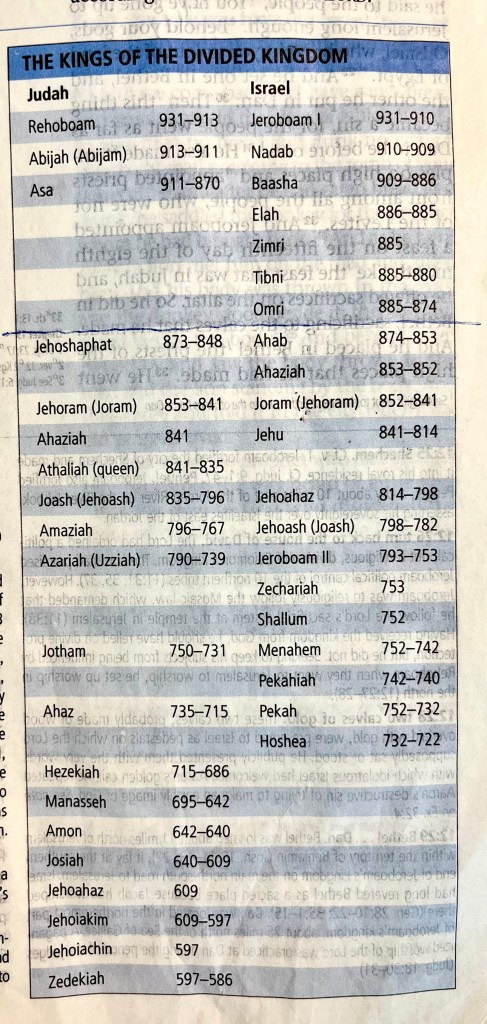
Right through here the names of the kings in Israel (north) and Judah (south) get a bit confusing for they are the same, and a few have the same or opposite “nicknames.”  Here’s the chart again. 

NOTE in Judah, after Jehoshaphat, there is Jehoram (Joram), another Ahaziah, Athaliah (the queen), Joash (Jehoash), and Amaziah.

NOTE in Israel, after Ahab, there is Ahaziah, another Joram (Jehoram), Jehu, Jehoahaz, another Jehoash (Joash).

Seriously, as you are reading, if you don’t mind marking your Bible, highlight or underline the northern king’s names in blue, and the southern kings’ names in red. (or other colors).

###

2 Kings 12.

This chapter continues what we learned in 2 Chronicles 23-24.  Even though the new king in Judah is called Jehoash here, we read about him as Joash, saved from his murdering grandmother, hidden away by the priest, Jehoida, until he was seven, and then crowned the king. His wicked “nana” was also killed that day.  We also read of the reforms the boy (under the priest’s tutelage) made, including repairing the Temple.

Now we see him calling again for the three types of offering that support the temple. 

  • The 1/2 shekel per man whenever a census was taken,
  • the payments of vows,
  • and voluntary offerings.

King Joash/Jehoash called for these offering.  After some years, when they did NOT come in, he had a special “offering box” made.  It was a reminder for the people to give.  When it was full, the priest would count and bag it and GIVE IT TO WORKMEN (carpenters, builders, masons and stonecutters) who were doing the repair.  (No “hanky-panky” in changing so many hands.

He reigned 40 years. Towards the end, Hazael (whom Elisha had anointed King of Syria) came and took Gath from the Philistines.  Now Gath was a mere 20-25 miles west of Jerusalem. And when Joash saw that the Syrian king meant to attack and take Jerusalem, he took all the sacred gifts, and his own gifts, and all the gold that was found in the treasuries of the Temple and the king’s house … and sent it to Hazael. 

Pleased, Hazael “went away from Jerusalem.”  (Too bad he did not pray for help from God!!)

************** And then – sheesh – two of Joash’s servants KILLED the king.  He was buried in the city of David, and his son Amaziah reigned.

.

2 Kings 13.

Meanwhile back up in the North, while Joash had been reigning, Jehoahaz (son of Jehu) began to reign. (17 years, evil)

Having left Jerusalem alone, the Syrian king, Hazael, and later his son Ben-Hadad III, continually harassed the northern kingdom, taking small bites of land/cities.  King Jehoahaz’s army was whittled down to 50 horsemen, ten chariots, and 10K foot soldiers.

BUT NOTICE!!!  This wicked king “sought the favor of the LORD, and the LORD listened to him, for He saw how oppressed they were.”  (God is so gracious and merciful!  He gave them “a savior” so the people could escape from the hand of the Syrians, and live in their homes.)

NOTE: This “savior” whom God gave to Israel is not named. But there are three choices.

  • 1. The Assyrian king, who attacked the Syrians from behind and forced them to turn from Israel.
  • 2. Elisha, the prophet, who continued his “secret” leadership in revealing where the Syrians would strike next.
  • or 3. Jeroboam II, the man who would be king after Jehoahaz, who fought the Syrians back. 

Take your pick.

Jehoahaz died and was buried in Samaria. 

His son Jehoash/Joash began to reign in ISRAEL. (Joash, king of JUDAH was still on the throne in the south.  Two kings named Joash: north & south!)

This new king “did what was evil in the sight of the LORD.” 

Elisha, the prophet of God be came deathly ill.  King Jehoash/Joash went to him and wept.  HE KNEW the northern kingdom was lost without this godly prophet.  

He cried out to Elisha, “My father, my father! The chariots of Israel and its horsemen!”  (Remember there were only 10 chariots and 50 horsemen!).  He was asking for military help!!

Elisha had King Jehoash/Joash shoot an arrow out the window, prophesying a victory over Syria.

Elisha then had the King strike the ground with his quiver of arrows. the king struck three times.

“Oh, no!!” said Elisha. “You should have struck 5-6 times then you would have totally defeated them.  Now it’s only three times, and they will come back and get you.

AND ELISHA DIED. They buried him, but it seems they forgot to fill in the grave. A band of Moabites came by, one of them died, and they threw him in the grave. HE BOUNCED BACK OUT ALIVE, AFTER TOUCHING ELISHA’S BONES. Elisha’s double portion of God’s power continued even after his death!

What??? 

The Syrian king, Hazael died and Ben-Hadad III reigned. Israel fought with him and took back the cities that were taken in war. THREE TIMES Israel defeated them. 

Jehoash/Joash reigned 16 years and died, and was buried in Samaria.

..

Jeroboam II became king in the NORTH.

.

2 Chronicles 24.

Okay…. were you curious at how quickly Judah’s king Joash was suddenly killed by two servants, after getting on with repairing the Temple??

I was!

Now, in Chronicles, we see the details.  King Joash had an about face, and TURNED AWAY FROM GOD, after his mentor and surrogate father, Jehoiada, the priest died.  Like Solomon’s son, Rehoboam, Joash then listened to the advice of the young princes of Judah.  He abandoned the Temple AND SERVED IDOLS! What?

Zechariah, the new priest and son of Jehoiada, called Joash out and said God would forsake HIM. Joash didn’t like that and commanded that the priest be STONED!!

The Syrians came again and took all those princes captive, and injured King Joash severely.  IT WAS THEN, THAT THOSE TWO SERVANTS CONSPIRED TO KILL KING JOASH – BECAUSE HE HAD THE PRIEST, ZACHARIAH STONED.

Okay then.  That makes sense.  Good for them!

Amaziah, the king’s son reigned instead in JUDAH.

Journaling through the Bible Chronologically in 2025, Days 180 & 181

Sundays and Mondays studies are posted together on Mondays

Day 180. Reading 1 Kings 22 and 2 Chronicles 18

Day 181.  Reading 2 Chronicles 19 – 23

Read Today’s Scriptures.
What insight or comfort do you receive?
 

Day 180 – 1 Kings 22.

After that ill-advised truce between King Ahab’s Israel (north) and King Ben-Hadad’s Syria (farther north), there were three years without war. Each country was trading in the other’s bazaars.  

But, there was a sore spot between the two kings. It was the town of Ramoth-Gilead.  Officially, it was in Israel’s territory, way east, across the Jordan River and right up next to Syria. (See map on yesterday’s post.) Syria was gradually “taking” the town, and Ahab didn’t like it.

So… when King Jehoshaphat of Judah (south) came to visit Ahab, Ahab asked him if he would go with him and battle for it and try to settle the dispute with Syria.

“Sure,” Jehoshaphat said. “My people are yours and my horses are yours. But … hey, let’s inquire of the the LORD first.”

King Ahab gathered his 400 prophets and inquired if they should go up against Syria at Ramoth-Gilead.

They ALL said, “Go up, for the LORD will give it into your hand.”

This seemed a little fishy to King Jehoshaphat, and he asked if there was ANOTHER prophet of the LORD that they could ask.

King Ahab grumbled, but finally said, yes, there was ONE, but Ahab didn’t like him because he ALWAYS prophesied against him.  Jehoshaphat pressed him, and Micaiah was called.  After a bit of messing around this real prophet of God said, “I saw all Israel scattered on the mountains, as sheep that have no shepherd.

“SEE!!! I told you.  He never says anything nice about me!” bemoaned Ahab.  And Ahab promptly put Micaiah in prison with meager food rations.

But, the Word of the LORD which Micaiah spoke came true.  The two Jewish kings went up to battle with the king of Syria, who had told his men to “fight with neither small or great, but with the King of Israel (Ahab) only.”

King Jehoshaphat (Judah) rode out in his chariot in regal clothing and a crown on his head.  But wily King Ahab disguised himself as a lowly soldier.  The Syrians of course, went after Jehoshaphat, who cried out to the LORD for help.  When the Syrian captains saw that he was not King Ahab they turned away.  

Then ,,, a random soldier drew his bow and randomly shot an arrow into the air.  “Oops!” That deadly missile flew right to the disguised King Ahab and entered his body through the crack separating his breastplate from his chain mail.  A scream.  And, “TURN AROUND AND CARRY ME OUT OF THE BATTLE FOR … I … AM … WOUNDED!  And troops fled every man to his city.

In the evening, King Ahab died.  His blood flowed into the bottom of the chariot. His body was brought to Samaria and buried.  

“And they washed the chariot by the pool of Samaria, and the dogs liked up his blood.”  Just as Elijah had prophesied.

Ahaziah, his son reigned in his place. He did what was evil in the sight of the LORD and walked in the way of his father, King Ahab, and in the way of his mother, Queen Jezebel. He served Baal and worshiped the pagan gods. He provoked the LORD, the God of Israel to anger in every way that his father did.

.

Meanwhile, in the south, King Jehoshaphat continued to reign over Judah. (We’ll learn some good things about him tomorrow from 2 Chronicles 19-23.  He continued to clean up the pagan worship that his father King Asa had begun.)

Jehoshaphat eventually died and HIS son, Jehoram reigned in his place. Jehoram was exceedingly wicked, and you will find out why (below) and how (tomorrow’s reading).  

.

2 Chronicles 18.

Here are a few interesting details on the story above about King Ahab in the north, and King Jehoshaphat in the south going to battle together for Ramoth-Gilead.

Jehoshaphat had GREAT RICHES and honor.  He – STUPIDLY!!! – made a marriage alliance with king Ahab.  (Ah ha! … now we see why the southern king was willing to go to war with Ahab against the Syrians.)  Jehoshaphat had arranged for his son, Jehoram, to marry Athaliah, the daughter of Ahab & Jezebel.

And the fall out of this union nearly wiped out the godly line of David through whom the Messiah Jesus would come!!! We’ll see that tomorrow.

.

###

.

Day 181 – 2 Chronicles 19.

When King Jehoshaphat returned to Judah after that narrow escape with the Syrians and the death of Ahab, he was met by Hanani, a prophet of God, for a thorough scolding

Should you help the wicked and love those who hate the LORD?”  (Yes, it did seem strange that he would help the wicked King Ahab fight the Syrians … until we learned that his son had married Ahab’s daughter.  There was a political obligation there.)

Hanani told the king of Judah that he SHOULD be punished … but that, “some” good had been found in him. He’d gotten rid of the pagan Asherah poles, and … MORE IMPORTANTLY, Jehoshaphat had “set his heart to seek the LORD.”  After that …

  • He went out to the people in his land and “brought them back to the LORD, the God of their Fathers”.
  • He appointed judges in all the fortified cities and reminded them that the LORD was watching them. They should make sure there was no injustice or bribery.
  • He appointed special Levites in Jerusalem to decide disputed cases.

.

2 Chronicles 20.

And then, a threat of war came to Judah (south). The descendants of Israel’s old relatives: (Moab & Ammon, both from Abraham’s nephew Lot) and Edom (descended from Jacob’s twin, Esau) joined together. They came around the south end of the Dead Sea, with the plan to de-throne Jehoshaphat.

Thankfully, the king did not call on the wicked kings in the north to help him, but “set his face to seek the LORD.” He proclaimed a fast for all his people. And prayed this prayer;

  • “O LORD, God of our fathers, are You not God in heaven?  You rule over all the kingdoms of the nations. In your hand are power and might, so that none is able to withstand You.  Did You not, our God, drive out the in habitants of this land before Your people Israel, and give it forever to the descendants of Abraham, Your friend?
  • “And they have lived in it, and have built in it a sanctuary for Your Name, saying, “If disaster comes upon us (the sword, judgment, pestilence, or famine), we will stand before this house and before You (for Your Name is in this house) and cry out to you in our affliction, You will hear and save!
  • And now behold, the men of AMMON, MOAB, and MOUNT SEIR, whom Your would not let Israel invade when we came up from Egypt – Behold, they “reward us” by coming to drive us out of Your possession.
  • O our God, will you not execute judgment on them?  For WE ARE POWERLESS AGAINST THIS GREAT HORDE that is coming against us. “WE DO NOT KNOW WHAT TO DO!  But our eyes are on You.”

**** (Oh, my goodness, what a prayer!  What if WE should pray this way, with such dependence on God!  What if modern Israel would pray this way, in total dependance on the LORD, their God! How would YOU respond, O LORD our God?)

As all Israel, with the little children and women, stood before the LORD, the Spirit of the LORD came on Jahazel, a descendent of Asaph, the Levite. And he said,

  • “LISTEN, all Judah, inhabitants of Jerusalem, and king Jehoshaphat. Thus says the LORD. “Do not be afraid and do not be dismayed at this great horde, FOR THE BATTLE IS NOT YOURS BUT GOD’S.”
  • “Tomorrow go down against them.  YOU WILL NOT NEED TO FIGHT IN THIS BATTLE.  Stand firm, hold your position, and see the salvation of the LORD, on YOUR behalf, O Judah and Jerusalem.
  • “DO NOT BE AFRAID AND DO NOT BE DISMAYED.  Tomorrow go out against them, and the LORD will be with you!”

Jehoshaphat, all Judah and Jerusalem fell down before the LORD, worshiping Him. They praised the LORD, the God of Israel with a very loud voice.

And they arose early in the morning and went out to meet the horde. Jehoshaphat stood and encouraged them. “Hear me, Judah and Jerusalem! Believe in the LORD your God, an you will be established. Believe the prophet and you will succeed.

AND THEN … Jehoshaphat appointed singers to sing and praise the LORD, as the went before the army.

Give thanks to the LORD, FOR His steadfast love endures forever.”

And when they BEGAN to sing and praise, the LORD set an ambush against the men of Ammon, Moab, and Mount Seir, so that they were routed.  They each destroyed one another!!!!!  Dead bodies all around. None escaped.

WOW!

Jehoshaphat and the people came to take the spoil and found GREAT NUMBERS of goods, clothing, precious things – which they took for themselves until they could carry no more.

They returned to Jerusalem with GREAT JOY for the LORD had made them rejoice over their enemies. 

And the fear of God came on all the kingdoms of the countries when they heard that the LORD had fought against the enemies of Israel.  So the realm of Jehoshaphat was quiet … for his God gave him rest all around.

.

At the end of his life, King Jehoshaphat joined in a venture to build a shipping fleet to Tarshish – with Israel’s wicked King Ahaziah (north).  But God destroyed all the ships because of this ungodly alignment.

Eventually Jehoshaphat died and was buried in the City of David (the southern part of Jerusalem, below the Temple Mount and palace).

.

2 Chronicles 21.

Jehoshaphat’s first-born son, Jehoram (the one he’d arranged a marriage with wicked Ahab/Jezebel’s daughter, Athaliah), ascended the throne.  HE WAS NOTHING LIKE HIS GODLY FATHER!  Immediately, he killed all his brothers, six in all, plus some of the princes of Israel (north), to assure his place in the kingdom.  (These men, were the lineage of “the house of David” through whom God had promised the reigning Messiah. Jehoram killed them all!) 

And yet God did not destroy him, even though he did what was totally evil in His sight, for God was not willing to destroy the house of David because of the Covenant He’d made with David. God had promised “a lamp to him and to his sons forever.”  But what about this totally evil man of darkness???

Do not fear. God is Sovereign over all.

But meanwhile Jehoram grew worse. He made high places for pagan worship. He led Judah into whoredom and made them go astray.

Elijah the prophet sent him a letter from the north. “Because you have walked in the ways of the kings of Israel (north) and have enticed Judah into whoredom, and killed your brothers, I, the LORD, will bring a great plague on your people, children, wives, possessions and YOU YOURSELF will have a severe sickness of your bowels, until them come out of your body.”

WHOA! (Leave it to Elijah to terrify!)

God stirred up the Philistines against Jehoram, and the Arabians, and they came and invaded Judah and carried away Jehoram’s possessions, his sons, and his wives. (Only Jehoahaz, his youngest son remained.)

Then God struck him with that dreaded bowel disease, an incurable disease.  In two years’ time all his bowels came out and Jehoram died IN GREAT AGONY. 

No one regretted his departure. He was buried in the city of David, BUT NOT IN THE TOMBS OF THE KINGS.

.

2 Chronicles 22.

So, Ahaziah/Jehoahaz, Jehoram’s youngest son reigned. He walked in the ways of his grandfather, King Ahab (north), for his mother was his counselor in doing wickedness. 

God ordained his downfall through His appointed Jehu, whom God had appointed to destroy the house of Ahab. (Remember, that was one responsibility the old prophet, Elijah had, to anoint Jehu.)  And Jehu did that – he killed Ahaziah/Jehoahaz and all the remaining princes of Ahab.

Now, there was no one able to rule the Kingdom of Judah.  

Why?  Because the wicked mother (daughter of Ahab) destroyed all the royal family of Judah. She proclaimed herself queen – but nobody took her reign seriously.

WAS JUDAH WIPED OUT?

WAS THERE TO BE NO SEED OF DAVID LEFT TO COME AS MESSIAH?

WHAT ABOUT GOD’S PROMISES?

But … there was a woman named Jehoshabeath, the daughter of the king, and the wife of the priest, Jehoiada.  She went into the “nursery” and carried away the very youngest son of the king, less than 1-year-old Josiah, AND HID HIM FROM HIS WICKED GRANDMOTHER. 

Josiah, the SEED OF DAVID, the “lamp of Israel,” lay hidden in a cradle. He stayed with the godly couple for six years, while Athaliah “reigned” over the land.   

****(Doesn’t this remind you of how God kept the baby Jesus safe from King Herod when he sent Joseph and Mary to Egypt?)

.

2 Chronicles 23.

Finally the time had come.

Josiah was seven years old.

He’d been trained by the priest, who now took courage.

Jehoida gathered the commanders of the army. They went through Judah and gathered the Levites from all their cities, as well as the fathers of the houses of Israel.

Jehoida showed them the boy-king, Josiah and said, “Behold, the king’s son! Let him reign as the LORD spoke concerning the sons of David.”

Then Jehoida revealed his carefully-though-out plan.  All the Levites and priests who had come off duty were divided into thirds and placed around the House of the Lord at the gates. “NO ONE MAY ENTER EXCEPT THE MINISTERING PRIESTS.” 

“Surround the king, each with his weapon in his hand.  Anyone approaching shall be killed.  Be with the king at all times.”

THEN, he brought out Josiah, the king’s son and placed the crown on his head.  “Long live the king!”

.

YIKES!  When Queen Athaliah heard the noise, she went to see what was happening and saw the young king. 

She tore her clothes and cried, “TREASON! TREASON!”

Jehoida commanded the captains to seize her. “Take her out of the court of the House of the Lord, and kill her!”  They led her through the horse gate of the king’s house and… did the deed.  The end of that wicked Ahab/Jezebel line … except for Josiah, whom the LORD had chosen to carry David’s seed.  WHEW!

.

Jehoida made a covenant between himself, the people, and the young king, that they ‘should be the LORD’s people.   He saw to it that the altars and images of Baal were destroyed. He reinstituted the sacrifices and offerings that Moses wrote about in the LAW.

Then he took the young boy king from the house of the LORD to the king’s house.  They set him on the ROYAL THRONE.  All the people rejoiced, and the city was quiet after Athaliah had been killed.

.

****(WOW. What a long tale of evil and good.  God is ALWAYS in control. HE is sovereign. He will fight for His people.  He will see that not a word of his prophecy EVER fails. His covenants are sure. HE IS GOD, and KING, and the LORD of Hosts forever and ever. Glory be to His name!)


Journaling through the Bible Chronologically in 2025, Day 176

Day 175.  Reading 1 Kings 15 and 2 Chronicles 13 – 16

 
Read Today’s Scriptures.
We now begin to read through the history of the reigning kings of the North and South. It can be confusing. Here are two helps.
1.) Check out (and maybe print) the list I posted yesterday of the kings and when they reigned.
2.) If you mark in your Bible, use a colored highlighter to mark the kings of the North, and a different color for the Southern kings.

1 Kings 15.

In the eighteenth year of King Jeroboam (north), King Abijah/Abijam began to reign over Judah (south).  He reigned for three years. He walked in the sins of his father before him – his heart was not wholly true to the LORD, as the heart of David.

  • “Nevertheless, for David’s sake, the LORD gave him a ‘lamp’ in Jerusalem, setting up his son after him, and establishing Jerusalem, because David did what was right in the eyes of the Lord.”  (I love this promise!)

.

2 Chronicles 13.

Now there was war between Abijah (south) and Jeroboam (north). Abijah, with 400K soldiers VS Jeroboam with 800K (who were positioned in front and behind Judah in an ambush stance.

But, although Abijah was not a good king, he had some good words to the Northern army that day.

  • Hear me, O Jeroboam and all Israel. Ought you not to KNOW that the LORD God of Israel gave the kingship over Israel forever to David and his sons? Yet Jeroboam – a servant of Solomon – rebelled and, because Rehoboam was young and irresolute, took the northern tribes to reign over them. 
  • “And NOW you think to withstand the kingdom of the LORD in the hand of the sons of David?  Because you are more in number and have golden calves???   AS FOR US, the LORD is OUR God, and we have not forsaken Him. We have priests ministering to Him, the sons of Aaron, and the Temple of God.
  • Behold, God is with us at our head.  O sons of Israel, do not fight against the LORD, the God of your fathers, because you cannot succeed.”

A bold proclamation, for sure, but then Judah noticed the 400K soldiers in front of them and the 400K behind them, ready to ambush. They “cried to the LORD, and the priests blew the trumpets, and the men of Judah raised the battle shout.”  And when Judah shouted, GOD defeated Jeroboam and all Israel before Abijah and all Judah!  WHOA! And the men of Israel fled before Judah, who struck down 500K of Israel.

Why this massive victory?  “Because they relied on the LORD, the God of their fathers.”

Jeroboam (north) did not recover his power in the days of Abijah (south). And the LORD struck him down, and he died.  But Abijah (south) grew mighty.

.

2 Chronicles 14.

Abijah (south) died and was buried in the City of David. His son, Asa, reigned in his place, and the land had rest for ten years.  “Asa did what was good and right in the eyes of the Lord his God,”  taking away the foreign altars, the high places, and the Asherim pillars. He also commanded the people of Judah to “seek the LORD, the God of their fathers, and keep the law and commands.”

The kingdom had rest under him. He had no war in those years, for the LORD gave him peace.

But then…

  • Zerah, the Ethiopian, came out against them with an army of a million men and 300 chariots!  WHOA!
  • And Asa cried to the LORD his God.  “O LORD, there is none like You to help between the mighty and the weak. Help us, O LORD our God, for we rely on You, and in Your Name we have come against this multitude. O LORD, You are our God; let not man prevail against You.”
  • So the LORD defeated the Ethiopians before Asa and Judah. And they fled.  Asa and Judah pursued them as far as Gerar, and the Ethiopians fell … until NONE remained alive. (a million!!!)  And Judah carried MUCH PLUNDER back to Jerusalem.

.

2 Chronicles 15.

Then the Spirit of God came on the prophet Azariah, and he took a message from God to King Asa (south), to Judah, and to Benjamin.

  • “The LORD is with you while you are with Him. If you seek Him, He will be found by you, but if you forsake Him, He will forsake you.”  “But you, take courage! Do not let your hands be weak, for your work shall be rewarded.”

And what was the “work” they had to do?  Clean out the land of all the detestable idols.  And as soon as Asa heard the prophet’s message, he took courage and put away the idols from Judah and Benjamin.

He also gathered those people from the northern tribes of Ephraim, Manasseh, and Simeon who were residing with them, for great numbers had deserted to him from Israel (north) when they saw that the LORD was with him.

All these, and Judah entered into a covenant to seek the LORD the God of their fathers, with all their heart and with all their soul.  They rejoiced over the oath, for they had sworn with all their heart and had sought him with their whole desire … and He was found by them, and the LORD gave them rest all around.

And King Asa removed his mother, Maacah, from being queen mother, because she had made a detestable image for Asherah.   The heart of Asa was wholly true all his days. 

And there was no more war …. until the thirty-fifth year of his reign.

.

2 Chronicles 16.

In the 36th year of Asa’s reign (south), the (northern) king Basha went up against Judah.  He built a fort so no more of his people could leave him and go to King Asa. 

NOTE: Instead of crying to the LORD his God, King Asa took money (gold and stuff from the treasuries of the LORD) to Ben-Hadad, king of Syria in Damascus, and paid him to fight King Basha (north) so he would withdraw from King Asa (south).

Ben-Hadad agreed and sent commanders of his armies against the cities of Israel (north), and they conquered Dan, other cities, and all the territory of Naphtali. The northern king Basha heard of it and withdrew from building the fort against Judah. 

But…

This was NOT what King Asa should have done. The prophet Hanani said to him,

  • Because you relied on the king of Syria and did not rely on the LORD your God, the army of Syria has escaped you. (He could have battled them and won!)  
  • Were not the million Ethiopians a huge army, yet because you relied on the LORD, he gave them into your hand. The eyes of the LORD run to and fro throughout the whole earth, to give strong support to those whose heart is blameless toward Him. 
  • YOU HAVE DONE FOOLISHLY IN THIS. From now on, you will have wars.

Well, that did not make King Asa (south) happy.  In a furious rage, he took Hanani and put him in stocks in the prison!

“Did that help, Asa???  I think not.  Accept your sin! Repent! Ask forgiveness!!  But he didn’t. In fact, “he inflicted cruelties on some of the people at the same time!”

Three years later, “King Asa (south) was diseased in his feet (did he think about those prison stocks??) and his disease became severe. EVEN THEN, he did not seek the LORD, but went to doctors.  Sheesh!

He died two years later and was buried in a tomb that he’d cut for himself in the city of David.  Curiously, the people filled his casket with various kinds of spices prepared by the perfumer’s art.  (YIKES, did his feet smell THAT bad???)  They made a very great fire in his honor.

(17:1 – And Jehoshaphat, his son, reigned in his place.)

Journaling through the Bible Chronologically in 2025, Days 131 & 132

(Sundays and Mondays studies are both posted on Monday.)

Day 131. Reading 2 Samuel 10, 1 Chronicles 19, and Psalm 20

Read Today’s Scriptures.

Day 131.

2 Samuel 10 and 1 Chronicles 19  (These two chapters tell the same story with very few differences.)

It started with a good deed. The friendly king of the Ammonites died, and David wanted to show his loyalty to the new king, Hanun, so he sent a company of his servants to console him.  Like many young and pompous advisors to new youthful kings, Hanun’s guys filled his mind with suspicion about David’s servants. They whispered in Hanun’s ear that King David had sent them to search the city, spy on it, and overthrow it. 

Really?  With bouquets of lilies?

The young (and foolish king – he reminds me of Solomon’s son Rehoboam & his foolish advisors – took David’s servants and humiliated them.  Half their beards (a symbol of manhood) were shaved off, and their robes were cut off at hip level, leaving them exposed.  They were greatly ashamed!

David heard about it, sent men to meet them (presumably with decent clothes), and told them to remain in Jericho until their beards grew out.

Young King Hanun, sensing he’d made a mistake and seeing how he now “stunk” in the eyes of Israel, got together an army, added some neighboring soldiers then fanned out for war. (second mistake)

David sent Joab and the host of his mighty men. (The empire strikes back!)

Joab and his co-commander brother Abishai spit up to fight the Syrians and Ammonites. Joab encouraged his brother and men with a great declaration.

  • Be of good courage, and let us be courageous for our people, and for the cities of our God, and may the LORD do what seems good to Him.

Way to go, Joab!

The Syrians fled.  When the Ammonites saw them running away, they fled too.  HA!  Joab and Abishai and their men returned to Jerusalem. 

Now the Syrians were embarrassed and returned with a new, powerful commander to fight again. (third mistake.)  This time DAVID himself, gathered all Israel together, led them across the Jordan River, and fought them.

The Syrians fled again. This time David and the company went after them, killing many thousands. And also, that great commander died too.  When the Syrians saw they were defeated they surrendered and became subject to Israel.

So the Syrians were not willing to save the Ammonites anymore.  (Let that be a lesson learned!)

Psalm 20.

This psalm is titled, “Trust in the Name of the LORD our God.” It’s a song most often sung before going out to battle.

That’s just what Joab and Abishai, and then King David did, and they won the day. All glory to God.

  • May the LORD answer you in the day of trouble! May the Name of the God of Jacob protect you!
  • May He send you help from the sanctuary and give you support from Zion!
  • May He remember all your offerings, and regard with favor your burnt sacrifices!
  • May He grant you your heart’s desire and fulfill all your plans!
  • May WE shout for joy over your salvation, and in the Name of our God set up our banners!
  • May the LORD fulfill all your petitions!
  • Now I know that the LORD saves His anointed; He will answer him from His holy heaven with the saving might of His right hand. 
  • SOME trust in chariots and SOME in horses, but WE trust in the Name of the LORD our God!

###


Day 132. (5 more psalms)

Psalm 65.

This psalm is a PRAISE psalm (to the MAX).  It’s hopeful, confident, and enthusiastic in response to God’s goodness.  It’s a celebration at the Tabernacle, probably at one of Israel’s Feasts.

  • Praise is due to you, O God, in Zion
  • O YOU WHO HEAR PRAYER, to You shall all flesh come.
  • Blessed is the one You choose and bring near to dwell in your courts! We shall be satisfied with your goodness and holiness.
  • By awesome deeds You answer us with righteousness, O God of our salvation.
  • You make the going out of the morning and the evening to shout for joy.
  • You crown the year with Your bounty; Your wagon tracks overflow with abundance!

Psalm 66.

Another psalm of praise titled “How Awesome Are Your Deeds”

  • Shout for joy to God, all the earth; sing the glory of His Name; give to Him glorious praise!  Say to God, “How awesome are Your deeds!”  So great is Your power that Your enemies come cringing to You.
  • Come and see what God has done; He is awesome in His deeds toward the children of man.
  • Bless our God, O peoples; let the sound of His praise be heard, who has kept our soul among the living and has not let our feet slip.

And then, a personal testimony;

  • Come and hear all you who fear God, and I will tell you what He has done for my soul.
  • I cried to Him with my mouth, and high praise was on my tongue.
  • If I had cherished iniquity in my heart, the LORD would not have listened. 
  • But truly God HAS listened, He has attended to the voice of my prayer.
  • BLESSED be God, because He has not rejected my prayer or removed His steadfast love from me!

Psalm 67.

This psalm shows that God’s desire is to save and bless ALL nations of the earth as they come to Him and fear him! But first a “benediction.”

  • May God be gracious to us and bless us and make His face shine on us.…..
  • that Your way may be known on the earth, Your saving power among all NATIONS.
  • Let the PEOPLES praise You, O God: let all the PEOPLES praise you!
  • Let the NATIONS  be glad and sing for joy; for You judge the PEOPLES with equity and guide the NATIONS upon the earth.
  • Let the PEOPLES praise You, O God; let all the PEOPLES praise you. 
  • …let all the ends of the earth fear Him!

Psalm 69.

This psalm is a prayer of desperation, titled “Save Me, O God.”   In it David realizes that he might be shortly killed. He begs for rescue.

This psalm also has inferences concerning the coming Messianic kingdom when God’s enemies are dealt with.  Much of it was applied to Christ in the New Testament – you will catch those parts as you read.  But any believer being ridiculed will identify too.

Read the whole thing.  It shows David’s intimacy with God that he can pray such personal prayers.  It shows US that we can cry out to God, no matter what our heartache or need.  No matter how desperate we are or what sin we have done.   

Psalm 70.

A short psalm, almost identical to Psalm 40.  David prays against his enemies, asking God to turn them back and be brought to shame.

But then he prays that ALL who WILL turn and seek God might be saved!

  • May ALL who seek You rejoice and be glad in You!  May those who LOVE YOUR SALVATION say evermore, “God is Great!”

.

Tomorrow, sadly, we will see the great king fall. 


Journaling through the Bible Chronologically in 2025, Day 130


Read Today’s Scriptures. Psalms, songs, prayers to read and savor.
 

Psalm 50.

This psalm is quite different. It quotes God Himself throughout. And so, it’s like a prophetic writing or an oracle. It tells the difference between true and false worship. First, God is introduced, then the different kinds of false worship are shown, and finally, the very last verse reveals true worship

1-6 – Who God is.

  • The Mighty One, God the LORD, the perfection of beauty, before Him a devouring fire, around Him a mighty tempest …
  • The heavens declare His righteousness, for God Himself is judge.

7-15 – Ritualism as worship, no!

  • Not for your sacrifices do I rebuke you; your burnt offerings are continually before me.
  • (But it’s for their attitude in sacrificing. As if they were giving to God what HE needs.) I will not accept your bulls … your goats.  EVERY BEAST of the forest (already) is MINE. 
  • I own the cattle on a thousand hills.  I know all the birds of the hills, and all that moves in the field is MINE.
  • If I were hungry, I would not tell YOU, for the world and its fullness are MINE. 
  • NO!  Offer to God a sacrifice of thanksgiving, perform your vows, and call on Me in the day of trouble: I will deliver you, and you shall glorify me.

16-21 – Rebellion as worship, no!  To the wicked —

  • What right have you to recite my statutes or take my covenant on your lips?
  • You hate discipline. You cast My Words behind you. You are pleased with thieves. You keep company with adulterers. 
  • You give your mouth free rein for evil. Your tongue frames deceit. You speak against your brother. You slander your own mother’s son. 
  • You’ve done these things, and I’ve been silent. But now I rebuke you and lay the charge before you.

22-23 – Right approach to God.

  • The one who offers thanksgiving as his sacrifice glorifies me; to one who orders his way rightly, I will show the salvation of God!”


Psalm 53.

This psalm is very much like Psalm 14, which we’ve already read. 

  • The fool says in his heart, “There is no God.” They are corrupt, doing abominable iniquity; there is none who does good.


Psalm 60.

Now this is unusual. David actually tells when he wrote this psalm. Remember yesterday, when we read of all the ways God helped him to defeat his enemies?  Zorbah, plus the thousands of Edom in the Valley of Salt? 

David here seems discouraged before God gives him victory in both the extreme North (Syria) and South (Edom) of Israel.  Then, David sees the victories.  

  • O God, You have rejected us, broken our defenses; You have been angry; oh, restore us!
  • God has spoken in his holiness, “Moab is my washbasin; upon Edom, I cast my shoe; over Philistia, I shout in triumph!”  (Talk about God getting into the fray enthusiastically!)
  • And David, “With God we shall do valiantly; it is He who will tread down our foes.”

Don’t you love reading these psalms in their proper places in Israel’s history?


Psalm 75.

Note, that the writer, Asaph, says this psalm is to be sung to the tune of “Do not destroy” as he wrote on Psalm 57.  Don’t you wonder what that tune sounded like?

  • “We give thanks to You, O God; we give thanks, for Your Name is near. We recount your wondrous deeds.

If you have read through the Book of The Revelation recently, much of this psalm sounds similar.

  • At the set time that I appoint I will judge with equity.
  • When the earth totters, and all its inhabitants, it is I who keep steady its pillars.
  • For in the hand of the LORD there is a cup with foaming wine, well mixed, and He pours out from it, and all the wicked of the earth shall drain it down to the dregs.

WOW!

  • But I will declare it forever; I will sing praises to the God of Jacob.
  • All the horns (power) of the wicked I will cut off, but the horns (strength) of the righteous shall be lifted up. 

Yea, and amen!