Days 266 & 267—We are in the NINETH month of Bible reading, with more of Israel’s history in ESTHER.
NOTE: Sunday and Monday studies are posted on Monday. These two days’ posts will be longer than usual.
 Day 266 – Esther 1 – 5 (A fascinating story of God’s providence for His chosen people, the Jews. A plot is hatched to destroy them.)
Esther 1. Background. King Ahasuerus (or Xerxes, in Greek) is king of Persia, and his winter capital is Susa. He reigns from India to Ethiopia!! He was so rich that he gave a feast for all his servants and officials, governors and nobles, and the army of Persia and Media FOR 180 DAYS!! (6 months)
He added a special feast at the end for ALL the citizens of Susa. And any man could drink as much or as little as they liked. On the seventh day, probably drunk, he called for his Queen Vashti, wearing her royal crown (nothing else??), to show her beauty to the people and princes.
She refused.
What an uproar this caused. The king has been affronted. All the men in the kingdom are now afraid THEIR wives will refuse to obey them. Stamp out this trend RIGHT NOW! The king listens. He fires Vashti and sends out notices of his decision (so all those wives and women will take note and give honor to their husbands.) But then, the King got lonely for her.
,
Esther 2. But never fear. The king’s young men come up with a new plan. Call for all the beautiful young virgins from all 127 of your providences to “audition” for Vashti’s place. This pleased the king, and he did so.
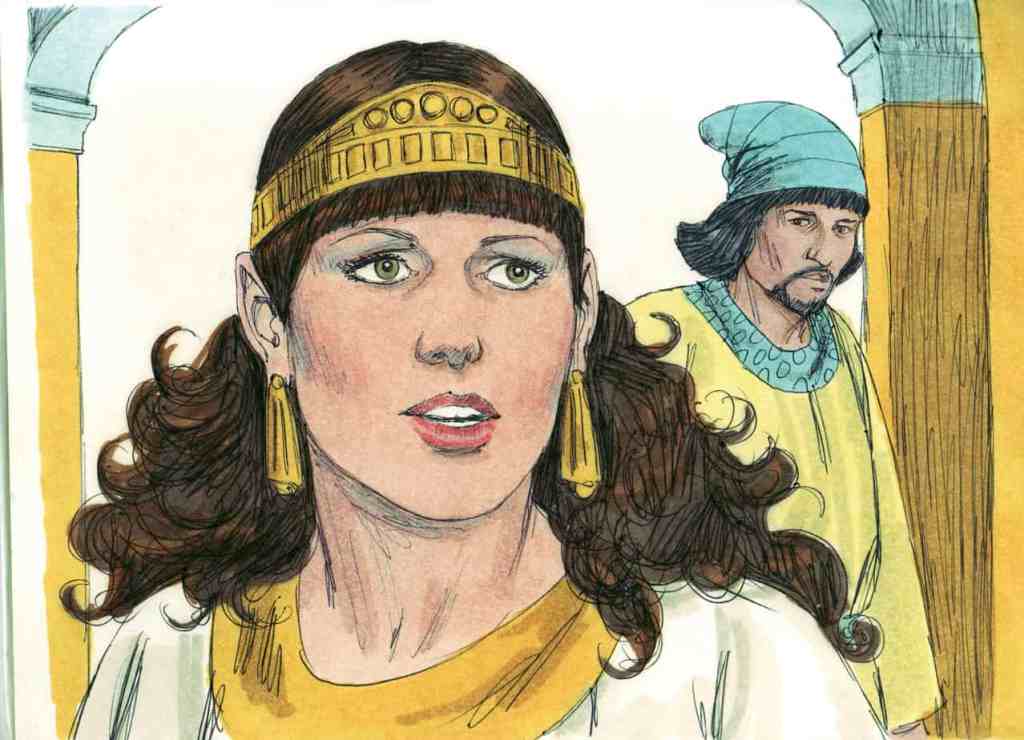
Now….. There was a Jew in Susa, a Benjaminite, descended from King Saul’s line, named Mordecai. He had been brought as a captive to Babylon in Nebuchadnezzar’s second wave of captives, along with King Jeconiah (Jehoiachin). His uncle was taken, too. When his uncle and aunt died, Mordecai raised their young daughter Hadassah/Esther as his own. And this beautiful young (12-14 year old) girl was taken in the “beauty contest” of Ahasuerus.
The head eunuch, Hegai, liked Esther and quickly gave her all the cosmetics, treatments, foods, etc., that she would need to “win.” And sure enough, when it was her time to “go into the king,” he delighted in her and chose Esther as his new queen. Big celebration.
Now….. It just so happened that one day, Mordecai was sitting by the king’s gate when he overheard two guards trash-talking the king and planning to assassinate him. He told that to Queen Esther who told the king about it in the name of Mordecai. The guards were investigated and hanged, and the incident was recorded in the book of the chronicles of the king.
,
Esther 3. Now….. There was another man in Susa, whom the king promoted above all the other officials. All the king’s servants bowed down and paid homage to him…. except Mordecai. This infuriated Haman.
(A little history here: Haman was an Agagite, a descendent of King Agag, the Amalekite, whom King Saul (Mordecai’s ancestor) was supposed to have killed. Ages before, God had decreed that all the Amalekites should be annihilated for their harsh treatment of their distant kinsmen (the Jews) as they wandered in the wilderness. Amalek was the grandson of Esau, the twin brother to Jacob/Israel. They had attacked the unprepared Israelites from behind.)
Because of this history, Haman had a deep hatred of the Jews, personified in Mordecai. (Esther had not made her heritage known as Mordecai had instructed.)
Passing by Mordecai’s indifference every day infuriated Haman so much that he asked King Ahasuerus (in a roundabout manner) to write an edict that all the Jews in his kingdom be killed on a specific day. They were, after all, troublemakers who disobeyed the king’s laws. “Okay, sure, do as you wish, Haman.” Pandemonium broke out in the capital and spread throughout the kingdom. (Haman was like modern-day Hitler & Hamas)
,
Esther 4. When Mordecai heard about the edict, he tore his clothes and put on sackcloth and ashes as a sign of deep mourning, as did the whole city and land. Weeping and lamenting could be heard everywhere. Esther heard about it and sent a message to her “cousin/uncle” to learn the reason. Then, using Hathach, one of the king’s eunuchs assigned to her, she and Mordecai had this conversation.
“Esther, Haman is planning to destroy all the Jews. Here is the letter he sent out. Go to the king and plead on behalf of your people.”
“Mordecai, everyone knows that any man or woman who goes to the king without being summoned and he doesn’t hold out his golden scepter to… will be killed! The king has not called for me in 30 days!!”
“Esther, do not think you will escape in the king’s palace. For if you keep silent at this time, deliverance WILL COME for the Jews from another place, but you and your father’s house will perish. And… who knows whether you have not come to the kingdom for such a time as this.”
“Okay, Mordecai. Go gather all the Jews to be found in Susa and hold a fast on my behalf for three days. My maids and I will do the same. Then I will go to the king, though it is against the law, and if I perish, I perish.”
,
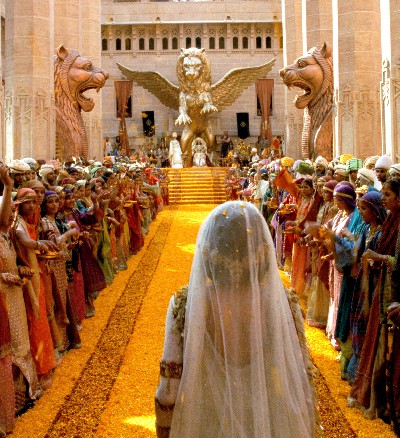
Esther 5. On the third day, Esther puts on her royal robes and stands at the King’s throne room entrance. He is in there. He sees his queen…. and smiles. He holds out the golden scepter that is in his hand.
“Ah, Queen Esther, What is your request? To half of my kingdom, I will give you.” WOW!!!
Esther sweetly requests his (and Haman’s) presence at a banquet she is preparing. He accepts, and the top two men in Persia come to dine in her palace. Again, the king asks what her request is – to half his kingdom.
Esther demurs again, saying she will tell him at another banquet for them the following night. Well-fed and maybe a little tipsy, they leave.
Haman is on top of the world, having feasted and been invited to feast again with the King and Queen. That is, until he sees Mordecai at the gate, neither bowing nor trembling before him. At home, he rants and raves and tells his wife and relatives about his hatred. They say, “Build a gallows, tell the king to hang the man, then go joyfully to your banquet.”
The idea pleased Haman and he had the gallows made. He’ll see the king in the morning.
.
Day 267 – Esther 6 – 10 (The conclusion of the story, a new holiday, Mordecai’s rise to power)
Esther 6. Maybe Esther’s banquet was a bit too rich for the King. Or perhaps he just over-indulged. Regardless, he couldn’t sleep and called for some bedtime reading. They “just happen” to bring him the Book of Memorable Deeds, the chronicles, and read about how Mordecai saved his life in the incident of the two guards planning his assassination.
“Has this man ever been rewarded for this?” he asks.
“No, nothing has been done for him,” they answer.
“Who is in the court right now?” he asks.
And, it just so happens that Haman is coming to the king right then to ask that Mordecai be hanged.” OOPS!
“Hey, Haman, what should be done to the man whom the king delights to honor?” says Ahasuerus.
“It’s me! It’s ME!!” Haman thinks to himself. “Well… let your royal robes be brought, the horse the king rides, and a crown the king has worn. Dress him in these and let one of the court’s most noble officials lead him around the city, proclaiming that THIS is the one the king wants to honor.”
“Great idea, Haman.” says the king. “Hurry, take the robes and the horse as you have said, and do so to Mordecai, the Jew, who sits at my gate. Leave nothing out that you have mentioned.”
Could Haman even move??
Yes, and he obeyed the king, mortified! And afterward, he went home with his head covered, mourning. This time, his wife and relatives said, “Well, if Mordecai, before whom you have begun to fall, is of the Jewish people, you will not overcome him but will surely fall before him.”
And while they were speaking, the king’s eunuch arrived to take him to Esther’s banquet.
,
Esther 7. So the two men feast and drink wine at Esther’s table, and the king again asks her what she would like – even to half of his kingdom. Then, she discloses the plot against HERSELF and HER PEOPLE to be destroyed, killed, and annihilated (words of Haman’s edict).
“Who? WHO would dare to do this??” the king screams.
“A foe and enemy! This wicked Haman!!” she cries.
The king is so upset that he gets up and goes out to the terrace.
Haman, however, stays to plead his case. He means to fall at her feet to beg but is drunk and lands on top of her instead. Just then, the king returns and sees what he thinks is Haman assaulting his Queen in his presence, in his own house!
A eunuch in attendance says calmly, “Haman has also prepared gallows to hang Mordecai, whom the king has honored for saving his life. It’s standing at his house, 75 feet tall……” Just saying.
“HANG HIM ON THAT!” the king commands.
They do. Haman is “hoisted upon his own petard,” and the king’s wrath subsides.
,
Esther 8. Mordecai is honored and elevated to Haman’s place. But the queen’s work is not done. The edict to kill all the Jews on Adar 13. (end of February) still stands. Esther again attempts an audience with the king, and he agrees. At her request, he okays a second letter to be sent to all his provinces from India to Ethiopia, telling the Jews that they can fight back and plunder all the goods of their enemies on Adar 13. It is signed, sealed, and delivered to the 50 million people under his rule.
Then, the Jews had “light and gladness and joy and honor,” a feast, and a holiday.
,
Esther 9. So, on that fateful day, the Jews in his kingdom gathered and gained mastery over those who hated them. They killed any who sought to harm them. Everyone was afraid of them! The governors and royal agents even HELPED them for fear of Mordecai. In the melee in Susa, all 10 of Haman’s sons were killed. The king even granted another day (Adar 14) to “clean up the enemies” of the Jews in Susa.
But the Jews did not plunder their enemies.
Curious. Why didn’t they? The king gave them permission.
(Go back to Deut. 25:17-19 — “Remember what Amalek did to you on the way as you came out of Egypt, how he attacked you on the way when you were faint and weary and cut off those who were lagging and did not fear God. Therefore, when the LORD your God has given you rest from all your enemies around you in the land…you shall blot out the memory of Amalek from under heaven; you shall not forget.)
(Later, King Saul was instructed to kill ALL the Amalekites and take no plunder. But he disobeyed God and kept the prize sheep and King Agag alive. Samuel had to kill the king for him. See 1 Samuel 15:3, 9. Because of this, Haman, the Agagite, hated the Jews. And because of God’s instructions to the disobedient Saul, the people did as he was supposed to do and TOOK NO PLUNDER.)
Afterward, Mordecai recorded the numbers and sent letters to the Jews in all the provinces. From then on, they were to keep the 14th day of Adar every year as a day of rest and remembrance of when they got relief from their enemies, turning it from a day of sorrow to a day of gladness and holiday. There should be feasting and sending gifts to one another and the poor.
The day would be called Purim (lots or dice) because Haman had cast lots for the day of the holocaust. Queen Esther’s command confirmed these practices of Purim, and it was recorded in writing.
.
Esther 10. The last chapter confirms King Ahasuerus elevating Mordecai to second-in-command in the land. It also states that Mordecai was popular among the Jews for “he sought the welfare of all his people and spoke peace to all his people.”
A good old man, that Mordecai. And “Bravo!” Queen Esther.
 Morning Meditations