Archives

Journaling through the Bible Chronologically in 2025, Day 310

A NEW MONTH!

Day 310 – Reading – Mark 13

Read and believe in Jesus!

Mark 13.

Today’s reading is another account of the dire predictions we read about yesterday in Luke 21, and what we will read about again in Matthew 24 tomorrow.  The setting is Jerusalem, mid-week before the horrible time of Jesus’s suffering leading up to His crucifixion on Passover. He has had several encounters with Jewish leaders, who are even angrier now. 

Jesus also spoke some dire things about the future that have made His disciples curious.  When they leave the Temple, one of His disciples comments, “Look, Teacher, what wonderful stones and what wonderful buildings!”

Jesus answers him cryptically, “Do you see these great buildings? There will not be left here one stone upon another that will not be thrown down.”  

As they walked through Jerusalem and out the gates, through the Kidron Valley to the Mount of Olives, I’m sure they were thinking about what Jesus had predicted.  From their viewpoint, they could see the Holy City across the Western horizon, with the Temple prominently standing. All the enormous stones were “golden” in the setting sun.  It was hard to imagine it all in rubble.  (But hadn’t that very thing happened centuries before when Babylon attacked and destroyed the city and temple, taking Israel into exile?  Would that happen again?  (Sadly, yes.)

Sadly, this first part would happen in less than 40 years after Jesus’ warning. The destruction of Jerusalem and the Temple buildings by the Roman General Titus occurred in 70 A.D., and thousands of Jews were killed or taken as slaves.

.

As they rested on the Mount of Olives – possibly in the Garden of Gethsemane – the four fisherman brothers (Peter & Andrew, James & John) approached Jesus privately. “Tell us, when will these things be, and what will be the sign when all these things are about to be accomplished?”

They wondered if this would happen very soon, not-so soon, or not for a long while. Should they start preparing? 

,

His answer may have been confusing. 

Jesus begins with warnings, Beware that no one leads you astray.”  “Don’t be alarmed.”  “Be on your guard.”  “Don’t be anxious.”  “The one who endures to the end will be saved.”

This first section seems to refer to the near future, and the persecution they will suffer after He has departed.  However, it could refer to any suffering by believers throughout the centuries.  There will be “false Messiahs” coming that try to fool believers into believing that He has returned.  There will be earthquakes, famines, and wars between nations, but these are just the beginning.

They are to expect persecution from the Jews and governments (think of all that happens in the book of Acts) as they spread the Gospel.  They will be brought to court to give their testimony.  In those times, the Holy Spirit will show them what to say. 

And they are to expect persecution even from their own families, including being put to death (possibly out of fear for their own lives).

.

In the next section, Jesus seems to be warning believers IN THE END TIMES. (see verse 14, “let the reader understand.)  The Antichrist of the Great Tribulation will act and appear like that historical Antiochus Epiphanes, king of Syria in the second century B.C., who raided Jerusalem, killing 80,000 Jews, and then set up a statue of Zeus in the temple and sacrificed pigs on the holy altar. 

Jesus, “For in those days there will be such tribulation as has not been from the beginning of the creation that God created until now, and never will be.  And if the Lord had not cut short the days, no human being would be saved.  (Read Revelation for further details.)  But for the sake of the elect, whom God chose, He shortened the days.”

.

I’m sure the disciples were thoroughly scared by then (I would be).  But Jesus has a little more to reveal.

“After that tribulation, the sun will be darkened, and the moon will not give its light, and the stars will be falling from heaven, and the powers in the heavens will be shaken.”  (As if they were not fearful enough!)  

And THEN they will see the Son of man coming in clouds with great power and glory. And then He will send out the angels and gather His elect from the four winds, from the ends of the earth to the ends of heaven.”

.

And as for their “When?” question, Jesus gives an example of the fig tree.  When it begins to leaf out, you know that summer is near. “So, also, WHEN YOU SEE THESE THINGS TAKING PLACE, you know that he (and the Kingdom of God) is near, at the very gates. 

Then, before they can ask further, Jesus answers. “But concerning the DAY and the HOUR… no one knows, not even the angels in heaven, nor the Son, but only the Father.”  Only those alive in that final generation will live to see the return of Christ.

And some final warnings, “Be on guard. Keep awake. Stay awake.”


Journaling through the Bible Chronologically in 2025, Day 275

A NEW MONTH – THE NEW TESTAMENT!

Day 275 – Reading – Matthew 1 and Luke 2

Read and believe in Jesus!

MATTHEW.

Yes! Read the genealogy!  (Don’t worry about pronunciation.) 

If you’ve been with me in the Old Testament study, you will recognize some names. (Most recently, Jechoniah/Jehoiachin [the king who surrendered to Nebuchadnezzar and was later honored] and Zerubbabel.)  Also, there are FOUR women mentioned, three by name. (Can you find them?)  THIS genealogy is the history of Joseph, Mary’s husband, and the stepfather of Jesus.  It traces the ROYAL line and places Jesus firmly in the kingly heritage of King David, as God promised this “man after His heart.”

(Luke’s genealogy traces Jesus’ lineage through another son of King David, Nathan (not the prophet), down to Mary, which avoids the curse on the later kings of Judah). 

.

Matthew 1.

The genealogy of Jesus Christ from Abraham down, through King Solomon to Jesus’ stepfather, Joseph.  

Matthew also gives us a glimpse of the man, Joseph, who is called a “just man.”  When he learned/SAW that his fiancée, Mary, was pregnant and knew the baby was NOT his, Joseph had the right by Jewish Law to either have her “stoned to death” or divorce her.  He loved Mary, so he decided to divorce her quietly. 

Had Mary told him the story of Gabriel’s announcement? Did he not believe her? Was it too outlandish?

But before he could start proceedings, the angel of the Lord (Gabriel?) appeared to him in a dream. “Joseph! son of David! Do not fear to take Mary as your wife, for that which is conceived in her is from the Holy Spirit. She will bear a son, and you shall call his name Jesus (Savior), for He will save His people from their sins.

This fulfilled what the LORD had spoken to the prophet Isaiah, that “the virgin shall conceive and bear a son” (Isaiah 7:14), and “they will call Him Immanuel, or ‘God with us.'” (Isaiah 8:8, 10)

So, the “just, but obedient” man, Joseph, did as the angel commanded and married the pregnant Mary.  But they stayed apart, intimately, until after she gave birth. 

Oh, and they did call the baby JESUS, as the angel told Joseph.

.

Luke 2.

This is the most familiar account of the birth of Jesus, with portions of it printed on many Christmas cards each year.  So often is it read in December that many of us could recite the 20 verses by heart. (Our son, a 6th grader at the time, did just that for Bible reading at our church one Christmas Sunday.).

Old Caesar Augustus thought it a good idea to “register” everyone in the Roman Empire. He commanded “all the world” to go to their ancestral town and be counted. It was primarily to register young Roman men for the draft.  Formerly, Israel had been exempt from a census because Jewish men did not serve in the Roman army. But this census (to be repeated every 14 years) would also enable Augustus to levy poll taxes on everyone.

So, as we’ve seen in the genealogies, Joseph was in the line of David, so he had to travel the 70 miles from Nazareth to Bethlehem, David’s ancestral home. The same with Mary.

But … Mary’s due date was only days away!  Nevertheless, they traveled with a large family group to Bethlehem.  (Of course, we KNOW this was to fulfill prophecy about where the Messiah would be born. (Micah 5:2).  

They walked (or rode) and arrived in a completely packed town. Mary started having contractions.  The only private place was where they kept the animals, so Joseph booked it. Mary started labor as the animals looked on.

In hours, Jesus, the Son of God, the Savior of the World, the second Person of the Holy Trinity, was pushed out into a hostile world which would, in a mere 33 years, horrifically kill Him. But for now, He was held safely in warm swaddling cloths, close to Mary’s breast. Later, he was placed in a straw-filled, stone feed trough while Mary slept.

So many prophecies fulfilled.  So many more to be fulfilled. God’s plan of salvation had begun.

.

Meanwhile, those shepherds outside Bethlehem got a FIVE-STAR show in the midnight sky.  First,  an angel appeared in lightning brightness with a heavenly birth announcement.

FEAR NOT! For behold, I bring you Good News of great joy for all the people. For unto you is born this day in the city of David, a Savior, who is Christ (Messiah), the Lord.” 

The angel went on to tell the shepherds HOW they would recognize this Savior-Messiah. “You will find the baby wrapped in swaddling cloths and lying in a manger …. YES, a manger.”

Then that glorious, brilliant, light and song of a million angels began. “Glory to God in the highest, and on earth peace among those with whom He is pleased.”

Then a silence and blackness.  It took the shepherds a few minutes for their hearts to slow, their vision and hearing to return.  They looked at each other. “Did you…?” “Yes!” “The Messiah…?”  “I KNOW!”  And then, the agreed, “Let’s go!”   And forsaking their sheep (sleeping through it all, no doubt), and ran as one towards Bethlehem.  The star – Yes, THAT star – pointed to the stable.  AND THEY FOUND HIM just as they’d been told. 

When the excitement ended, and the now-awake Jesus was shown around, the shepherds told the young family about the angels, the announcement, and the glorious singing.  Mary, eyes large as saucers, “treasured up all these things in her heart.”

Eventually, the shepherds left, but they weren’t finished.  They went back glorifying and praising God, and sharing all they had heard and seen with everyone they met.

.

Eight days later, as per the Law of Moses, baby Jesus was circumcised as a sign he was a Son of the Covenant (a Jew). At that time, He also officially got his name, Jesus. 

Forty days after his birthday, Mary and Joseph, again according to the Law of Moses, went to the temple to present (and redeem) Jesus, and to offer the sacrifice of 2 doves to show that the purification of Mary had been completed.  (Only then could her marriage to Joseph be consummated.)

While they were there, they met two elderly senior citizens: the righteous and devout Simeon, and the godly, widowed praying prophetess, Anna.  Both had been waiting a lifetime for that day….. the day they would see the Messiah of Israel. 

Simeon took the baby in his arms and prophesied over him.

My eyes, Lord, have seen Your salvation that You have prepared in the presence of all peoples,

a light for revelation to the Gentiles, and for glory to your people Israel.”

Simeon handed back Jesus and said with a sweet sigh, “Now I can depart in peace.”

After seeing Jesus, Anna began to give thanks to God and to speak of Him to all who were waiting for the redemption of Jerusalem. 

.

(Luke here omits the visit from the Eastern Kings, and the family’s hurried trip to and stay in Egypt.) 

.

He tells of them going back to Nazareth, and Jesus growing strong and filled with wisdom. His parents also saw God’s favor on Him.

Luke then fast-forwards to when Jesus was twelve and the family made the annual trip to Jerusalem for Passover.  After the feast days, they returned, but later discovered that Jesus was nowhere to be found.  His parents hurried back to Jerusalem and searched high and low for the boy. 

Yes, they found him and were both relieved and angry. 

He was at the Temple conversing with the Teachers of the Law (scribes and Pharisees). He was asking and answering questions about the Law, and these learned men were amazed at His wisdom.

Mary scolded Him (hopefully not in front of the Teachers, for at 12, He was considered a man).

Jesus answered that He was in His Father’s House.  Whoa, a slight that Joseph, whom He obeyed and respected, was NOT His true Father.

“What….?” they answered. (More stuff for Mary to ponder in her heart.)

But Jesus obediently returned to Nazareth with them.  And He continued to grow in wisdom, stature, and in favor with God and man  (….for 18 more years).


Journaling through the Bible Chronologically in 2025, Day 263

Day 263 – Reading – Zechariah 1 – 4.

Read the Scriptures first. Do you like reading prophetic visions?  

Today begins three days in the book of Zechariah.  Remember in Ezra 5:1-2, God sent two prophets, Haggai and Zechariah, to get the Jews off their recliners and back to work to finish rebuilding the Temple. He was in a priestly line, born in Babylon and raised by his priest-grandfather, Iddo. He’s described as a “young man” in Zechariah 2:4, so he was probably younger than Haggai and hadn’t begun his priestly duties (age 30).  According to Matthew 23:35, he was murdered between the temple and the altar!

Not only did Zechariah challenge the Jews to complete the Temple rebuild, but he went on to encourage them concerning their Messiah and His glorious kingdom and new Temple in the future. 

In each of his three main prophesies, Zechariah begins with the present situation in Judah and goes forward to the exaltation of the Messiah’s reign.  It is sometimes called “the apocalypse of the Old Testament.”

God used Zechariah to bring an outburst of promise for the future to sustain the faithful remnant through the coming 400 “silent years” when no word from God was heard until John the Baptist’s words announcing “the Lamb of God.”

(I think it’s cool that Israel was in Egypt for 400 years, until they killed the Passover Lamb.  And soon there would be another 400 dark years until they heard the announcement of (and killed) Jesus, “the Lamb of God.”  See Mark 1:1-11)

.

Zechariah 1.

“‘Return to me, and I will return to you,’ says the LORD.” were Zechariah’s first words. And the people repented. Then Zechariah gave these two visions for the comfort of the exiles.

  • 1.)  In the night, Zechariah “saw” a Man/angel among the myrtle trees, and 3 other riders of colored horses.  These men on horses patrolled the earth, and discovered all the nations (Gentiles) were at ease/rest, while Jerusalem & Zion lay in disaster.
  • The Man/angel then told Zechariah and the Jews these gracious and comforting words from the LORD.
  • I have returned to Jerusalem with mercy; my house shall be built in it, and the measuring line shall be stretched out over Jerusalem (the walls were finished 75 years later).  My cities shall again overflow with prosperity, and the LORD will again comfort Zion and again “choose Jerusalem.” (during the Millennial Kingdom.)


  • 2.) Next, Zechariah “saw” four horns! He asked what they represented. 
  • The angel said they were the horns (or powers) that scattered Judah, Israel, and Jerusalem.” (Maybe the four who attacked Israel: Egypt, Assyria, Babylon, and Persia, but most likely the four world empires of Daniel 2:7: Babylon, Persia, Greece & Rome.)
  • Then Zechariah “saw” four craftsmen (“hammers”), and asked the angel/man what these were coming to do.
  • The angel said, “These have come to terrify the “horns” that scattered Judah. The craftsmen will terrify them and cast them down.

.

Zechariah 2.

  • 3.)  Next, the prophet “sees” a man with a measuring line, and he asks the man where he’s going and what he’s planning to do.
  • To measure Jerusalem, to see what is its width and length.”  The angel/man then sends a runner after the measuring man to tell him that the future Jerusalem will have NO WALL. The LORD will be a “wall of fire” all around the city, AND He will also be the Glory in her midst.

Then Zechariah comes back to the present with a message to the Jews still remaining in Babylon.  “Up! Up! Flee from the land of the north, declares the LORD.  Up! Escape to Zion, you who dwell with the daughter of Babylon, who plundered you.  For he who touches you touches the apple of His (God’s) eye. I will shake my hand over them, and they (captors) shall become the plunder for those who served them.”

  • Then Zechariah again resorts to the distant future when the LORD will dwell in Zion, and many nations shall join themselves to the LORD and also be His people.  He will dwell in their midst, in “the holy land.”  He will again “choose Jerusalem.”  So, “Sing and rejoice, O daughter of Zion!”

.

Zechariah 3.

This next vision reveals the need for Israel’s cleansing and restoration as a priestly nation.

  • 4.)  The LORD showed Zechariah the High Priest Jeshua, standing before the angel of the LORD, and Satan standing at his right hand (God’s or Jeshua’s?) to ACCUSE HIM.  This is symbolic. Jeshua stands in for Israel as a whole. Will he be rejected or accepted? 
  • The LORD rebukes Satan for his accusation. He tells the enemy that He has snatched him (Jeshua/Israel) out of the fire of destruction/exile, like a stick about to burn. 
  • Satan fires back, pointing out Jeshua’s filthy garments (Israel’s sin). 
  • The LORD commands that the filthy garments be removed from Jeshua. Then He says to the priest representing all of Israel, “Behold, I have taken your iniquity away from you, and I will clothe you with pure vestments.”

(This is righteousness imputed, as God does to those who believe in Jesus, the Christ.  Nothing that they/we do can make us clean. God changes our filthiness to purity and glory, and the ability now to serve Him.)

  • Then, Zechariah joins the scene and reminds them to put a clean turban on Jeshua’s head.  The priestly turban, inscribed “Holy to the LORD,” is placed on Jeshua’s head.
  • The LORD of Hosts then charges Jeshua, “If you will walk in my ways and keep my charge, then you shall rule my house and have charge of my courts, and I will give you the right of access with those who stand here.” (Access to God’s throne room through offerings and prayer.)  “And behold, I will bring my servant, “the Branch.” (Jeremiah 23:5-6)  I will remove the iniquity of this land in a single day. “

.

Zechariah 4.

  • 5.) The angel/man came again to Zechariah and showed him a lampstand, all of gold. It had a bowl on top and seven lamps.  There were two olive trees by it, on the right and left, which supplied a continual flow of oil to burn.
  • Then the angel/man gave a message from the LORD to Zerubbabel. “Not by might, nor by power, but by my Spirit, says the LORD of hosts.” He was speaking of the task of finishing the rebuilding of the Temple. 
  • Who are you, O great mountain? Before Zerubbabel you shall become a plain.  And he shall bring forward the “top stone” (finishing stone of the temple) amid shouts of “Grace, grace to it!” The hands of Zerubbabel have laid the foundation of this house; his hands shall complete it!”

(And it WAS completed 6 years later.)

  • Zechariah asked about the two olive trees on either side of the lampstand with pipes to pour in the oil.
  • “Do you know what these represent?” asked the angel/man.
  • “No, my lord,” said Zechariah.
  • “These are the “anointed ones” who stand by the LORD of the whole earth.” 

Who were anointed to serve in Israel?  The king and the priest.  Representing these two offices (for the returned exiles) through which the blessing of God would flow were Zerubbabel, descended from the royal line, and Jeshua, from the priestly line.  Both together foreshadowed the Messiah, as priest and king.

.

****LORD, thank you for all the imagery in this section, especially the courtroom scene where Jeshua stood before You, clothed in filthy garments.  This is like all the people of the world, sinners in need of cleansing.  Then YOU took off the dirty clothes and put on clean ones. YOU, not Jeshua. And you gave him access to YOU! 

 This is such a beautiful picture of what Jesus did for all who believe in Him.  Just like 2 Corinthians 5:21 says. “For our sake, He made Him to be sin who knew no sin, so that in Him, we might become the righteousness of God.”  Thank you, oh, thank you!

Journaling through the Bible Chronologically in 2025, Day 261

Day 260 – Reading – Ezra 4 – 6,  Psalm 137.

Read the Scriptures first. 

Again, a little background reading would be helpful.  Who are the people living in the land of Israel who were adversaries of the newly returned Jews?  Read 2 Kings 17:24-41 for background. 

When the Assyrians deported the people of the northern kingdom, whose capital was Samaria, they brought back people from all their other conquered nations to mix and marry with the remaining “low” Jews who were left and keep the land. These people brought their own worship of pagan gods, and God sent lions among them. Then the Assyrian king sent a Jewish priest back to teach (also) the ways of the LORD.  And so the people who settled there had a religion made up of worship of the LORD plus all the other despicable pagan gods. They became known as the Samaritans, whom, still in Jesus’ time, the Jews hated.

Now these “Samaritans” were objecting to the influx of thousands of pure Jews who were settling in the land and rebuilding the Temple of the LORD in Jerusalem.

Ezra 4

These Samaritans approached the heads of the Jews and offered to “help” them rebuild the Temple, since they’d been worshiping this God too, since King Esarhaddon (Assyria) brought them there. 

Zerubbabel and Jeshua, the high priest, said, “No way!  We alone are building a house for OUR God, as King Cyrus of Persia commanded us.” (They could throw around a royal name, too!)

So the Samaritans resorted to discouraging and threatening the Jews, and bribing the contractors to slow the work.  They did this for SIXTEEN YEARS, through three Persian kings, until the time of King Darius! 

Whoa! 

During the reign of King Ahasuerus (after Cyrus), these Samaritans wrote an accusation against the Jews in Judah and Jerusalem. (No response, maybe because the king was busy with his new Queen Esther, Mordecai, and his wicked prime minister, Haman.)

Then, during the reign of King Artaxerxes, they wrote another letter against Jerusalem. The exact letter is shown in Ezra 4:11-16. It ends with a threat, “…if the city is rebuilt and its walls finished, you will then have NO possession in the province beyond the river!”  The Samaritans asked him to search the records and see if this city is not as rebellious and seditious as they claim!

This king listened to the Samaritans this time and sent a decree that all the work in Jerusalem was to “cease and desist.”   And so “the work on the house of God that is in Jerusalem STOPPED and it CEASED until the second year of the reign of King Darius of Persia.”

.

Ezra 5.

After the prophets of God, Haggai and Zechariah, prophesied to the Jews in Judah and Jerusalem in the name of the LORD, Zerubbabel and Jeshua, the high priest, were encouraged and arose to begin rebuilding the Temple of the Lord. 

Once again, the opposition arose. The governor of the province and his associates came to them, demanding to see any new decree that allowed them to start building again.  They also demanded the names of all the workers.  (Sounds like Communism!)  The Jews ignored them… until a report could be sent to King Darius, and an answer returned.

Again, a copy of the letter the Governor sent to King Darius is included in Ezra 5:5b-17.  This letter is humorous to read because the Samaritans quote Zerubbabel, who explained how they were obeying the God of heaven and earth. They also quote him saying that King Cyrus had commanded them to rebuild it and had sent much money to make sure it was done.  

The Samaritans again ask the Persian king to “search the royal archives of Babylon” to see if such a decree WAS issued by Cyrus.   

(They had requested this of Artaxerxes, but he’d just given the decree WITHOUT searching the records!  But this king was actually going to do it.)

.

Ezra 6.

King Darius DID make a search of the archives, and a scroll was found on which was written a decree by Cyrus, the king.  “Concerning the house of God at Jerusalem, let the house be rebuilt, the place where sacrifices were offered, and let its foundations be retained. Its height and breadth shall be 60 cubits each, with three layers of great stones and one layer of timber. LET THE COST BE PAID FROM THE ROYAL TREASURY. And let the gold and silver vessels which Nebuchadnezzar took be brought back to the temple of God.”

Ha!  Well, that serves those Samaritans right.  But wait!  King Darius continues,

  • Now, therefore, let the Governor and his associates keep away and let the work on the house of God alone.  Let the Jews rebuild the house of God on its site. 
  • MOREOVER … I make a decree that the cost of rebuilding the house of the God of the Jews IS TO BE PAID IN FULL AND WITHOUT DELAY from the royal revenue, the tribute of the province (Samaritans).
  • AND, whatever is needed — bulls, rams, sheep for the burn offerings to the God of heaven, and wheat, salt, wine, or oil as the priests at Jerusalem require — let that be given to them day by day WITHOUT FAIL, that they may offer pleasing sacrifices to the God of heaven (and pray for the life of the king and his sons.)
  • ALSO, I decree that anyone who alters this edict, that a beam shall be pulled out of his house and he be impaled on it, and the house be made a dunghill.  WHOA!!
  • May the God who has caused His name to dwell there overthrow any king or people who shall put out a hand to alter this, or to destroy this house of God that is in Jerusalem.
  • I, Darius, make a decree; let it be done with all diligence!  (And I imagine a swirling signature… or maybe the imprint of the royal ring in the clay.)

And according to the word sent by Darius, the Governor and his associates did with all diligence what the king ordered.  The Jews finished their building by decree  of the God of Israel, and by decree of Cyrus and Darius of Persia.  It had been 20 years since the foundation was laid.

The priests, Levites, and the returned exiles celebrated the dedication of this house of God with joy.  And they set up everything as it was written in the Book of Moses.

Then the returned exiles kept the Passover.  And the kept the feast of Unleavened Bread for seven days, with joy for the LORD had made them joyful.  

And so ended the work of the house of God, the God of Israel.

.

(Praise God!  He always keeps his promises.  He supplies, encourages, protects and helps those who obey Him.  Thank You, LORD, for doing those things for us today as well.  YOU are the God we serve, and love, and obey. You gave us salvation through Jesus… an even greater gift than the rebuilt temple. Thank You!)


Journaling through the Bible Chronologically in 2025, Day 260

Day 260 – Reading – Ezra 1 – 3

Read the Scriptures listed.

Read 2 Chronicles 36:22-23 first. (It’s the book just before Ezra.)  Also read Isaiah 44:8 and 45:1-4,  Jeremiah 29:10-15, and Daniel 9:2.

This stirring up of Cyrus, king of Persia, was not just a random thing, but had been foretold by the prophets in detail.  Seventy years. Cyrus, king of Persia.  Return to rebuild the “House of the LORD”

Ezra 1.

The way the LORD changes people’s minds is by stirring up their spirits.  Perhaps Daniel, his prime minister, showed him his own name – Cyrus – in the ancient Hebrew prophet of Isaiah. Regardless, Cyrus proclaimed throughout his kingdom that the LORD, God of heaven, had charged him to rebuild HIS house at Jerusalem.  Then an open invitation.  “Whoever is among you of all His people, may his God be with him, AND LET HIM GO UP TO JERUSALEM AND REBUILD THE HOUSE OF THE LORD, THE GOD OF ISRAEL.”

The beginning of the returned Israel must begin with their God, and His house of worship.  Then they can see to themselves.  It’s like our own lives.  If God is honored at the center, then the rest will fall into place.

Cyrus also called for the people who remained (Jew or Babylonian) to assist those who were going by giving them silver, gold, goods, and beasts, and freewill offerings for the new Temple.  (Does this remind you of the night of Passover in Egypt?  The Egyptians then had loaded the Israelites with goods and beautiful ornaments, jewelry, vessels, and clothing. 

And so the priests, Levites, and the “leaders” of Judah and Benjamin rose up and made ready to go the 800 miles back to Judah and Jerusalem to rebuild the House of the LORD in Jerusalem. Cyrus brought out the gold and silver vessels from Solomon’s Temple (that Nebuchadnezzar had stolen, and Belshazzar had wickedly used). There were 5,400 articles!! WOW!   Cyrus gave them to Sheshbazzar, the treasurer, for safekeeping as they traveled and while the Temple building progressed. 

(There is no mention of the Ark of the Covenant with them.)

.

Ezra 2.

This chapter lists by name and family those who returned in the first wave.  They returned each to his own town.

(Wow, what a sight it must have been! How many changes had there been in 70 years, with the crops, orchards, and vineyards barely kept going by the unskilled farmers who had been left behind?  Did the returnees “itch” to get things in order and fix up or rebuild their houses and barns?  BUT, the Temple was first.)

Those who led this group of 50,000 were Zerubbabel (in the line of Christ, see Matthew 1:13), Jeshua/Joshua (the high priest of the first return, in the line of Aaron), Nehemiah (not the same as the Book), Seraiah, Reelaiah, Mordecai (not Esther’s uncle), Belshan, Mispar, Bigval, Rehum, Baanah, and the king’s appointed treasurer, Sheshbazzar.  Twelve men.  

The returnees were divided into these categories: The (general) people of Israel, the priests, the Levites, the temple servants (singers, gatekeepers, etc.), the sons of Solomon’s servants, and those who could not prove (lost their lineage) that they belonged to Israel.  (They were only excluded from the priesthood.)

Some of the heads of families donated thousands of gold and silver coins to the project. They also gave 100 priests’ garments! 

.

Ezra 3.

The returnees actually took seven months to fix up their own dwellings.  Then they built the altar of the God of Israel and sacrificed burnt offerings on it as was written in the Law of Moses. Morning and evening, they offered burnt offerings on it. There were also freewill offerings, offerings at the new moon, and at the feasts.  The first they kept was the Feast of Booths (Tabernacles).

Then they got to work on the foundation of the new temple.  They hired (with the money King Cyrus gave) Sidonians and Tyrians to bring cedar trees from Lebanon via the sea to Joppa.

Seven months later. Zerubbabel and the others made a beginning. Jeshua, the priests, and the Levites supervised the work and the workmen.  When the foundation was laid, the priests in their vestments came out blowing trumpets and praising the LORD, according to the directions of David, the king of Israel.  And they sang the songs he had written and thanked the LORD.

  • “For He is good, His mercy endures forever toward Israel.”

All the people shouted and praised the LORD because the foundation of the house of the LORD was laid. Many shouted for joy, but there were those–old men–who had seen the former Temple.  They wept with equally loud voices.

And the sound of rejoicing and weeping was heard far away.  (Ah-oh!)

.

(How wonderful that the Temple was the first thing to be built. It would be the place where their God would live among them, as before. Yet it wasn’t exactly like before.   Things were not so lavish in gold. There was no palace or king. And for the most part, the city and the great walls were rubble.  But the Temple would stand again!!

O LORD, help me to make sure YOU are at the center of my heart and my life.  May I not stray from worship, praise and thanksgiving to You, oh, precious Lord.)

Journaling through the Bible Chronologically in 2025, Day 176

Day 175.  Reading 1 Kings 15 and 2 Chronicles 13 – 16

 
Read Today’s Scriptures.
We now begin to read through the history of the reigning kings of the North and South. It can be confusing. Here are two helps.
1.) Check out (and maybe print) the list I posted yesterday of the kings and when they reigned.
2.) If you mark in your Bible, use a colored highlighter to mark the kings of the North, and a different color for the Southern kings.

1 Kings 15.

In the eighteenth year of King Jeroboam (north), King Abijah/Abijam began to reign over Judah (south).  He reigned for three years. He walked in the sins of his father before him – his heart was not wholly true to the LORD, as the heart of David.

  • “Nevertheless, for David’s sake, the LORD gave him a ‘lamp’ in Jerusalem, setting up his son after him, and establishing Jerusalem, because David did what was right in the eyes of the Lord.”  (I love this promise!)

.

2 Chronicles 13.

Now there was war between Abijah (south) and Jeroboam (north). Abijah, with 400K soldiers VS Jeroboam with 800K (who were positioned in front and behind Judah in an ambush stance.

But, although Abijah was not a good king, he had some good words to the Northern army that day.

  • Hear me, O Jeroboam and all Israel. Ought you not to KNOW that the LORD God of Israel gave the kingship over Israel forever to David and his sons? Yet Jeroboam – a servant of Solomon – rebelled and, because Rehoboam was young and irresolute, took the northern tribes to reign over them. 
  • “And NOW you think to withstand the kingdom of the LORD in the hand of the sons of David?  Because you are more in number and have golden calves???   AS FOR US, the LORD is OUR God, and we have not forsaken Him. We have priests ministering to Him, the sons of Aaron, and the Temple of God.
  • Behold, God is with us at our head.  O sons of Israel, do not fight against the LORD, the God of your fathers, because you cannot succeed.”

A bold proclamation, for sure, but then Judah noticed the 400K soldiers in front of them and the 400K behind them, ready to ambush. They “cried to the LORD, and the priests blew the trumpets, and the men of Judah raised the battle shout.”  And when Judah shouted, GOD defeated Jeroboam and all Israel before Abijah and all Judah!  WHOA! And the men of Israel fled before Judah, who struck down 500K of Israel.

Why this massive victory?  “Because they relied on the LORD, the God of their fathers.”

Jeroboam (north) did not recover his power in the days of Abijah (south). And the LORD struck him down, and he died.  But Abijah (south) grew mighty.

.

2 Chronicles 14.

Abijah (south) died and was buried in the City of David. His son, Asa, reigned in his place, and the land had rest for ten years.  “Asa did what was good and right in the eyes of the Lord his God,”  taking away the foreign altars, the high places, and the Asherim pillars. He also commanded the people of Judah to “seek the LORD, the God of their fathers, and keep the law and commands.”

The kingdom had rest under him. He had no war in those years, for the LORD gave him peace.

But then…

  • Zerah, the Ethiopian, came out against them with an army of a million men and 300 chariots!  WHOA!
  • And Asa cried to the LORD his God.  “O LORD, there is none like You to help between the mighty and the weak. Help us, O LORD our God, for we rely on You, and in Your Name we have come against this multitude. O LORD, You are our God; let not man prevail against You.”
  • So the LORD defeated the Ethiopians before Asa and Judah. And they fled.  Asa and Judah pursued them as far as Gerar, and the Ethiopians fell … until NONE remained alive. (a million!!!)  And Judah carried MUCH PLUNDER back to Jerusalem.

.

2 Chronicles 15.

Then the Spirit of God came on the prophet Azariah, and he took a message from God to King Asa (south), to Judah, and to Benjamin.

  • “The LORD is with you while you are with Him. If you seek Him, He will be found by you, but if you forsake Him, He will forsake you.”  “But you, take courage! Do not let your hands be weak, for your work shall be rewarded.”

And what was the “work” they had to do?  Clean out the land of all the detestable idols.  And as soon as Asa heard the prophet’s message, he took courage and put away the idols from Judah and Benjamin.

He also gathered those people from the northern tribes of Ephraim, Manasseh, and Simeon who were residing with them, for great numbers had deserted to him from Israel (north) when they saw that the LORD was with him.

All these, and Judah entered into a covenant to seek the LORD the God of their fathers, with all their heart and with all their soul.  They rejoiced over the oath, for they had sworn with all their heart and had sought him with their whole desire … and He was found by them, and the LORD gave them rest all around.

And King Asa removed his mother, Maacah, from being queen mother, because she had made a detestable image for Asherah.   The heart of Asa was wholly true all his days. 

And there was no more war …. until the thirty-fifth year of his reign.

.

2 Chronicles 16.

In the 36th year of Asa’s reign (south), the (northern) king Basha went up against Judah.  He built a fort so no more of his people could leave him and go to King Asa. 

NOTE: Instead of crying to the LORD his God, King Asa took money (gold and stuff from the treasuries of the LORD) to Ben-Hadad, king of Syria in Damascus, and paid him to fight King Basha (north) so he would withdraw from King Asa (south).

Ben-Hadad agreed and sent commanders of his armies against the cities of Israel (north), and they conquered Dan, other cities, and all the territory of Naphtali. The northern king Basha heard of it and withdrew from building the fort against Judah. 

But…

This was NOT what King Asa should have done. The prophet Hanani said to him,

  • Because you relied on the king of Syria and did not rely on the LORD your God, the army of Syria has escaped you. (He could have battled them and won!)  
  • Were not the million Ethiopians a huge army, yet because you relied on the LORD, he gave them into your hand. The eyes of the LORD run to and fro throughout the whole earth, to give strong support to those whose heart is blameless toward Him. 
  • YOU HAVE DONE FOOLISHLY IN THIS. From now on, you will have wars.

Well, that did not make King Asa (south) happy.  In a furious rage, he took Hanani and put him in stocks in the prison!

“Did that help, Asa???  I think not.  Accept your sin! Repent! Ask forgiveness!!  But he didn’t. In fact, “he inflicted cruelties on some of the people at the same time!”

Three years later, “King Asa (south) was diseased in his feet (did he think about those prison stocks??) and his disease became severe. EVEN THEN, he did not seek the LORD, but went to doctors.  Sheesh!

He died two years later and was buried in a tomb that he’d cut for himself in the city of David.  Curiously, the people filled his casket with various kinds of spices prepared by the perfumer’s art.  (YIKES, did his feet smell THAT bad???)  They made a very great fire in his honor.

(17:1 – And Jehoshaphat, his son, reigned in his place.)

Journaling through the Bible Chronologically in 2025, Days 166 & 167

Sundays and Mondays studies are posted together on Mondays

Day 166. Reading Psalm 134, 146, 147, 148, 149, and 150.

Day 167.  Reading 1 Kings 9,  2 Chronicles 8

Read Today’s Scriptures.
What insight or comfort do you receive?
 

Day 166 – Psalm 134 – 150.

What a wonderful psalm to remind us of Solomon’s dedication of the Temple.

  • Come, bless the LORD, all you servants of the LORD who stand by night in the house of the LORD!
  • Life up your hands to the holy place and bless the LORD!
  • May the LORD bless you from Zion, he who made heaven and earth!

Oh, DO READ the rest of these Psalms to 150.  These are the songs the people sang as they “sent up to Jerusalem” for the feasts of the Lord. They are psalms of praise!

Here’s just a verse or two from each.

  • Psalm 146.  “Praise the LORD! Praise the LORD, O my soul! I will praise the LORD as long as I live; I will sing praises to my God while I have being.”
  • Psalm 147. “Praise the LORD! For it is good to sing praises to our God; for it is pleasant, and a song of praise is fitting.”  “Sing to the LORD with thanksgiving, made melody to our God on the lyre.”
  • Psalm 148. “Praise the LORD! Praise the LORD from the heavens, praise Him in the heights! Praise Him all his angels, praise Him, all His hosts!  Praise Him, sun and moon, praise Him, all you shining stars! Praise Him, you highest heavens, and you waters above the heavens.”
  • Psalm 149. “Praise the LORD! Sing to the LORD a new song, His praise in the assembly of the godly!”
  • Psalm 150. “Praise the LORD!”   “Let everything that has breath praise the LORD! PRAISE THE LORD!”


###


Day 167 – 1 Kings 9a.

The first part of this chapter repeats God’s “If-Then” blessings and warnings to Solomon and Israel.

IF Solomon will walk in the ways of David with integrity of heart and uprightness, keeping God’s statutes and rules … THEN God will establish his royal throne over Israel forever.

But IF Solomon and Israel do NOT keep God’s commandments and statutes but serve other gods and worship them … THEN God will cut off Israel from the land and make it a byword and a proverb among the peoples. And the “house” (Temple) will become a pile of ruins.

Dire warnings, indeed!

1 Kings 9b and 2 Chronicles 8.

It took Solomon twenty years to build the Temple, his own palace, and the palace of his queen. The queen’s “house” was outside Jerusalem, away from the temple, because she was the daughter of Pharaoh, a pagan, and Solomon did not want her living near the Ark of the Covenant.  

(You wonder why Solomon’s first wife (of Song of Solomon?) was a pagan Egyptian, the very people from whom God had rescued Israel. It was breaking God’s specific law about a King’s marrying.  Yes, it was a political deal, and Pharaoh had killed a bunch of Canaanites and given a city to Solomon as part of the dowery for his daughter, but still …  

  • Deuteronomy 7:3-4. “You shall not intermarry with them (pagans) giving your daughters to their sons or taking their daughters for your sons, for they would turn away your sons from following me, to serve other gods…”
  • 1 Kings 11:1-4.Now King Solomon loved many foreign women, along with the daughter of Pharaoh …. “Solomon clung to these in love …. “And his wives turned away his heart. For when Solomon was old, his wives turned away his heart after other gods, and his heart was not wholly true to the LORD his God as was the heart of David, his father.” 

There go God’s promises.

But meanwhile, Solomon got busy building cities.  He gave twenty of them in Galilee to King Hiram in appreciation for all the help and material he had supplied. But Hiram didn’t like them and gave them back. (What??)

Solomon used forced labor (slaves) for all his building projects, much like his father-in-law, the Pharaoh, had done.  But since God’s law forbade any Jewish people from being enslaved, Solomon used the Canaanites, which they had captured, to do the work and oversee the projects.

Solomon filled in the land depression between the city of David and the temple/palace, built the wall of Jerusalem, and the military outposts of Hazor, Megiddo, Gezer, and others, as well as grain storage cities (also like Pharaoh), and cities for stabling his horses and chariots.  He also built a fleet of ships at Ezion-Geber on the shore of the Red Sea for international trading. (Gold from Ophir, etc.) (King Hiram sent ship-builders and seamen to teach Solomon’s workers the trade.)

“And whatever Solomon desired to build in Jerusalem, Lebanon, and in all the land of his dominion, he built.”

It’s interesting that in Ecclesiastes, Solomon bemoans all this grandeur and wealth as “vanity,” worthless to his soul. (We’ll get there soon.)

##

  • 1 Timothy 6:6-10.  Now there is great gain in godliness with contentment, for we brought nothing into the world, and we cannot take anything out of the world. But if we have food and clothing, with these, we will be content. But those who desire to be rich fall into temptation, into a snare, into many senseless and harmful desires that plunge people into ruin and destruction.  For the love of money is the root of all evils. It is through this craving that some have wandered away from the faith…”


  • Hebrews 13:5.  “Keep your life free from love of money, and be content with what you have, for he has said, “I will never leave you nor forsake you.”

Oh, Father, keep me from greed and a desire for riches and the abundance of “things.”  Help me see the so much greater value of knowing YOU. Help me to be content with what I have.


Journaling through the Bible Chronologically in 2025, Day 165

Day 165.  Reading 2 Chronicles 6-7, Psalm 136

 
Read Today’s Scriptures.
*What truth about God stays in your mind?
 
Today’s reading is similar to yesterday’s verses in 1 Kings, about Solomon’s blessing the people of Israel and his prayer of dedication of the Temple.

2 Chronicles 6 and 2 Chronicles 7a.

Verses of note:

  • Blessed be the LORD, the God of Israel, who with His hand has fulfilled what he promised with his mouth to David, my father.”
  • Now the LORD has fulfilled His promise that He made.”

God’s word is ever true, and we can be sure He will “fulfill what he promises.”

  • O LORD, God of Israel, there is no God like You, in heaven or on earth, keeping covenant and showing steadfast love to Your servants who walk before you with all their hearts.”
  • Behold, heaven and the highest heaven cannot contain You, how much less this house that I have built.”

Then Solomon prays for all the “if-then” times when Israel will fail and sin, and God will bring disaster on them … that if they turn, repent, and pray, that God will indeed HEAR and FORGIVE.

  • “…then hear from heaven your dwelling place and forgive and render to each whose heart You know, according to all his ways, for You, You only, know the hearts of the children of mankind.”

Even when Israel is taken into captivity for their sin, perversion, and wickedness (wow, prophecy for sure!), but they REPENT with all their mind and with all their heart and pray toward their land and this house…. Solomon prays that God would HEAR and FORGIVE.

And when Solomon’s prayer was finished, “fire came down from heaven and consumed the burn offering and the sacrifices ... and the glory of the LORD filled the temple.  And everyone – Solomon, the priests, and the people – bowed down with their faces to the ground on the pavement and WORSHIPPED and GAVE THANKS to the LORD, saying, “for He is good, for His steadfast love endures forever.”

King Solomon offered sacrifice before the LORD = 22K oxen and 120K sheep (wow!).  The Levites stood at their posts with instruments playing music to the LORD that King David had written for giving thanks, “for His steadfast love endures forever.”

Psalm 136.

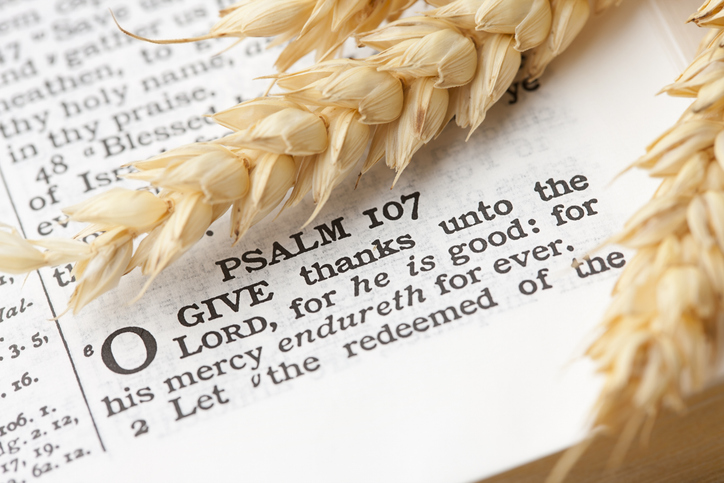
David wrote: “Give thanks to the LORD, for He is good.”  “Give thanks to the God of gods.”  “Give thanks to the Lord of lords.”  “For His Steadfast Love (mercy) endures forever.”  

In this psalm, David repeats that concluding phrase after every element of praise he states about the awesome God of Israel…. 25 TIMES!   For His Steadfast Love endures forever.  

Read all those praise phrases!  If you ever find your heart stingy and grumpy.  Read all these beginning praise praises. How awesome is our God. He does such wonderous things for His own people. He is strong and mighty.  He is tender and kind. 

SERIOUSLY!! Read them and praise Him.  

WHY is He so good to His own people???  For (because) his everlasting love and mercy towards us …. endures…. forever!  (FOREVER!  THINK ON THAT.)

(And then, after you read those praise phrases in Psalm 136, make a list of your own.  I’ll start…

  • Lord, You searched me out and found me – Why? Your love endures forever.
  • You saved me and gave me new life – Why? Your love endures forever.
  • You help me walk in righteousness – Why? Your love endures forever.
  • You forgive and restore me when I sin and repent – Why? Your love endures forever.
  • You supply all I need – Why? Your love endures forever.
  • You give me joy in sorrow and suffering – Why? Your love endures forever.
  • Your presence is with me, even in death – Why? Your love endures forever.
  • You have promised me eternal life with YOU – Why? Your love endures forever. 

And on, and on, and on…….

.

2 Chronicles 7b.

After all the celebration, glory, and praise, God appeared to Solomon in the cool, dark, silence of the night.

  • I have heard your prayer and have chosen this place for myself as a house of sacrifice.”  “My eyes will be open and my ears attentive to the prayer that is made in this place. For now I have chosen and consecrated this house that my Name may be there forever. My eyes and my heart will be there for all time.”

And then that verse we know so well, and often maybe mistakenly pray for our own countries.  God says about Israel, 

  • If my people who are called by name humble themselves, and pray and seek my face and turn from their wicked ways, then I will hear from heaven and will forgive their sin and heal their land.”
  • If you (Solomon) will walk before me as David your father walked, doing according to all that I have commanded you and keeping my statutes and rules, then I will establish your throne, as I covenanted with David your father, saying ‘You shall not lack a man to rule Israel.”

Such glorious promises!!

But there is a dire warning as well.  Sadly, this one comes to pass…. 

  • “BUT IF…. you turn aside and forsake my statutes and my commandments that I have set before you, and go and serve other gods and worship them, THEN….I will pluck you up from my land that I have given you, and THIS HOUSE THAT I HAVE CONSECRATED FOR MY NAME, I will cast out of my sight, and I will make it a proverb and a byword among all peoples.
  • And THIS HOUSE, WHICH WAS EXALTED, everyone passing by will be astonished and say, ‘Why has the LORD done thus to this land and this house?’
  • Then they will say, ‘Because they abandoned the LORD, the God of their fathers who brought them out of the land of Egypt and laid hold on OTHER gods and worshiped them and served them. Therefore He has brought all this disaster on them”

Solomon’s dream/vision turned into a nightmare of warning.  Will it keep his heart wholly for the LORD???

.

*As for the truth(s) about God that stays in my mind after this reading?  It is His utter, enduring, amazing grace and love that He has for His people …. until they raise a fist in His face, turn their backs on Him, and seek to fulfill their own sinful and prideful cravings away from Him.  EVEN THEN, He is willing to forgive and restore if they repent and return to Him.  SUCH MERCY and STEADFAST LOVE!


Journaling through the Bible Chronologically in 2025, Day 164

Day 164.  Reading 1 Kings 8, 2 Chronicles 5

Read Today’s Scriptures.

What truth about God stays in your mind?

1 Kings 8 and 2 Chronicles 5.

The Temple that King David had imagined, planned, and provided for, and that King Solomon had built … was finished.  A fantastic monument for the LORD GOD of Heaven, glorious and magnificent, only awaiting the breath of God Himself!

Solomon gathered all of Israel for the dedication. The priests were consecrated and sacrificed so many sheep and oxen that they could not be counted. Then, they brought up the Ark of the Covenant from Zion, the City of David. They placed it in the Most Holy Place in the Temple, under the wings of the cherubim.

And when they came out … a cloud filled the house of the LORD, so that the priests could not minister, for the GLORY of the LORD filled the house of the LORD!

King Solomon then blesses the LORD God of Heaven.

  • Blessed be the LORD, the God of Israel, who with His hand has fulfilled what He promised with His mouth to David, my father, saying… ‘Since the day that I brought My people Israel out of Egypt, I chose no city out of all the tribes of Israel in which to build a house, that My Name might be there. But I chose David to be over my people, Israel.’  Now it was in the heart of David, my father, to build a house for the name of the LORD, the God of Israel. (But the LORD said, you shall not build the house, but your son shall build the house for my name.)  NOW, THE LORD HAS FULFILLED HIS PROMISE.”

Then Solomon spread out his hands toward heaven and prayed a lengthy prayer to the LORD, filled with praise, humility, contrition, and confidence in God.

  • O LORD, God of Israel, there is no God like You, in heaven above or on earth beneath, keeping covenant and showing steadfast love to your servants who walk before you with all their heart.”  “Now therefore, O God of Israel, let your word be confirmed, which you have spoken to your servant David, my father (that he would not lack a man to sit before you on the throne of Israel). 

Solomon pleads that God when He hears prayer offered from that place, would hear it and forgive.

  • If a person sins against his neighbor and comes before the altar…
  • When the people of Israel are defeated because they have sinned…
  • When there is no rain because the people have sinned…
  • If there is a famine, pestilence, blight, mildew, locus, or enemy at the gates because they have sinned and they come before this place with repentance…
  • When a foreigner comes to pray before this place…
  • If your people go to battle and pray for help…
  • If they sin against You, and you send enemies to take them captive, and they turn to you….
  • If your people repent with all their mind and hearts…

Then, O God, hear in heaven Your dwelling place their prayer and their plea and maintain their cause and forgive your people who have sinned against you, and for all their transgressions that they have committed against You, grant them compassion.”

Then Solomon got up from his prayer and blessed all the assembly of Israel with a loud voice:

  • “The LORD our God be with us, as He was with our fathers, may He not leave us or forsake us, that He may incline our hearts to Him to walk in all his ways and to keep His commandments, statutes, and rules he commanded our fathers.  Let your heart, therefore, be wholly true to the LORD our God.”

After that, there were tons more sacrifices and offerings.  After eight days, the people went home to their houses, joyful and glad of heart for all the goodness that the LORD had shown to David, his servant, and to Israel, his people.

(More tomorrow on Solomon’s prayer and dedication and God’s well-known promise of forgiveness and healing. (2 Chronicles 7:14)

.

(Oh, the mountain-top experiences! How we all wish we could stay there. Filled with the joy of the LORD, praises, goodwill, and full tummies. 

There will be more good things about Solomon, but eventually, as he goes against the laws for a king, we will see him falter. God is faithful, but sin will show its ugly head in his own son’s reign. 

Message to me?  Stay alert, be on guard, for my heart tends to sin, pride, greed, and wishes for glory.)

Journaling through the Bible Chronologically in 2025, Day 163

Day 163.  Reading 1 Kings 7, 2 Chronicles 4

Read Today’s Scriptures.
What truth about God stays in your mind?
(We are on a break from Proverbs for a few days to catch up on Solomon and his building and dedication of the Temple of God.)

1 Kings 7 and 2 Chronicles 4.

SOLOMON’S PALACE

In a few verses (7:1-12), the description of Solomon’s own palace is given.  (It was larger than the Temple and stood just south of it.) It took the king thirteen years to build it.

Solomon called his palace “The House of the Forest of Lebanon” for the many cedar pillars, beams, ceilings, floors, and paneling. (Can you imagine the lovely cedar fragrance he breathed in each day?)

Some of the rooms were named “The Hall of Pillars,” “The Hall of the Throne,” and “The Hall of Judgment.” Connected to the palace were several halls for his personal living space and for that of his queen, the daughter of Pharoah. The foundations and walls were made of massive stones, 12-15 feet in length.

TEMPLE FURNISHINGS

Oh my!  Everything Solomon had made to furnish the Temple was larger, grander, and more numerous. The “sea,” which replaced the “basin” that had stood directly in front of the Tabernacle, was now 15 feet across, 7.5 feet high, and held 12,000 gallons of water. Ten movable carts with basins were made to transport water to this mini “swimming pool” used for washing priests and sacrificial animals. To support this massive basin were 12 bronze oxen underneath, three facing in each direction.  WOW!

Inside the Holy Place, instead of one lampstand, there now stood ten, half on either side, plus all that was necessary to keep them burning.  Ten tables for the shewbread were made, equally divided, north and south, but only one golden altar of incense. It stood before the Most Holy Place.

Only the Ark of the Covenant was not remade.

The Holy Place and The Most Holy Place were both lined with pure gold.  In the Most Holy Place stood the two golden cherubim that Solomon made, wings spread out to touch each other and the sides of the room. They both faced the Holy Place, though The Veil separated the rooms.  (The Ark of God would be set between them).

Outside the Temple, holding up the wide porch, were two massive bronze pillars, 27 feet high (plus the capitals, which added another 7.5 feet) and 18 feet in circumference. Solomon named them Jachin and Boaz, which meant, “He shall establish” and “In it is strength.”  They would remind the people and the king of the stability and strength of God’s promises of a “forever” Kingdom of David.

Solomon also had made all the vessels that would be used in the Temple worship. King Hiram’s man, Huram-abi led in the design and construction of them all.

.

Tomorrow…. the Ark of God is brought in.