Archives

Journaling through the Bible Chronologically in 2025, Day 340

The LAST Month of 2025’s Reading!

Day 340 – Reading – 2 Corinthians 10 – 13

Read and believe in Jesus!

 2 Corinthians 10-13

Chapters 10-13 have a somewhat different tone as Paul prepares the Corinthians for his promised 3rd visit.  In these chapters, he defends his ministry (as opposed to those “super-apostles” trying to turn them away); he “boasts” some about his travails; mentions that amazing vision of Heaven and subsequent “thorn in the flesh;” and gives his final exhortation to them to examine their own hearts.

2 Corinthians 10.

Paul agrees with his accusers that when he is away from the Corinthians, he’s bold in his rebukes, but when he is with them, he’s like a lamb.  It’s because he loves them and want’s sweet fellowship with them when he is there. 

He admits that they are all walking in their “fleshly” bodies, but the war for their sanctification is waged spiritually.

  • The weapons of our warfare are not of the flesh but have divine power to destroy strongholds. We destroy arguments and every lofty opinion raised against the knowledge of God. We take every thought captive to obey Christ, being ready to punish every disobedience, when your obedience is complete.”

Paul says he doesn’t want to appear frightening to them with his boasts of the authority, but the Lord gave him such authority so to reach them. 

.

2 Corinthians 11.

Paul is stern with them because he is divinely jealous of them, as a husband to a wife. He’s afraid they will be led astray from a “sincere and pure devotion to Christ.”  Let any who proclaim another Gospel be accursed.

“Even if I am unskilled in speaking, I am not unskilled in knowledge. I am not in the least inferior to those “super-apostles” who attempt to sway them. THEY are deceitful workmen, disguising themselves as apostles of Christ.  And no wonder!  Satan disguises himself as an angel of light, so no surprise that his servants make themselves appear righteous!

Paul’s embarrassed to boast of his credentials, but he feels the Corinthians need it. 

  • He, too, is a Hebrew and Israelite, a son of Abraham, and a better servant of Christ. 
  • He’s done far greater labors, far more imprisonments, countless beatings, and often near death.
  • Five times he received the 39 whips from the Jews, three times he was beaten with rods. Once, he was stoned. Three times he was shipwrecked (with 24 hours adrift in the sea)
  • On frequent journeys, in danger from rivers, robbers, his own people, Gentiles, in the city, in the wilderness, at sea, and from false brothers.
  • In toil and hardships, through many sleepless nights, hungry and thirsty, often without food, in cold and exposure.
  • AND … apart from that, there is the daily pressure on him of the anxiety for all the churches.
  • And once – this seems to be the most humiliating of all to Paul – he was let down in a basket through a window in the wall of Damascus to escape the governor!!!

WOW!! How much have “I” suffered for Christ and the ministry?  Nada.

.

2 Corinthians 12.

And then Paul tells of the most amazing happening of all.  He uses the 3rd person to avoid self-aggrandizement. 

  • Fourteen years ago, ‘this man’ was caught up into Heaven (God’s dwelling place), whether in the body or not, he couldn’t tell. ‘This man’ was in Paradise, and he heard things that cannot be told, which man may not utter. On behalf of ‘this man I will boast, but on my own behalf I will NOT boast, except on my weaknesses. I refrain from boasting SO THAT no one will think more highly of him than he should.
  • So… to keep me from becoming conceited because of the surpassing greatness of the revelations, a thorn was given to me in the flesh, a messenger of Satan to harass me, to keep me from becoming conceited. ****
  • Three times I pleaded with the LORD about this, that it should leave me.  But He said, “My grace is sufficient for you, for My power is made perfect in weakness.”  Therefore, I will boast all the more gladly of my weaknesses, so that the power of Christ may rest on me.  For the sake of Christ, then, I am content with weaknesses, insults, hardships, persecutions, and calamities. For when I am weak … then I am strong.”

Then Paul says he’s been a fool, but they forced him to do it.  THEY should have commended him, but he had to do it himself to show he was not inferior to those super-apostles. 

Paul did among them the signs of a TRUE APOSTLE – signs and wonders and mighty works.

Like a parent (which he was to them), he was glad to spend and be spent for their souls.  He LOVED them.

.

2 Corinthians 13.

And so, before his third visit, Paul gives them final warnings. He would not “spare” those he’d warned before if they had not repented.

They are to “Examine themselves, to see whether they are IN THE FAITH.  They should test themselves to see if Jesus Christ is IN them.   “We pray to God that you may not do wrong, that you may have met the test and are doing what is right.”

THIS IS WHY he was writing to them.  Their restoration is what he prays for.  He doesn’t want to be so severe when he comes, using the authority the Lord gave him to build up the churches.

  • And so, rejoice!  Aim for restoration, comfort one another, agree with one another, live in peace;  and the God of love and peace will be with you.”

.

**** NOTE:  There have been many speculations as to what that “thorn in the flesh” was.  Yes, it was “a messenger of Satan,” but it was GOD who sent it.  Like Job, God allowed Satan to afflict Paul’s body in some way to keep him humble.

Some believe it was a continual eye problem, a gradual blindness, perhaps.  Paul mentions that the Galatian churches would have gladly gouged out their own eyes and given them to him. (Galatians 4:15)

Some believe this “thorn” was a demonized person, a demon indwelling the ringleader of the Corinthian conspiracy, the leader of those “false apostles.”  Paul says the “thorn” was sent to “harass” him. “Harass” always refers to ill-treatment from other people. And in the O.T., Israel’s opponents are described “thorns.”

However you view Paul’s thorn, I think the identity was kept vague, so that we, too, might see an evil person, a condition, or an experience as a warning from God or a way to keep us humble.  AND to be assured that God’s GRACE is sufficient in whatever situation.  We can trust Him.


Journaling through the Bible Chronologically in 2025, Day 179

Day 179.  Reading 1 Kings 20-21

 
Read today’s Scriptures.

1 Kings 20….

…tells a surprisingly good story about the wicked King Ahab.  Until the last part, that is.

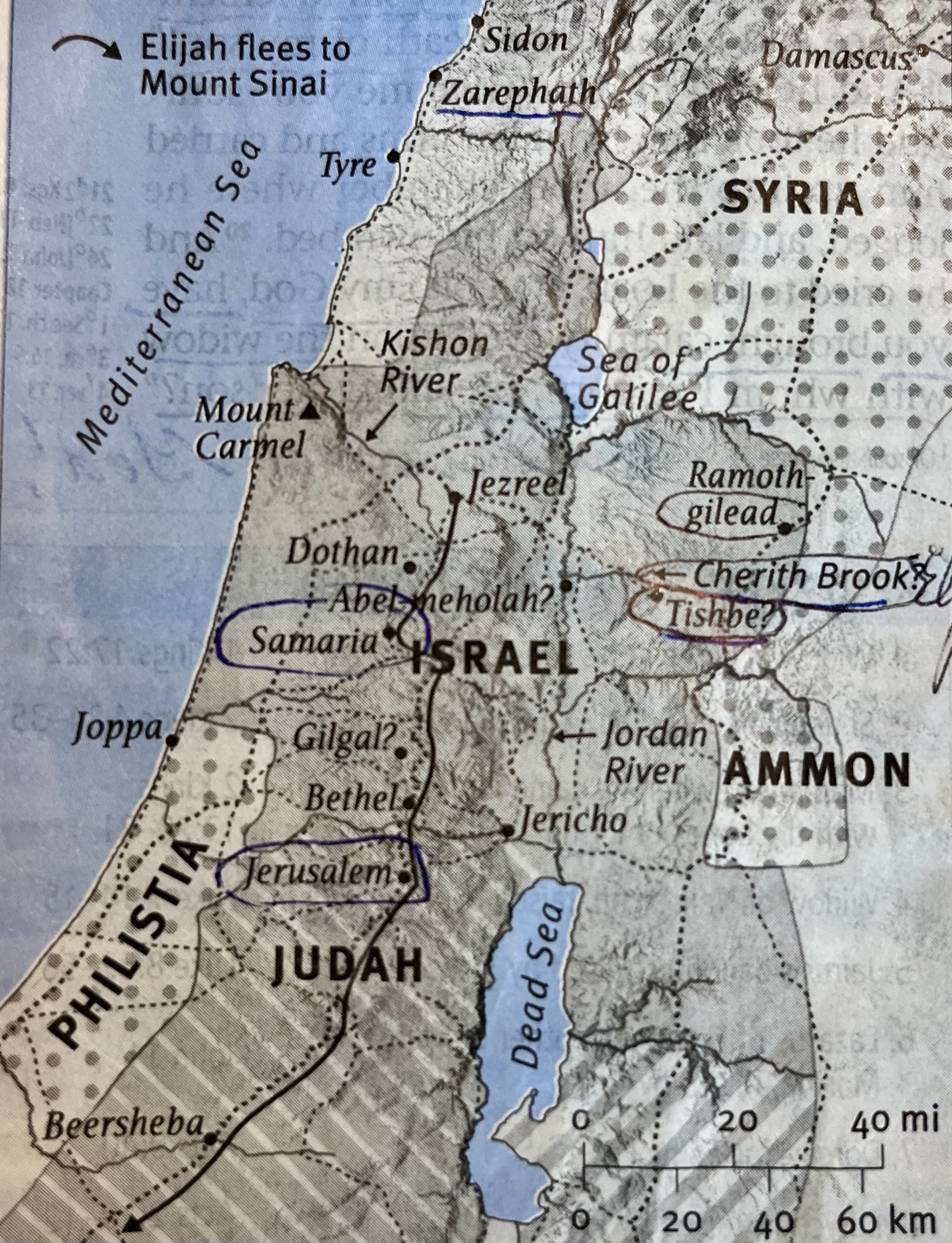
We see King Ben-Hadad, king of Syria, again in this chapter. (Syria is the country just north-east of Israel, with Damascus as the capital.) (This map also shows the two places Elijah stayed during the drought, and Mt. Carmel, where the great “showdown” happened. Samaria is the capital of Israel, where Ahab lives.) 


Remember, in Chapter 15, King Asa (south) had paid Ben-Hadad a large amount of gold and silver from the temple, to harass King Basha (north) so he’d stop fortifying the border. The Syrian King had agreed. Now, it seems, Ben-Hadad was sure King Ahab could also be easily defeated.

Hey, King Ahab, give me your silver and gold and the best of your wives and children.” 

“Okay, sure,” said Ahab.

Then Ben-Hadad got greedy. “I will send my servants to you tomorrow, and they will search your house and take whatever pleases them.”

Um, no! The gold and silver and best wives and kids I will do, but NOT THAT,” sent back King Ahab.

Okay, then. It’s war!”

“Make my day!” replied Ahab.

Now, here is the strange part.  A prophet of God came to Ahab and told him that he would get the victory, “So you will know that I am the LORD.”  Ahab got some military instructions from the prophet, and at noon they went out to confront King Ben-Hadad’s army.

The Syrian king was drunk, however, and commanded, “If they come in peace, TAKE THEM ALIVE!  But if they come out for war …. TAKE THEM ALIVE!”  (Huh?)

Ben-Hadad didn’t have the chance to do either, because King Ahab struck his forces a “very great blow!” The Syrians fled and Ben-hadad escaped on a horse.

The prophet of God told King Ahab to rest up, for in the Spring the king of Syria would be back.  (Now, the Syrians believed that Israel’s God was only a god of the hills. That’s why they were defeated.  Next time they would bring lots of chariots and fight on the plains.  The Jewish God would be defeated there.)

Oh, Syria.  You’ve a lot to learn!!

So, in the spring Ben-Hadad mustered the Syrians and went up to fight against Israel … in the plains. The army of Israel that encamped before them was as “two little flocks of goats” compared to the Syrians who filled the country.  (Hahaha. Oh, Ben-Hadad, did you never hear of David and Goliath??)

The prophet of God came to Ahab and said, “BECAUSE the Syrians claim the LORD is only a god of the hills, I will give all this great multitude into your hand, and YOU SHALL KNOW that I am the LORD.”

And the people of Israel struck down of the Syrians 100K foot soldiers in one day.  When the rest fled to a town, the wall fell on them and 27K more were killed.  Ben-Hadad hid deep in the town and sent a message to King Ahab, “Please let me live.

AND HERE IS WHERE KING AHAB WENT WRONG.  God had “devoted the Syrian king to destruction,” meaning he was to be killed.  But King Ahab thought it would be cool not to kill him.

He’s alive? He’s “my brother!” he said.

Yes! Your brother, Ben-Hadad!”

Go, bring him out.”

When the Syrian king was brought out, King Ahab invited him up into his own chariot. And the two kings made a trade deal between their countries. And …. Ahab let him go.

LATER…

The prophet of God came to King Ahab with a bit of play-acting, but then told him.  “Because you have let go the man whom I had devoted to destruction, therefore YOUR life shall be for HIS life, and YOUR people for HIS people.”  Dire news indeed.  Instead of the Syrians and their king under this law, now Ahab and Israel would be “devoted to destruction.”

Ahab, went home, vexed and sullen.  

.

1 Kings 21.

King Ahab’s boredom caused him to sin.  He saw a lovely vineyard that he coveted for himself. It belonged to another, but he WANTED it, and the obsession grew. 

(Oh, my goodness, this reminds me of our favorite King David. 

Idleness is a TERRIBLE sin.

It leads to much worse sin. 

Desire and lust and a flame in the belly, which James 1:14-15  says leads to death.

Watch out for it!!)

Ahab at first proposed to Naboth, the vineyard’s owner, that he give it to the king, in exchange for a “better vineyard.”  Or… he could sell it to Ahab, who would give him the vineyard’s value in money.” 

Reasonable, right?  NOT!

What Ahab neglected to realize in his coveting, is that the men of Israel had their land as a divine allotment from God.  They were not to sell/give it to someone outside their tribe.  He said “The LORD forbid that I should give you the inheritance of my fathers.”

Ahab “lay down on his bed and turned away his face and would eat no food.”  

Really??  What a spoiled-brat!!

Enter his wicked wife, Jezebel.  “Hey, Hubby.  What’s wrong?”

“Naboth won’t give me his vineyard!”

“ARE YOU NOT THE KING OF ISRAEL!” she said.  “Get up, eat some bread, be happy!  I’ll get the vineyard for you!’

And the wicked Jezebel set into motion her wicked plan.  She defamed Naboth before of the town council, and tricked them into condemning the innocent vineyard owner. They killed him and sent a sweet note to the Queen.

Naboth has been stoned. He is dead.”

And so, she skipped into King Ahab’s room with the news, “Arise, take possession of the vineyard for Naboth is not alive, but dead.”   And quickly, without any questions, Ahab got dressed and went down and took possession of it.

Sick!  And after all God had done for the king!

And God sent His top man, Elijah, to condemn the king.  “Arise, Elijah, go down and meet Ahab king of Israel in the vineyard of Naboth.

With this gruesome prophecy.

  • Thus says the LORD: ‘In the place where dogs liked up the blood of Naboth, shall dogs lick up YOUR blood.”

Oh, my enemy!  You have found me!” said Ahab to Elijah.

And the LORD’s message continued.

  • I have found you because you have sold yourself to do what is evil in the sight of the LORD.
  • I will bring disaster upon you. I will utterly burn you up, and will cut off from Ahab EVERY MALE, bond or free in Israel.   
  • And….. of Jezebel, the dogs shall eat Jezebel within the walls of Jezreel.
  • Anyone belonging to Ahab who dies in the city, the dogs shall eat, and anyone of his who dies in the country the birds of the heavens shall eat.”   

(And oh, wow, you will read about this happening in 2 Kings 9:10, 30-37.)

(“There was none who sold himself to do what was evil in the sight of the LORD like Ahab, whom Jezebel his wife incited.  He acted very abominably in going after idols.”)

And here’s another VERY INTERESTING DEVELOPMENT. Ahab tore his clothes, put on sackcloth and fasted. (This was not his usual pouting.)  In the Old Testament, this is a sign of REPENTANCE.  Was it sincere? 

God saw this evil, weak, man’s heart. “Because he has humbled himself before me,” said the LORD. “I will not bring this disaster in his days, but in his son’s days I will bring the disaster on his house.”

.

(Wow. There is hope for you and me.  God sees a person’s heart. He knows if repentance is real. He knows if we truly will humble ourselves before Him.  O, my heart, fall on your knees before the all wise, living God. He is merciful to save.)


Journaling through the Bible Chronologically in 2025, Days 166 & 167

Sundays and Mondays studies are posted together on Mondays

Day 166. Reading Psalm 134, 146, 147, 148, 149, and 150.

Day 167.  Reading 1 Kings 9,  2 Chronicles 8

Read Today’s Scriptures.
What insight or comfort do you receive?
 

Day 166 – Psalm 134 – 150.

What a wonderful psalm to remind us of Solomon’s dedication of the Temple.

  • Come, bless the LORD, all you servants of the LORD who stand by night in the house of the LORD!
  • Life up your hands to the holy place and bless the LORD!
  • May the LORD bless you from Zion, he who made heaven and earth!

Oh, DO READ the rest of these Psalms to 150.  These are the songs the people sang as they “sent up to Jerusalem” for the feasts of the Lord. They are psalms of praise!

Here’s just a verse or two from each.

  • Psalm 146.  “Praise the LORD! Praise the LORD, O my soul! I will praise the LORD as long as I live; I will sing praises to my God while I have being.”
  • Psalm 147. “Praise the LORD! For it is good to sing praises to our God; for it is pleasant, and a song of praise is fitting.”  “Sing to the LORD with thanksgiving, made melody to our God on the lyre.”
  • Psalm 148. “Praise the LORD! Praise the LORD from the heavens, praise Him in the heights! Praise Him all his angels, praise Him, all His hosts!  Praise Him, sun and moon, praise Him, all you shining stars! Praise Him, you highest heavens, and you waters above the heavens.”
  • Psalm 149. “Praise the LORD! Sing to the LORD a new song, His praise in the assembly of the godly!”
  • Psalm 150. “Praise the LORD!”   “Let everything that has breath praise the LORD! PRAISE THE LORD!”


###


Day 167 – 1 Kings 9a.

The first part of this chapter repeats God’s “If-Then” blessings and warnings to Solomon and Israel.

IF Solomon will walk in the ways of David with integrity of heart and uprightness, keeping God’s statutes and rules … THEN God will establish his royal throne over Israel forever.

But IF Solomon and Israel do NOT keep God’s commandments and statutes but serve other gods and worship them … THEN God will cut off Israel from the land and make it a byword and a proverb among the peoples. And the “house” (Temple) will become a pile of ruins.

Dire warnings, indeed!

1 Kings 9b and 2 Chronicles 8.

It took Solomon twenty years to build the Temple, his own palace, and the palace of his queen. The queen’s “house” was outside Jerusalem, away from the temple, because she was the daughter of Pharaoh, a pagan, and Solomon did not want her living near the Ark of the Covenant.  

(You wonder why Solomon’s first wife (of Song of Solomon?) was a pagan Egyptian, the very people from whom God had rescued Israel. It was breaking God’s specific law about a King’s marrying.  Yes, it was a political deal, and Pharaoh had killed a bunch of Canaanites and given a city to Solomon as part of the dowery for his daughter, but still …  

  • Deuteronomy 7:3-4. “You shall not intermarry with them (pagans) giving your daughters to their sons or taking their daughters for your sons, for they would turn away your sons from following me, to serve other gods…”
  • 1 Kings 11:1-4.Now King Solomon loved many foreign women, along with the daughter of Pharaoh …. “Solomon clung to these in love …. “And his wives turned away his heart. For when Solomon was old, his wives turned away his heart after other gods, and his heart was not wholly true to the LORD his God as was the heart of David, his father.” 

There go God’s promises.

But meanwhile, Solomon got busy building cities.  He gave twenty of them in Galilee to King Hiram in appreciation for all the help and material he had supplied. But Hiram didn’t like them and gave them back. (What??)

Solomon used forced labor (slaves) for all his building projects, much like his father-in-law, the Pharaoh, had done.  But since God’s law forbade any Jewish people from being enslaved, Solomon used the Canaanites, which they had captured, to do the work and oversee the projects.

Solomon filled in the land depression between the city of David and the temple/palace, built the wall of Jerusalem, and the military outposts of Hazor, Megiddo, Gezer, and others, as well as grain storage cities (also like Pharaoh), and cities for stabling his horses and chariots.  He also built a fleet of ships at Ezion-Geber on the shore of the Red Sea for international trading. (Gold from Ophir, etc.) (King Hiram sent ship-builders and seamen to teach Solomon’s workers the trade.)

“And whatever Solomon desired to build in Jerusalem, Lebanon, and in all the land of his dominion, he built.”

It’s interesting that in Ecclesiastes, Solomon bemoans all this grandeur and wealth as “vanity,” worthless to his soul. (We’ll get there soon.)

##

  • 1 Timothy 6:6-10.  Now there is great gain in godliness with contentment, for we brought nothing into the world, and we cannot take anything out of the world. But if we have food and clothing, with these, we will be content. But those who desire to be rich fall into temptation, into a snare, into many senseless and harmful desires that plunge people into ruin and destruction.  For the love of money is the root of all evils. It is through this craving that some have wandered away from the faith…”


  • Hebrews 13:5.  “Keep your life free from love of money, and be content with what you have, for he has said, “I will never leave you nor forsake you.”

Oh, Father, keep me from greed and a desire for riches and the abundance of “things.”  Help me see the so much greater value of knowing YOU. Help me to be content with what I have.


Journaling through the Bible Chronologically in 2025, Day 156

Day 156.  Reading Proverbs 7 – 9.

Read Today’s Scriptures.
Name some things you have learned about Wisdom.
.
Proverbs 7.

Solomon continues with his warnings about the Adulteress. He knows his son (and perhaps he, himself) needs to be repeatedly told of her sly ways.

But first, he extols the virtues of the other woman, Wisdom. “Keep my WORDS, treasure up my COMMANDMENTS, keep my TEACHING as the “apple (pupil) of your eye,” and write them on your heart.”

Let your “sister” and “intimate friend,” Wisdom, “keep you from the forbidden woman, from the adulteress with her smooth words.

  • This reminds me of David’s Psalm 119:11, “Thy Word have I hid in my heart, that I might not sin against thee.”

Then follows a scene that has happened many times. A young man is lured to the house, the arms, and the bed of either an adulterous wife or a prostitute. She is wily; she knows what he wants; she tells him what he wants to hear. She’s ritually “clean,” and her husband is far away.  Oh my!

And the fellow listens and follows “as an OX goes to the slaughter, or as a STAG is caught fast till an arrow pierces its liver, as a BIRD rushes into a snare.  He does not know that it will cost him his life.”

  • James 1:14-15 says, “Each person is tempted when he is lured and enticed by his own desire. Then desire when it has conceived gives birth to sin, and sin when it is fully grown brings forth death.”
  • James 1:5 also says, “If any of you LACK wisdom, let him ask of God, who gives generously to all without reproach, and it will be given him.”

“O sons! Listen to me.  Let not your heart turn aside to her ways.”

.

Proverbs 8.

Now Solomon praises the “other path,” that of Wisdom (sometimes personified as Christ).  Unlike the Adulteress, Wisdom’s call is faithful and righteous.

  • On the heights beside the way, at the crossroads, she takes her stand; besides the gates in front of the town, at the entrance or the portals, she cries aloud, “To you, O men, I call, and my cry is to the children of man.  O simple ones, learn prudence; O fools, learn sense. HEAR, for I will speak noble things, and from MY lips will come what is right, for the words of MY mouth are righteous.”

And then Wisdom’s worth.

  • Take my instruction instead of silver, and knowledge rather than choice gold, for wisdom is better than jewels, and all that you may desire cannot compare with her.  My fruit is better than gold, even fine gold, and my yield is better than choice silver.

Christ used His eternal Wisdom in creation.

  • The LORD possessed me at the beginning of His work, the first of His acts of old. Ages ago I was set up, at the first, before the beginning of the earth. 
  • When He established the heavens, I was there; when He drew a circle on the face of the deep… when He made firm the skies above… when He established the fountains of the deep… when He assigned to the sea its limit… when He marked out the foundations of the earth, then I was beside Him, like a master workman.
  • I was daily His delight, rejoicing before Him always, rejoicing in His inhabited world and delighting in the children of man.”

Blessed are those who keep my ways.

Blessed is the one who listens to me

Whoever finds me finds life and obtains favor from the LORD.

.

Proverbs 9.

Solid truth: “The fear of the LORD is the beginning of wisdom, and the knowledge of the Holy One is insight.”

The pleasant, abundant, long-lasting ways of Wisdom are contrasted now with the ways of “Folly.”

  • The woman Folly is loud; she is seductive and knows NOTHING.
  • She sits at the door of her house; she takes a seat in the highest places of the town and calls to those who pass by.  “Stolen water is sweet, and bread eaten in secret is pleasant.”
  • But the listener does not know that the DEAD are there, that her guests are in the depths of Sheol.

And so, Solomon ends his warnings there.  Does his son(s) hear and respond?  Does he “get” Wisdom? Does he learn to fear the LORD above all?

.

Do I heed the sweet words of Wisdom?  Do I shun the blatant, off-key untruths of Folly? 

O, LORD, the Holy One, please keep me on the narrow way. May I not be tricked and seduced by my own desires but seek You and Your face always!   

Remind me constantly to keep Your Word in my heart as a guardrail against Folly.” 

Journaling through the Bible Chronologically in 2025, Day 143

Read Today’s Scriptures.
2 Samuel 24 and 1 Chronicles 21

Okay, David… sigh.

You “blew it” before, you had to run for your life, and you lost two, no three sons, why would you now do something else foolish?

1 Chron 21:1 says, “Then Satan stood against Israel and incited David to number Israel.”

God sovereignly used Satan in this matter. And for some reason — perhaps a fear of an attack by enemies, perhaps pride, or maybe ambition, or some other unknown sin of Israel — David yielded to the temptation of Satan, and CHOSE to go against God’s will and NUMBER ISRAEL to see how many men were fit for the army.

DAVID:  “Joab, Go through all the tribes of Israel, from Dan to Beersheba (top to bottom), and number the people that I may KNOW the number of people…and bring me a report.”

Well, old Joab surprised me here. He actually cautions the king.

JOAB:  “May the LORD add to His people a hundred times as many as they are while the eyes of my lord the king still see it, but why does my lord delight in this thing? Are they not, my lord the king, all of them my lord’s servants?  Why then should my lord require this?  Why should it be a cause of guilt for Israel?”

But David insisted. So Joab and his men went throughout Israel and came back to Jerusalem nine and a half months later with the numbers.

NOTE:  There is a seeming discrepancy between the totals between the 2 Samuel and the 1 Chronicles accounts. Never fear. You can trust the word.  2 Samuel reports a different way of numbering: all the men, plus from Judah, including the ones already in his army. 1 Chronicles says Joab stopped the counting before he included Benjamin (or Levi) because it abhorred him.  David also stopped the counting at some point because of God’s conviction.

David’s heart struck him. “I have sinned greatly in what I have done, but now O LORD, please take away the iniquity of your servant, for I have done very foolishly.”

(NOTE: A census is not wrong in itself. God called for them in Numbers 1 and 28.  But they were for reasons the LORD mentioned, and not to puff up a sinful king.)

And so God sent the prophet Gad to David (as he had done with Nathan).  Gad was to give David THREE OPTIONS of judgment, as the result of his sin. And ALL the options meant pain and suffering for ISRAEL

  1. three years of famine on the land
  2. three months of fleeing from a pursuing enemy
  3. three days of plague on the land.

David was in great distress.  “Let us fall into the hand of the LORD, for His mercy is great, but let us not fall into the hand of man.”

And so, the LORD sent a plague on Israel.  From Dan to Beersheba 70,000 men died. But when the Angel of Death put out his hand toward Jerusalem to destroy it, THE LORD RELENTED FROM THE CALAMITY and said to the angel, “It is enough.”

David was distraught. “I have sinned and done wickedly.  But these sheep (the people of Israel), what have they done. Please let your hand be against me and my father’s house.”

The LORD told him to raise an altar on the threshing floor of Araunah/Ornan, the Jebusite. When David went there, the man said he would give the place (and the oxen to sacrifice) to the king FOR FREE. But David said he would not offer to the LORD that which had not cost him anything.  He paid the price asked, built an altar, and offered burnt offerings and peace offerings.

And the LORD stopped the plague on the people of Israel (“The Angel of the LORD put his sword back into its sheath”}.

.

Psalm 30.

Joy comes in the morning…

  • O LORD my God, I cried to You for help, and you have healed me.
  • O LORD, you have brought up my soul from Sheol; You restored me to life from among those who go down to the pit.
  • Sing praises to the LORD, O you His saints, and give thanks to His holy Name.
  • For His anger is but for a moment, and His favor is for a lifetime.
  • Weeping may tarry for the night, but joy comes in the morning.
  • You have turned for me my mourning into dancing; You have loosed my sackcloth, and clothed me with gladness, that my glory may sing your praise and not be silent. O LORD my God I will give thanks to you forever.

.

And David said, “HERE shall be the house of the LORD God and HERE the altar of burnt offering for Israel.”  This is where the Jerusalem temple was to be built by Solomon.

1 Chronicles 22.

And so, David prepares for the Temple building.

David set stonecutters to prepare the great stones for building the House of God.  He provided great quantities of iron for nails and clamps, as well as bronze in quantities BEYOND WEIGHING, and cedar timbers without number from the kings of Tyre and Sidon. (Lebanon)

DAVID:  “Solomon my son is young and inexperienced, and the house that is to be built for the LORD must be exceedingly magnificent, of fame and glory throughout the lands.” 

So David said to Solomon….

  • “My son, I had it in my heart to build a house to the Name of the LORD my God. But the word of the LORD came to me, saying….
  • You have shed much blood and have waged great wars. You shall not build a house to my Name, because you have shed so much blood before me on the earth. Behold a son shall be born to you who shall be a man of rest. I will give him rest from all his surrounding enemies.  For his name shall be Solomon (peace), and I will give peace and quiet to Israel in his days.  HE shall be my son, and I will be his father, and I will establish his royal throne in Israel forever.”
  • Now, my son, the LORD be with you, so that you may succeed in building the house of the LORD your God, as He has spoken concerning you. Only, may the LORD grant you discretion and understanding, that when he gives you charge over Israel you may keep the law of the LORD your God. Then you will prosper if you are careful to observe the statutes and the rules that the LORD commanded Moses for Israel.  Be strong and courageous. Fear not do not be dismayed.  Arise and work!  The LORD be with you!”

David also commended all the leaders of Israel to help Solomon.  “Arise and build the sanctuary of the LORD God, so that the Ark of the Covenant of the LORD and the holy vessels of God may be brought into a house built for the Name of the LORD.

Journaling through the Bible Chronologically in 2025, Day 74


Read today’s scripture.

What do you learn about NEW God’s goodness?

Who can you share that with today?

Deuteronomy 11.

Again, Moses pounds home the promises and warnings of Israel’s God, “Love the LORD your God and keep His charge, His statutes, His rules, and His commandments always … that you may be strong, and go in and take possession of the land, and that you may live long in the land.” 

That land drinks water by the rain from heaven, a land that the LORD your God cares for. His eyes are always upon it, from the beginning of the year to the end of the year. He will give rain for your land in its season, the early rain and the later raid, that you may gather in your grain, wine, and oil. He will give grass in your fields for your livestock, and you shall eat and be full.”

“So love the LORD your God, and serve Him with all your heart and soul.”  “And if you are careful to do all the commandment that I command you to do, loving the LORD your God, walking in all His ways, and holding fast to him … then the LORD will drive out all those nations before you, nations greater and mightier than you. Every place on which the sole of your foot treads shall be yours. NO ONE will stand against you. The fear of you and the dread of you the LORD will put on all the land.”

“But if you do not… a curse.

Deuteronomy 12.

Their main task in conquering the land is to “destroy all the places where the nations serve their gods, on mountains, hills and under every green tree. They are to tear down, dash into pieces, burn, chop into pieces, and utterly destroy any images and idols. They are to NOT, NOT, NOT worship them, in any way, place, shape or form.  AND, they shall worship and sacrifice ONLY at the place where the LORD chooses to put His name and home. And ONLY in the manner He has taught them.

But… they CAN eat any clean meat now, whenever they wish, as much as they wish, of their flocks and herds and of gazelles or deer.  Only the animals pledged for sacrifice, offerings, and vows they shall only eat in God’s presence.

Deuteronomy 12.

WARNING:  If anyone – a dreamer of dreams or “prophet” tells you to go after other gods to serve them -DO NOT LISTEN!  That person shall be put to death, and so you shall purge evil from your midst. 

EVEN if your own brother, mother, or friend entices you to serve other gods, DO NOT YIELD or LISTEN to them. You shall not pity, conceal, or spare him.  You shall kill him. (stone him) YOU, YOURSELF shall cast the first stone!

AND if any worthless men in another city try to draw away the inhabitants to serve other gods, you shall (first) inquire, make search, and ask diligently.  If it is so, then you shall destroy the inhabitants of that city with the sword – all who are in that city, even its cattle, and burn everything else.  WOW. GOD IS SERIOUS!

.

****O LORD, if only WE were as diligent in destroying the things in our lives that distract us from your Word, or prayer or in serving You in any way. Help us to deny ourselves, give them up, throw them away, ask others to help us in our addictive ways … and repent to serve and love YOU ONLY!

Journaling through the Bible Chronologically in 2025, Day 63


Read today’s scripture.

What do you learn about God’s goodness?

Who can you share that with today?

Numbers 21.

Let the battles begin!

Living in the Negev (South desert) was the small kingdom of Arad. The king captured a few Jews. Israel vowed to the LORD, if He would give them this people, they would “devote all the cities to destruction.”  God did, and they did, and they named it Hormah (destruction). 

After that victory they set themselves to go around Edom and to turn north on the Eastern side of the Dead Sea/Jordan Valley.  BUT!!!!! The people became impatient. They spoke against God and Moses. There’s no food. There’s no water. And we hate this worthless manna.”

(Sigh)

Obviously there were still some of the “Old Guard” among them who needed killing.  God sent fiery serpents among them. (Eek!!) The snakes bit many people and they died a horrible death.

Moses! We have sinned, for we haven spoken against the LORD and against you.  Pray to the LORD to take away the serpents!”

Moses prayed, and the LORD provided a way to defeat the snakes’ poison. Moses was to make an image of a serpent and put it on a pole to hold high up.  When the people looked on the bronze serpent (believing  what God said) they would be healed.   

(Jesus used this Old Testament story to show how HE would be lifted up on a CROSS, and if anyone looked to HIM in faith, they would be saved from death.)

Israel swung around the southern and eastern boarders of Edom, and past Moab on the Eastern side of the Dead Sea and Jordan Valley to the Arnon River**, the boarder between Moab and the Amorites. 

(**NOTE:  I picture the land on the east side of the Jordan River Valley from Galilee down to the bottom of the Dead sea, like the figure of a man with the rivers at parts of his body. 

  • Going into the bottom of the Dead Sea is the ZERED BROOK. Think of that as the feet of the man-figure, wearing zories (flip-flops).
  • The ARNON RIVER enters the Dead Sea about midway. I think of that as an “iron-on patch” on the man-figure’s knees. 
  • Further up the JABBOK RIVER flows into the Jordan between the Dead Sea and the Sea of Galilee. I picture this as a finger jabbing the man-figure in the ribs. 
  • The YARMOUK RIVER flows into the Jordan just south of Galilee.  I picture that as the Yarmulka (skull cap) on the head of the man-figure. 

I know, I’m weird, but “pictures” help me remember.)

Numbers 22. 

So, Israel is camped near the Arnon River, which is the boarder between the Amorites and Moabites. They send a message to Sihon, king of the Amorites, asking him to let them pass through their land.  “Nope! Let’s fight.”  And Israel soundly beat them, all the way to the Jabbok River. And Israel moved into the territory.

Og, the city king of Bashon came out against Israel, but God told Israel not to worry. As they’d defeated Sihon, they would defeat Og.  And so they did.  Then Israel camped in the plains of Moab on the East of the Jordan River at Jericho.

Balak king of Moab sent messages to the Midianites about Israel. This horde will not like up all that is around us, as the ox licks up the grass of the field.” And he sent a personal message to Balaam, a seer/prophet.  Behold, a people has come out of Egypt. They cover the face of the earth, and they are dwelling opposite me. Come now, curse this people for me, since they are too mighty for me. I know that whomever you bless is blessed, and whomever you curse is cursed.”

The elders of Moab and Midian, raised a “fee for divination” to give to Balaam. 

But Balaam told them to wait a night while he asked God.  God said, “You shall NOT go with them. You shall NOT curse the people, for they are blessed.”

So far, so good with Balaam. He told the messengers “no” and they left.

BUT, the kings would not accept “no.”  They sent messages back saying they would give Balaam “great honor” and whatever he asked for. 

Balaam holds steady at first. “Though Balak were to give me his house full of silver and gold I could not go beyond the command of the LORD…. BUT….. stay here tonight and I will inquire of the Lord again.” 

Ah-OH. Didn’t God already say NO?

God said, “You can go with them, BUT ONLY DO WHAT I TELL YOU.”

The next part is weird, because “God’s anger was kindled because Balaam went.”  God probably knew that Balaam would actually try to curse the people and get the money. So God sent an angel to stop him. Except Balaam did not SEE the angel with the drawn sword blocking the road. ONLY THE DONKEY SAW IT. What??

Balaam beat the poor donkey because it kept turning aside into the bushes, and scratching his legs.

FINALLY, THE DONKEY SPOKE!!!  “Am I not your donkey, on which you have ridden all your life to this day?  Is it my habit to treat you this way?”

AND BALAAM ACTUALLY ANSWERED THE DONKEY!  “No.”

And the LORD opened his eyes to see the angel.

Balaam realized he’d sinned and said he’d turn back. But God said THAT was NOT His plan. Balaam was to go with them…. but ONLY SAY WHAT GOD TOLD HIM.  Perhaps Balaam understood this time, for he went with the men and warned the king he could only say what God gave him.

In the morning, King Balak took Balaam up on a hill and showed him “a fraction” of the masses of Israel.

.

WHAT WILL BALAAM DO? Stay tuned for tomorrow. 


Journaling through the Bible Chronologically in 2025, Day 56

Read the scripture for today. What do you learn about God? Share what you learn with others.

Numbers 5.

Uncleanness in the camp.

God cannot say enough about His holiness and the people’s (our) uncleanness. Anyone unclean through leprosy, a discharge, or has touched the dead must be put outside the camp so that they do not “defile the camp in which the LORD dwells.”

Any sin a man or woman commits must be dealt with once they realize their guilt. First, confession, then full restitution, and an atonement offering.

(The following one seems one-sided, but consider the culture of the time, in which a man sometimes has multiple wives to build his family.)  The wife (or each one) must remain faithful to him.

If the husband “thinks” she has cheated on him, he institutes a ceremony to prove if 1) she is indeed guilty or 2) she is innocent. It’s a bit weird and involves her bringing a grain offering and the priest taking holy water (with dust from the Tabernacle floor), and after hearing her vow her innocence (or guilt), making her drink it. The results are proof.  Nothing = innocence. Some gross physical results of poison in her system, OR a pregnancy that is aborted = guilt. She will be a curse among her people.

Numbers 6.

This chapter goes over the procedures involving a Nazirite Vow. When a man or woman makes such a vow (a woman with her husband’s or father’s permission), he/she separates themself to the LORD. They will not drink wine or strong drink, vinegar or juice made from grapes, and not eat grapes, fresh or dried (raisins), or even the skins or seeds.  They will also not cut their hair or go near a dead body (not even of a close relative). They will be considered holy to the LORD all the time of the vow.

A Nazirite Vow can be for a lifetime or as little as a month.  If the vow is accidentally broken, the person should shave their head and begin again.  At the end of the temporary time, specific offerings and gifts to the LORD were to be brought to the priests. They would shave their heads, and the hair put on the fire of the peace offering.

This chapter closes with the familiar blessing of Aaron on the people of Israel.

  • The LORD bless you and keep you: the LORD make His face to shine upon you and be gracious to you; the LORD lift up his countenance upon you and give you peace. 

Amen.


Journaling through the Bible Chronologically in 2025, Day 25

Day 25. Reading in Genesis 38 – 40. 

I invite you to read the scripture for the day and meditate on it. What stood out to you?


Genesis 38.

What a chapter. It shows that God can use the vilest of us for His glory when He changes our hearts. 

Judah, Jacob’s fourth son to his wife Leah, is the next in line for inheritance. (We’ll learn that Rueben, Simeon, and Levi were all disqualified through their actions. See Genesis 49:3-8) 

Judah takes a wife and has three sons. When they grow up, he gets a wife for the eldest, but Er is wicked, and God kills him before he can father children.  As customary in those days, Judah gives his second son to Tamar to fulfill his duty and make an inheritance for his dead brother. Onan is wicked as well and does NOT do his duty, so God kills him. Judah’s third son is still a boy. (And besides, Judah doesn’t want HIM to die too.)

Widow Tamar goes back home to wait for Shelah to grow up.  He does, but no word is sent. So she takes things into her own hands, plays a prostitute, and lures Judah into her tent (his own wife has died). He leaves his signet with the cord, and his staff for surety for the goat he promises to send her. But she disappears back home, keeping the three items. 

When it’s discovered, and Judah is told that she’s pregnant, he is outraged and says she should be burned. (Seriously, Judah?? Who’s at fault here?) Anyway, when she produces HIS three identifying items, he gulps, admits she is “more righteous than he,” rescinds the death sentence, and never touches her again.  But, his seed line, through the youngest of their twin sons, later produces King David and the Lord Jesus Christ.

Genesis 39.

This chapter contrasts sharply with the previous one. Against Judah and his family’s immorality, we see Joseph’s righteousness. 

He has become a man of importance in Potiphar’s household. The Captain has given Joseph control of his entire estate. He trusts his Hebrew slave completely, and Joseph honors God by being trustworthy. However, Potiphar’s wife is NOT so inclined. Spoiled and bored, she lusts after the handsome Hebrew slave. While her husband is away, she tries to seduce him, but Joseph wants no part of it.

One day, when no one is around, she grabs him and demands he sleep with her.  Joseph does what we all should do when tempted. He flees the scene as quick as lightning.  The problem is the shunned woman keeps hold of his garment. A woman scorned is a horrible thing, and soon the whole household hears her screams, “Rape! He tried to rape me!”

When Potiphar comes home, looking forward to his pipe and a chair by the fire, he’s confronted by his wife’s accusations. “This is what YOUR Hebrew slave tried to do to me … and here’s the proof.”

Of course, Potiphar had to act. He sent Joseph to the prison where the king’s prisoners were kept.  But the LORD was with Joseph and showed him His steadfast love and mercy.  He gave Joseph favor in the eyes of the keeper.  Soon, Joseph was in charge of all the prisoners. Like Potiphar had been, the keeper now laid back and let Joseph do his managing thing. 

Meanwhile, Potiphar had to go back to running his own estate.  Grrrr.

Genesis 40.

Joseph the young dreamer becomes a more mature interpreter of dreams. God gives him this gift, much like He will give to His man, Daniel one day in Babylon. 

The cupbearer and the baker in the king of Egypt’s palace both came into disfavor and were cast into “Joseph’s prison.”  Of the two, the cupbearer (butler) had the more crucial job. He tasted whatever was served in the king’s cup FIRST, to make sure it held no poison. Every time the king drank something, this cupbearer put his life on the line.

Anyway, there they sat in a jail cell.  Joseph comes by on his rounds, sees these important men and “attends to them.”  After a while he sees they are very troubled. He asks and discovers that they both have had very scary dreams. They are sure they mean something, but don’t know what.

Joseph pulls up a stool and asks that they tell him the dreams.  They do, and God gives Joseph understanding.  One is good news, the other foretells very bad news.  The cupbearer will be soon reinstated to his former position, but the baker will be soon executed.  And it happens as God showed Joseph. As the cupbearer is leaving the prison, Joseph pleads with the man to mention him when he goes back to the king, to get him out of prison.

The baker dies, and the cupbearer forgets Joseph … for two whole years.

  • God is faithful to His Word and to His own servants. There is no shadow of turning with Him. As I live my life day by day, His eye and hand are on me, whether I feel it or not. He sees my sin and hears my confession. He sees both mistreatment and honor and how I deal with each. He has a plan for me – maybe a far, far reaching plan – and nothing changes it. Thank You, Lord.

Journaling through the Bible Chronologically in 2025, Day 24

Day 24. Reading in Genesis 35 – 37. 

I invite you to read the scripture for the day and meditate on it. What stood out to you in today’s reading?


Genesis 35.

After that huge faux pas by Simeon and Levi in Shechem, Jacob feared for his life.  God – in His kindness – spoke to Jacob and told him to go south to Bethel (House of God), where he first encountered God when he ran away. So Jacob had everyone give him their idols and gold earrings, and he buried them under a tree. Then he made them all cleanse themselves before they journeyed away.  And GOD caused a supernatural terror to fall on all the people and towns they passed as a wall of protection. When they arrived at Bethel, Jacob-Israel built an altar and worshiped God.

  • So, where did all those foreign idols Jacob collected come from? Rachel stole her father’s “household idols,” which caused a curse on her (Genesis 31:32), but these seem like different ones.  Then I remembered that when Simeon & Levi killed all the men of Shechem and plundered the town, they brought away all the wives of the men as their servants (and possible spouses).  These had brought their Canaanite gods along.  
  • Are there things I hold like idols too dear to my heart? Lord, help me to identify and “bury” them away from me. “Cleanse me, O Lord, wash me, and I will be whiter than snow.”

Rachel, pregnant again (Wow!), goes into labor. She has a hard time and dies as the baby boy is born. She breathes out his name with her last breath, Benoni, “Son of my sorrow.”  But Jacob names him Benjamin, “Son of my right hand.” 

  • They bury Rachel along the road near Bethlehem and set up a gravestone. (Remember after Jesus’ birth in Bethlehem how Herod killed all the baby boys, trying to get ride of the “new king.” Matthew 2:18 speaks about “weeping and lamentations… Rachel weeping for her children…”)

Jacob-Israel and all those with him finally make it to Hebron, where he spends just a little time with his father before Isaac dies. Esau returns, and together, they bury Isaac in the tomb where their mother and grandparents are buried.  And so now Jacob inhabits the promised land (and the blessings) of Abraham and Isaac. God has renewed his promises through Israel.

Genesis 36.

This chapter gives the lineage of Isaac and Rebekah’s first son, Esau. He became the nation of Edom and lived in Seif, south and east of the Dead Sea, in the high hill country. It’s interesting that the Amalekites (who will become Israel’s deadly enemies) were Esau’s descendants, and possibly also the Midianites.

Genesis 37.

The next generation begins. Jacob-Israel now has twelve sons. His favorite is the one he considers the “birthright son” because Joseph was the firstborn son of Rachel, whom Jacob considers his first wife. He lavishes attention and gifts on the young man, including one gorgeous coat that signifies Joseph as Jacob’s birthright heir. Of course, this causes a lot of jealousy and bad feelings toward the teenager. 

Also, Joseph has a series of dreams that (I think) God gave to him to keep to himself as a hope for those long days of slavery that were coming to him in Egypt. But the cherished boy openly shares his dreams with his brothers and parents. The dreams show him as chief among them, and the others bowing to him. (You can see how annoying this would be.)

So one day, when Joseph was on an errand for his father – wearing that fabulous coat – his brothers plot to get rid of him. Most of them want to kill him outright, but Rueben and Judah’s conscience (or perhaps concern for their father) keeps them from outright killing Joseph.  Reuben said to put him into a pit to die, but he planned later to rescue him and restore the boy to his father.

While Reuben is away, Judah suggests they sell Joseph to some passing Ishmaelites and get rid of the boy that way. His blood wouldn’t be on their hands, but they’d never see him again. (ho-ho, Judah! don’t you wish)  Plus, they’d get some money. 

This plan pleases the men, and they sell Joseph to the merchants, although he cries and pleads for them not to. “Ahhhhh. Sweet revenge!” they think.   Of course, Rueben is beside himself when he sees Joseph gone. (Maybe as the firstborn he feels some responsibility towards him or his father.)

They devise a cruel, wicked plan to deceive Jacob. This plan will get revenge on THEIR FATHER for his preferential treatment of Joseph. They take that despised coat that shows Joseph is better than them, tear it, smear it with goat’s blood, stomp it in the dirt, and…. present it to their father.  With false concern on their faces, they say, “Is this our brother’s coat?  It looks like a wild animal may have killed him.” 

AAAAAAAAGGGGHHHH!  Jacob wails. NOOOOOOOOOOOOOOOO!  His beloved wife Rachel is gone, and now their beloved, highly-favored, and adored first son is gone. OOOOOOOOOHHHHHHAAAAAA!  He can’t bear it. He wants to die.  He is NOT consoled even when his whole family tries to comfort him.  He weeps and cannot eat. Joseph, his beloved Joseph, is DEAD!

Down in Egypt, the boy is re-sold to Potiphar, an officer of Pharaoh, the captain of the guard.


  • Oh, what a tangled web we weave when first we practice to deceive.”  This truth came to mind as I thought about Jacob – that old deceiver – now experiencing MORE deception. And it’s still not over yet.
  • Lord, I know what James says is true in James 1:14-15. We are tempted by our OWN desires, and when desire has conceived, it gives birth to SIN, and sin, when it is fully grown, brings forth death.  Thank You, Father, that I know the end of the story, and after Jacob and all his sons experience the just rewards for their deceptions and they confess, your kindness will be revealed. 
  • Psalm 130:3-4. If you, O LORD, should mark iniquities, O Lord, who could stand? But with You, there is forgiveness, that you may be feared.”