Archives

Reading the Gospels in 2026: (3/13) Luke 2:22-40

A 5-day per week study.

March 13 – Reading Luke 2:22-40

Read and believe in Jesus.

“…my eyes have seen Your salvation that You have prepared in the presence of all peoples.”  Luke 2:30

.

The Gospel according to Luke 2:22-40

(Review)  In the last study, we read the familiar story of Jesus’ nativity. Everything pointed to a lowly birth, except for one thing that happened in the middle.  It began with the long trip from Nazareth to Bethlehem, then no room to lodge in the usual places, and finally settling in a stable, where Jesus’ first “crib” was a feed trough.  Afterwards, the group of sheep-smelling men came to ooh and aah over the baby and tell their tale of a vision.

But right in the middle, Heaven couldn’t contain itself.  Jesus, the second person of the Trinity, who sat at the Almighty’s right hand, had made it safely to earth and mankind.  The glorious work of salvation – stolen from man in the Garden of Eden – was about to take place.  And… a Heavenly Host burst out in a song of praise, “Glory to God in the Highest!”

.

Vss. 22-24.

At the end of yesterday’s study, the first “rite” of babyhood took place. At eight days old, Jesus was circumcised (initiated into the Community of Israel) and given His name. (which Gabriel has told Mary)

Now, at about 6 weeks, there were two more Jewish rites written in “the Law of the Lord” that had to be fulfilled.

  1. The Rite of Purification. (Leviticus 12:2-4)  When a woman had a baby boy, she was considered “ceremonially unclean” for 40 days. After that, she was to bring a lamb and a pigeon or dove (or two pigeons or 2 doves, if she was poor) to the priest, who would make an offering for her, and then she would be “ceremonially clean” and able to worship, fellowship, and partake in marital relations.  (Mary and Joseph’s offering was two birds.)
  2. The Dedication (and Redemption) of the Firstborn Son.  (Exodus 13:2, 12-15 and Numbers 18:16)  Because the LORD freed the Israelites from slavery with the death of Egypt’s firstborn sons, He claimed all the firstborn males of Israel to be HIS (man and beast). The animals would be sacrificed, but the baby boys were to be ‘redeemed’ or bought back.  The amount was five silver shekels.

Joseph and Mary faithfully performed these rituals according to “the Law of the Lord.”  Right from His beginning, Jesus fulfilled ALL the Law perfectly – for us – so He would be the perfect “spotless” Lamb of God sacrifice.

.

Vss. 25-35.

Simeon, a special old man (not a priest), who was righteous, devout, and waiting (longing) for “the consolation of Israel” (a messianic title derived from the O.T., like in Isaiah 40:1-2).   The Holy Spirit had revealed to Simeon that he would not die until he saw the Messiah with his own eyes.

(Wow!  Can you imagine a promise like that?)  What hope and expectation he must have had!)

On that day, when Mary and Joseph brought Jesus to the temple to “redeem” Him, Simeon “just happened” to be there. The Spirit of God indicated somehow that THIS BABY was the Messiah Simeon had been looking for.  Simeon walked over to the couple, took baby Jesus up in his arms, and praised God.

“Lord, now you are letting your servant 

depart in peace,

According to Your word;

For my eyes have seen Your salvation

that you have prepared in the Presence

of all peoples;

a Light for revelation to the Gentiles,

and for Glory to your people Israel.”


Mary and Joseph stood there and marveled at what Simeon said about Jesus.  Then this dear old man blessed them.  He also warned Mary that “a sword will pierce through your own soul.”

.

Vss. 36-40.

There was also an eighty-four-year-old prophetess named Anna in the Temple that day.  She had been married only seven years before becoming a widow.  Now, she didn’t leave the Temple area, but worshiped with fasting and prayer night and day.

When she saw the parents and Jesus, she began to give thanks to God and to speak of Him to all who were “waiting for the redemption of Jerusalem.” (Those who looked forward to the Messiah)

.

(What a wonderful thing that God included these two old people early in the life of Jesus.  Yes, God still has a use for seniors.  Just think how grandparents and great-grandparents can have a godly influence on our children today!!  Thank You, Lord!)

.

(NOTE:  Luke omits the visit of the Magi when Jesus was around 2-years old, and the flight to Egypt for a time, and picks up when they are heading back home.  Finally.)

The family travelled to Nazareth after years away.  They were a family now. Did anyone remember when Mary left in disgrace as an unwed mother?  (Well, yes. Some did.)   They settled back into the familiar patterns, and Jesus grew up.  He became strong and filled with wisdom.  And the favor of God was upon Him.

.

Jesus fulfilled everything according to the Law, even when He was an enfant and couldn’t do it Himself.  He did what WE never could do – not sin, EVER.  And all that God required in the Law, it was done. Jesus lived sinless, in perfect harmony with His Father in Heaven.  Then He died – the spotless Lamb of God – to take away the sin of the world.  He paid sin’s debt = death.  For us.  THANK YOU, Jesus.


.

Vss.

Reading the Gospels in 2026: (3/12) Luke 2:1-21

A 5-day per week study.

March 12 – Reading Luke 2:1-21

Read and believe in Jesus.

“Behold, I bring you good news of great joy that will be for all people.”  Luke 2:10

.

The Gospel according to Luke 2:1-21

In the last study, we saw the birth and naming of John (the Baptist) and Zechariah’s voice returning. Immediately after confirming his son’s name, the old priest was filled with the Holy Spirit.  He praised God for the salvation He was sending and His great mercy. Zechariah also prophesied his son’s future ministry as a prophet and the herald of the Messiah.

Then we saw John grow and become strong in spirit, and retreat into the wilderness until God would call him to appear in Israel and begin his ministry.

.

Vss. 1-7.

And now we return to Mary and follow the details of Jesus’ birth.

          (This chapter is very familiar to believers. We’ve probably heard it read many, many times at Christmas.  Some can probably recite it by heart.  But let’s read it with “fresh eyes” if we can.)

.

The Roman ruler of the “world” said everyone had to be registered.  This was so Augustus wouldn’t miss anyone when levying taxes.  And at least for the Jews, who kept records of their genealogies, their ancestors’ birthplaces were mostly known to them. For both Mary and Joseph, the place was the same because both were of the “house and lineage of King David.”  And David was born in Bethlehem.

.

(NOTE:  Luke records Jesus’ lineage back from Mary’s line, through King David’s son Nathan (3:31), to Adam.  Matthew records the lineage from Abraham down through King David’s son Solomon (Matt. 1:6) to Joseph, the husband of Mary.  BOTH these lineages were important.

           The line that came through Solomon was eventually cursed because of the last despicable king who reigned until Jerusalem fell. (See Jeremiah 22:30.) Jesus had no genetic connection to this line (other than title) because of His virgin birth.   Jesus, born of Mary, came through the line of Nathan, which had no curse.  Jesus, called the Son of David, would inherit the kingdom from his earthly ancestor David, through the “uncursed” line.)

.

Okay, back to the account of Jesus’ birth.

Even though Mary was due to give birth very soon, she and Joseph were forced to travel to Bethlehem (more than 70 miles).  Were Joseph and Mary remembering Micah 5:2, which says the Messiah would be born in that little town … or were they just concentrating on the grueling trip and Mary’s condition?

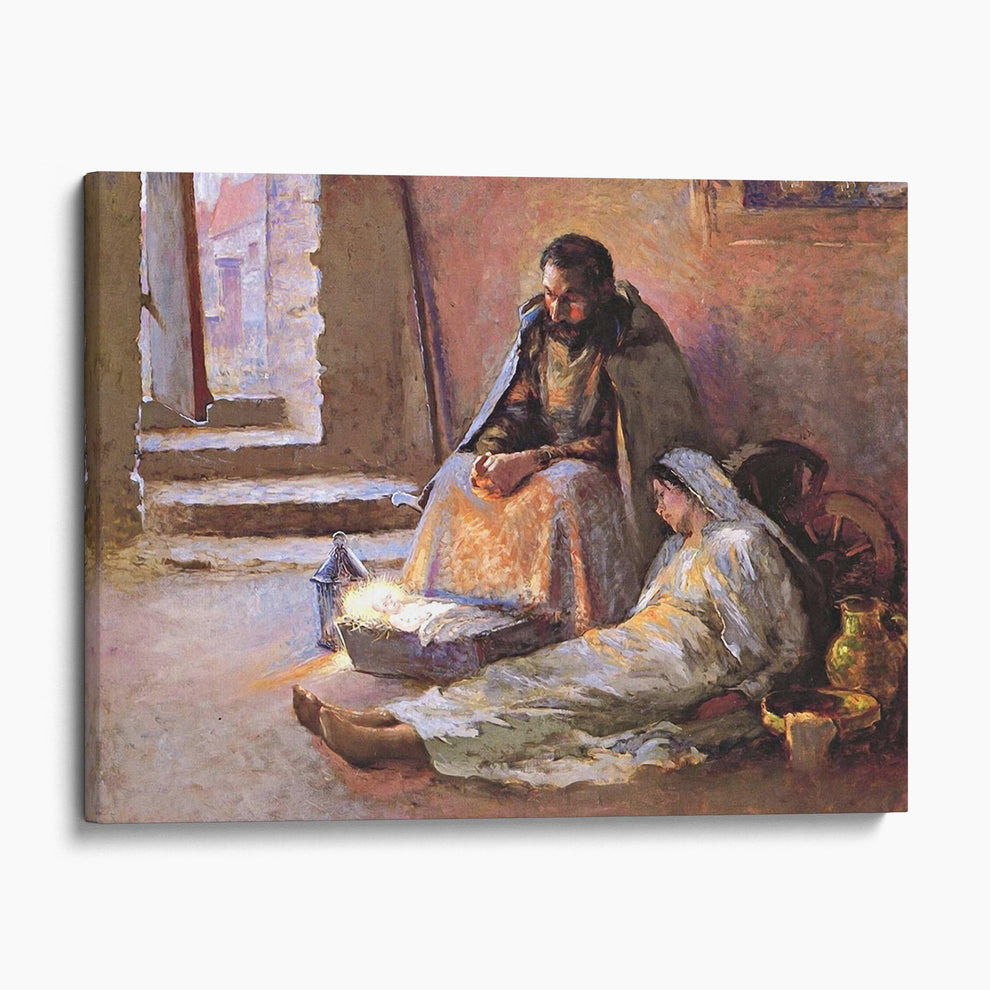
They finally made it, and while they were there, she gave birth to Jesus in a lowly stable. (All the inns were full by then.)  She wrapped baby Jesus in swaddling cloths and laid him in an animal’s feed trough.

I love this painting by Gari Melchers, which is probably closer to how it was than our traditional nativity scenes…

Vss. 8-20.

Meanwhile, in the hills outside Bethlehem, there was a group of shepherds watching their sheep.  The animals were probably all snuggled down together, sleeping, while the men sat around a campfire that was fast going out.

THEN AN ANGEL APPEARED!

THE GLORY OF THE LORD SHONE AROUND THE SHEPHERDS!

They were VERY afraid.

But the angel (could it have been the messenger, Gabriel?) told them,

  • “Fear not, for behold, I bring you Good News of great joy that will be for all people.  For unto you is born this day in the city of David, a Savior who is Christ the Lord. And THIS will be a sign for you: you will find a baby wrapped in swaddling cloths and lying … in a manger.”

And then, more wonderfully terrifying, a multitude of heavenly hosts appeared, praising God and saying,

  • “Glory to God in the highest, and on earth peace among those with whom He is pleased!”

And then they were gone, and again it was a dark, silent night.

“Let’s go to Bethlehem and see this thing that has happened which the Lord has made known to us!”

And so they did.  They didn’t search inns, but looked for a stable. (After all, the angel said the baby would be in a feed trough.)  And they FOUND Mary and Joseph and the baby … lying in the manger, just as the angel had said.  They told the couple what had happened out on that hillside.  And Mary treasured up all these things, pondering them in her heart.

And then the shepherds returned to their duties, glorifying and praising God for all they’d seen and heard, as it was told to them.  And everybody who heard their story was in wonder about it.

.

Vs. 21.

And at eight days, Jesus was circumcised and officially named JESUS, the name that Gabriel had given to Mary before He was conceived.

.

.

“For God so loved the world that He gave His only begotten Son, that whosoever believed on Him, would not perish but have eternal life.” John 3:16


Reading the Gospels in 2026: (3/11) Luke 1:67-80

A 5-day per week study.

March 11 – Reading Luke 1:67-80

Read and believe in Jesus.

“And you, child, will be called the prophet of the Most High.”  Luke 1:76

.

The Gospel according to Luke 1:67-80

In the last study, we saw Elizabeth giving birth to a baby boy. Since Zechariah was still mute (and possibly deaf), SHE announced his name at the circumcision ceremony.  He would be JOHN.  Of course, the family objected, saying he should be Zechariah Jr.  Nope!

The old priest took a notepad and clearly wrote out “His name will be called John.”  And immediately Zechariah’s speech returned.  Everyone was excited and eagerly listened to his account of all that had happened in the Temple with the angel, Gabriel.

.

Vss. 67-75.

And now, the old priest is filled with the Holy Spirit and begins to speak forth God’s words and prophesy.  (Zech is really happy to be speaking again, I think.)

First, he praises the Lord God of Israel.  He recalls all the promises of God from Abraham onward and tells how God has now fulfilled them.  The LORD God has redeemed His people and raised up a “horn of salvation” in the house of His servant David… just as the prophets foretold.

Then Zecharia looks towards his son, perhaps laying his hand on the baby boy’s head, and by the Holy Spirit says, “And you, child, will be called the prophet of the Most High, for you will go before the Lord to prepare His ways, to give knowledge of salvation to his people in the forgiveness of their sins.”

And then, “The sunrise (Messiah) shall visit us from on high to give Light to those who sit in darkness and in the shadow of death,  and to guide our feet into the way of peace.”

What a benediction!  What a way to end ten months of inability to utter one word!

.

Verse 80.

“And the child (John) grew and became strong in spirit, and he was in the wilderness until the day of his public appearance to Israel.”

Out in the danger and loneliness of the desert, filled with the Holy Spirit from birth, John probably prayed long prayers and recalled the scriptures he’d learned as a youth in a priest’s house. Like Elijah, he was tough and lived on what the desert could supply.

.

How did John know when he would begin his ministry and start baptizing and preparing the people for the Messiah?   

We will get into that in Chapter Three, but if you want to peek, see Luke 3;1-3.


Reading the Gospels in 2026: (3/6) Luke 1:26-38

A 5-day per week study.

March 6 – Reading Luke 1:26-38

Read and believe in Jesus.

“For nothing will be impossible with God.”  Luke 1:37

.

The Gospel according to Luke 1:26-38

It’s happening.  The time when the Old Testament writers and prophets foretold and longed for.  From Genesis 3:15 (s triumphant Savior will come) to Malachi 4:5-6 (a forerunner like the prophet Elijah will come first), it is happening.

Yesterday, we saw the announcement of the coming of John, the one who would prepare the way for the Messiah.  The old priest had a hard time believing it, even though it was the angel Gabriel in person telling him, AND while he was in the temple just outside the Most Holy Place.  And so, Zechariah was made mute and prevented from announcing this great miracle to the other priests and the people praying outside.

Soon, his wife became pregnant (and at a great age!).  He HAD to believe it now.  But still, Zechariah was mute.  Six months have passed. Elizabeth is in her last trimester.  And in a little town, way north of Jerusalem, Gabriel is sent to make another announcement.

.

Vss. 26-30.

In Nazareth, a small, unappreciated town, there lived a young (possibly early teens) virgin named Mary.  She had been betrothed to an older man named Joseph.  Both were in the lineage of King David, although through different lines.  Mary was probably in her parents’ house doing chores when Gabriel appeared.

“Greetings, O favored one, the Lord is with you,”  came the bold announcement from the herald of God.  You get the feeling that Gabriel was the one honored in this situation.

Like Zechariah, Mary was more than startled.  Seeing a large, shining angel appear in your kitchen would be frightening. And hearing those words probably didn’t calm her.  What did this mean??

The angel spoke more gently this time, “Do not be afraid, Mary, for you have found favor with God.”

.

Vss. 31-33.

And then that wonderful, amazing announcement.  “Behold, you will conceive in your womb and bear a son, and you shall call His name Jesus. He will be great and will be called the Son of the Most High. And the Lord God will give to Him the throne of His father David, and He will reign over the house of Jacob forever, and of His kingdom there will be no end.”

What a message!  What a prophecy!  “Son of the Most High?”  “The throne of David?”  “Reign forever?”  It was so much to take in, but you can be sure Mary remembered those words forever.

.

Vss. 34-38.

Even as a young teenager, Mary knew the facts of life.  She’d been raised around animals.  And her mother had probably instructed her before she was betrothed to Joseph.  So….  when would this happen? It sounded like the angel’s words had an urgent, immediate tone, as if this conception would be very soon.  Her marriage was still a little way off.  Would Joseph be…..?

“How will this be, since I am a virgin?”

And then, those magnificent and scary words.  “The Holy Spirit will come upon you, and the power of the Most High will overshadow you; therefore, the child to be born will be called holy – the Son of God.”

“The Son of God….”

The angel continued, building Mary’s faith.  “And behold, your relative Elizabeth in her old age has also conceived a son, and this is the sixth month with her who WAS called barren.”  Did Mary’s mouth silently form a big, “WOW?”

And the words that sealed Mary’s faith.  ‘For nothing will be impossible with God.”

Well, that said it all.  Mary acquiesced with a bow of her head.  “Behold, I am the servant of the Lord; let it be to me according to your word.”

And Gabriel left.

.

And so two women, one very aged, and the other barely a “woman” and a virgin, are miraculously “with child.”  Truly, nothing is impossible with God.

Mary is allowed, with other family members, to go and stay with Elizabeth for three months.  The family probably thought the young Mary could help the older woman (now advanced in age and “great with child”) with the housework.  She could probably learn more about being a wife and “eventual mother” as well.

Who knew that these two women, carrying “men of God,” would be able to encourage each other “in the Lord?”   Next time, we’ll read about their first meeting and of Mary’s great “song of praise” to the Lord.


Reading the Gospels in 2026: (3/5) Luke 1:1-25

A 5-day per week study.

March 5 – Reading Luke 1:1-25.

Read and believe in Jesus.

“You shall call his name John… ”  Luke 1:13

.

The Gospel according to Luke 1:1-25

And so we begin again with the “Good News” of Jesus the Messiah … according to Luke.  Luke is the only Gentile to write a book in the Bible (he also wrote Acts).  He writes to Theophilus (“lover of God”), who could have been a real person or a nickname for a well-known (“most excellent”) dignitary.

Luke admits his story of Jesus comes from interviews with “eyewitnesses,” and that his aim is to write an orderly and accurate account of the life of Jesus.  It’s very obvious that Luke’s research and writing were “moved by the Spirit of God” (See 1 Peter 1:21), and are the infallible “Word of God.”

Paul, who knew him well, says Luke was a doctor.  So, as we read through this Gospel, note his interest, more detailed descriptions of diseases and illnesses, and his concern for women.

And although this is the Gospel of Jesus Christ, Dr. Luke begins with the story of John the Baptist, the forerunner of the Messiah.

.

Vss. 1-4.

Luke tells his friend that, although many “eyewitnesses” and “ministers of the Word” have compiled narratives about Jesus, it seemed good for HIM also to write an “orderly” account.  And why?  So that his friend would have certainty concerning the things he’d been taught.”

This Theophilus had been taught the bare basics of Jesus, and maybe he wondered aloud to Luke if it all was true.  Good friend that he was, Luke set down in writing the Gospel story for him … and for us Gentiles who read it as well.

.

Vss. 5-10.

Luke sets out the details to set the scene:

  1. During the days of Herod, the king of Judea.
  2. A priest named Zechariah, of the Abijah division.
  3. (There were 24 priestly divisions, each serving the Temple for a week, twice a year. Individual priests were chosen by lot to actually minister inside the Temple. This was Zechariah’s BIG MOMENT.  See 1 Chronicles 24:4-19)
  4. His wife, Elizabeth, was also from the tribe of Aaron.
  5. Both priest and wife were righteous before God, walking in the commandments & statutes of the LORD.
  6. They had no children.
  7. They were old.
  8. Outside the Temple, a crowd waited and prayed.

.

Vss, 11-17.

And then the action:

Zechariah carefully burned incense on the Altar of Incense right in front of the veil that hid the Holy of Holies. (Yes, he was nervous!)

Suddenly, in front of him, to the right of the Incense Altar, an “angel of the Lord” appeared.  Zechariah was terrified.

(Imagine … in the dark Holy Place, lit only by the Lampstand with its small oil flames off to his left, and some coals in his sensor … Zechariah’s eyes adjusted to the dimness.  THEN a bright being appears.  Yikes.

The being spoke,  “Do not be afraid, Zechariah, for your prayer has been heard, and your wife Elizabeth will bear you a son, and you shall call his name John.”

Surely his and Elizabeth’s prayer for countless years had been a son, but … had he also been praying that prayer as he stood mere feet from the “Presence of God” behind that veil?

The angel continued, “You will have joy and gladness, and many will rejoice at his birth, for he will be great before the Lord.”

Did Zechariah imagine a son who would become a great priest after him… maybe even… High Priest???

He listened to the angel saying that this boy must have the Nazarite Vow on him his entire life.  That meant he wouldn’t cut his hair – except for a holy vow to the Lord – and he would NOT eat grapes in ANY form: fresh, dried as raisins, juice, or wine, and he would not touch a dead body.  “A prophet, then,” thought Zechariah.

There was more.

“He will be filled with the  Holy Spirit… from the womb. 

He will turn many of the children of Israel to the Lord.

He will go before Him in the spirit and power of … Elijah.

.

Vss 18-21.

But then, doubt flooded into Zechariah’s heart and mind.  A son at OUR old age?  A great PROPHET of the Lord?  Maybe I’m dreaming.  This incense is boggling my mind…

“How shall I KNOW this?  For I am an old man and my wife is advanced in years…”

Okay, that really angered the angel of the Lord.  How dare he question the very word of God??

“I am Gabriel. 

I stand in the presence of God. 

I was sent to speak to you and to bring you this great news.”

I’m sure Zechariah was cowering a bit by now, perhaps with an arm raised to deflect the angelic ire.

“And behold, you will be silent and unable to speak until the day that these things take place, BECAUSE you did not believe my words, which WILL be fulfilled in their time.”

Gabriel left, and Zecharia stood, shaking and stunned, for minutes. Did he try to speak?  Did he clear his throat and try again?  And again? Did it finally sink in that what the angel had said might be true?  Could it be?

Meanwhile, the praying people outside were getting concerned.  What was taking Zechariah so long to put new incense on the Altar and light it?  Had … he died?  Had the Lord struck him dead for some mistake?

.

Vss. 22-25.

At last, Zechariah came out, and the people breathed a collective sigh of relief. But something had happened to him.  He looked shocked.  And… and, he couldn’t speak!  WHAT HAD HAPPENED?  Zechariah made signs and motions, and finally, they realized that he had seen a vision in the Temple.  But what WAS it?  He couldn’t tell them, because he was MUTE!

Zechariah finished out his week of service and went home.  He wrote out on some parchment what happened (could Elizabeth read?)  He explained what the angel said with gestures and signs, mouthing the words.  Did he tell her that their son would be called John, writing it out clearly?

Then, miracle of miracles, Elizabeth got pregnant!  She didn’t tell anyone else, and she kept to herself in the house.  For five months.  And she gave glory to the Lord.


Reading the Gospels in 2026: (2/20) Mark 13:1-36

A 5-day per week study.

February 20– Reading Mark 13:1-36.

Read and believe in Jesus.

“Be on guard, keep awake. For you do not know when the time will come.”  Mark 13:33

.

The Gospel according to Mark 13:1-36

Jesus (and His disciples) have been at the Temple Mount in Jerusalem all day. He has been teaching the crowds and confronting the religious leaders. He ends the time with praise for an extremely poor, but generous, widow and her meager offering.

Now, as they leave for the day, one of His disciples exclaims at the grandeur of the Temple buildings, specifically the great huge gleaming white marble stones.

(Some of the foundation stones were 40’x12’x12′.  The ones on the east-facing wall were covered with gold plates that gleamed in the morning sun. This was the Temple that Herod was rebuilding.)

.

Vss. 1-2.

Look, Teacher, what wonderful stones and what wonderful buildings!” said one of the twelve.

Do you see these great buildings?” Jesus asked. “There will not be left here one stone upon another that will not be thrown down.”

That silenced them.  How did that relate to Jesus coming into His Kingdom, since they believed it was about to happen? (Remember His triumphant ride into Jerusalem?)

(What Jesus was talking about was the destruction of Jerusalem and the Temple in 70 A.D., when the Roman general, Titus, invaded.  He built large wooden scaffolds around the temple buildings, piled them high with flammable materials, and set them on fire.  The heat was so intense that the great stones crumbled.  Later, the rubble was sifted to retrieve the melted gold. The remaining ruins were “thrown down” into the Kidron Valley.)  

(Most of the disciples will be martyred before this happens.  We only know for sure that John lived to hear of Jerusalem’s destruction. (It’s believed John died in 100 A.D.)  It’s also possible that Simon the Zealot lived a couple of years after (74 A.D.). But before General Titus came, all the disciples would have left the city to carry the Gospel “to the uttermost parts of the world.”)

.

Vss. 3-8.

Once outside the city, Jesus and the men rested on the Mount of Olives before continuing over and down to Bethany to His friends’ home, where they would stay the night.  From where they sat, the Temple Mount was in clear view. (Today, the Muslim Dome of the Rock stands in that place.)

Jesus’ four closest disciples came near, and one asked Him, “Tell us when these things will be, and what will be the sign when all these things are about to happen.”

Of course, the disciples “thought” that Jesus was about to usher in His Kingdom. They probably thought some huge miracle would happen – like the Temple being gone – to announce the coming Millennial Kingdom of Jesus.

They had a rude awakening.

“See that you are not led astray,” Jesus warned. “Many will come in my name. You will hear of wars and rumors of wars.  Do not be alarmed.  This MUST take place, but the end … is not yet.”

Jesus went on to tell of continuous wars, earthquakes, and famines that would happen.  But THAT was only the beginning (the birth pangs) of the End.

.

Vss. 9-13.

Jesus speaks of persecution and martyrdom, of their witness before kings, and of the gospel first spreading to all nations, and warns, “Be on your guard.”

.

Vss. 14-23.

Then Jesus warns them about “the abomination of desolation standing where he ought not to be.”  (This first happened during the time of the Maccabees when Antiochus Epiphanes sacrificed a pig on the altar. But it would be duplicated in the end times by the Antichrist, who would also set up an image of himself in the Holy place.)

Jesus tells them that those living in Judea at that time should immediately flee to the mountains. (He says, “Let the reader beware, speaking to those who live in the end times, and not to His disciples.)  The tribulation in THOSE days will be worse than ever before, since Creation.  Many will try to duplicate Jesus and deceive people.  But the Lord says again, Be on guard!”

.

Vss. 24-27.

Jesus tells them that after “that” tribulation (the Great Tribulation in the end times), horrific signs will occur in the literal heavens (sun, moon, and stars) and in the spiritual heavens (the “powers” will be shaken).

And THEN, they will see “the Son of Man coming in clouds with great power and glory.”  And He will send out His angels to gather His elect from the ends of the earth.

.

Vss. 28-31.

Jesus seems to return to the disciples’ initial question, “When will this happen, and what is the sign of your coming?”  Perhaps His gaze took in that withered fig tree from a day ago, and He said, “From the fig tree (a healthy one), learn its lesson.  When its branch puts out leaves, you know summer is near. So also when you see these things taking place, you know that He is near, at the very gates.”   

Jesus then says that “THIS generation,” meaning the one who lives in the end times, “will not pass away until all these things take place.”

.

Vss. 32-37.

Then to keep the disciples, and indeed US READERS. from predicting exactly when Jesus will return, He says, “Concerning that day or that hour, NO ONE KNOWS, not even the angels in heaven, NOR THE SON, but only the Father.  Be on guard, keep awake. For YOU do not know when the time will come.”

It’s like a master going away (Jesus says) and leaving his servants to stay awake and watch for his return.  The servants won’t know if he is to return in the evening, at midnight, when the rooster crows, or in the morning.  They are just to stay awake and be ready to open the door and welcome him in.

Jesus concludes with, “What I say to you, I say to all: STAY AWAKE.”

.

.

(NOTE:  Take some time with your Bible and a Bible commentary, and read this again. See where Jesus is talking about the disciples, and when He tells about the times still future to us, when the Antichrist will appear, the Great Tribulation will happen, and Jesus’ glorious second coming in the clouds.

.

Also, realize that these disciples do not know that their world is about to be turned upside down. Jesus is about to be arrested, tried, and crucified in just a matter of days.  All their beliefs of becoming partners in His earthly reign NOW, will be replaced by fear and confusion. Then, the resurrection, the ascension, and the Holy Spirit’s power on them.  They won’t be thinking of beautiful walls falling, or crowns on their heads.  They will begin fulfilling the Great Commission to take the Good News throughout the world.


Reading the Gospels in 2026: (2/12) Mark 11:12-25

A 5-day per week study.

February 12– Reading Mark 11:12-25

Read and believe in Jesus

“My house shall be called a house of prayer for all nations.”  Mark 11:17b

.

The Gospel according to Mark 11:12-25

Last time, we saw Jesus ride into Jerusalem on a donkey, to the hails of “Hosannah!  Blessed is He who comes in the name of the Lord.”  The people thought that Jesus was finally going to set up His Kingdom and defeat the Romans.  They didn’t know that by that Friday, Jesus was going to be crucified by those very Romans at the behest of their Jewish religious leaders.

After He came into the Holy City, He went to the Temple Mount, where He looked carefully around at the buying and selling, the noise and the mess, the greed and the hypocrisy.  Then He went with His disciples back to Bethany, possibly to the home of Mary, Martha, and Lazarus for the night.

.

Vss.15-19.

The next morning (Monday), Jesus entered the city and went again to the Temple Mount.  A cacophony of raised voices and distressed animal cries assaulted Him. Vile odors filled his nostrils, and where peace and worship should have been, there was hypocrisy, greed, and extortion. Yes, many who traveled a great distance for Passover had to purchase animals for sacrifice upon their arrival. Their Roman or foreign coins were not accepted in the Temple, and they also had to be exchanged (for a fee). But this all should have been done outside the courts of the Temple!

In righteous anger for the sake of His Father, the Holy One of Israel, Jesus began driving out those who sold and those who bought animals.  He overturned the tables of the moneychangers, scattering the coins across the pavement, and He upset the seats of those who sold pigeons. Chaos ensued. Angry shouts and threats followed His actions.

In a loud voice, Jesus quoted Isaiah 56:7, “It is written, ‘My house shall be called a house of prayer for all nations!'” and Jeremiah 7:11, “But you have made it a den of robbers!”

The chief priests and scribes were furious at the loss of their commerce.  They wanted to destroy Jesus, but feared Him, because the crowd was astonished at his teaching. 

Later, towards evening, when things quieted down, Jesus and the disciples left the city.

.

That was the “meat” of this section’s “sandwich.”  You remember Mark’s sandwiches?  Next, we’ll look at the top and bottom “bread” sections.

.

Vss. 12-14. (bottom slice)

Early that same morning, Jesus and the men left Bethany. Jesus was hungry. (Perhaps they’d left before Martha could prepare food.)  As they walked over and down the Mount of OLIVES, Jesus saw a green FIG tree in the distance, along the road.  A handful of figs would do nicely for breakfast. But when they got close, they saw the tree had NO FRUIT, despite being fully leafed out. 

(When fig trees end their winter dormancy, they first develop figs, which grow ripe as the leaves come on.  It was early in the year, but if there were leaves, the tree SHOULD have had fruit.)  What a disappointment.

Jesus said to the tree, “May no one ever eat fruit from you again.”

Okay, Jesus was not having a temper tantrum. 

Because He spoke “to” the tree, this shows He was personifying it.  The fig tree was frequently an Old Testament “type” of the Jewish nation of Israel. (See Hosea 9:10, Joel 1:7, Nahum 3:12, Zechariah 3:10.)  This was a divine “object lesson” about Israel’s hypocrisy and fruitlessness despite all its advantages.  Jesus’ cursing of it illustrated God’s judgment against the earthly Israel, especially in the rejection of their Messiah.

.

Vss. 20-26. (top slice)

Morning again.  It’s Tuesday, and again Jesus and the disciples are leaving Bethany and heading towards the City. They come by the fig tree, which is now completely withered from the ground up.

At once, Peter notices it and cries out, “Rabbi, look! The fig tree that You cursed has withered.”

And Jesus answers, “Have faith in God. Truly, I tell you, whoever says to this mountain, ‘Be taken up and thrown into the sea, and does not doubt in his heart, but believes that what he says will come to pass … it will be done for him.”  And, “Therefore, I tell you, whatever you ask in prayer, believe that you have received it, and it will be yours.”

.

Now, what in the world was Jesus teaching?  Surely NOT the “Name it and Claim it” doctrine so foolishly taught by some tele-evangelists today.

The expression “rooter up of mountains” was used in Jewish lore about great rabbis or leaders who could solve difficult problems and seemingly do the impossible. 

(NOTE: Jesus never did gratuitous miracles, although the Pharisees demanded Him several times for such a sign to prove He was a Messiah.)   

No, Jesus was telling His disciples that if they sincerely trusted in God and realized the power that is available through such faith in Him, they would see mighty powers at work. 

In His private “upper room discourse” with them (John 14:12-13), Jesus said, “Whoever believes in Me will also do the works that I do and greater works than these will he do, because I am going to the Father.” And, “Whatever you ask in My name, this I will do, that the FATHER MAY BE GLORIFIED in the Son.”

And of course, 1 John 5:14. “And this is the confidence that we have toward Him, that if we ask anything ACCORDING TO HIS WILL, He hears us.” (and will give us what we request.)

.

Yes, Jesus is still teaching His disciples by words and actions. His time with them is very short.  In two days, what He told them three times  will begin to come to pass:

  1. The Son of Man will be delivered over to the chief priests and the scribes.
  2. They will condemn him to death and deliver Him over to the Gentiles.
  3. They will mock Him and spit on Him and flog Him … and kill Him.
  4. And after three days, He will rise.  (Mark 10: 33-34)


Reading the Gospels in 2026: (2/11) Mark 11:1-11

A 5-day per week study.

February 11– Reading Mark 11:1-11

Read and believe in Jesus.

“Hosanna!  Blessed is He who comes in the name of the Lord! Blessed is the coming kingdom of our father David!  Hosanna in the highest!”  Mark 11:9b-10

.

The Gospel according to Mark 11:1-11

Last time, we saw Jesus and His disciples moving from east of the Jordan River, through Jericho, stopping to heal blind Bartimaeus, and then going “on the way.”  This means “towards Jerusalem” (and His death, which He’s been foretelling to His disciples for months).  The crowds are still with Him, and many others are heading towards the Holy City too for the upcoming Passover Celebration in less than a week.

.

Vss. 1-3

Bethphage and Bethany (where Mary & Martha lived) were on the east slope of the Mount of Olives, which stands just before Mt Zion, on which Jerusalem is built.   Jesus tells two of his disciples to go into “the village in front of you,” (probably Bethphage).  (I wonder which two He sent…)

Anyway, they would immediately find a colt tied up. (Matthew mentions that its mother was also there.)  They were to untie it (them) and come back to Jesus.  If anyone asked what they were doing, they were to say simply, “The Lord needs it.”

And so it happened.

.

Vss 4-10.

Many of the crowds witnessed this and wondered.  What was Jesus doing?  Some began thinking of, and maybe quoting, the scriptures, especially when a cloak was thrown over the back of the colt, and Jesus mounted it.

.

  • Zechariah 9:9 – “Rejoice greatly, O daughter of Zion! Shout aloud, O daughter of Jerusalem!  Behold, your king is coming to you; righteous and having salvation is He, humble and mounted on a donkey, on a colt, the foal of a donkey!”
  • Isaiah 62:11 – “Say to the daughter of Zion, ‘Behold, your salvation comes; behold, His reward is with Him, and His is recompense before Him.'”
  • Psalm 118:25b-25a – “Save us (Hosanna), we pray, O LORD!  O LORD, we pray, give us success!  Blessed is He who comes in the name of the LORD!”

.

They began cutting palm and other branches, waving them and laying them down with their cloaks, on the road before Jesus: a colorful, leafy green path to the Holy City.  (Jesus, with the steady hands of its creator, calmed the young colt in this chaos.)

The whispered verses from before were said aloud, then shouted with joy.  He IS the king!  THEY KNEW IT from when He fed the multitude in Galilee! And here He was entering the city to be crowned… to free Israel from oppression!  Hallelujah!  “Blessed is the coming kingdom of our father David!” Hosannah!  Hosanna in the Highest!”

.

(Luke 19:39-40 tells of some Pharisees coming to Jesus as he approached the city and demanding that He stop the crowds from saying these things. Jesus answered, “I tell you, if these were silent, the very stones would cry out.”)

(Luke 19:41-44 also mentions Jesus weeping as He nears Jerusalem. He foresees the time when the Holy City is destroyed, it and its people… “because you did not know the time of your visitation.”)

.

Vs. 11.

Inside the city, Jesus dismounted and sent the donkeys back to their owner.  The crowds watched or went their own way.  With kingly authority, He went to the temple, “and looked around at everything.”  

Jesus inspected the buildings and the grounds, missing nothing…. including the noisy moneychangers and merchants, the loud animals and birds, and their messes… in the Temple.

It was late, so He and the disciples went back to Bethany.  But He would be back the next day… and they had better watch out.


Reading the Gospels in 2026: (2/10) Mark 10:32-52

A 5-day per week study.

February 10– Reading Mark 10:32-52

Read and believe in Jesus.

“What do you want me to do for you?”  Mark 10:50b

.

The Gospel according to Mark 10:32-52

We left Jesus and the disciples on the eastern side of the Jordan River.  They’d just watched the rich young ruler turn away from Jesus.  Jesus told them that riches did not buy their way into the kingdom of God, but following Him and giving up material things was the way to blessing.

Now they were heading west towards Jerusalem.  They would pause for a short time in Jericho, then walk through the wilderness up to the holy city for Passover.

.

Vss. 32-34.

Right on the heels of that conversation about leaving all to follow Jesus, He – for the third time – told the disciples that He would “be delivered over to the chief priests and scribes, and they would condemn Him to death and deliver him over to the Gentiles. And they will mock Him and spit on Him, and flog Him and kill Him. And after three days He will rise.”

Again, we see no response.  Surely they heard the words. Pain. Death. Resurrection….

.

Vss. 35-45.

But it seems it was the turn of the “Sons of Thunder” to ask about the Kingdom of God.  Not about leaving everything behind or about suffering and dying, but about honor and privilege when the kingdom came.

  • Teacher, we want you to do for us whatever we ask of you,” said James and John.
  • “What do you want me to do for you?” asked Jesus, although He knew exactly what they were going to ask.
  • “Grant us to sit, one at your right hand and one at your left, in Your glory.”
  • I imagine Jesus just shook His head at their naivety. “You do not know what you are asking.  Are you able to drink the cup that I drink, or to be baptised with the baptism with which I am baptised?” 

Jesus, of course, was speaking of the suffering and the horrible substitutional death He would experience for all who would be saved from their sins.

  • Proudly, the two answered, “We are able.”

Jesus probably looked at them with love, these two fiery young men who willingly followed Him. He knew that James would be the first martyr of the Twelve in just a few years, and that although John would live to an old age, he would be tortured and spend years in exile.

  • “The cup I drink, you WILL drink, and my baptism, you WILL experience.  But to sit at my right and left hands … is not mine to grant, but for those for whom it’s been prepared.”

Of course, the other ten disciples were indignant with James and John.  How dare they!  Why did they think THEY were better?

  • Jesus had to calm them all down. “Actually…”He said, “Ruling and authority over others shall NOT be so among YOU.” 
  • He looked around at them closely. “Whoever would be great among you must be your servant, and whoever would be first among you must be slave of all.”
  • “Even the Son of Man came not to be served but to serve, and to give His life as a ransom for many.”  

(I bet that quieted them for a while.)

.

Vss 46-52.

They spent a short time in Jericho, then, amid a huge crowd of people, they went out from the city. By the side of the road was a blind beggar, whose name was Bartimaeus (Son of Timaeus).  He heard the crowd passing -possibly coughed at the dust that rose.  He learned that it was Jesus of Nazareth.  He’d heard of the great teacher/healer, and who He was.  Hope rose in him.  And panic that Jesus would pass him by.

  • “Jesus, Son of David, have mercy on me!” cried Bartimaeus.
  • The crowd looked at him, not in pity but in annoyance.  “Be quiet!”
  • “Jesus, Son of David, have mercy on me!” he cried even louder.

Jesus heard him and stopped. He called for someone to bring the blind man to Him.

  • Now the voice of the crowd changed. “Take heart. Get up; He is calling for you.”

Bartimaeus threw off his cloak, sprang up, and came to Jesus … following the sound of that kind voice.

  • What do you want me to do for you?”
  • “Rabbi, let me recover my sight.”
  • “Go your way; your faith has made you well.

And immediately he recovered his sight … AND FOLLOWED JESUS ON THE WAY.

.

What a good story of simple faith. And determination.

Since the blind man was named (and was wearing a cloak), it’s possible that he was a known merchant of some standing in the city, who had, for some reason, lost his sight and was left to beg for a living.  Perhaps an accident or a disease had caused him to be blind. Notice he asked that his sight be recovered, as in, found after being lost.

He’d heard of Jesus.  And he believed in Him.  Notice what Bartimaeus called Jesus.  “Son of David” was Jesus’ Messianic title.  Bartimaeus knew Jesus was “the One to come,” and knew if he could get close to Him, he would be healed.

And afterward… Bartimaeus followed Jesus.   No question. So unlike the rich young ruler.


Reading the Gospels in 2026: (2/3) Mark 9:2-13

A 5-day per week study.

February 3– Reading Mark 9:2-13

Read and believe in Jesus.

“And He was transfigured before them, and His clothes became radiant, intensely white as no one on earth could bleach them.  And there appeared … Elijah with Moses … talking with Jesus.”  Mark 9:2-4

.

The Gospel according to Mark 9:2-13.

Jesus and the disciples have been north of Israel, in the area of Caesarea Philippi, where Jesus gives them the hard teaching about His suffering, death, and resurrection (though they seem not to have heard the last word).

And he taught them (and the crowd) that they too would suffer and possibly lose their lives if they desired to follow Him.  Sobering words!

Then Jesus said that some of them WOULD NOT see death until they saw “the kingdom of God come with power.”  What did that mean?   (Pentecost?  Or what was about to happen to His inner three disciples on the mountain?)

.

Vss. 2-3.

Six days after that amazing statement, Jesus and his men climbed Mount Hermon. Jesus left nine disciples waiting in a lower place and took Peter, James, and John higher up the mountain. Then, to their utter amazement, terror, and fascination …. Jesus was “transfigured” before them.

What does that mean?

He was “transformed” (partially) from the Jewish man in a homespun robe, into the true Eternal One clothed with the heavenly glory He shared with His Father from Eternity past.  This was “the true Light that had come into the world.” It was radiant. Intensely white. No human could have bleached His clothes to shine so brilliantly.

.

(I’ve always pictured this scene like some modern-day superhero, pulling his human shirt open to allow his true character to be seen.  But THIS glory, which emanated from the Lord Jesus, was shining through His robes.  HE WAS the Light.)

(The promise to true believers is that we will one day be “transformed” into the “likeness of Jesus.” 2 Corinthians 3:18.)

,

Vss. 4-8.

This vision of Jesus would have been enough, but the disciples also saw the living Elijah and Moses talking with Him.  (Luke 9:31 says they were talking to Jesus about His upcoming death.) 

.

(How did the disciples recognize Elijah and Moses? God revealed it to them, just as we will recognize the souls of Bible characters, family members, and even the babies we’ve lost, when we get to heaven.)

(It’s interesting that Moses and Elijah represent the whole Old Testament: The Law and The Prophets, both of which pointed to Jesus and His work of redemption, from Genesis 3:15 onwards. These two will be seen again during the final days of earth, according to Revelation 11:5-6.)

.

Peter, ever with an open mouth and an opinion, spoke to Jesus, even though he didn’t know what he was saying.

“Rabbi, it is good that we are here. Let us make three tents, one for You, one for Moses, and one for Elijah.”

(I’m sure we’ve all said similar nonsense in our nervousness!)

But God Almighty, the Father of Eternity, interruped Peter’s feeble words by surrounding the three holy ones in the Shekinah Cloud of His Presence.  And speaking aloud,

This is my beloved Son, LISTEN to HIM.”

(Matthew tells us that when the disciples heard this, they fell on their faces (which is the typical response of a mere human in the presence of God. (See Isaiah 6:5, Rev. 1:17)

The next thing they knew, Jesus, in his everyday clothes, was touching them, helping them up. It was once again a mountain place, and not the halls of Heaven.

.

Vss. 9-13.

As they returned down to the other disciples, Jesus commanded them TO TELL NO ONE what they had seen (and that included the other nine) UNTIL He had risen from the dead.

Peter, James, and John kept this amazing incident to themselves (who would even believe them anyway?) but still questioned Jesus’s words about the resurrection.

(Hadn’t they heard his prediction that he would DIE… and be resurrected?  They, like we, sometimes only hear what we WANT to hear, and they wanted to hear about Jesus setting up His Kingdom here and now.)

.

Also on the climb down, the disciples asked Jesus about Elijah. “Why do the scribes say that first Elijah must come?”

This had been a conversation before, and indeed, the Jews from Jerusalem had even asked John the Baptist if HE was Elijah.  Jesus told the three that “Elijah HAS come, and they did to him whatever they pleased, as it was written of him.”  ***

(NOTE: *** John’s murder “typically” fulfilled the fate that was intended for the OT Elijah, although it had not been “actually” prophesied. The vile, murderous Queen Jezebel vowed to kill Elijah (1 Kings 19:1-2), but God had other things for Elijah to do.  However, when the vile, murderous Queen Herodias vowed to kill John the Baptist, her equally evil husband, Herod, killed the prophet.)

Luke 1:17 does say that John the Baptist came, “in the Spirit and Power of Elijah,” if they would accept that.  


.