Archives

Journaling through the Bible Chronologically in 2025, Day 200 (wow)

Day 200 – Reading – 2 Kings 18, 2 Chronicles 29 – 31, and Psalm 48

Do you see connections?

2 Kings 18:1-8 and 2 Chronicles 29

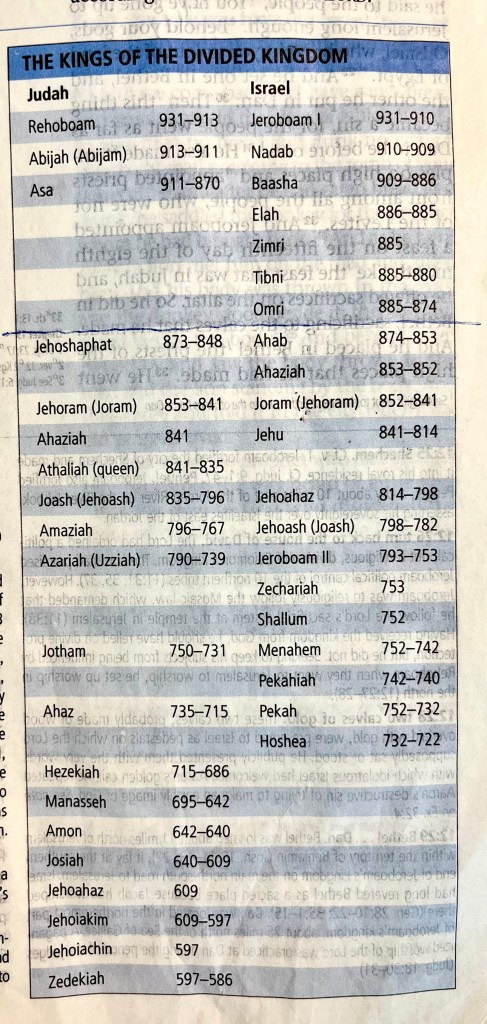
First, we learn that in the third year of Israel’s King Hoshea’s nine-year-reign, Hezekiah began his 29-year reign in the southern kingdom of Judah.  HE DID WHAT WAS RIGHT IN THE EYES OF THE LORD.  Praise God!  (In all the sons that King Ahaz’s burned on that pagan altar … God kept Hezekiah safe.) Praise God!

Hezekiah “trusted in the LORD, the God of Israel, so that there was none like him among all the kings of Judah after him, nor among those who were before him. He held fast to the LORD. He did not depart from following Him, but kept the commandments that the LORD commanded Moses. And the LORD was with him.”

And King Hezekiah began to “clean up Judah.” In the first year of his reign,

          2 Kings:

  • he REMOVED the high places, BROKE the pillars, and CUT DOWN the Asherah.
  • he BROKE IN PIECES THE BRONZE SERPENT that Moses had made, for until those days the people of Israel had made offerings to it. (WHAT??)  (See Numbers 21:4-9)

           2 Chronicles 29:

  • he OPENED the doors of the House of the Lord, that his father, King Ahaz had permanently shut (See 28:22-25). 
  • he CALLED BACK the priests and Levites and charged them to consecrate themselves and the House of the LORD.  (Take out the filth that was in the Holy Place!!)
  • he REMINDED them that the LORD had chosen THEM to stand in His presence and to minister to Him.

And the three clans of Levites consecrated themselves went into the inner part of the House of the LORD to cleanse it. They brought out all the uncleanness they found in the court and the Temple. For EIGHT DAYS they consecrated it. Then they told the king it was done.

And Hezekiah rose early and had sacrificed to the LORD many sin offerings and burnt offerings … to make atonement for Israel.  And with musical instruments, they sang to the LORD, and worshiped Him.  They sang the praises of David and Asaph, with gladness. They bowed down and worshiped! 

WOW. Halleluia!

And so the service of the House of the LORD was restored.

.

2 Chronicles 30.

Then Hezekiah sent letters to ALL of Israel AND Judah, that they should come to the House of the LORD at Jerusalem to “keep the Passover to the LORD, the God of Israel.”  It was going to be a month late, because of the time it took to cleanse the Temple, but the plan seemed right to the king and the assembly.

So the proclamation went out – from Beersheba to Dan. (ALL the country of the united Israel from the southern tip to the most northern boarder.) “Come to Jerusalem. Come and keep the Passover to the LORD, the God of Israel.”

O people of Israel, return to the LORD, the God of Abraham, Isaac, and Israel, that He may turn again to you. The LORD your God is gracious and merciful and will not turn away His face from you, if you return to Him.”

WOW, what a message!!!  PREACH IT, Hezekiah!!

But …………………………… they laughed the messengers to scorn and mocked them.

However, some of the men of Asher, Manasseh, and Zebulun humbled themselves and came to Jerusalem. And many from Ephraim and Issachar came.  They had not cleansed themselves, yet they came to eat the Passover lamb. 

  • FOR HEZEKIAH HAD PRAYED FOR THEM SAYING, “May the good LORD pardon everyone who sets his heart to seek God, the LORD, the God of his fathers, even though not according to the rules of cleanness.”
  • And the LORD heard Hezekiah and healed the people.  And the people of ISRAEL who were present kept the Feast of Unleavened Bread seven days with GREAT GLADNESS.
  • And the Levites and priests praised the LORD day by day, singing with all their might to the LORD.

And the whole assembly that came out of Israel, and the sojourners who came out of the land of Israel, and the sojourners who lived in Judah… REJOICED.  So there was GREAT JOY in Jerusalem, for since the time of Solomon, there had been nothing like this in Jerusalem. 

.

2 Chronicles 31.

And when it was finished, Judah, and their brothers from Israel went out into the cities of Judah and Benjamin, and ….

  • broke in pieces the pillars
  • cut down the Asherim poles
  • broke down the high places and altars
  • … until they had destroyed them all.

Then Hezekiah commanded the people who lived in Jerusalem to give the portion due to the priests and Levites … that THEY could give themselves to the Law of the LORD.

And people begin to bring in their offerings IN ABUNDANCE. And the people of Israel and Judah who lived in the cities brought in the tithe too.  And the priests reported, that since the contributions began, “we have eaten and had enough and have plenty left, for the LORD has blessed the people.”

Thus Hezekiah DID throughout all Judah, and he did WHAT WAS GOOD AND RIGHT AND FAITHFUL before the LORD his God.  And every work he undertook in the service of the house of God, seeking his God, HE DID WITH ALL HIS HEART, and prospered.”

……………………………………………………

2 Kings 18:9-12

Meanwhile … In the 4th year of Hezekiah’s reign in Judah, and the 7th year of King Hoshea’s reign in the north, Shalmaneser, King of Assyria came up to Samaria (northern capital) and besieged it for three years. 

In the 9th year of King Hoshea of Israel, SAMARIA WAS TAKEN and the Israelites (who had not gone to Judah) were carried away to Assyria and put into cities of the Medes …….. BECAUSE they did not obey the voice of the LORD their God, but transgressed His covenant.  They neither listened or obeyed the LORD’s commandments.

 .

What a contrast between Israel and Judah with the godly King Hezekiah!

O LORD, may I always set my heart to SEEK YOU. May I hear and obey Your Word!


Journaling through the Bible Chronologically in 2025, Day 199

Day 199 – Reading – Isaiah 23 – 27

Read today’s Scriptures.  (Yes, they are hard to understand!)

Isaiah 23.

This “oracle” is directed at Tyre and Sidon (modern-day Lebanon). They were famous for their ships and shipping industry, as far west as Tarshish (modern-day Spain). The King of this country assisted Solomon in supplying building materials for his palace and the Temple of the LORD.  Later, relations were broken.

Now Isaiah predicts doom for these proud people. “The LORD of hosts has purposed it, to defile the pompous pride of all glory, to dishonor all the honored of the earth.”

“In that day, Trye will be forgotten for seventy years, like the days of one king.”   

“At the end of seventy years, the LORD will visit Tyre…. Her merchandise and wages will be holy to the LORD. It will not be stored or hoarded, but her merchandise will supply abundant food and fine clothing for those who dwell before the LORD.”   Tyre’s sinful gain was to support Judah when they returned.

.

Isaiah 24.

The horrific judgments in this chapter, against the WHOLE WORLD, reflect the tribulations as described in Revelation 6+.  The LORD God is to deal with the whole earth MORE SEVERELY than He did at the Tower of Babel and Noah’s Flood!

  • “Behold, the LORD will empty the earth and make it desolate, and He will twist its surface and scatter its inhabitants.
  • “The earth shall be utterly empty and utterly plundered; for the LORD has spoken this word.
  • “The earth is utterly broken, the earth is split apart, the earth is violently shaken.
  • The earth staggers like a drunken man; it sways like a hut.

And the PEOPLE of the earth languish. The inhabitants of the earth are scorched, and few men are left.  WHY??

  • Because they have transgressed the laws, violated the statutes, broken the EVERLASTING COVENANT.

What is “the everlasting covenant?”  See Genesis 17:7, 13, & 19 and 1 Chronicles 16:15-17.

.

Isaiah 25.

Isaiah now praises the LORD for the wonderful things He’s planned (judgment and future restoration).

  • He will swallow up death forever; and the Lord GOD will wipe away tears from all faces, and the reproach of His People He will take away from all the earth.”
  • It will be said on that day, ‘Behold, this is our God; we have waited for Him, that He might save us.  This is the LORD, we have waited for Him; let us be glad and rejoice in His salvation.'”

.

Isaiah 26.

The prophet continues praise for that day of final restoration.

  • “In that day, this song will be sung in the land of Judah. ‘Open the gates, that the righteous nation that KEEPS faith may enter in.”
  • “You keep him in perfect peace, whose mind is stayed on You, because he trusts in You.
  • “Trust in the LORD forever, for the LORD GOD is an everlasting rock.”
  • “The path of the righteous is level; You make level the way of the righteous.
  • “O LORD, You will ordain peace for us, for You have indeed done for us all our works. (“It is finished,” said Jesus.)

.

Isaiah 27.

And then that great promise of the final destruction of that Great Serpent, Satan…

  • “In that day, the LORD, with His hard and great and strong sword will punish Leviathan the fleeing serpent, Leviathan the twisting serpent, and he will slay the DRAGON that is in the sea.

And then there is ANOTHER VINEYARD SONG.  How different this one is from the sad tale of a wasted one in Isaiah 5:1-7.  This one is called “a pleasant vineyard.”

  • In days to come Jacob shall take root, Israel shall blossom and put forth shoots, and fill the whole world with fruit.”  (In Messiah’s kingdom)
  • In that day from the river Euphrates to the Brook of Egypt the LORD will thresh out the grain, and you will be gleaned one by one, O people of Israel.  (Matthew 24:31)
  • “In that day a great trumpet will be blown, and those who were lost in the land of Assyria and those who were driven out to the land of Egypt will come and worship the LORD on the holy mountain at Jerusalem”

.

(Promises of the horrors of Revelation, and the promises of the beautiful restoration of Israel in the Millennian Kingdom.  God can be trusted to fulfill each … in detail.  I believe the “beginning of sorrows”
has, or is about to start.   LORD, Thank you for your word that tells us to PERSEVERE to the end… the glorious end.)

Journaling through the Bible Chronologically in 2025, Day 198

Day 198 – Reading – Isaiah 18 – 22

Read today’s Scriptures.  Do you see connections?

Isaiah 18.

Cush (Ethiopia), a nation, tall and smooth, to a people feared near and far, a nation mighty and conquering, whose land the rivers divide. (The Nile River and its tributaries extend south through Ethiopia.)  

At that time (Messiah’s Kingdom) tribute will be brought to the LORD of hosts from a people tall and smooth, from a people feared near and far, a nation mighty and conquering, whose land the rivers divide …. to Mount Zion, the place of the Name of the LORD of hosts.”

.

Isaiah 19.

Behold the LORD is riding on a swift cloud and comes to Egypt (to execute judgment); and the idols of Egypt will tremble at his presence, and the heart of the Egyptians will melt within them.

I will confound their counsel; and they will inquire of the idols and sorcerers, and the mediums and the necromancers; and I will give over the Egyptians into the hand of a hard master, and a fierce king (Assyria) will rule over them,declares the LORD GOD of hosts. 

‘And the river will be dry and parched, and its canals will become foul, and the branches of Egypt’s Nile will diminish and dry up, reeds and rushes will rot away…..

  • And the fishermen, who cast hooks and spread nets will mourn and lament…
  • The workers in combed flax and weavers of white cotton will be crushed and grieved….
  • And there will be nothing for Egypt to do.

Nevertheless, “in THAT Day” (Messiah’s Kingdom)….

  • there will be five cities in the land of Egypt that speak the language of Canaan and swear allegiance to the LORD of hosts…. 
  • And there will be an altar to the LORD in the midst of Egypt…
  • And the LORD will make Himself known to the Egyptians…
  • And the Egyptians will know the LORD in that day and worship….
  • They will return to the LORD and He will listen… and heal them.

IN THAT DAY, there will be a highway from Egypt to Assyria (through Israel), and the Egyptians will worship (the LORD) with the Assyrians. 

IN THAT DAY, Israel will be the third with Egypt and Assyria, a blessing in the midst of the earth whom the LORD has blessed.  “Blessed be EGYPT my people, and ASSYRIA the work of my hands, and ISRAEL, my inheritance.

.

Isaiah 20.

But, BEFORE the Day of the LORD comes, Egypt and Ethiopia will be shamed and conquered by Assyria, and taken captive.

The LORD told Isaiah to strip off his clothes and sandals and walk about naked. WHAT??  Often the prophets of God did things to “symbolize” what they were also speaking.  This nakedness was to show the shame of Egypt and Ethiopia being conquered and taken away.

.

Isaiah 21.

Then suddenly, we go past Babylon’s conquest of Jerusalem and captivity of the Jews, to a time IN PROPHECY, that Babylon itself will be conquered by the Medes 

Isaiah says, “A stern vision is told to me; the traitor betrays, and the destroyer destroys.  Go up, O Elam (Persia); lay siege, O Media; all the sighing she (Babylon) has caused I will bring to an end.

Then God reveals to Isaiah the wicked feast of Belshazzar (Daniel 5), “They prepare the table, they spread the rugs, they eat, they drink…” when amid the celebration the call to fight the attacking enemy invading the city came. (Remember the writing on the wall?)

Fallen, fallen is Babylon…”

Isaiah finishes the chapter with Oracles against other smaller nations.

Isaiah 22.

And then… Isaiah circles back to Israel, and JERUSALEM.  He portrays a picture of destruction (without a sword, for Babylon starved the people of Jerusalem) and of capture. But all the while Jerusalem is celebrating with wild parties.  THEY SHOULD HAVE BEEN IN SACKCLOTH, REPENTING!!

Judah is shown trying to withstand the enemy by their own methods (which will surely fail) instead of looking to God for help.

The LORD:  Weep and mourn, shave your heads and wear sackcloth (evidence of repentance).

The people of JUDAH:  Joy and gladness, killing oxen and slaughtering sheep, eating flesh and drinking wine, saying, “Let us eat and drink, for tomorrow we die.”
The LORD:  Surely this iniquity will NOT BE ATONED FOR YOU until you die.”

.

From Egypt and Cush in the south, to Assyria, to Babylon’s fall, and the refusal to repent in Jerusalem, Isaiah proclaims the truth of God, hard as it may be (or as embarrassing as when he’s naked). 

God had asked for a servant to proclaim His message, even they wouldn’t listen,  Isaiah had said, “Send ME!”  Now God was using this faithful prophet to predict His purposes. 

(And Isaiah would one day pay for his faithfulness with martyrdom.

He would be sawed in half by a wooden saw under wicked King Manasseh.)


Journaling through the Bible Chronologically in 2025, Day 197

Day 197 – Reading – Isaiah 13 – 17

Read today’s Scriptures. 

Isaiah 13.

Isaiah’s prophecies of judgment now turn to the surrounding nations, particularly those that God used to discipline His own people.  Isaiah prophesies about Babylon, first as a great nation and then as having fallen to another.  He told about this 100+ years before Babylon became a world power.  Unbelievable as it was, they would overthrow the brutal and powerful Assyrian empire.  

Judgment was coming to them, by the Medes in a couple of centuries, and then in the end-times, when all the godly will rejoice that “Babylon the Great” has fallen forever.  Much of this passage is about when the Messiah comes. 

I will punish the world for its evil, and the wicked for their iniquity; I will put an end to the pomp of the arrogant, and lay low the pompous pride of the ruthless.

In verses 15-17, Isaiah turns to the immediate future, when the Medes will commit all kinds of atrocities on Babylon, which they had done in the past.  Infants killed, houses plundered, wives ravished, and the young men slaughtered without mercy.

Babylon, the glory of kingdoms, the splendor and pomp of the Chaldeans, will be like Sodom and Gomorrah.” 

.

Isaiah 14.

A brief light begins this chapter, prophesying the release and return of the Jews to their land.

“The LORD will have compassion on Jacob and will again choose Israel, and will set them in their own land….”

Then Isaiah switches from the upcoming physical Babylon to the future evil millennial nation, and the celebration of the Jews when Babylon the Great falls.

Then Isaiah turns toward Assyria in his prophecy.  Yes, he drew them to Israel to judge His people, but now THEY will be judged by God.

As I have planned, so it shall be, and as I have purposed, so shall it stand, that I will break the Assyrian in My land, and on My mountains trample him underfoot; and his yoke shall depart from them, and his burden from their shoulder.”

Next, in the year that the wicked King Ahaz of Judah dies, Isaiah prophesies against Philistia, another of Israel’s enemies.  

Rejoice not, O Philistia, all of you, that the rod that struck you is broken, for from the serpent’s root will come forth an adder, and its fruit will be a flying fiery serpent.  Wail, O gate, cry out, O city; melt in fear, O Philistia, all of you!”

.

Isaiah 15 and 16.

Isaiah’s following “oracle of doom” concerns Moab.

Isaiah prophesies of Moab being laid waste in the night, being undone, weeping, wailing, wearing sackcloth, and melting in tears.  They cry out, they tremble, they weep at the destruction that has come upon them.

Isaiah actually “cries out” in sympathy for Moab (verse 5) and his “inner parts moan like a lyre for Moab” (verse 11).  Wow!

The LORD has spoken, saying, ‘In three years, like the years of a hired worker, the glory of Moab will be brought into contempt, despite all his great multitude … those who remain will be very few and feeble.” (Assyria was not allowed to completely overrun Moab.)

.

Isaiah 17.

Isaiah’s “oracle” now turns to Damascus (the capital of Syria). Its destruction by Assyria is addressed in this chapter.

Syria, which had joined with Israel (“Ephraim“) to resist Assyria, would fall as they did.  But a small remnant of Syria would remain. (The picture is of an olive tree harvested, with two or three fruit left on the top branches.)

God’s judgments are to awaken Ephraim to their failure to depend on the Lord. 

For you have forgotten the God of your salvation and have not remembered the Rock of your refuge; therefore, though you plant pleasant plants and sow the vine-branch of a stranger, though you make them grow on the day you plant them, and make them blossom in the morning that you sow … YET the harvest will flee away in a day of grief and incurable pain.”

Then Isaiah turns to the coming armies of Judah’s enemies and pronounces a “woe” on them. 

.

God uses pagan armies to discipline his people, but THEY will then suffer and be defeated.  Everything and everyone are like instruments in God’s hands. He will bless and he will “spank” His people.  But for His OWN, all things work for their good and His glory!”

Journaling through the Bible Chronologically in 2025, Day 185

Day 185 – Reading – 2 Kings 9 – 11

Read today’s Scriptures. Whoa! The prophesied Jehu. What do you learn about him?

2 Kings 9.

God had previously told Elijah, way back at Mt Horeb, that Jehu would become king over Israel, and he would kill all those involved in the worship of Baal (1 Kings 19:17).  The time had come for Elisha to see to Jehu’s anointing. He sent one of the young prophets to Ramoth-Gilead (that Eastern border town with Syria) to find Jehu and privately commission him.

Say, “I anoint you king over Israel.” THEN OPEN THE DOOR AND FLEE. DO NOT LINGER!”

The young prophet-student did just that … adding, “AND … you shall strike down the house of Ahab your master, so that God may avenge on Jezebel the blood of His servants the prophets of the LORD.”  “AND, the dogs shall eat Jezebel in the territory of Jezreel and none shall bury her.”

“Then he opened the door and fled.”

Jehu came out and told his fellow servants, “Well, the LORD says I am anointed king over Israel.” 

And all those men threw down their garments, blew the trumpet, and proclaimed, “JEHU IS KING!”

FIRST THING:  Jehu plotted to kill Israel’s king Joram. He told the servants who’d proclaimed HIM king to keep quiet and tell no one of this.  Then Jehu mounted his chariot and went to Jezreel, because Joram (injured in the battle) lay there.  King Ahaziah of JUDAH was also visiting him. 

The king saw him coming and sent messengers (who did not return). But a servant exclaimed, “The driving is like the driving of Jehu, for he drives furiously!”

Both the king of Israel and the king of Judah got into their chariots and went out to meet Jehu. They came together at the property of Naboth. (Remember, he was the righteous vineyard keeper whom Jezebel killed so Ahab could make a veggie garden.)

“Is it peace?” asked the king of Israel.

What peace can there be, so long as the whorings and the sorceries of your mother Jezebel are so many?”

King Joram saw the situation, turned his chariot around, and fled.  Jehu shot an arrow into his back, clear to his heart, and killed him.  “Throw his body onto Naboth’s land, as the LORD had prophesied.’

Judah’s king Ahaziah also fled, and Jehu shot him too.  Ahaziah’s servants carried him back to Jerusalem for burial.

When Jehu came to Jezreel, where the kings lived, Jezebel heard he was coming. She put on her makeup and fixed her hair.  Then she leaned out her window to watch his approach. “Is it peace, your murderer of your master?”

Jehu looked up and asked, “Who’s on my side?”  Several of her eunuch servants nodded.

“Throw her down!” commanded Jehu.  And they did.

She fell splat, for the window was way up high. Some of her blood splattered on the wall and on the horses and they trampled on her.

Jehu and his party went inside, ate, and drank.  Finally, Jehu said that they should see about burying that “cursed woman.”  But outside, only her skull, the bottoms of her feet, and the palms of her hands could be found.  The dogs had totally consumed her.

Ah,” said Jehu. “This fulfills the word of the LORD that Elijah spoke.” (1 Kings 21:23)

.

2 Kings 10.

Jehu continues to fulfill the prophecy and commands of the LORD.  He conspired and succeeded in killing all 70 of Ahab’s sons. He also killed all of Ahab’s great men, close friends, and priests. He left none standing.  He even killed a group of Ahaziah’s (the dead king of Judah) relatives as they came to visit Israel. Jehu struck down all who remained of Ahab in Samaria.

THEN, he tricks the worshippers of Baal into attending a big celebration for Baal.  Not one was to miss this.  And when they all assembled in the house of Baal, and while they were sacrificing, Jehu’s 80 soldiers went in and killed them all.  They brought out the statue of Baal and burned it. Then, they demolished the house of Baal and burned it too …and made it a latrine (toilet) to this day. 

BUT, he did not destroy the golden calves that were in Dan and Bethel.

Nevertheless, because he had obeyed God’s command about the house of Ahab and the worshippers of Baal, He promised King Jehu that his sons would reign on Israel’s throne for four generations.

.

But the Syrians under King Hazael began to “cut off parts of Israel,” starting on the east side of the Jordan River, taking all the land of the three tribes of Israel who lived there (Gad, Reuben, 1/2 tribe of Manasseh).

Jehu reigned 28 years in Samaria. When he died his son Jehoahaz reigned in his place.

.

2 Kings 11.

This is a repeat telling of the wicked Queen Athaliah (2 Chronicles 22 – 23) when she saw that her son was dead (killed by the second arrow of Jehu). She killed all his children living in Jerusalem and set herself up as Queen in Judah (no one believed her). But she missed the baby Joash, who was hidden with his wet-nurse by a priest and his wife for seven years. At that time, the priest arranged for him to be anointed, crowned, and hailed as king … and for Athaliah to be killed.

The boy-king reigned and did what was right in God’s eyes.

.

(WHOA. This was a bloody day of reading. Evil is wiped out, and good (mostly) triumphs.  For a while.

Oh, LORD, I know our hearts are desperately wicked.  How can you love us and forgive?  Thank you for Jesus, the pure, sinless Son who sacrificed his life in our wicked place, so we could be forgiven!)

Journaling through the Bible Chronologically in 2025, Days 180 & 181

Sundays and Mondays studies are posted together on Mondays

Day 180. Reading 1 Kings 22 and 2 Chronicles 18

Day 181.  Reading 2 Chronicles 19 – 23

Read Today’s Scriptures.
What insight or comfort do you receive?
 

Day 180 – 1 Kings 22.

After that ill-advised truce between King Ahab’s Israel (north) and King Ben-Hadad’s Syria (farther north), there were three years without war. Each country was trading in the other’s bazaars.  

But, there was a sore spot between the two kings. It was the town of Ramoth-Gilead.  Officially, it was in Israel’s territory, way east, across the Jordan River and right up next to Syria. (See map on yesterday’s post.) Syria was gradually “taking” the town, and Ahab didn’t like it.

So… when King Jehoshaphat of Judah (south) came to visit Ahab, Ahab asked him if he would go with him and battle for it and try to settle the dispute with Syria.

“Sure,” Jehoshaphat said. “My people are yours and my horses are yours. But … hey, let’s inquire of the the LORD first.”

King Ahab gathered his 400 prophets and inquired if they should go up against Syria at Ramoth-Gilead.

They ALL said, “Go up, for the LORD will give it into your hand.”

This seemed a little fishy to King Jehoshaphat, and he asked if there was ANOTHER prophet of the LORD that they could ask.

King Ahab grumbled, but finally said, yes, there was ONE, but Ahab didn’t like him because he ALWAYS prophesied against him.  Jehoshaphat pressed him, and Micaiah was called.  After a bit of messing around this real prophet of God said, “I saw all Israel scattered on the mountains, as sheep that have no shepherd.

“SEE!!! I told you.  He never says anything nice about me!” bemoaned Ahab.  And Ahab promptly put Micaiah in prison with meager food rations.

But, the Word of the LORD which Micaiah spoke came true.  The two Jewish kings went up to battle with the king of Syria, who had told his men to “fight with neither small or great, but with the King of Israel (Ahab) only.”

King Jehoshaphat (Judah) rode out in his chariot in regal clothing and a crown on his head.  But wily King Ahab disguised himself as a lowly soldier.  The Syrians of course, went after Jehoshaphat, who cried out to the LORD for help.  When the Syrian captains saw that he was not King Ahab they turned away.  

Then ,,, a random soldier drew his bow and randomly shot an arrow into the air.  “Oops!” That deadly missile flew right to the disguised King Ahab and entered his body through the crack separating his breastplate from his chain mail.  A scream.  And, “TURN AROUND AND CARRY ME OUT OF THE BATTLE FOR … I … AM … WOUNDED!  And troops fled every man to his city.

In the evening, King Ahab died.  His blood flowed into the bottom of the chariot. His body was brought to Samaria and buried.  

“And they washed the chariot by the pool of Samaria, and the dogs liked up his blood.”  Just as Elijah had prophesied.

Ahaziah, his son reigned in his place. He did what was evil in the sight of the LORD and walked in the way of his father, King Ahab, and in the way of his mother, Queen Jezebel. He served Baal and worshiped the pagan gods. He provoked the LORD, the God of Israel to anger in every way that his father did.

.

Meanwhile, in the south, King Jehoshaphat continued to reign over Judah. (We’ll learn some good things about him tomorrow from 2 Chronicles 19-23.  He continued to clean up the pagan worship that his father King Asa had begun.)

Jehoshaphat eventually died and HIS son, Jehoram reigned in his place. Jehoram was exceedingly wicked, and you will find out why (below) and how (tomorrow’s reading).  

.

2 Chronicles 18.

Here are a few interesting details on the story above about King Ahab in the north, and King Jehoshaphat in the south going to battle together for Ramoth-Gilead.

Jehoshaphat had GREAT RICHES and honor.  He – STUPIDLY!!! – made a marriage alliance with king Ahab.  (Ah ha! … now we see why the southern king was willing to go to war with Ahab against the Syrians.)  Jehoshaphat had arranged for his son, Jehoram, to marry Athaliah, the daughter of Ahab & Jezebel.

And the fall out of this union nearly wiped out the godly line of David through whom the Messiah Jesus would come!!! We’ll see that tomorrow.

.

###

.

Day 181 – 2 Chronicles 19.

When King Jehoshaphat returned to Judah after that narrow escape with the Syrians and the death of Ahab, he was met by Hanani, a prophet of God, for a thorough scolding

Should you help the wicked and love those who hate the LORD?”  (Yes, it did seem strange that he would help the wicked King Ahab fight the Syrians … until we learned that his son had married Ahab’s daughter.  There was a political obligation there.)

Hanani told the king of Judah that he SHOULD be punished … but that, “some” good had been found in him. He’d gotten rid of the pagan Asherah poles, and … MORE IMPORTANTLY, Jehoshaphat had “set his heart to seek the LORD.”  After that …

  • He went out to the people in his land and “brought them back to the LORD, the God of their Fathers”.
  • He appointed judges in all the fortified cities and reminded them that the LORD was watching them. They should make sure there was no injustice or bribery.
  • He appointed special Levites in Jerusalem to decide disputed cases.

.

2 Chronicles 20.

And then, a threat of war came to Judah (south). The descendants of Israel’s old relatives: (Moab & Ammon, both from Abraham’s nephew Lot) and Edom (descended from Jacob’s twin, Esau) joined together. They came around the south end of the Dead Sea, with the plan to de-throne Jehoshaphat.

Thankfully, the king did not call on the wicked kings in the north to help him, but “set his face to seek the LORD.” He proclaimed a fast for all his people. And prayed this prayer;

  • “O LORD, God of our fathers, are You not God in heaven?  You rule over all the kingdoms of the nations. In your hand are power and might, so that none is able to withstand You.  Did You not, our God, drive out the in habitants of this land before Your people Israel, and give it forever to the descendants of Abraham, Your friend?
  • “And they have lived in it, and have built in it a sanctuary for Your Name, saying, “If disaster comes upon us (the sword, judgment, pestilence, or famine), we will stand before this house and before You (for Your Name is in this house) and cry out to you in our affliction, You will hear and save!
  • And now behold, the men of AMMON, MOAB, and MOUNT SEIR, whom Your would not let Israel invade when we came up from Egypt – Behold, they “reward us” by coming to drive us out of Your possession.
  • O our God, will you not execute judgment on them?  For WE ARE POWERLESS AGAINST THIS GREAT HORDE that is coming against us. “WE DO NOT KNOW WHAT TO DO!  But our eyes are on You.”

**** (Oh, my goodness, what a prayer!  What if WE should pray this way, with such dependence on God!  What if modern Israel would pray this way, in total dependance on the LORD, their God! How would YOU respond, O LORD our God?)

As all Israel, with the little children and women, stood before the LORD, the Spirit of the LORD came on Jahazel, a descendent of Asaph, the Levite. And he said,

  • “LISTEN, all Judah, inhabitants of Jerusalem, and king Jehoshaphat. Thus says the LORD. “Do not be afraid and do not be dismayed at this great horde, FOR THE BATTLE IS NOT YOURS BUT GOD’S.”
  • “Tomorrow go down against them.  YOU WILL NOT NEED TO FIGHT IN THIS BATTLE.  Stand firm, hold your position, and see the salvation of the LORD, on YOUR behalf, O Judah and Jerusalem.
  • “DO NOT BE AFRAID AND DO NOT BE DISMAYED.  Tomorrow go out against them, and the LORD will be with you!”

Jehoshaphat, all Judah and Jerusalem fell down before the LORD, worshiping Him. They praised the LORD, the God of Israel with a very loud voice.

And they arose early in the morning and went out to meet the horde. Jehoshaphat stood and encouraged them. “Hear me, Judah and Jerusalem! Believe in the LORD your God, an you will be established. Believe the prophet and you will succeed.

AND THEN … Jehoshaphat appointed singers to sing and praise the LORD, as the went before the army.

Give thanks to the LORD, FOR His steadfast love endures forever.”

And when they BEGAN to sing and praise, the LORD set an ambush against the men of Ammon, Moab, and Mount Seir, so that they were routed.  They each destroyed one another!!!!!  Dead bodies all around. None escaped.

WOW!

Jehoshaphat and the people came to take the spoil and found GREAT NUMBERS of goods, clothing, precious things – which they took for themselves until they could carry no more.

They returned to Jerusalem with GREAT JOY for the LORD had made them rejoice over their enemies. 

And the fear of God came on all the kingdoms of the countries when they heard that the LORD had fought against the enemies of Israel.  So the realm of Jehoshaphat was quiet … for his God gave him rest all around.

.

At the end of his life, King Jehoshaphat joined in a venture to build a shipping fleet to Tarshish – with Israel’s wicked King Ahaziah (north).  But God destroyed all the ships because of this ungodly alignment.

Eventually Jehoshaphat died and was buried in the City of David (the southern part of Jerusalem, below the Temple Mount and palace).

.

2 Chronicles 21.

Jehoshaphat’s first-born son, Jehoram (the one he’d arranged a marriage with wicked Ahab/Jezebel’s daughter, Athaliah), ascended the throne.  HE WAS NOTHING LIKE HIS GODLY FATHER!  Immediately, he killed all his brothers, six in all, plus some of the princes of Israel (north), to assure his place in the kingdom.  (These men, were the lineage of “the house of David” through whom God had promised the reigning Messiah. Jehoram killed them all!) 

And yet God did not destroy him, even though he did what was totally evil in His sight, for God was not willing to destroy the house of David because of the Covenant He’d made with David. God had promised “a lamp to him and to his sons forever.”  But what about this totally evil man of darkness???

Do not fear. God is Sovereign over all.

But meanwhile Jehoram grew worse. He made high places for pagan worship. He led Judah into whoredom and made them go astray.

Elijah the prophet sent him a letter from the north. “Because you have walked in the ways of the kings of Israel (north) and have enticed Judah into whoredom, and killed your brothers, I, the LORD, will bring a great plague on your people, children, wives, possessions and YOU YOURSELF will have a severe sickness of your bowels, until them come out of your body.”

WHOA! (Leave it to Elijah to terrify!)

God stirred up the Philistines against Jehoram, and the Arabians, and they came and invaded Judah and carried away Jehoram’s possessions, his sons, and his wives. (Only Jehoahaz, his youngest son remained.)

Then God struck him with that dreaded bowel disease, an incurable disease.  In two years’ time all his bowels came out and Jehoram died IN GREAT AGONY. 

No one regretted his departure. He was buried in the city of David, BUT NOT IN THE TOMBS OF THE KINGS.

.

2 Chronicles 22.

So, Ahaziah/Jehoahaz, Jehoram’s youngest son reigned. He walked in the ways of his grandfather, King Ahab (north), for his mother was his counselor in doing wickedness. 

God ordained his downfall through His appointed Jehu, whom God had appointed to destroy the house of Ahab. (Remember, that was one responsibility the old prophet, Elijah had, to anoint Jehu.)  And Jehu did that – he killed Ahaziah/Jehoahaz and all the remaining princes of Ahab.

Now, there was no one able to rule the Kingdom of Judah.  

Why?  Because the wicked mother (daughter of Ahab) destroyed all the royal family of Judah. She proclaimed herself queen – but nobody took her reign seriously.

WAS JUDAH WIPED OUT?

WAS THERE TO BE NO SEED OF DAVID LEFT TO COME AS MESSIAH?

WHAT ABOUT GOD’S PROMISES?

But … there was a woman named Jehoshabeath, the daughter of the king, and the wife of the priest, Jehoiada.  She went into the “nursery” and carried away the very youngest son of the king, less than 1-year-old Josiah, AND HID HIM FROM HIS WICKED GRANDMOTHER. 

Josiah, the SEED OF DAVID, the “lamp of Israel,” lay hidden in a cradle. He stayed with the godly couple for six years, while Athaliah “reigned” over the land.   

****(Doesn’t this remind you of how God kept the baby Jesus safe from King Herod when he sent Joseph and Mary to Egypt?)

.

2 Chronicles 23.

Finally the time had come.

Josiah was seven years old.

He’d been trained by the priest, who now took courage.

Jehoida gathered the commanders of the army. They went through Judah and gathered the Levites from all their cities, as well as the fathers of the houses of Israel.

Jehoida showed them the boy-king, Josiah and said, “Behold, the king’s son! Let him reign as the LORD spoke concerning the sons of David.”

Then Jehoida revealed his carefully-though-out plan.  All the Levites and priests who had come off duty were divided into thirds and placed around the House of the Lord at the gates. “NO ONE MAY ENTER EXCEPT THE MINISTERING PRIESTS.” 

“Surround the king, each with his weapon in his hand.  Anyone approaching shall be killed.  Be with the king at all times.”

THEN, he brought out Josiah, the king’s son and placed the crown on his head.  “Long live the king!”

.

YIKES!  When Queen Athaliah heard the noise, she went to see what was happening and saw the young king. 

She tore her clothes and cried, “TREASON! TREASON!”

Jehoida commanded the captains to seize her. “Take her out of the court of the House of the Lord, and kill her!”  They led her through the horse gate of the king’s house and… did the deed.  The end of that wicked Ahab/Jezebel line … except for Josiah, whom the LORD had chosen to carry David’s seed.  WHEW!

.

Jehoida made a covenant between himself, the people, and the young king, that they ‘should be the LORD’s people.   He saw to it that the altars and images of Baal were destroyed. He reinstituted the sacrifices and offerings that Moses wrote about in the LAW.

Then he took the young boy king from the house of the LORD to the king’s house.  They set him on the ROYAL THRONE.  All the people rejoiced, and the city was quiet after Athaliah had been killed.

.

****(WOW. What a long tale of evil and good.  God is ALWAYS in control. HE is sovereign. He will fight for His people.  He will see that not a word of his prophecy EVER fails. His covenants are sure. HE IS GOD, and KING, and the LORD of Hosts forever and ever. Glory be to His name!)


Journaling through the Bible Chronologically in 2025, Day 163

Day 163.  Reading 1 Kings 7, 2 Chronicles 4

Read Today’s Scriptures.
What truth about God stays in your mind?
(We are on a break from Proverbs for a few days to catch up on Solomon and his building and dedication of the Temple of God.)

1 Kings 7 and 2 Chronicles 4.

SOLOMON’S PALACE

In a few verses (7:1-12), the description of Solomon’s own palace is given.  (It was larger than the Temple and stood just south of it.) It took the king thirteen years to build it.

Solomon called his palace “The House of the Forest of Lebanon” for the many cedar pillars, beams, ceilings, floors, and paneling. (Can you imagine the lovely cedar fragrance he breathed in each day?)

Some of the rooms were named “The Hall of Pillars,” “The Hall of the Throne,” and “The Hall of Judgment.” Connected to the palace were several halls for his personal living space and for that of his queen, the daughter of Pharoah. The foundations and walls were made of massive stones, 12-15 feet in length.

TEMPLE FURNISHINGS

Oh my!  Everything Solomon had made to furnish the Temple was larger, grander, and more numerous. The “sea,” which replaced the “basin” that had stood directly in front of the Tabernacle, was now 15 feet across, 7.5 feet high, and held 12,000 gallons of water. Ten movable carts with basins were made to transport water to this mini “swimming pool” used for washing priests and sacrificial animals. To support this massive basin were 12 bronze oxen underneath, three facing in each direction.  WOW!

Inside the Holy Place, instead of one lampstand, there now stood ten, half on either side, plus all that was necessary to keep them burning.  Ten tables for the shewbread were made, equally divided, north and south, but only one golden altar of incense. It stood before the Most Holy Place.

Only the Ark of the Covenant was not remade.

The Holy Place and The Most Holy Place were both lined with pure gold.  In the Most Holy Place stood the two golden cherubim that Solomon made, wings spread out to touch each other and the sides of the room. They both faced the Holy Place, though The Veil separated the rooms.  (The Ark of God would be set between them).

Outside the Temple, holding up the wide porch, were two massive bronze pillars, 27 feet high (plus the capitals, which added another 7.5 feet) and 18 feet in circumference. Solomon named them Jachin and Boaz, which meant, “He shall establish” and “In it is strength.”  They would remind the people and the king of the stability and strength of God’s promises of a “forever” Kingdom of David.

Solomon also had made all the vessels that would be used in the Temple worship. King Hiram’s man, Huram-abi led in the design and construction of them all.

.

Tomorrow…. the Ark of God is brought in.

Journaling through the Bible Chronologically in 2025, Day 162

Day 162.  Reading 1 Kings 5-6, 2 Chronicles 2-3

Read Today’s Scriptures.
What amazes you about Solomon’s Temple?
(We are taking a break from Proverbs for a few days to catch up on Solomon and his building and dedication of the Temple of God.)

1 Kings 5 and 2 Chronicles 2.

PREPARATION & SUPPLIES

Time to build the Temple, for “the LORD my God has given me rest on every side. There is neither adversary nor misfortune.”

Solomon’s father, King David, had known and had good relations with King Hiram of Tyre. (“Hiram had always loved David.”)  So when Solomon sent to him for cedar wood to build the Temple, Hiram was more than willing.

He had woodsmen cut the great logs, carry them to the sea, and raft them down to Joppa, where Solomon took them up to Jerusalem. Hiram also sent cypress and algum (sandalwood) timber.

Interestingly, Solomon also asked Hiram for “a man skilled to work in gold, silver, bronze, and iron, and in purple, crimson, and blue fabrics, trained in engraving, to work with Solomon’s skilled workers.”  (This reminds me of Bezalel, whom God chose to do the same for the building of the original Tabernacle.) Hiram’s man was Huram-abi, whose mother was a Jew from Dan.

Hiram gladly complied with Solomon’s requests, asking only for food to be sent, which Solomon did yearly.  Solomon then counted all the “resident aliens” (people they had conquered in the land but whom God did not command to kill) and found over 150K to use as laborers to carry materials, quarry stone, and oversee the workers.

1 Kings 6 and 2 Chronicles 3.

THE BUILDING BEGINS & FINISHES

In the 4th year of Solomon’s reign, after he had gathered the materials, the king began the construction of the Temple.

  • This was 480 years after the people of Israel came out of Egypt.  THAT’S A LONG TIME.  If we were to think back from today (2025), it would be 1545, and King Henry VIII would be reigning in England!
  • I wonder how the Tabernacle tent was enduring by that time. While King David had brought the Ark of the Covenant to Jerusalem, the Tabernacle itself, with the bronze altar for sacrifices and all the other holy items, was still in Gibeon, where the people went to worship God.

Solomon built the Temple on Mount Moriah, the very place where Abraham had been willing to sacrifice his son, Isaac, until the Angel of the LORD stopped him, saying, “I will provide a sacrifice,” and indicated a ram caught in the thorn bush.  Mount Moriah is also the place where God provided “THE Sacrifice,” His only begotten Son, Jesus, who died there on the cross.

While Solomon was building the Temple, the LORD came to him and spoke this promise, “Concerning this house that you are building, if you will walk in my statutes and obey my rules and keep all my commandments and walk in them, then I will establish my word with you, which I spoke to David, your father. And I will dwell among the children of Israel and will not forsake my people Israel.”

The materials and measurements, the details of decorations, and the beauty and majesty of the Temple are almost beyond conceiving. The actual building process took seven years to complete. (the perfect number)

.

(The following chapters describe the furnishings Solomon made for the Temple, similar to the Tabernacle but more majestic and large. Unlike the Tabernacle furnishings, they didn’t need to be portable.)

Journaling through the Bible Chronologically in 2025, Day 147

 
Read Today’s Scriptures.
 

1 Chronicles 26.

David continues to organize the services of the Temple which Solomon will build.  It’s not that he doesn’t trust his young son to do it all, I believe he is super-enjoying the planning of it all, picturing in his mind how it will be.

After all the musicians, David now organizes the gatekeepers.  They will guard the gates and doors in two-week shifts. Note the prominence of Obed-Edom and his sons.  Remember it was at his house the Ark of the Covenant was kept after that disaster when Uzzah touched it and was killed. It stayed in Obed-Edom’s house for three months until David learned the correct way to carry the “Presence of God.”  Meanwhile God had blessed the house of Obed-Edom. 

David also appoints Levites to be in charge of the treasuries of the House of God, and the dedicated gifts, and all of the spoil from the wars, going back to that of King Saul, Samuel, and also from Abner and Joab. David also appoints families to be officers and judges.

.

1 Chronicles 27.

David then organizes the military divisions and their commanders who served the king, month by month.

He chose officers over each of the tribes of Israel.  He appointed those over the kings treasuries in the country, cities and villages, as well as those who did the agricultural work. 

Wow – wouldn’t Solomon be grateful for all this organization!!

.

1 Chronicles 28.

After all that, David assembled all the officials at Jerusalem.  He then told them how God had chosen him as leader from the house of Judah and his father’s line, and had then, out of his many sons, chosen Solomon to reign after him.  Although David had so yearned to build a House for God, it would be his son, Solomon who would build the temple.  

God had also promised David that his father’s house was to be king over Israel forever.

  • Now, therefore in the sight of all Israel, the assembly of the LORD, and in the hearing of our God, observe and seek out all the commandments of the LORD your God, that you may possess this good land and leave it for an inheritance to your children after you forever.”

And he turned to his son, with this charge,

  • And you, Solomon my son, know the God of your father and serve Him with a whole heart and with a willing mind, for the LORD searches all hearts and understands every plan and thought.  If you seek Him, He will be found by you, but if you forsake Him, He will cast you off forever. Be careful now, for the LORD has chosen you to build a house for the sanctuary; be strong and do it!”

Then David gave Solomon the plans he’d made for the Temple, and all that went with building it.

  • “Be strong and courageous and do it.  Do not be afraid and do not be dismayed, for the LORD God, even my God, is with you. He will not leave you or forsake you, until all the work for the service of the house of the LORD is finished.”

He also encouraged Solomon by saying all the priests, Levites, officers and all the people “will be wholly at your command.”

.

1 Chronicles 29.

Then David turns to all the assembly and charges them to work faithfully for Solomon,

  • whom alone God has chosen. He is young and inexperienced and the work is great, for the palace will not be for man but for the LORD God.  I have provided for the house of my God, so far as I was able, of gold, silver, bronze, iron, wood, and precious stones.  And of his own private treasury, he dedicates to the House of God, gold and silver.”

He the turns to the people,

  • Who then will offer willingly, consecrating himself to the LORD?”

And the leaders, commanders, and officers brought their freewill offerings, huge amounts of gold, silver, bronze, iron and precious stones.  The people then rejoiced, and David the king also rejoiced greatly.

And so, finally, David turns his thoughts and words to God. 

  • Blessed are You, O LORD, the God of  Israel, our father, forever and ever. Yours, O LORD, is the greatness and the power and the glory and the victory and the majesty, for all that is in the heavens, and in the earth is yours. Yours is the kingdom, O LORD, and You are exalted as head above all. Both riches and honor come from You and You rule over all. In Your hand are power and might, and in Your hand it is to make great and to give strength to all. And now we thank You, or God, and praise your glorious Name!”

WOW.  No wonder David is a “man after God’s own heart” despite his many sins.  His heart never ever strayed from the LORD God of Israel to other idols. 

Be sure to read the rest of his prayer to God, his humility and knowledge that all he has is from the LORD.

  • Grant to Solomon my son a whole heart that he may keep your commandments, your testimonies, and Your statutes, performing all, and that he may build the palace for which I have made provision.

Oh, that we prayed for our own children this way!

NOTE: The end of this chapter tells how Solomon was made king in David’s place, how Solomon took the throne, and how David died “at a good old age.”  BUT THERE IS MORE TO READ ABOUT KING DAVID AS WE GO FORWARD INTO THE BOOK OF 1 KINGS  IN A COUPLE DAYS.  HANG IN THERE.  THE SWEET PSALMIST OF ISRAEL IS NOT DEAD YET!

.

Psalm 127.

  • Unless the LORD builds the house, those who build it labor in vain, unless the LORD watches over the city, the watchman stays awake in vain.”

This psalm is written by Solomon.  Could it have been about his task of building the House/Temple of God, and about all those gatekeepers and watchmen that his father, David had organized to keep it safe?

  • “It is in vain that you rise up early and go late to rest, eating the bread of anxious toil; for He gives to His beloved sleep.”

.


Journaling through the Bible Chronologically in 2025, Day 135

 
Read Today’s Scriptures.  Consequences.
 

       And now the trouble begins. God forgave David of his gross sins because he truly repented and confessed. But remember how David raged at the rich man in Nathan’s story, and said he owed the poor man four-fold of what he’d stolen?  Now, God tells David FOUR consequences of his sin. (2 Samuel 12:5-6 and 10-14)

  1. The “sword will not depart from his house; death and division in his family.
  2. His wives will be taken away in a humiliating way.
  3. Enemies will rise against him in his own household.
  4. His baby with Bathsheba will die.

We’ve seen ONE of them fulfilled already. (the baby died)  And now the next one – death and division in his own family.


2 Samuel 13.

David’s FIRST son, Amnon inherited some bad traits of his father. (Perhaps he watched all that his father hand done, and saw that no punishment was meted out. He WAS king, after all.) 

Amnon lusted for a woman too, his 1/2 sister, Tamar. He called for his cousin Jonadab, who gave him evil advice on how to lure Tamar and take her. Amnon followed that, and although Tamar cried “NO!” he raped her, ruining any prospects she might have had. Then he cast her out.  

Now Tamar was a full sister to Absalom, David’s third-born (but second living) son. (His mother was the daughter of the Syrian king, Talmai.)  Tamar ran to her brother and stayed in his house for the rest of her life.

David heard about the incident and got angry, but it doesn’t seem he did anything about it.  (Was he seeing himself in his son, hating and feeling guilty for what his own sin had caused, and paralyzed to respond?)

Absalom hated his brother Amnon and would not talk to him. Instead, he plotted a slow-burning revenge that would end Amnon’s life at a party Absalom held two years later for all his half-brothers.  (Absalom had also invited his father. Did he plan to kill HIM as well?  But David declined.)

At first, David thought the gruesome news was that ALL his sons were dead, but his slimy nephew, Jonadab came to him and said “Let not m’lord suppose that they have killed ALL the king’s sons, for Amnon ALONE is dead.  Absalom determined this from the day he violated his sister Tamar. (A pause, perhaps?) Don’t take it to heart. Only Amnon is dead.”  (David had said a similar thing to Joab after Uriah’s death.)

Soon all the other sons of David who were at the party appeared, weeping and wailing for Amnon. (“See, I told you,” said Jonadab.)  And David also wept bitterly for Amnon.  REALLY!!

And Absalom fled to his grandfather, Talmai, in Geshur, in the territory of Syria.  Maybe Tamar went along since he was her grandfather as well. They stayed for three years.

Having committed pre-meditated MURDER, the “avenger of blood” (another son? the king?)  had the right to stalk and kill Absalom if he stayed in Israel. (Numbers 35:21).


2 Samuel 14.

(The spirit of King David longed to go to Absalom, but he did not.)

Action-man, Commander Joab thought it time to do something about the breach in the house of David.  He devised a plan (Boy, David’s nephews were always planning sneaky things!)  Joab paid a woman to tell a story to the king – much like Nathan had, but not a story from God.

She was to say SHE, a widow and had two sons. One had killed the other and now the first son was being chased by the avenger of blood.  She didn’t want to lose BOTH her sons. (She’d be a helpless widow.) “Please, let the king invoke the LORD your God, that the avenger of blood kill no more, and my son is not destroyed.”

David falls for the story. “As the LORD  lives, not one hair of your son shall fall to the ground.” (A king’s pardon.)

Then like Nathan, she tells the true story, about Absalom. “The king convicts himself since he does not bring his banished son home.”

Again David catches on. “Is the hand of Joab with you in all this?”

It was your servant Joab who commanded me. It was he who put all these words in my mouth.”

Then David told Joab to bring Absalom home. Thrilled, Joab went to Geshur and brought back Absalom, but….. David said, “Let him live in his own house. He is not to come into my presence.”

Absalom simmered at this treatment, and he began plotting (for two years again).  He sent for Joab TWO TIMES, but the Commander wouldn’t respond.  So he told his servant, “Go, set Joab’s barley field on fire.”  And of course, Joab now shows up, burning up himself.  “WHY???”

Go ask the king why he brought me from Geshur if I am to be so treated.  I want an audience with him.  Make it happen!

Joab did.

Absalom went.

David kissed Absalom.

(Another son NOT judged for his wrong. Did David blame himself?)


2 Samuel 15.

David did as he’d answered in the woman’s false story.  Not one hair** on Absalom’s head fell to the ground….he was not punished in any way for murdering Amnon!!!   There was now a murderer in the court. He’d done it once, he could do it again.

(** Whoa! did Absalom HAVE HAIR!!  He cut it every year, and it weighed TWO POUNDS! And Absalom was vain about his hair.)

Absalom now began the process to de-throne his father, King David. 

  1. He got himself a chariot, horses, and 50 men to run before him.
  2. He rose early and stood at the gate of the city diverting people who came with problems to solve, FROM going to the King, and TO himself, saying he was on THEIR side.
  3. Whenever a man would come near to pay homage to him, Absalom would raise him up and kiss him. And so he STOLE the hearts of the men of Israel.
  4. He asked permission and got it from David, to go pay a “vow to the LORD” in Hebron, meaning to stage a coup there. He even enlisted David’s prime advisor, Ahithophel.
  5. He enticed 200 men to go with him and sent messages to all Israel saying that when they heard the sound of the trumpet, they were to say, “Absalom is king at Hebron!  (Where David started out.)

Well, finally a messenger comes to David saying, “The hearts of the men of Israel have gone after Absalom.”

Did David, call for Joab?

Did he raise an army to quell this uprising?

Did he even enquire of the LORD??

No.  He gathered all his servants and said, “Arise and let us flee, or else there will be no escape for us from Absalom.  Go quickly!”

BUT THE KING LEFT TEN CONCUBINES TO KEEP THE HOUSE. (These were considered his wives … remember the #2 consequence (above) that God spoke of because of his sin? The fulfillment is coming.)

The king’s bodyguard filed out with him (the Cherethites and Pelethites, led by Benaiah). Also, came 600 armed Gittites from Gath (Philistines) led by Ittai, who had sworn allegiance to David. For his faithful service, David later made Ittai commander of a third of his army. And the king passed the brook Kidron towards the wilderness.

  • (Can you picture this? David is in Jerusalem, the capital city, where the Tent and the Ark of God are. He and the crowd in front and following him leave through the Eastern Gate, and cross the Kidron Brook and Valley and up the Mount of Olives. This is where Jesus entered on Palm Sunday, from Bethany, riding on a donkey. David might have passed a young olive orchard and olive press (Gethsemane) on his way.)

Abiathar and Zadok the priest, and the Levites came after, bearing the Ark of God on their shoulders!  But David told them to take the Ark back into the city.  “If I find favor in the eyes of the LORD, He will bring me back and let me see both it and His dwelling place.  But, if not, behold here I am, let Him do to me what seems good to Him.”

David is remembering and accepting the consequences of his great sin, weeping as he goes.

  • David also sets up a spy link with Zadok and his two sons to send him news of what is happening in the city. 
  • Then he hears about his chief counselor going over to Absalom!  He prays that God would “turn his counsel into foolishness.” 
  • Then David sends Hushai, his second counselor back to the city,  pretending to be another helper to Absalom, to “defeat the counsel of Ahithophel.”  Hushai is to send any news to David, via Zadok’s sons.  

So Hushai, David’s friend, came into Jerusalem, just as Absalom was entering……..