Archives

Journaling through the Bible Chronologically in 2025, Day 205

Day 205 – Reading – Isaiah 35 – 36.

Read today’s Scriptures.  

Isaiah 35.

This is a glorious chapter of the ultimate restoration of Israel in the Messiah’s Kingdom. (Parts may have been fulfilled partially during Christ’s ministry on earth, and even today.) 

The Wilderness and the dry land shall be glad;
the desert shall rejoice and blossom like the crocus.
It shall blossom abundantly
and rejoice with joy and singing.

The glory of Lebanon shall be given to it,
the majesty of Carmel and Sharon.
They shall see the glory of the LORD,
the majesty of our God.

Strengthen the weak hands,
and make firm the feeble knew.
Say to those who have an anxious heart,
'Be strong, fear not!

Behold your God will come with vengeance,
with the recompense of God.
He will come and save you.

The the eyes of the blind shall be opened,
the ears of the deaf unstopped;
then shall the lame man leap like a deer,
and the tongue of the mute sing for joy.

For waters break forth in the wilderness,
and streams in the desert;
the burning sand shall become a pool,
and the thirsty ground springs of water;
in the haunt of jackals, where they lie down,
the grass shall become reeds and rushes.

And a highway shall be there,
and it shall be called the Way of Holiness;
the unclean shall not pass over it.
It shall belong to those who walk on the way;
even if they are fools, they shall not go astray.

No lion shall be there,
nor shall any ravenous beast come up on it;
they shall not be found there,
but the redeemed shall walk there.

And the ransomed of the LORD shall return
and come to Zion with singing;
everlasting joy shall be upon the heads;
they shall obtain gladness and joy;
and sorrow and sighing shall flee away.

Isaiah 36.

NOTE: These next four chapters show a section of Israel’s history, and are almost word-for-word the same as 2 Kings 18:13 – 20:19, and 2 Chronicles 32:1-23. These chapters also separate the chapters on Judah’s deliverance from the Assyrians (1-35) and a preview of the Babylonian captivity (40-66). 

Hezekiah has been king fourteen years when the new king of Assyria, Sennacherib, came against the fortified cities of Judah and took them.

(Remember, Assyria already had control of all the northern kingdom of Israel, and the border  was a mere ten miles from Jerusalem.)

Sennacherib sent his Commander Rabshakeh to Jerusalem with a great army. Eliakim, the spokesman for King Hezekiah went out to meet him.  Rabshakeh began his taunting speech.

  • Rabshakeh:  “Tell King Hezekiah that the “great king of Assyria” asks WHOM you trust to save you, that you have rebelled against me?  Is it that “broken reed” Pharaoh of Egypt?  Let’s make a wager:  We will give you 2,000 horses… IF you are able to set riders on them.  You trust in Egypt for chariots and horsemen?  Where are they??
  • “OR… are you trusting in the LORD your God?  Hey, didn’t you remove all His high places? (Won’t He be mad at you?)  Oh, and by the way… the LORD said to me, ‘Go up against the land and destroy it!'”  (This is actually true!!  See Isaiah 8:7-8 and 10:5-6. And Judah knew it.)


  • Eliakim:  “Please speak to your servants in Aramaic, for we understand it.  Do not speak to us in the language of Judah within the hearing of the people who are on the wall.”


  • Rabshakeh:  “Has my master sent me to speak these words to your master and to you, and not to the men sitting on the wall, WHO ARE DOOMED WITH YOU TO EAT THEIR OWN DUNG AND DRINK THEIR OWN URINE??”
  • “Hey, YOU, people of Judah! Hear the words of the great king, the king of Assyria. ‘Do not let Hezekiah deceive you, for he will not be able to deliver you.  Do not let Hezekiah make you trust in the LORD by saying, ‘The LORD will surely delivers us. This city will not be given into the hand of the King of Assyria.’
  • DO NOT LISTEN TO KING HEZEKIAH. For thus says the king of Assyria: ‘Make your peace with me and come out to me, and “keep your vine and fig tree and cistern…. until I come and take you away to a “land of grain and wine, a land of bread and vineyards…..”
  • BEWARE LEST HEZEKIAH MISLEAD YOU, saying ‘The LORD will deliver us.’  Has any other of the gods delivered their lands out of the hand of Assyria?   Did the gods of Samaria save them???   Ha! that the LORD should deliver Jerusalem out of my hand!”

But, they were all silent and answered him not a word, at King Hezekiah’s command.  Then Eliakim came to Hezekiah with his clothes torn, and TOLD HIM THE WORDS OF RABSHAKEH……..

To be continued tomorrow……

.

What do you think will happen?  Will the LORD save Judah?  Will He do a miracle?  Or will He give his sinning children over to the wicked, brutal Assyrians from Nineveh as he did with Israel?  

God has a plan for his children today too. Salvation through His Son, yes, but salvation from persecution and suffering now?  Perhaps.  Or maybe not.  But we can trust in His perfect will for us. And remember chapter 35!!


Journaling through the Bible Chronologically in 2025, Days 180 & 181

Sundays and Mondays studies are posted together on Mondays

Day 180. Reading 1 Kings 22 and 2 Chronicles 18

Day 181.  Reading 2 Chronicles 19 – 23

Read Today’s Scriptures.
What insight or comfort do you receive?
 

Day 180 – 1 Kings 22.

After that ill-advised truce between King Ahab’s Israel (north) and King Ben-Hadad’s Syria (farther north), there were three years without war. Each country was trading in the other’s bazaars.  

But, there was a sore spot between the two kings. It was the town of Ramoth-Gilead.  Officially, it was in Israel’s territory, way east, across the Jordan River and right up next to Syria. (See map on yesterday’s post.) Syria was gradually “taking” the town, and Ahab didn’t like it.

So… when King Jehoshaphat of Judah (south) came to visit Ahab, Ahab asked him if he would go with him and battle for it and try to settle the dispute with Syria.

“Sure,” Jehoshaphat said. “My people are yours and my horses are yours. But … hey, let’s inquire of the the LORD first.”

King Ahab gathered his 400 prophets and inquired if they should go up against Syria at Ramoth-Gilead.

They ALL said, “Go up, for the LORD will give it into your hand.”

This seemed a little fishy to King Jehoshaphat, and he asked if there was ANOTHER prophet of the LORD that they could ask.

King Ahab grumbled, but finally said, yes, there was ONE, but Ahab didn’t like him because he ALWAYS prophesied against him.  Jehoshaphat pressed him, and Micaiah was called.  After a bit of messing around this real prophet of God said, “I saw all Israel scattered on the mountains, as sheep that have no shepherd.

“SEE!!! I told you.  He never says anything nice about me!” bemoaned Ahab.  And Ahab promptly put Micaiah in prison with meager food rations.

But, the Word of the LORD which Micaiah spoke came true.  The two Jewish kings went up to battle with the king of Syria, who had told his men to “fight with neither small or great, but with the King of Israel (Ahab) only.”

King Jehoshaphat (Judah) rode out in his chariot in regal clothing and a crown on his head.  But wily King Ahab disguised himself as a lowly soldier.  The Syrians of course, went after Jehoshaphat, who cried out to the LORD for help.  When the Syrian captains saw that he was not King Ahab they turned away.  

Then ,,, a random soldier drew his bow and randomly shot an arrow into the air.  “Oops!” That deadly missile flew right to the disguised King Ahab and entered his body through the crack separating his breastplate from his chain mail.  A scream.  And, “TURN AROUND AND CARRY ME OUT OF THE BATTLE FOR … I … AM … WOUNDED!  And troops fled every man to his city.

In the evening, King Ahab died.  His blood flowed into the bottom of the chariot. His body was brought to Samaria and buried.  

“And they washed the chariot by the pool of Samaria, and the dogs liked up his blood.”  Just as Elijah had prophesied.

Ahaziah, his son reigned in his place. He did what was evil in the sight of the LORD and walked in the way of his father, King Ahab, and in the way of his mother, Queen Jezebel. He served Baal and worshiped the pagan gods. He provoked the LORD, the God of Israel to anger in every way that his father did.

.

Meanwhile, in the south, King Jehoshaphat continued to reign over Judah. (We’ll learn some good things about him tomorrow from 2 Chronicles 19-23.  He continued to clean up the pagan worship that his father King Asa had begun.)

Jehoshaphat eventually died and HIS son, Jehoram reigned in his place. Jehoram was exceedingly wicked, and you will find out why (below) and how (tomorrow’s reading).  

.

2 Chronicles 18.

Here are a few interesting details on the story above about King Ahab in the north, and King Jehoshaphat in the south going to battle together for Ramoth-Gilead.

Jehoshaphat had GREAT RICHES and honor.  He – STUPIDLY!!! – made a marriage alliance with king Ahab.  (Ah ha! … now we see why the southern king was willing to go to war with Ahab against the Syrians.)  Jehoshaphat had arranged for his son, Jehoram, to marry Athaliah, the daughter of Ahab & Jezebel.

And the fall out of this union nearly wiped out the godly line of David through whom the Messiah Jesus would come!!! We’ll see that tomorrow.

.

###

.

Day 181 – 2 Chronicles 19.

When King Jehoshaphat returned to Judah after that narrow escape with the Syrians and the death of Ahab, he was met by Hanani, a prophet of God, for a thorough scolding

Should you help the wicked and love those who hate the LORD?”  (Yes, it did seem strange that he would help the wicked King Ahab fight the Syrians … until we learned that his son had married Ahab’s daughter.  There was a political obligation there.)

Hanani told the king of Judah that he SHOULD be punished … but that, “some” good had been found in him. He’d gotten rid of the pagan Asherah poles, and … MORE IMPORTANTLY, Jehoshaphat had “set his heart to seek the LORD.”  After that …

  • He went out to the people in his land and “brought them back to the LORD, the God of their Fathers”.
  • He appointed judges in all the fortified cities and reminded them that the LORD was watching them. They should make sure there was no injustice or bribery.
  • He appointed special Levites in Jerusalem to decide disputed cases.

.

2 Chronicles 20.

And then, a threat of war came to Judah (south). The descendants of Israel’s old relatives: (Moab & Ammon, both from Abraham’s nephew Lot) and Edom (descended from Jacob’s twin, Esau) joined together. They came around the south end of the Dead Sea, with the plan to de-throne Jehoshaphat.

Thankfully, the king did not call on the wicked kings in the north to help him, but “set his face to seek the LORD.” He proclaimed a fast for all his people. And prayed this prayer;

  • “O LORD, God of our fathers, are You not God in heaven?  You rule over all the kingdoms of the nations. In your hand are power and might, so that none is able to withstand You.  Did You not, our God, drive out the in habitants of this land before Your people Israel, and give it forever to the descendants of Abraham, Your friend?
  • “And they have lived in it, and have built in it a sanctuary for Your Name, saying, “If disaster comes upon us (the sword, judgment, pestilence, or famine), we will stand before this house and before You (for Your Name is in this house) and cry out to you in our affliction, You will hear and save!
  • And now behold, the men of AMMON, MOAB, and MOUNT SEIR, whom Your would not let Israel invade when we came up from Egypt – Behold, they “reward us” by coming to drive us out of Your possession.
  • O our God, will you not execute judgment on them?  For WE ARE POWERLESS AGAINST THIS GREAT HORDE that is coming against us. “WE DO NOT KNOW WHAT TO DO!  But our eyes are on You.”

**** (Oh, my goodness, what a prayer!  What if WE should pray this way, with such dependence on God!  What if modern Israel would pray this way, in total dependance on the LORD, their God! How would YOU respond, O LORD our God?)

As all Israel, with the little children and women, stood before the LORD, the Spirit of the LORD came on Jahazel, a descendent of Asaph, the Levite. And he said,

  • “LISTEN, all Judah, inhabitants of Jerusalem, and king Jehoshaphat. Thus says the LORD. “Do not be afraid and do not be dismayed at this great horde, FOR THE BATTLE IS NOT YOURS BUT GOD’S.”
  • “Tomorrow go down against them.  YOU WILL NOT NEED TO FIGHT IN THIS BATTLE.  Stand firm, hold your position, and see the salvation of the LORD, on YOUR behalf, O Judah and Jerusalem.
  • “DO NOT BE AFRAID AND DO NOT BE DISMAYED.  Tomorrow go out against them, and the LORD will be with you!”

Jehoshaphat, all Judah and Jerusalem fell down before the LORD, worshiping Him. They praised the LORD, the God of Israel with a very loud voice.

And they arose early in the morning and went out to meet the horde. Jehoshaphat stood and encouraged them. “Hear me, Judah and Jerusalem! Believe in the LORD your God, an you will be established. Believe the prophet and you will succeed.

AND THEN … Jehoshaphat appointed singers to sing and praise the LORD, as the went before the army.

Give thanks to the LORD, FOR His steadfast love endures forever.”

And when they BEGAN to sing and praise, the LORD set an ambush against the men of Ammon, Moab, and Mount Seir, so that they were routed.  They each destroyed one another!!!!!  Dead bodies all around. None escaped.

WOW!

Jehoshaphat and the people came to take the spoil and found GREAT NUMBERS of goods, clothing, precious things – which they took for themselves until they could carry no more.

They returned to Jerusalem with GREAT JOY for the LORD had made them rejoice over their enemies. 

And the fear of God came on all the kingdoms of the countries when they heard that the LORD had fought against the enemies of Israel.  So the realm of Jehoshaphat was quiet … for his God gave him rest all around.

.

At the end of his life, King Jehoshaphat joined in a venture to build a shipping fleet to Tarshish – with Israel’s wicked King Ahaziah (north).  But God destroyed all the ships because of this ungodly alignment.

Eventually Jehoshaphat died and was buried in the City of David (the southern part of Jerusalem, below the Temple Mount and palace).

.

2 Chronicles 21.

Jehoshaphat’s first-born son, Jehoram (the one he’d arranged a marriage with wicked Ahab/Jezebel’s daughter, Athaliah), ascended the throne.  HE WAS NOTHING LIKE HIS GODLY FATHER!  Immediately, he killed all his brothers, six in all, plus some of the princes of Israel (north), to assure his place in the kingdom.  (These men, were the lineage of “the house of David” through whom God had promised the reigning Messiah. Jehoram killed them all!) 

And yet God did not destroy him, even though he did what was totally evil in His sight, for God was not willing to destroy the house of David because of the Covenant He’d made with David. God had promised “a lamp to him and to his sons forever.”  But what about this totally evil man of darkness???

Do not fear. God is Sovereign over all.

But meanwhile Jehoram grew worse. He made high places for pagan worship. He led Judah into whoredom and made them go astray.

Elijah the prophet sent him a letter from the north. “Because you have walked in the ways of the kings of Israel (north) and have enticed Judah into whoredom, and killed your brothers, I, the LORD, will bring a great plague on your people, children, wives, possessions and YOU YOURSELF will have a severe sickness of your bowels, until them come out of your body.”

WHOA! (Leave it to Elijah to terrify!)

God stirred up the Philistines against Jehoram, and the Arabians, and they came and invaded Judah and carried away Jehoram’s possessions, his sons, and his wives. (Only Jehoahaz, his youngest son remained.)

Then God struck him with that dreaded bowel disease, an incurable disease.  In two years’ time all his bowels came out and Jehoram died IN GREAT AGONY. 

No one regretted his departure. He was buried in the city of David, BUT NOT IN THE TOMBS OF THE KINGS.

.

2 Chronicles 22.

So, Ahaziah/Jehoahaz, Jehoram’s youngest son reigned. He walked in the ways of his grandfather, King Ahab (north), for his mother was his counselor in doing wickedness. 

God ordained his downfall through His appointed Jehu, whom God had appointed to destroy the house of Ahab. (Remember, that was one responsibility the old prophet, Elijah had, to anoint Jehu.)  And Jehu did that – he killed Ahaziah/Jehoahaz and all the remaining princes of Ahab.

Now, there was no one able to rule the Kingdom of Judah.  

Why?  Because the wicked mother (daughter of Ahab) destroyed all the royal family of Judah. She proclaimed herself queen – but nobody took her reign seriously.

WAS JUDAH WIPED OUT?

WAS THERE TO BE NO SEED OF DAVID LEFT TO COME AS MESSIAH?

WHAT ABOUT GOD’S PROMISES?

But … there was a woman named Jehoshabeath, the daughter of the king, and the wife of the priest, Jehoiada.  She went into the “nursery” and carried away the very youngest son of the king, less than 1-year-old Josiah, AND HID HIM FROM HIS WICKED GRANDMOTHER. 

Josiah, the SEED OF DAVID, the “lamp of Israel,” lay hidden in a cradle. He stayed with the godly couple for six years, while Athaliah “reigned” over the land.   

****(Doesn’t this remind you of how God kept the baby Jesus safe from King Herod when he sent Joseph and Mary to Egypt?)

.

2 Chronicles 23.

Finally the time had come.

Josiah was seven years old.

He’d been trained by the priest, who now took courage.

Jehoida gathered the commanders of the army. They went through Judah and gathered the Levites from all their cities, as well as the fathers of the houses of Israel.

Jehoida showed them the boy-king, Josiah and said, “Behold, the king’s son! Let him reign as the LORD spoke concerning the sons of David.”

Then Jehoida revealed his carefully-though-out plan.  All the Levites and priests who had come off duty were divided into thirds and placed around the House of the Lord at the gates. “NO ONE MAY ENTER EXCEPT THE MINISTERING PRIESTS.” 

“Surround the king, each with his weapon in his hand.  Anyone approaching shall be killed.  Be with the king at all times.”

THEN, he brought out Josiah, the king’s son and placed the crown on his head.  “Long live the king!”

.

YIKES!  When Queen Athaliah heard the noise, she went to see what was happening and saw the young king. 

She tore her clothes and cried, “TREASON! TREASON!”

Jehoida commanded the captains to seize her. “Take her out of the court of the House of the Lord, and kill her!”  They led her through the horse gate of the king’s house and… did the deed.  The end of that wicked Ahab/Jezebel line … except for Josiah, whom the LORD had chosen to carry David’s seed.  WHEW!

.

Jehoida made a covenant between himself, the people, and the young king, that they ‘should be the LORD’s people.   He saw to it that the altars and images of Baal were destroyed. He reinstituted the sacrifices and offerings that Moses wrote about in the LAW.

Then he took the young boy king from the house of the LORD to the king’s house.  They set him on the ROYAL THRONE.  All the people rejoiced, and the city was quiet after Athaliah had been killed.

.

****(WOW. What a long tale of evil and good.  God is ALWAYS in control. HE is sovereign. He will fight for His people.  He will see that not a word of his prophecy EVER fails. His covenants are sure. HE IS GOD, and KING, and the LORD of Hosts forever and ever. Glory be to His name!)



Journaling through the Bible Chronologically in 2025, Day 177

Day 177.  Reading 1 Kings 16 and 2 Chronicles 17.

 
Read the Scriptures.
What are you discovering about the Kings of Israel/Judah?
How can you pray for your own country with these sins?

1 Kings 16.

I skipped a brief reign of Nadab, Jeroboam’s son in 1 Kings 15 yesterday. In the second year of King Asa in Judah (south), Nadab reigned in Israel (north). He did EVIL in the sight of God, just like Jeroboam had.  A man named Basha (house of Issachar), conspired against him and killed him in Philistine territory where they’d been fighting.

Basha then reigned in his place. And, as per prophecy (1 Kings14:9-11), he killed all the house of Jeroboam, leaving “none that breathed.”

King Basha (north) then reigned 24 years, and did EVIL in God’s sight.

Now, to chapter 16.

Because of his evilness, King Basha (north) also had a prophecy of utter destruction against him.  And so, King Basha died, and Elah his son reigned in his place.  In the 26th hear of the southern King Asa’s reign, King Elah (north) began to reign.  He made it two years,  But the Zimri, commander of half of his chariots, conspired against him.  When Elah was at a friend’s house, drunk as a skunk, Zimri came in and killed him.  Zimri then became the new (northern) king.  He also then killed all the remaining relatives of the house of Basha – as prophesied because of Basha’s and Elah’s sin.

King Zimri (north) reigned seven DAYS.  The troops still down in Philistine territory heard this, and made Omri  their “commander-in-chief.  When Zimri heard about it he went into the king’s house, set aflame and died inside.  WHOA!

So, after a power struggle with one Tibni, Omri became the new northern King. (King Asa still was reigning in Judah (south).)  King Omri reigned in the north for twelve years.  Halfway through his reign, he moved the capital to Samaria.  He also “did what was EVIL” in God’s sight.  He died and …. AHAB, his son, reigned in his place in the northern kingdom.

King Ahab reigned 22 years, and did “evil in the sight of the LORD, more than all who were before him. And as if it had been a light thing for him to walk in the sins of Jeroboam, he took his wife, JEZEBEL, the daughter of the Sidonian king (and priest of Baal) and worshiped him. Ahab erected an altar to Baal in Samaria, and made an Asherah (female version of Baal).  HE DID THOSE THINGS TO PROVOKE THE LORD, THE GOD OF ISRAEL TO ANGER, more than all the kings of Israel before him.

And, interestingly, during Ahab’s reign, a man named Hiel REBUILT JERICHO. If you remember in Joshua 6:29, Joshua cursed anyone who rebuilt that city, saying that it would be at the cost of the man’s first born and youngest sons.  That prophecy was fulfilled, but Jericho was rebuilt.

.

2 Chronicles 17.

Meanwhile in the south, remember the long-reigning King Asa of Judah finally died from that stinky feet disease.  His son, Jehoshaphat reigned in his place.  The LORD was with King Jehoshaphat because he walked in the earlier ways of his father David.  He did not seek Baals, but sought the God of his father and walked in his commandments.  THEREFORE, God established the kingdom in his hand.

He fortified the cities along the Judah-Israel boarder in Ephraim that his father had captured.

More significantly, in his third year of reign, he sent his officials, and with them the Levites, into the cities of Judah to teach them the Book of the Law of the LORD.  And the fear of the LORD fell upon all the kingdoms of the land – that were AROUND Judah – and they made no war against King Jehoshaphat.

Some of the Philistines even came to King Jehoshaphat with gifts of silver, and the Arabians brought rams and goats as tribute. 

(This reminds me of Proverbs 16:7, that says, “If a man’s ways please the LORD, even his enemies are at peace with him.”)

Jehoshaphat built garrisons and store cities. His army was great and full of mighty men of valor.

(Why, oh why, don’t we always seek to please and honor and glorify the LORD.  What benefits!)

.

(Jehoshaphat DOES make a major mistake, however, which we’ll cover on Sunday.)


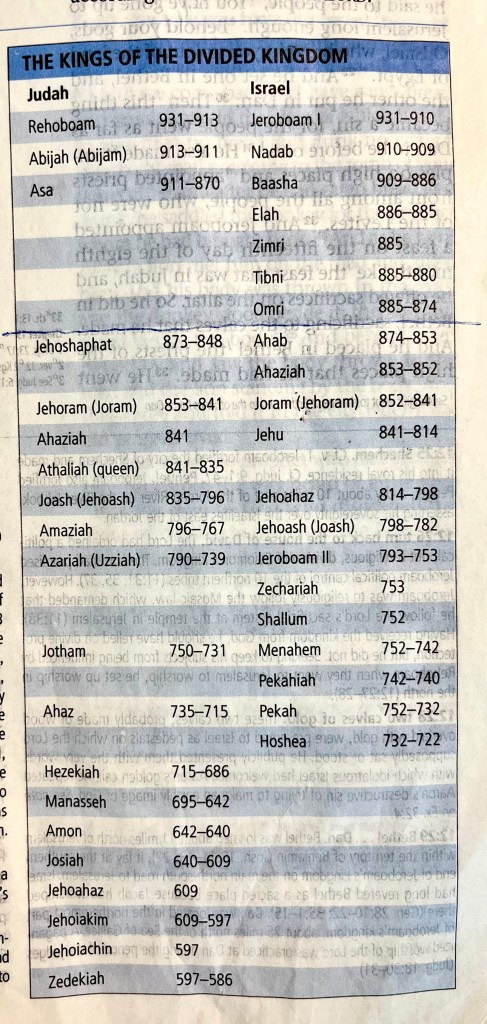
List of north/south kings:


Journaling through the Bible Chronologically in 2025, Day 150

 
Read Today’s Scriptures.
 
Psalm 119.

God’s Word is precious and good for any problem, joy, need, and instruction. 

This psalm reminds me of Paul’s words to Timothy in 2 Timothy 3:16 (“All scripture is breathed out by God and profitable for teaching, for reproof, for correction, and for training in righteousness, that the man (or woman) of God may be competent, equipped for every good work.”) 

READ ALL 176 VERSES OF THIS WONDERFUL “ACCROSTIC” PSALM AND BE BLESSED. The verses in each alphabetical section begin with that letter in Hebrew.

Here are a few of my “fave” verses from each alphabetical section.

ALEPH, “A” verses 1-8

  • Oh, that my ways may be steadfast in keeping Your statutes!

BET, “B” verses 9-16

  • I have stored up Your word in my heart, that I might not sin against You.

GIMEL, “G” verses 17-24.

  • Open my eyes, that I may behold wondrous things out of Your law.

DALET, “D” verses 25-32

  • I have chosen the way of righteousness; I set your rules before me.

HE, (hay) “H” verses 33-40

  • Incline my heart to your testimonies and not to selfish gain!

VAV, “V” verses 41-48

  • I find my delight in Your commandments, which I love.

ZAYIN, “Z” verses 49-56

  • I remember Your Name in the night, O LORD, and keep your law.

CHET, “CH” (like clearing your throat) verses 57-64

  • At midnight, I rise to praise You because of your righteous rules.

TET, “T” verses 65-72

  • Before I was afflicted, I went astray, but now I keep Your word.

YOD, (yood) “Y” verses 73-80

  • I know, O LORD, that your rules are righteous, and that in faithfulness you have afflicted me.

KAPH, “K” verses 81-88

  • My soul longs for Your salvation; I hope in Your word.

LAMED, “L” verses 89-96

  • If Your law had not been my delight, I would have perished in my affliction.

MEM, “M” verses 97-104

  • How sweet are Your words to my taste, sweeter than honey to my mouth.

NUN (noon), “N” verses 105-112

  • Your word is a lamp to my feet and a light to my path.

SAMECH, (guttural) “S” verses 113-120

  • You are my hiding place and my shield; I hope in Your word.

AYIN, (guttural) “AYE” verses 121-128

  • Therefore, I love Your commandments above gold, above fine gold.

PE, (pay) “P” verses 129-136

  • The unfolding of Your words gives light; it imparts understanding to the simple.

TSADHE, “TS” verses 137-144

  • Your promise is well-tried, and your servant loves it.

QOPH, (koof) “Q” verses 145-152

  • My eyes are awake before the watches of the night, that I may meditate on your promise.

RESH, “R” verses 153-160

  • The sum of Your word is truth, and every one of Your righteous rules endures forever.

SHIN, (sheen) “SH” or “S” verses 161-168

  • Great peace have those who love Your law; nothing can make them stumble.

TAV, “T” verses 169-176

  • My tongue will sing of Your word, for all Your commandments are right.

.##

.There are so many more that are my favorites. How about you?  Which have you memorized? or held dear?

How David must have enjoyed composing this Psalm!  Can YOU try it?  Write one praise to God or His Word from each letter of your alphabet!


Journaling through the Bible Chronologically in 2025, Day 112


Read today’s scripture.

How do you love in these Psalms?

Psalm 6.

Perhaps this was written after David rescued his family from the Amalekites, only to come home and learn King Saul and his “Best Friend Forever” Jonathan had been killed in battle and Israel had been soundly defeated. He mourns and laments the losses.

  • I am weary with my moaning, every night I flood my bed with weeping.
  • My eye wastes away because of my grief; it grows weak because of all my foes.
  • Depart from me, all you workers of evil, for the LORD has heard the sound of my weeping.
  • The LORD has heard my plea; the LORD accepts my prayer.

Psalm 8,

(I love this psalm!)

  • O LORD, our Lord, how excellent is Your Name in all the earth! You have set Your glory above the heavens.
  • Out of the mouths of babies and infants, You have established strength because of your foes, to still the enemy and the avenger.
  • When I look at your heavens, the work of your fingers, the moon, and the stars, which You have set in place, what is MAN than You are mindful of him, and the son of man that You care for him?

Psalm 9.

  • I will give thanks to the LORD with my whole heart; I will recount all of Your wonderful deeds.
  • I  will be glad and exult in you; I will sing praise to Your name, O Most High.
  • The LORD is a stronghold for the oppressed, a stronghold in times of trouble.
  • And those who know Your Name, put their trust in You, for You, O LORD, have not forsaken those who seek You.
  • Sing praises to the LORD, who sits enthroned in Zion! Tell among the peoples His deeds!
  • For He who avenges blood is mindful of them; He does not forget the cry of the afflicted.

Psalm 10.

  • Why, O LORD, do You stand far away?
  • Why do you hide Yourself in times of trouble?
  • In arrogance the wicked hotly pursue the poor; let them be caught in the schemes that they have devised
  • In the pride of his face, the wicked does not seek Him; all his thoughts are, “There is no God.”
  • The helpless are crushed, sink down, and fall by his might.
  • He (the wicked) says in his heart, “God has forgotten, He has hidden His face, He will never see it.”
  • Arise, O LORD: O God, lift up your hand; forget not the afflicted.
  • O LORD, You hear the desires of the afflicted; You will strengthen their heart; You will incline your ear to do justice to the fatherless and the oppressed, so that man who is of the earth may strike terror no more. 

Psalm 14.

  • The FOOL has said in his heart, “There is no God.”  They are corrupt, they do abominable deeds; there is NONE who does good.
  • The LORD looks down from heaven on the children of man, to see IF there are any who understand, who seek after God.
  • THEY HAVE ALL TURNED ASIDE; together they have become corrupt; there is NONE who does good, not even ONE.
  • Oh, that salvation for Israel would come out of Zion!  When the LORD restores the fortunes of His people, let Jacob rejoice, let Israel be glad.

Psalm 16.

  • I say to the LORD, You are my Lord; I have no good apart from you.
  • I bless the LORD who gives me counsel; in the night also my heart instructs me.
  • I have set the LORD always before me; because He is at my right hand, I shall not be shaken.
  • Therefore my heart is glad, and my whole being rejoices; my flesh who dwells secure.
  • You make known to me the path of life; in your presence, there is fullness of joy; at your right hand are pleasures forevermore.

Psalm 19.

  • MAY THE LORD answer you in the day of trouble,
  • MAY THE NAME of the God of Jacob protect you!
  • MAY HE grant you your heart’s desires and fulfill all your plans!
  • MAY THE LORD fulfill all your petitions!
  • O LORD save the king!
  • MAY HE answer us when we call.

Psalm 21.

(I love reading this psalm pointing to David’s love for and closeness to the LORD … before his fall.)

  • O LORD, in Your strength the KING rejoices, and in Your salvation how greatly he exalts!
  • You have given him his heart’s desire and have not withheld the request of his lips.
  • For You meet him with rich blessings; you set a crown of fine gold upon his head.
  • He asked life of You, and You gave it to him, length of days forever and ever.
  • HIS glory is great through Your salvation; splendor and majesty You bestow on HIM.
  • For You make him most blessed forever; You make him glad with the joy of Your presence.
  • For the KING trusts in the LORD, and through the mercy of the Most High he shall not be moved.

.

Yes, David will fail God horribly, but he was always “a man after God’s own heart.”


Journaling through the Bible Chronologically in 2025, Day 109


Read today’s scripture.

Did anything in these chapters bother you, cause you to question, or give you closure?

1 Samuel 28.

Remember how we ended yesterday? The Philistine King Achish said, “David shall always be my servant.” Well God has other plans for David, and here’s how He brings them about.

David had been going out and fighting Israel’s enemies while letting Achish think he was fighting against Israel. So when the big push against Israel came, the king signed up David as his bodyguard and his 600 men as part of the Philistine army.

(Pause here while we see what is happening in Israel’s King Saul’s camp.) 

Saul gathered all of Israel at Gilboa (his hometown) to fight the Philistines. But when he SAW their army, he was afraid. His heart trembled greatly. (No David to fight for him this time. In fact, if he’d looked, he might have seen David in the hoard. Don’t worry, God’s going to take care of that.)

Saul tries to “inquire of the LORD,” but the LORD does not answer him, either by a dream, or by the Urim, or by prophets. (Remember Samuel died.) Who else was there?  Who could tell him GOD’s will?  Oh! A witch! A necromancer who could bring up the dead!  NOT!!!

(Read what God says about witches, necromancers, mediums, charmers, sorcerers, fortune tellers, diviners, or omen interpreters in Deut. 18:10-11, Lev. 19:31 and 20:27, Exodus 22:18)  “Don’t go to them! Remove them from Israel! Kill them all!”)

It’s pretty clear that this is a huge no-no, but Saul is at his disobedient end. He has nowhere to turn except repentance to God, and he does not choose that option.  “Seek out for me a woman who is a medium that I may inquire of her.”

It’s interesting, his servants know right where one is, in En-dor. (Even this witch knows that Saul had “cut off the mediums and necromancers from the land.”  Obviously, he’d missed one.)

Saul disguises himself, goes to her, and tells her to bring up the spirit of someone he tells her.  She’s no dummy and is reluctant, but Saul swears “by the LORD” not to punish her.  Oh boy!!!  

“Bring up Samuel.”  And the witch is terrified when Samuel actually appears.  She’s used to her demons impersonating people.  She screams and accuses Saul. But the hapless king reassures her.

SAMUEL: Why have you disturbed me by bringing me up?

SAUL: I am in great distress for the Philistines are warring against me and God has turned away from me and answers me no more, either by prophets or dreams. TELL ME WHAT I SHALL DO!

SAMUEL:  Why do you ask ME since the LORD has turned from you and become your enemy?  The LORD has torn the kingdom out of your hand and given it to David…BECAUSE YOU DID NOT OBEY HIM and carry out his wrath against Amalek.  The LORD will give Israel to the Philistines tomorrow. You and your sons will “soon be with ME.” 

Not what Saul wanted to hear! He collapses.

1 Samuel 29.

Meanwhile, in the Philistines’ camp, the commanders object to “those Hebrews” being among them. 

King Achish said “Is this not David, the servant of Saul, king of Israel who has been with me these years since he deserted. I have found no fault in him.”

But the commanders insisted the king send them back from the battle “lest he become an adversary to us. Is this not David of whom they sing and dance, “David has struck his ten thousands (of us!)”

(This is how God was protecting David from having to fight his own people.)

Achish relented, apologized to David, and sent him back, so as not to displease his commanders.  “Arise before dawn and depart as soon as you have light.”

So David did.  (Thank You, LORD!)

1 Samuel 30.

When David and his men returned to their home in Ziklag, they discovered the town burned and all their goods and families taken away. (No one had be killed – see the hand of the LORD!)  But his men were so distraught that they spoke of stoning David!!!

David “strengthened himself in the LORD his God.”  Then he asked Abiathar the priest, the son of Ahimelech (remember, he was the only one to escape when Saul had Doeg kill all the priests for helping David),  “Bring the ephod and inquire of the LORD. Shall I pursue this band?  Shall I overtake them?”

The LORD answered, Yes. So they set out, David and the 600.  At Besor, 200 of the men were left behind “with the baggage” because they were too exhausted to go on.   And (wow!) they found an Egyptian man in the open country, dying of hunger and thirst.  It seems he was a slave to one of the Amalekites, who’d left him behind to die.  When David promised not to desert him, he said he would lead them to the Amalekite camp.

He did. They were spread out in the valley, eating and drinking and dancing.

David struck them down from twilight until the evening of the next day. Not a man escaped, except a few who got on camels and rode off.  All the loot (and people) they had taken from David was there, including his two wives, Abigail and Ahinoam. 

So the 400 and David took it all back, plus loot from the Amalekites.  David told the 400 to share the loot with the 200 who’d stayed behind, but they were reluctant to at first. David insisted, saying that all who fought AND all who protected the baggage would share alike. (It actually became a statute for Israel from that day on.)

When they got back to Ziklag (I assumed they rebuilt it), David sent presents of the spoil to the elders of Judah for all the places he and his men had looted while in the service of the Philistines (more than 13).  WOW.

1 Samuel 31.

Meanwhile, north of Ziklag, the Philistines fought Israel. The men of Israel fell slain on Mount Gilboa. They overtook Saul and his sons, Jonathan, Abinadab, and Malchishu, and killed them. They pressed hard against Saul and he was seriously wounded by Philistine archers. 

Saul pled with his armor-bearer to kill him, so the Philistines would not “mistreat him.”  But the man refused to kill the king. Saul committed suicide. Then the armor-bearer did likewise. 

Thus Saul died, and his three sons, and his armor-bearer, and all his men, on the same day.” just as God had said through Samuel.  (God never let any of Samuel’s words fall to the ground, even after his death!)

When the men on the other side of the valley saw their leader dead, they abandoned their cities and ran away. The Philistines came and lived in them.

The next day the Philistines found the body of Saul, cut off his head, and put it and his armor in the house of their idols, then hung his body on the wall. 

(Can you imagine if David had been there??? Praise God, He had removed him from SEEING Saul and Jonathan dead and mistreated.)

Later the people of Jabesh-Gilead, whom Saul had helped at the beginning of his reign, came by night, took the bodies of Saul and his sons from the wall, and burned them. They took their bones and buried them under the tamarisk tree in Jabesh, and fasted seven days.

And so ignominiously ends the rule of Israel’s first king, and his line.

Why? Because he had twice disobeyed God’s specific word through Samuel, and then continuously refused to repent.  (We will see David grievously sin against God too, but he repents. He suffers the consequences, but always turns back to his God.)

  • O LORD, let Saul’s life be a warning to us, and to me. When I sin, even grievously, cause me to remember to turn to you, confess, repent, then walk in obedience.

Psalm 18.

  • David:  “I love You, O LORD, my strength. The LORD is my rock and my fortress and my deliverer, my God, my rock, in whom I take refuge, my shield, and the horn of my salvation, my stronghold!
  • I call upon the LORD, who is worthy to be praised, and I am saved from my enemies. 
  • In my distress I called upon the LORD; to my God, I cried for help. From His temple, He heard my voice, and my cry to him reached His ears.
  • He rescued me from my strong enemy and from those who hated me; for they were too mighty for me.
  • For it is You who light my lamp; the LORD my God lightens my darkness. For by You, I can run against a troop, and by my God, I can leap over a wall.
  • This God, His way is perfect, the word of the LORD proves true; He is a shield for all those who take refuge in Him.
  • The LORD lives, and blessed by my rock, and exalted be the God of my salvation.
  • For this I will praise you O LORD, among the nations, and sing to Your Name. Great salvation He brings to His king, and shows steadfast love to his anointed, to David and his offspring forever.


Journaling through the Bible Chronologically in 2025, Day 98


Read today’s scripture.

How was God faithful to Israel in these chapters?

1 Samuel 1.

A sweet and sad love story. 

Hannah was deeply loved by her husband Elkanah (a member of the Kohathite clan of the tribe of Levi), but she had no children. He married a second wife, Peninnah, to produce an inheritance, but he loved Hannah and treated her very well. 

Each year they would go to Shiloh where the Tabernacle was, to worship God as all men were required to. (This was probably the Feast of Tabernacles.)  This year, Hannah went to the gate of the Tabernacle and silently poured out her heart to the LORD. She promised that if God would give her a son, she would give him back to the LORD all the days of his life. 

Eli (a corrupt priest, with corrupt sons, as we shall see), thought she was drunk, and rebuked her.  Hannah said she was praying, and Eli probably felt rebuked himself and blessed her, “Go in peace, and the God of Israel grant your petition.”

Back at home, she conceived and bore a son. She named him Samuel, which means “heard of God.”

(So far, this kind of sounds like Samson’s story. Samuel would also “judge Israel” all his life, but how differently!)

For three years Hannah and baby Samuel stayed home when the others went to Shiloh. (Elkanah agreed with her vow to give the boy to the LORD. As her husband, he “could” have annulled it.)  I know that she prayed for her son and filled him with songs and truths about God as he grew, and perhaps of his destiny in the service of God.  At 3 years old, after she weaned him, she took him to Shiloh when the family went to worship.  

And she fulfilled her promise to give him to the LORD.  It must have been doubly hard because the priest, Eli was so lax in raising and disciplining his own sons. But she left Samuel there, as she had vowed.  Did her heart break???

1 Samuel 2.

Hannah’s prayer is nothing but praise to God!

  • My heart exults in the LORD; my strength is exalted in the LORD…
  • I rejoice in Your salvation.
  • There is none holy like the LORD; there is none besides You; there is no rock like our God.
  • He raises up the poor from the dust; He lifts the needy from the ash heap to make them sit with princes and inherit a seat of honor.
  • The pillars of the earth are the LORD’s, and on them, He has set the world. 

Elkanah and Hanna went back home.  And the boy, Samuel, ministered to the LORD in the presence of Eli the priest.   But the sons of Eli were worthless men. They did not know the LORD. They stole the LORD’s portion. They extorted meat from the worshippers, treating the LORD’s offering with contempt for their own gratification.

But the boy Samuel ministered before the LORD, wearing a tiny linen ephod.  Hannah made and brought him a new robe each year when they came for the yearly sacrifice. And Eli would bless her and Elkanah.

And, indeed the LORD blessed them. Hannah conceived and bore THREE more sons and TWO daughters!!

The young man Samuel grew in the presence of the LORD.

But the very old Eli did nothing to stop his own priest-sons from grossly sinning. They even had sex with the women ministering at the gate of the Tabernacle.  Eli did scold them, but they didn’t listen.

HOWEVER, the young man, Samuel, continued to grow both in stature and in favor with the LORD and man. (It truly must have been a miracle of God for him to do this, living in such corruption of the priesthood.)  

One day a prophet of God came to Eli and told him the LORD’s will. “Why do you scorn my sacrifices and my offerings that I commanded, and honor your sons above me by fattening yourselves on the choicest part of every offering of my people Israel??”  “Behold the days are coming when I will cut off your strength and the strength of your father’s house so that there will not be an old man in your house.”  “And Hopni and Phinehas, your two sons, shall both die on the same day.”

1 Samuel 3.

Meanwhile, Samuel ministered to the LORD under Eli, whose eyesight was fading.  It seems that Samuel was sleeping in the Holy place of the Tabernacle (??) where the Golden Candlestick burned, in front of the veil which hid the Ark of the Covenant.

Samuel!” the young man heard and ran to Eli. 

“Here I am, for you called me.”  

“I didn’t call you, go lie down.”

Samuel!” the LORD called again. Samuel went to Eli.

“Here I am, for you called me.”

“I did not call you, my son, lie down again.”

Samuel!the LORD called a third time, and off Samuel went to Eli.

“Here I am, for you called me.” 

Hmm, though Eli. Could it be?  “Go, lie down, and if He calls you, you shall say, ‘Speak, LORD, for your servant hears’.”

And God did call Samuel again. “Samuel! Samuel!”

Speak, for your servant hears.” 

Then the LORD gave him a message that was very hard to hear. “I will fulfill against Eli all that I have spoken concerning his house, from beginning to end. I am about to punish his house forever, for the iniquity that he knew, because his sons were blaspheming God and he did not restrain them. Therefore I swear to the house of Eli that the iniquity of his house shall not be atoned for by sacrifice or offering forever.”

Wow. 

Samuel lay there until morning.  He was afraid to tell the vision to Eli, but the old priest said, “What was it that He told you?  Do not hide it from me.”

So Samuel told him everything.  (Like a prophet has to do, speaking the hard things of the LORD to a people who need to hear them.)

“It is the LORD. Let Him do what seems good to Him,” said Eli.

After that, the LORD was with Samuel and let none of his words “fall to the ground.”  From Dan to Beersheba, all Israel knew that Samuel was established as a prophet of the LORD.

Journaling through the Bible Chronologically in 2025, Days 96 & 97


Read today’s scripture.

How are you encouraged in the book of Judges?

How is God shown as faithful in the book of Ruth?

DAY 96.

Judges 19.

Wow, today, we finish Judges.  I’m glad we do. This section is really horrible.  It shows so clearly what happens when people turn from God and “everyone did what was right in his own eyes.”

This is a story about a despicable Levite (not the same one who traveled north with the Danites).  This one lived in the hill country of Ephraim. He took a concubine (servant with benefits) from the tribe of Judah. She was unfaithful to him and ran home. The Levite went there to get her and was kind to her, but the woman’s father kept him staying day after day and night after night eating and drinking. Finally the Levite got tired of that and left with the woman.

In another town in the land of Benjamin, they were forced to spend the night in the town square until a nice old man said it wasn’t safe and invited them to stay with him.  So they were eating and drinking and making merry.

And then….  (Replay Sodom at Lot’s house.)  Men from the city came seeking the Levite. These aberrant men lusted after him. The old man went out to calm them down and offered his two daughter for them to “use.”  But their lust was not satisfied and demanded the man.  Then the Levite threw  out his concubine forcibly. The men abused her all night until she died.

Next morning, the Levite saw her lying at his doorstep. “C’mon let’s go.” But she didn’t move. He three her body on his donkey and took her home.  THERE, HE TOOK A KNIFE LAND CUT HER UP INTO PIECES!!!!!  THEN HE SENT ONE OF EACH OF THE TWELVE PIECES THROUGHOUT ISRAEL TO THE TRIBES.”

Judges 20.

Well, all the men of Israel came out – from Dan to Beersheba (far north to far south) – over 400K men.

“This is what happened when I stayed in a town in Benjamin.” the Levite said.

After a lot of palaver, talking, and deciding, including inquiring the High Priest about what to do, Israel gathered together and fought against Benjamin, destroying over 25K of the men of valor. Then they struck the cities, and men and beasts with the edge of their swords. And finally set all the towns on fire.

Judges 21.

Then when the remaining Benjamite people wept, saying, “O LORD, the God of Israel, why has this happened in Israel, that today there should be one tribe lacking in Israel?”

“What shall we do?”  Their great idea was to go up to an area that had not sent men to fight, kill all the men and wives, and bring back the virgins to the remaining men of Benjamin.  They did, and brought back 400 virgins.  Peace was proclaimed and the women were given to the tribe of Benjamin.  And, oh my, there was still not enough. So the army went and captured 200 more virgins from Shiloh and gave them to fill the quota.

The people of Benjamin took the wives, returned to their inheritance and rebuilt the towns and lived in them.  And the army of tribes went back home and did likewise.

There was no king.

Everyone did what was right in their own eyes.

(NO ONE thought to inquire of the LORD, turn to Him, seek His face…. or even read His Law.)

I am so glad this is the last of the book of Judges.

Tomorrow we’ll begin a book of HOPE after DISPAIR … a godly woman meets a godly man, and the royal line is established. Praise God!

###

DAY 97.

Ruth 1.

In the days when the judges ruled, there was a famine in the land.”  The text doesn’t say exactly, but figuring backward, the story could have happened during the judgeship of Tola (23 years) and Jair (22 years) from Judges 10: 1-5

A (local?) famine was in the land, and a man, Elimelech (my God is king). his wife, Naomi (pleasant), and their two grown sons, Mahlon (sick) and Chillion (pining) from the tribe of Judah (important) living in Bethlehem decided to migrate to Moab until the famine was over.  Sadly, Elimelech died there.  Naomi’s sons married Moabite women, Orpah (stubborn) and Ruth (friendship), but it doesn’t seem any children were born from these unions.  Finally, the two sons also died.

Three widows. In a pagan land.

It’s been ten years. Naomi decides to go home.  She sends her daughters-in-law back to their homes in hopes they can remarry and have good lives. Orpah hugs her and leaves. But Ruth refuses, even when Naomi insists and tells her the bleak story of what their lives would be like in Israel as widows.

Nope. Ruth remains firm. “Do not urge me to leave you, or to return from following you. For where you go I will go, and where you lodge I will lodge. Your people shall be my people, and your God my God.  Where you die, I will die and there be buried.  May the LORD do so to me and more also if anything but death parts me from you.”

WOW. How many young women love their mothers-in-law like that today?

Naomi gives in and the two make their way back to Bethlehem. Naomi tells the women of the town to call her “Mara” (bitter) “for the Almighty has dealt very bitterly with me. I went away full and the LORD has brought me back empty.”

It was near the end of April, the time of barley harvest (the famine had ended!).

Ruth 2.

A close relative of Naomi’s husband (important), whose name was Boaz (strength) was someone she could “maybe” go to for help. He was “a man of valor” (like Gideon and Jephthah) and could manage and protect his property. He’d never married, or maybe was a widower too.

Naomi sent Ruth to his barley fields to “glean.” God’s law said that farmers were to leave the corners of their fields, and any grain that dropped, for the poor to pick up. (See Leviticus 19:10-11, 23:22)  Ruth labored long and well in Boaz’s field.  Later he happened to pass by and saw her. He asked his men who she was and learned her story, 

Boaz went to Ruth and told her to stay and work in his fields only. His men would not interfere, and if she got thirsty, she was to go to the water the young men had drawn and drink. 

Ruth bowed deeply and asked why he was so kind. He told her he’d heard about her faithfulness to Naomi. “The LORD repay you and may a full reward be given you by the LORD under whose wings you have come to take refuge.”

At the noon break, he invited her to eat bread, roasted grain, and wine with the reapers. When she returned to work, Boaz told his workers, “Let her work among the sheaves too, and do not reproach her. Also, pull out some stalks from the bundles and leave them for her to pick up.”

After gleaning all day (back-breaking work) she went to the threshing floor and beat out the grain. This she took to Naomi (about 30-40 pounds!).  Naomi was astounded at the amount and told her to stay in his field. So Ruth worked there until the end of the barley harvest.

Meanwhile, Naomi’s heart lifted. Boaz was a near redeemer in her family. That meant he could rescue them. He could marry Ruth, and their firstborn would be accounted to Abimelech’s line, like a grandchild to Naomi, so her husband’s name wouldn’t be lost in Israel. After that, the children would be for Boaz.

Ruth 3.

Naomi tells Ruth about Boaz as their redeemer and explains what she should do to let him know that she is available and willing for him to redeem. 

He was willing and gave her a pledge of 6 measures of barley.  He explained that there was one glitch (a closer redeemer) that he had to take care of first. She should be patient.

Ruth 4.

Boaz went to the gate of the city – where business was transacted – and approached the man who was a closer redeemer. He told the man about Ruth and Naomi and asked if HE wanted to be the redeemer.

At first, the man was willing, but when he learned there was no offspring from Elimelech, and he would need to provide one, he turned down the offer.  He had children of his own, and didn’t want to split up their inheritance for the dead man’s offspring.

Boaz was formal, but inside he was rejoicing. Ruth could be his. And sure enough, soon they were married.  And the LORD gave her conception, and she bore a son. Naomi was once again blessed by the LORD, and when she held the baby boy, her own grandson, she rejoiced.

They named him Obed.  He was the father of Jesse, who was the father of David, who would become KING in Israel (and ancestor of the Messiah, Jesus).

  • Wow, what a wonderful ending, after those horrid accounts in the book of Judges.  During all that sin and forsaking of the law, God had His eye on one family, descended from Judah through Perez, Salmon (with Rahab), Boaz, and on to David, a “man after God’s own heart” and eventually to the “Son of David,” to the Savior, His only begotten Son, Jesus. PRAISE HIM!

Yay! We’ve now finished the  8th and 9th books of the Bible, in our Chronological Reading!

Journaling through the Bible Chronologically in 2025, Day 91


BEGINNING THE MONTH OF APRIL

Continuing with the judges of Israel and the repeating cycles of sin.

What truth can help you TODAY?

Judges 6.

Oh, no! It’s happening again!

“The people did what was evil in the sight of the LORD.”

And the LORD gave them into the hand of Midian for seven years. (Those people who had corrupted Israel by the hand of Balaam when Moses was alive. Israel had declared a holy war against them and defeated them soundly, killing all except the young girls. Now they were back to repay Israel.)

The Midianites overpowered them. Israel hid in caves and dens. The Midianites stole and destroyed all their crops and produce, so food was scarce. Midian came like locusts with their camels (not chariots) and laid waste to the land. 

Israel was brought VERY LOW. 

And the cried out for help to the LORD.

The LORD sent a prophet saying, “I led you up out of Egypt and drove out all in this land and gave it to you. I said I am the LORD your God, you shall not fear the gods in the land you dwell. But you have not obeyed my voice.”

Nevertheless, God raised up another judge, one fearful little man who was threshing his meager grain at night so as not to be seen.

The Angel of the LORD: “The LORD be with you, O mighty man of valor!

Gideon: “Huh? If the LORD is with us, why has all this happened?  Where are all God’s wonderful deeds that our fathers talked about? The LORD brought us out of Egypt, but now He has forsaken us,” 

The Angel of the LORD: “Go in this might of yours and save Israel from Midian. I’m sending YOU.”

Gideon: “Seriously??? My clan is the weakest in Manasseh, and I am least in my father’s house!”

The Angel of the LORD: “I will be with you, and you shall strike the Midianites as one man.”

Gideon. “Show me a sign! Oh, wait, if it’s really you, stay here and I’ll bring you a present.”

The Angel of the LORD: “I will stay till you return.”

This was an extraordinary conversation!  But amazingly, the Angel remained till Gideon brought back some food. The Angel zapped the meat and broth and unleavened bread that Gideon brought with His staff and consumed it. 

Whoa! Now I know I’ve seen the Angel of the LORD!

The LORD gave Gideon the task of destroying the local alters of Baal and Asheroth that night, and Gideon obeyed. The whole town was angry and wanted to kill Gideon, but his father mocked.  “Do YOU defend the gods? Why don’t they defend themselves?”

Then the Midianites came. And the Amalekites. And the people of the East. They crossed the Jordan and camped in the plain of Jezreel. And all Israel quaked.

BUT… not Gideon because the Spirit of the LORD clothed him.  He sent messages to his tribe of Manasseh, and to Asher, Zebulun and Naphtali to meet him and they did, all 30K of them.  Then Gideon got the shakes. 

God, if you will save Israel by my hand – as you have said – behold I’m laying a fleece of wool on the floor. If there is dew on it and not the surrounding area in the morning, I WILL KNOW YOU WILL SAVE US.

It happened as Gideon asked.

But he was still shaking.  “God, this time, let the fleece be dry and the surrounding floor be wet.”  Yep. It happened.  

Convinced yet, Gideon?  

Judges 7.

And so, Gideon and his 30K set themselves in array camped by a spring, ready for battle.

The LORD:  “The people with you are too many for me to give the Midianites into their hand, lest Israel boast over me saying, ‘My OWN HAND HAS DONE IT.’  So, tell all who are afraid to go home.”

And 22,000 left Gideon!!!

Still too many, Gideon.  Give them the water lapping test.”  

Gideon did, and there were but 300 men left to fight the hoard of Midianites.

With the 300 men I will save you and give the Midianites into your hand.”

And it seems that Gideon believed God.

Later that night God sent him to spy out the Midianite camp, and he heard one of the soldiers recounting a dream he’d had about a simple disaster.  But the other soldier declared, “It’s none other than the sword of Gideon, a man of Israel. God has given us into his hand, the whole camp.”

Whoa!  Prophecy from the mouth of the enemy, no less. And Gideon worshiped God.

Get up, men, the LORD has given the host of Midian into your hand!”

And so, Gideon and the 300, with only empty jars with torches inside and their trumpets, attacked at the sound of Gideon’s trumpet. “THE SWORD OF THE LORD AND GIDEON,”  they shouted and blew their horns.

And all of Midian fell into chaos, turning, spinning, falling, killing their own. Gideon called the other tribes to chase and capture them before they got to the Jordan River.  They did and also captured the two princes of Midian and killed them.  

Whew.

  • LORD, encourage my little faith as you did with Gideon. Help me to remember that YOU are a majority. YOU have the power to defeat any enemy in my life. O may I trust you!


Journaling through the Bible Chronologically in 2025, Days 26 – 27

Days 26 – 27. Reading in Genesis 41 – 42 and 43 – 45.

Sunday and Monday’s studies are posted together on Monday. 

I invite you to read the scripture for the day and meditate on it. What stood out to you?

Genesis 41.

Today’s and tomorrow’s readings are fun, almost like reading a novel. Joseph is clever, his brothers are convicted, and Jacob is first in agony and then in ecstasy. And our promise-keeping God is sovereign over it all.

Two years after Joseph correctly interpreted the dreams of the baker and butler, Pharaoh had a dream. He knew it meant something ominous, but he couldn’t figure it out and neither could all his court soothsayers and wise men. 

A light bulb flashes on in the butler’s mind! “Oh, I remember my offenses today,” he cried, two years late for Joseph but in God’s perfect time. “When I and the baker were in prison, a young Hebrew man perfectly told us the meaning of our dreams.”

“Call the young man here!” ordered Pharaoh.  

Joseph is quickly brought out of prison, bathed, shaved, dressed in new “appropriate” clothes, and brought to the king.  Immediately, Pharaoh says that he’s heard Joseph can interpret dreams.  Of course, like Daniel many years later, Joseph says it is not he, who can interpret them, but God.

Pharaoh tells his repeated dream about the seven fat cows and plump corn ears eaten by the seven skinny cows and thin ears of corn.  Easy-peasy for Joseph (and God). Pharaoh’s fat and plump sevens pictured seven years of unequaled plenty in Egypt. The ravenous, skinny, ugly sevens pictured the following seven years of unequaled famine in the entire area (Egypt and beyond). Since the dream was repeated, it meant that God would shortly do it.

Then, without permission, Joseph, who had managed Potiphar’s estate and the entire prison so well, recommended a way to mitigate the years of famine to Pharaoh. 

“Good idea!” Pharaoh cried. “And who better to do it than YOU.  What did you say your name was?”

So Joseph was given wealth, authority, and honor in Egypt, second only to the Pharaoh.  He was also given an Egyptian name and an Egyptian wife (who bore him Manasseh and Ephraim). And Joseph did what he had suggested. He managed Egypt’s years of plenty wisely, so a great abundance of grain (like the sand of the sea) was stored up for the famine years.  And when those years came, and the people cried out in hunger, Joseph opened the storehouses and sold them the grain. And, when the surrounding peoples also suffered in famine and came to Joseph, he sold grain to THEM. 

And Egypt became “filthy rich.” How proud and pleased Pharaoh must have been with his prodigy. But it was God who orchestrated it all, and His reasons were many.

Genesis 42.

Back in Canaan, the famine hit hard. Jacob-Israel learned grain was for sale in Egypt, so he sent his ten older sons with donkeys and sacks of money to buy grain for them all. Little Bennie (about 33) stayed home with Papa.

In Egypt, Joseph recognized his brothers. As they bowed before him, he remembered his long-ago dreams (oh, wow!) and knew God was in all that had happened. Quickly, he counted only ten men and feared that perhaps they had also gotten rid of his little brother. He would test them.

“SPIES!” he yelled at them through an interpreter.  “You are SPIES, coming to see Egypt’s nakedness!”

“No, my lord,” the ten cried in terror. “We are the sons of one man. We have never been spies!”

“You are SPIES!” Joseph repeated. 

The brothers explain how they were twelve sons born to one man. “One is no more (Joseph), and the youngest is with our father.”

“No, you are SPIES.”  To test the veracity of their story, he tells them they can’t leave Egypt until the youngest brother comes as proof they are innocent. Then, he puts them all into custody for three days. 

Of course, guilt over what they had done to Joseph was still heavy on their consciences twenty years afterward.  “We SAW how Joseph begged us not to kill or sell him, and we didn’t listen. That is why THIS is happening.”  Reuben pipes up, defending himself. “Didn’t I tell you not to sin against the boy???”

They don’t know Joseph overhears them and understands what they’re saying. At one point, he has to turn away and weep. (But he did learn that Reuben had stood up for him. Perhaps that’s why he held back the second oldest brother in prison.)

Joseph keeps Simeon in prison and sends back the nine with their paid-for grain and a warning. “Don’t bother returning for more grain without your young brother.” (He also has his steward put their money sacks back into their grain bags.)

At one point, one of them opens a bag of grain to feed the donkeys on the return trip and discovers the money pouch. YIKES, he yells. They all find the same when they open the other sacks.  “What has God done to us?” they cry. (By now, they know this is a just repayment for their long-ago deeds.)

At home, they recount all that’s happened to their father, Jacob.  They show him their returned money pouches.  and Jacob goes into mourning. 

You have bereaved me of my children. Joseph is no more, and Simeon is no more, and now, you would take BENJAMIN??  All this has come against me. My son shall NOT go down with you, for his brother is dead, and he is the only one left. If harm should happen to him on the journey that you are to make, you would bring down my gray hairs with sorrow to the grave.” 

To be continued…..


Day 27 – Genesis 43 – 45

Genesis 43.

Another year has passed. The grain they purchased in Egypt is about gone, and Jacob asks his sons why they delayed. “Go back to Egypt and buy some grain.”

Judah speaks up. “Um, Dad, did you forget what the man said? Unless you send Benjamin with us, we won’t go.”

“Oh, why did you tell him you had another brother?”

“Because he ASKED us if we had one. We didn’t know he’d demand we brought him with us.”

Then Judah (whose idea it was 20+ years earlier to KILL Joseph) steps up and offers his own life in place of Benjamin’s.  He adds a plea for urgency. “If we hadn’t delayed, we could have been there and back two times.”

Jacob-Israel finally relents and, with a heavy heart sends ALL his remaining sons to Egypt, adding some good things from Canaan as a gift. “May God Almighty grant you mercy before the man.”  (Oh, Jacob, if you only knew!)

Joseph saw immediately that his brothers had brought Benjamin. How his heart must have swelled. He ordered a lunch at his home to be prepared.  Of course, the brothers were terrified about the returned money last time, so they approached the steward right away and assured him they’d brought double the money. 

“Nah, your God must have blessed you. I received your money before.” 

They are confused but very glad to see Simeon alive and well again. 

Joseph inquires about their father and is relieved to hear Jacob is alive.  Then he looked at Benjamin – a young teen when he left, and now a man – and his heart swelled.  He has to run to his room where he cries for joy. Afterward, he orders lunch.

After a wash-up the brothers are all seated in Joseph’s dining hall in order of their birth. Reuben, Simeon, Levi, Judah, Dan, Naphtali, Gad, Asher, Issachar, Zebulun (perhaps a space here for the “missing” Joseph), and Benjamin.  The brothers are shocked. HOW could this Egyptian lord know their birth order???

Joseph sends portions of delicacies from his own table, with five times more to Benjamin.  Was it just for the love of his full brother, or was he testing the others to see how they reacted to the preferential treatment of the youngest?

Genesis 44.

After lunch, Joseph orders all their sacks to be filled with grain, their TWO pouches of money, and, in Benjamin’s sack, Joseph’s own silver chalice.  The following morning, all eleven of Jacob’s sons left Egypt.  They are joyful to get away with all the grain and all the brothers. They are eager to return to their father with both Simeon and Benjamin.

Then, a dust cloud appears behind them. A chariot roars up and slides to a stop. The stern-faced steward gets out and accuses one of them of stealing the prized silver chalice from the Viceroy of Egypt. Immediately, the brother’s joy turns to terror. They deny it, open all their sacks, and proclaim their innocence. In whoever’s sack it’s found, that one will die, and we’ll all become your servants.

“I’ll only arrest the thief,” says the steward, “and all the rest of you will go free.”  

OF COURSE (as planned), the chalice is found in Benjamin’s sack, just where the steward put it. The brothers’ hearts stop. NOT BENJAMIN!!!  They ALL load up the donkeys and return to Egypt. Will this nightmare ever end? 

(Hey, Bros, how do you think your young brother felt being thrown into a pit, then sold to traders, taken as a slave into an Egyptian household, falsely accused, and put into prison for years??)

At Joseph’s palace, the brothers stood before the powerful man. “What is this that you have done?” 

A confession begins to tumble out. “What shall we say to my lord?  What shall we speak? Or how can we clear ourselves? God has found out the guilt of your servants. Behold, we are my lord’s servants, both we and he also in whose hand the chalice was found.”

“No, no, no,” says Joseph. “ONLY the man in whose hand the chalice was found shall be my servant.  You all can return to your father in peace.”

And now Judah shines. The one who said his daughter-in-law was “more righteous than he.”  The one who pledged to his father HIS own life forfeited for Benjamin’s sake.  This broken man (whose descendant would one day step into the punishment for OUR sake.) went to Joseph and pled for mercy for his little brother.

My lord asked his servants if we had a father or a brother, We said our father was an old man, and we have a young brother, the child of his old age. His brother is dead, and he alone is left of his mother’s children, and his father loves him. We told you how we couldn’t bring the boy because our father would die if he lost this one. His life is bound up in the boy’s life. If he isn’t with us, our father will die. 

But you insisted and we finally convinced our father because I became a pledge of safety for him. I will bear the blame if he does not return. PLEASE, let me remain as servant, and let the boy go back with his brothers. For how can I go back to my father if the boy is not with me? I fear to see the evil that would find my father.”

Genesis 45.

At this change of heart and confession, Joseph can no longer control himself. He sends all his Egyptian staff out. and he wept aloud.

I AM JOSEPH!” he cried in Hebrew.

They all are stunned to silence, mouths agape.

Come near me. I am your brother, Joseph, whom you sold into Egypt. But don’t be distressed or angry with yourselves. God sent me before you to preserve life.  There are five more years of famine. God sent me before you to preserve for you a remnant on earth and to keep alive for you many survivors. It was not you who sent me here, but God. He made me a father to the Pharaoh, lord over his house, and ruler over all of Egypt.

“Hurry now. Go get my father. Tell him God has made me ruler in Egypt. Come down to me.  Hurry!”

After telling them he’s prepared a place in Goshen for them all to live and reminding them that it’s him (Isn’t he speaking in Hebrew to them?), he grabs Benjamin, hugs him tight, and kisses him.  Then the other brothers too.

Later, Joseph sent their grain with them and wagons filled with provisions for the journey for ALL of Jacob-Israel’s extended family, plus his flocks and herds. He also sent many gifts to his father, new clothes to the brothers, and to Benjamin, he gave 300 silver shekels.

“Don’t quarrel on the way!” he calls after them. (Oh, how he knows his brothers!)

.

Jacob-Israel sees the wagons. He counts all eleven of his sons.  Even before they stop, the brothers call out, “Joseph is still alive, and he is ruler over all the land of Egypt!”

Jacob is faint. He gasps.  “What? Joseph, still alive?  OHHHHHH GOD!!! It is enough! Joseph, my son, is still alive. I will go and see him before I die!”

.

What a glorious story, but it’s not over yet. The relieved brothers now have to tell their father the truth about Joseph’s disappearance.  They have to confess their wicked sin and deception. How will he respond? 

Stay tuned.