Archives

Reading the Gospels in 2026: (1/9) Mark 3:1-12

A 5-day per week study.

January 9 – Reading Mark 3:1-12.

Read and believe in Jesus.

“Is it lawful on the Sabbath to do good or to do harm, to save a life or to KILL?”  Mark 3:3b 


The Gospel according to Mark 3:1-12

In today’s study, we saw the religious leaders again carefully watching Jesus. They had grumbled at and questioned His teaching, but it was the miracle healings He did on the Sabbath that really stirred up their ire.

Healing or helping someone in need (even an animal) on the Sabbath was not against the Mosaic Law. But it offended the rules (all 39 of them), the rabbis had invented to “protect” what God had said!  (As if!)


Vss 1-2.

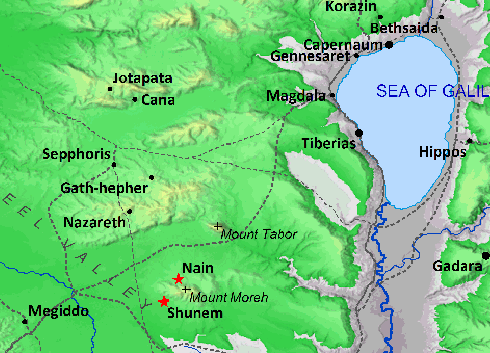
We see Jesus back in the synagogue on the Sabbath, where any good Jewish man would be.  It was probably the same synagogue in Capernaum where Jesus had released the demon-possessed man in chapter one. That miracle had caught the religious leaders off guard, but now they were “watching Jesus” to see if they could “accuse Him.” 

(I wouldn’t put it past them to have arranged the crippled fellow to be there that day.)

.

Vss 3-6.

Jesus saw the man as soon as He entered, and beckoned him to come near. I can see Jesus laying his arm across the man’s shoulders, assuring him. Then Jesus turned to the “super-sanctified” Pharisees and said, “Is it lawful on the Sabbath to do good or to do harm, to save a life or … to KILL?” 

They were silent.

Jesus looked into the eyes of each man, angry and grieved at their hardness of heart. Angry at their lack of compassion, and grieved at how they treated the Word of God.  Then he turned to the man, his face now showing kindness.

Stretch out your hand.”  

The man obeyed, and his hand was instantly restored.  Can you imagine his joy? What had for some time kept him from uselessness was now healed!  The pain was gone. He could support his family again.

What happened next?  It was really scary. 

The Pharisees went out immediately and held counsel with the Herodians (!!) against Jesus, on how to kill Him.  KILL Jesus!  The Man who brought hope and healing to many … but also correction and even embarrassment to these teachers of the Law. 

.

NOTE: The Herodians were a Jewish political party named after Herod Antipas (who ruled Galilee). The Herodians strongly supported Rome (and Herod’s rule) and opposed the Pharisees on nearly every issue.  But they were willing to join forces with them now, because they also wanted to destroy Jesus. (For more insight on this sect, see Matthew 22:15-22 and Luke 13:31-32.)

.

Vss 7-8.

Regardless of what the Pharisees thought of Jesus, ordinary people came to Him en masse for healing and to hear Him teach. The crowds from all the surrounding areas grew so large that Jesus could no longer stand along the beach or docks to teach.  He asked His fishermen-disciples to have a boat ready, so he could escape the “crush” if needed. 

Jesus healed all those with various diseases and those possessed by demons, and yet more and more needy folk came and tried to touch Him. The unclean spirits KNEW Jesus was the Son of God, and voiced this, but Jesus always told them to “SHUT UP!”  He did not want the testimony of an imp from Hell. 


These crowds, or mobs, seem wild to us, but imagine you had a horrible affliction or disfigurement, or that you were in pain or totally shunned, like the lepers.  Imagine being both mentally and physically tormented day and night by unclean spirits.  You would do anything to touch Jesus and be healed. 

I know I would!

But these diseases only “pictured” the sad spiritual state of mankind.  Jesus had come, ultimately, to heal them from their SIN.


Reading the Gospels in 2026: (1/8) Mark 2:18-28

A 5-day per week study.

January 8 – Reading Mark 2:18-28.

Read and believe in Jesus.

“The Sabbath was made for man, not man for the Sabbath.”  Mark 2:27

.

The Gospel according to Mark 2:18-28.

In today’s reading, we see the Pharisees becoming more vocal in their displeasure with Jesus.

When the paralytic man was forgiven and healed, they criticized Jesus “in their hearts.”  When Jesus had dinner with a tax collector and other “sinners,” the Pharisees spoke their criticism aloud, but only to each other. 

Now, they openly confront Jesus with a question that is actually an accusation.  They will get an answer, alright, and it will be outrageous.  But first…

.

Vs. 18.

John the Baptist still had some followers as he preached and baptized people for the forgiveness of their sins. These were super loyal to him, especially now that he was in prison.  They would have supplied him with food and carried messages, including the haunting question they later took to Jesus from John and Jesus’ answer. They also told Jesus the news of John’s death. 

These disciples of John adhered to the strict Pharisaic practice of fasting twice a week.  The Pharisees used this unnecessary practice to “promote their holiness” in the eyes of the people.  God only required His people to fast on ONE DAY per year, the Day of Atonement in late autumn. (See Leviticus 16:29, 31).  (Sometimes, in a time of national crisis, a special fast might also be called.)

.

Vss. 19-20.

This concerned the people who daily crowded around Jesus. Eventually, they asked Him, “Why do John’s disciples and the disciples of the Pharisees fast… but YOUR disciples do not fast?”

Jesus’s answer might have confused them at first, but they would have understood what He meant after thinking about it.  “Can the wedding guests fast while the bridegroom is with them?  As long as they have the bridegroom with them, they cannot fast. The days will come when the bridegroom is taken away from them, and THEN they will fast … in that day.”

Um…. was there a wedding somewhere? 

Was Jesus getting married? 

Who would be taking “this bridegroom” away?   

Then, the people saw the analogy.  A wedding was a time of celebration. No one fasted, but rejoiced and ate and drank.  Jesus wasn’t getting married, but His time among them with His teaching and healing miracles WAS a time for rejoicing … LIKE a wedding. And after He was gone, yes, THAT would be a sad time. Fasting would be suitable. 

(Of course, no one – even the disciples – realized that Jesus was talking about His death on the cross.) 

.

Vss. 21-22.

Jesus continues with some illustrations about the “new life” He was bringing to them, and how the “old traditions of the Pharisees” just wouldn’t mesh with it.  The people were certainly acquainted with the examples he gave.

  1. “No one sews a piece of unshrunk cloth onto an old garment. If he does, the patch will pull away from it (when washed), and a worse tear is made.”
  2. “No one puts new wine into old (stiff) wineskins. If he does, the wine (as it ferments) will burst the skins, and both the wine and the skins are destroyed.  New wine is for new wineskins.” (New life is for changed hearts.)

.

Vss. 23-24.

We know what “the Sabbath” is. (Sabbath actually just means “seventh.”)  After God’s six days of Creation, He “rested” on the seventh day.  He declared the day “holy,” which just means “set apart for Him.” 

God gave this GIFT to his people, Israel.  No longer would they be required to labor nonstop for seven days per week, month after month, year after year, as they had in Egypt.

They would now have a legally mandated day of rest.  Even the women would not be required to cook meals that day.  Rest, glorious rest.  God wanted them to also think of Him, as their Creator and Savior, and have a heart of gratitude.

.

Centuries later, the rabbis of Judaism, to protect the commandment to “NOT WORK” on the Sabbath, created 39 detailed restrictions on what constituted “work” on the Sabbath. 

  • You couldn’t spit on the ground, for it might make a groove in the dust, and that would be “plowing,” or it might make a little mud, and that would be “mixing mortar,” which would be “building.” 
  • You could have nothing in your pockets or wear a piece of jewelry, for that would be “carrying a burden.”  
  • Untying a knot was prohibited because it couldn’t be done with one hand.
  • You couldn’t cut your nails or trim your beard. It would be considered “shearing.”
  • AND, you couldn’t pluck grain, rub it in your hands to remove the chaff, and then blow the chaff from your hand.  THAT would be “reaping,” “threshing,” and “winnowing.”

.

Vss 25-28.

Well, one Sabbath, Jesus and his disciples were walking by a grainfield.  As they walked, the disciples began to pluck heads of grain to eat.  (God’s law allowed this. See Deuteronomy 23:25).  The “extra” rules of the Pharisees did NOT allow this.

Look!  Why are they doing what is not lawful on the Sabbath??” they demanded, no doubt pointing fingers.

Jesus, like a ‘mama bear,’ turned to protect his disciples.  He was harsh.  “Hey, you, Teachers of the Law, haven’t YOU read the Scriptures?   David, when he was in need and hungry, he and those with him entered the house of God (the Tent of Meeting) and ate the bread of the Presence (Showbread), which is not lawful for any but the priests to eat, and also gave it to his men.

Life or bread. Which is more important?  “The Sabbath was made FOR men, not man for the Sabbath.”

.

 Jesus would later emphasize this whenever He healed someone on the Sabbath.  If they could rescue a sheep in a pit on the Sabbath, why couldn’t He “rescue” one made in the image of God who had been suffering long with a disease or demon possession?   “The Sabbath was made FOR men, (for their health and welfare).  It was a kindness from their God.  Having food, helping others – this was good.

.

After this incident, the Pharisees and religious leaders kept an eagle eye on Jesus, and pounced on Him for every good deed He did on the Sabbath.  It was part of the case against Him that would later lead to their demand for His crucifixion. 

Reading the Gospels in 2026: (1/7) Mark 2:13-17

A 5-day per week study.

January 7 – Reading Mark 2:13-17.

Read and believe in Jesus.

“I came not to call the righteous, but sinners”  Mark 2:17b


The Gospel According to Mark 2:13-17

Vss. 13-14.

Jesus is again beside the Sea of Galilee (it was near Peter’s home).  The crowd was coming to him, and He was teaching them. (Standing by the water and speaking up the sloping land made for great acoustics. Many people were able to hear Jesus’ voice clearly.) 

Then, Jesus continued along a certain path, but this time He wasn’t looking at the boats.  He knew where He was going and who He would find there. And as he’d specifically called the two sets of fishing brothers to Himself, Jesus now spoke to a Tax Collector sitting at his tax booth.  

Follow me,” Jesus said, looking into the man’s eyes.  (I almost expected Him to say, “…and I will make you a ‘Collector of Men’,” but of course He didn’t say that.)  The tax collector, Levi, got up, left his coveted Roman franchise booth, where he’d become a rich man at the expense of his fellow Jews, and followed Jesus.  

Don’t you wonder what Peter, Andrew, James, and John were thinking?  Levi had probably extorted money from their family’s fishing businesses many times. And Jesus was calling… him?  How did the richly ornate robe of the Publican blend with the simple attire of local fishermen?  

(I’m so glad that Jesus calls all types of people to follow Him.)

Like with the fishermen, I believe Levi had heard Jesus speak before as He made his way along the shore of Galilee.  Perhaps he’d witnessed miraculous healings too, as he watched from inside his booth.  Whatever he’d seen and heard, Levi’s heart was now toward Jesus.  The instant the Master called, Levi was out of the booth – leaving the quills, ledgers, and piles of coins behind – and walking with Jesus.

(By the way, this man’s other name was Matthew.  And this careful calculator wrote the wonderful Gospel by his name, specifically to the Jews about their Messiah.)

.

Vss. 15-17.

Peter had invited Jesus to headquarter in his home. Now, Levi asked Jesus (and disciples) to a feast at his house. He also invited a bunch of other tax collectors (and “sinners”) that he knew. 

(Another tax collector – Zacchaeus – did the same thing in Luke 19.  This is SO like what happens to a person who has truly been converted. They want to share “the good news” with others. They want friends and family to know Jesus, too.)

Jesus, of course, accepted the invitation. He is comfortable with anyone who truly seeks Him.  Did other “sinners” there believe in Him and follow His way too?  

Outside, the Scribes (probably the same ones who’d observed the paralytic man being healed) had sour faces.  “Why does He eat with tax collectors and sinners?”  (THEY would never do that!)

Jesus heard what they said as He left Levi’s house.  He looked these self-righteous men in the eyes and said, “Those who are well have no need of a physician, but those who are sick do. I came not to call the righteous, but sinners.” 

Did they understand what Jesus meant?  What DID Jesus mean? 

.

Did He truly see these Jewish rulers as “righteous,” not needing forgiveness and salvation?  Absolutely not.  Psalm 14:2-3 says, “None is righteous (good), no, not one.”  Jesus was speaking about the “self-righteous” who “think” they don’t need a savior.

Later, in Luke 18, we will see that Jesus tells a parable about a Pharisee and a Tax Collector. Was He thinking of Levi and these men?   He told this story “to some who trusted in themselves that they were righteous and treated others with contempt.”

In the story, the Pharisee stood and bragged of all his good works and accomplishments, and how he had never done such sinful things as the extortioners, adulterers, the unjust, or even… the tax collector…

The Tax Collector, on the other hand, could say nothing but, “God, be merciful to me a sinner.”  (Were those Levi’s words that Jesus quoted?)   Jesus told his audience that the Tax Collector went to his house JUSTIFIED, while the braggadocio Pharisee did not.

.

Here, in Capernaum, the Jewish leaders were just beginning to spar with Jesus.  It would get worse. Would any of them recognize their lack of true righteousness before it was too late?


Reading the Gospels in 2026: (1/6) Mark 2:1-12

A 5-day per week study.

January 6 – Reading Mark 2:1-12.

Read and believe in Jesus.

“When Jesus saw their faith, He said to the paralytic, “Son, your sins are forgiven.”  Mark 2:5


The Gospel According to Mark 2:1-12.

Vss 1-2.

Jesus, and a few disciples, had been away preaching and casting out demons throughout all Galilee for several weeks or months. Then, after the glorious healing of the leper, Jesus had gone into seclusion for a bit because of the crowds thronged Him. 

Now, He had returned to Capernaum, to Peter’s house, and after a few days … it was reported that He was back.  Immediately many came to hear and be healed. They pushed into Peter’s house till it was packed like sardines, and they crowded around the door to try and hear Him. 

In that crowd, were some Scribes who had mananged to come inside. They were “sitting” and watching Jesus with hawk eyes.  And Jesus preached “the word.”  (The Gospel of grace, faith, and forgiveness.)

.

Vss 3-5.

In Capernaum, there lived a man who was paralyzed in his legs. We aren’t told if this was an injury or a birth defect.  But this man was very fortunate. He had four friends, perhaps former co-workers, who cared about him deeply. They heard that Jesus, the miracle-healer, was back in town.  They got a stretcher for their friend and jogged (double-time) to Peter’s house. 

But before they got close enough to even hear Jesus speaking inside, they saw the crowds straining and pushing around the door. 

Perhaps they stopped, took in the situation, speaking among themselves. What to do?  Should they wait outside till Jesus came out?  Did the paralytic tell them to just take him home, that maybe later….

But no!  One had spied the steps leading to the roof of Peter’s house. (It was a flat place where the family could sit or sleep when it got too hot inside.)  The friends nodded. They went around the house and carefully carried their friend up the steps.  Once there, they began removing the roofing material, surely laying it aside neatly so they could later repair it.

Inside, Jesus was aware of their efforts.  Soon everyone was, as an opening appeared in the ceiling. Gasps? Dismay? Outrage? 

But Jesus saw something else.  He saw THEIR FAITH.  And as they let down the paralyzed man, Jesus said to him, “Son, your sins are forgiven.” 

(Was there joy on the man’s face?  Was THIS his main problem, the one that haunted him even more than his useless legs? What joy he must have felt!

.

Vss 6-9.

Ah, but those Jewish scribes.  What were they thinking?  You could tell by their faces they weren’t happy. 

One was thinking, “Why does this man speak like this?

The second one, “He is blaspheming!”

The third one, “Who can forgive sins but GOD alone??”

Just like Jesus could see into the paralytic’s heart, he saw the darkness in these men’s hearts.

Why do you question these things in your hearts? Which is easier to say to the paralytic, ‘Your sins are forgiven,’ or to say, ‘Rise, take up your bed and walk?’  But, that you man KNOW that the Son of Man has authority on earth to forgive sins…Jesus turned to the paralyzed man and said, I say to you, rise, pick up your bed, and go home.”

The man, whose sins were forgiven, rose and immediately, picked up his bed, and went out before them all.  The parting crowd was amazed and they glorified God.  They said, “We never saw anything like this!’


(And of course, the friends of the man ran down the steps two at at time. The embraced him and joined in glorifying God. 

Yes, I think later they returned and repaired the roof.)

###

.

(Back to the question Jesus asked the Scribes.  “Which is easier TO SAY?”  This is different from, “Which is easier TO DO?”  Anyone could say anything, but did that make it true?   Jesus had backed up His words with actions. The Scribes didn’t believe their EARS, but they had to believe their EYES.

The paralyzed man of course believed his ears at both things Jesus said. And so did his friends.  He was forgiven.  He was healed.   And he had acted on both. He got up and went home, a forgiven man.

Oh, Lord! for FAITH to believe ALL You say to us in Your Word! Like You said to Thomas, ‘Blessed are those who don’t see and yet believe!’)                                       


Reading the Gospels in 2026: (1/5) Mark 1:29-45

A 5-day per week study.

January 5 – Reading Mark 1:29-45.

Read and believe in Jesus.

Let us go on to the next towns, that I may preach there also, for that is why I came out.” Mark 1:38


The Gospel According to Mark 

Vss. 29-31. 

In the last reading/study I wondered if Peter & Andrew and James & John had gone into the synagogue with Jesus, heard his teaching and witnessed the casting out of demons from the man.  Well, here, it seems that the four new “fishers of men” disciples had indeed been there, for after the service, they “left the synagogue and entered the house of Simon and Andrew.”

(Hmmm, brother Andrew lives there too?)

Peter’s mother-in-law (probably a widow) lived with them, and when they came in from the Sabbath Day’s service, they found her in bed and sicker than they left her. (Luke’s gospel [4:38] said it was a “high” fever, maybe life-threatening, and Luke WAS a doctor after all). 

Peter and/or his wife immediately told Jesus about her, and Jesus went to her bedside.  He took her by the hand and lifted her up. At the sight and touch of Jesus, the fever fled, and she was restored to health…so much so that she began to serve them. (A cold Sabbath meal, perhaps?)

.

Vss. 32-34. 

Later, after sundown when the Sabbath was over and the people were released from the prohibition of “carrying” anything, they began to bring to the door of Peter’s house, ALL who were sick of various deseases and conditions or were demon-possessed.

Jesus went outside and began healing them (as He had Peter’s mother-in-law).  He met the needs of the people of Capernaum long into the night.

.

Vs. 35. 

Very early in the morning, Jesus got up, dressed and left Peter’s home.  In the cool, quiet morning, he walked to a desolate place. There he prayed to His heavenly father. 

In this time of communion with God, Jesus was strengthened, assured, and directed to His next tasks.  He felt joy, and again yielded himself to all God’s plans for Him.

(I imagined that part, but isn’t it what WE feel when we take time, early in the morning, to pray, worship, read the Bible, and commit ourselves anew to the Lord?)

.

Vss. 36-38. 

When everyone in the house got up, they found Jesus missing. (Was there a bit of fear in their heart? Where was He? Had he deserted them?)   The four “fishers of men” searched everywhere for Him, and evenually found him in that lonely place.

Everyone is looking for you!” said Simon.  (Did that mean only those in Peter’s home, or were the needy again lining up at his door, looking for the great Healer?)

Jesus had compassion on the sick and demon possessed.  But sin was at the core of this suffering.  He had come to deal with sin, and He wanted to get to preaching and teaching about his mission, and turning HEARTS to Himself. 

Let us go on to the next towns, that I may preach there also, for that is why I came out,” He said. 

.

Vss. 39.   

So that is what He did.  And the four men followed Him.  (Did they go back to pack a lunch and get a cloak?  Did Jesus first heal those who had come in the morning?  We don’t know.

But we DO know that from there and at that time, “Jesus went throughout all Galilee, PREACHING in their synagogues and casting out demos.”  (This is but a short verse, but the time frame was probably weeks or even months.) 

.

Vss. 40-45.  

Mark records one incident that happened during this time of travel.   It was an astounding healing showing Jesus’s heart and pity for the lost and sick.  It also shows the problem they faced when Jesus did such miraculous healings. 

A leperous man aprroached Jesus.

(Since leprosy was contageous, lepers were required by the Law to stay 50 paces away from other people and constantly call out “unclean, unclean” to warn them.)

But this man, came close to Jesus, kneeling right infront of Him and begging.  “If You will, you can make me clean.”  The man did not doubt Jesus ability, only His willingness to do it.  

Jesus was “moved with pity.”  He reached out and ….. touched the Leper.  He TOUCHED the diseased man!!  And instead of the vile disease passing to Jesus, clean wholeness passed to the leper.  “I will, Jesus said. Be clean.

And immediately the leprosy left him.

Now listen,” Jesus warned him sternly. “See that you say nothing to anyone. Go show yourself to the priest, then give the offerings Moses commanded as “proof” of your cleansing.” (See Leviticus 14:1-32)

But, and who can actually fault him, the joyous man began proclaiming far and wide the miracle of cleansing Jesus had done for him.  “I’m clean!  Look at me!  Jesus cleansed me!  Clean!  No more leprosy!  I’m cleannnnnn…..”

And the lepers massed to Jesus, their desperate eyes full of hope. 

No more could He teach or preach in the towns for the lepers and sick crowded and called for healing and pleaded for mercy and tried to touch Him.  (Sigh.)  And so Jesus was forced to go out into desolate places until the excitement died down.  

But some good came of it. It was “alone” time with those few disciples.  And there were sweet times of prayer to His Father. (See Luke 5:16)

.

(NOTE: This section reminded me of the stress – body and spirit – that our own ministers and pastors experience in serving and teaching us. There are lots of expectations, needy people, “things to do.”   They can get rung out, desperate for that alone time with God.  Do we allow and foster that for them?  And do we pray for them?  Let’s do that his week.)


Journaling through the Bible Chronologically in 2025, Day 364

Day 364 – Reading – Revelation 12 – 18

Read and believe in Jesus!

The Revelation 12 – 18

The next seven chapters escalate. Satan, the Beast (Monster), the Antichrist appear. The Tribulation escalates. And there is all-out War in Heaven. Michael and his host of mighty angels battle. The seven bowls of wrath and the seven plagues do their worst, and the “great prostitute, Babylon” (who is a dwelling place of demons) appears and …. falls!

.

Revelation 12

And A GREAT SIGN appeared in heaven; a woman clothed with the sun, with the moon under her feet, and on her head a crown of twelve stars.”

A SIGN:  A symbol pointing to something else. This is the first of SEVEN SIGNS in the last half of Revelation. This first sign, the Woman giving birth, represents Israel

(There are three other symbolic women in Revelation. Jezebel (2:20) represents paganism, the Scarlet Woman (17:3-6) represents the Apostate Church, and the Wife of the Lamb (19:7) represents the True Church.

The next sign we see is the Great Red Dragon, which represents Satan. He is the woman’s mortal enemy. He has ceaselessly tried to destroy “her” to keep the Savior from coming, but he failed, and then he was unable to kill the baby, despite using Herod to massacre hundreds of infants at the time. Then Jesus did His redeeming work and ascended back to Heaven.


Although Satan and 1/3 of the angels (who are now his demons) fell from heaven after they rebelled, they still had access to it. (Remember Job?)  But now, after fighting with Michael and his host, they are THROWN DOWN to earth.  That old ACCUSER OF BELIEVERS who stood to accuse us day and night before God is cast down (and locked out).

Heaven rejoices, but “Woe to you, O earth and sea, for the devil has come down in great wrath, because he knows his time is short.”

.

Furious, Satan pursued the Woman/Israel to kill her.  But she was given “two wings” (heavenly protection) and fled to the wilderness, where God kept her safe and nourished her for 42 months.  Frustrated and angry, Satan then went to wage war on the rest of her offspring (believing Jews and Gentiles), “who kept the commandments of God and hold to the testimony of Jesus.”

Unable to destroy these, Satan went and stood on the sand of the sea………….

.

Revelation 13.

…………….. And it seemed he summoned up his strongest and most horrible demon. 

John saw “a beast rising out of the sea, with ten horns and seven heads, with ten crowns on its horns, and BLASPHEMOUS NAMES on its heads. And to this monster, Satan (the dragon) gave his power and his throne, and his great authority. 

The whole earth marveled as they followed the Beast. And they worshiped the dragon, for he had given his authority to the Beast, and they worshiped the Beast, saying, “Who is like the Beast, and who can fight against it?”

The Beast was allowed to exercise authority for 42 months.  It opened its mouth and uttered blasphemies against GOD, blaspheming His NAME and His Dwelling Place.  It was also allowed to make WAR on the saints and conquer them – from every tribe, people, language, and nation.

And ALL who dwelt on the earth… were made to worship it.  ALL whose name was NOT written from before the foundation of the world … in the Book of Life of the Lamb, who was slain.


John inserts a warning to his readers:  “Here is a call for the endurance and faith of the saints.”

.

Then I (John) saw another beast rising from out of the earth.  It had two horns… like a lamb… and it spoke like a dragon.” 

(We now have an unholy Satanic trinity of despicable evil.)

Unlikely as it looked, this lamb-appearing beast is the “enforcer” for the Beast.  It made the earth and its inhabitants worship the first beast.  It also performed great miracles, even making fire come down from Heaven to earth in front of people. It deceived those who dwelled on earth.  It told the people to create an image of the Beas.  And it gave the image … speech.

All who did not worship the image were killed.

All who would not receive the mark of the Beast on forehead or right hand could neither buy nor sell… anything.


John again inserts a warning to his readers. “This calls for wisdom; let the one who has understanding calculate the number of the beast, for it is the number of a man, and his number is …. 666.”

.

Revelation 14.

Then John looked, and in his vision he saw THE LAMB of God standing on Mount Zion, with the 144,000 who had NOT taken the mark of the beast. On THEIR foreheads was written the name of the LAMB and the name of His Father.  These 144K are the first fruits for God and the Lamb.  And a special song was sung to them and about them by the hosts of Heaven.

.

Next, John saw three flying heralding angels, each with a message.

  • The first – “Fear God and give Him glory, because the hour of His judgment has come, and worship Him who made heaven and earth, the sea and the springs of water.”
  • The second – “Fallen, fallen is Babylon the great, she who made all nations drink the wine of the passion of her sexual immorality.”
  • The third – “If anyone worships the Beast and its image and receives a mark on his forehead or hand, he also will drink of the wine of God’s wrath … and he will be tormented with fire and sulfur in the presence of the holy angels and in the presence of the Lamb.”


John again inserts a warning. “This is a call  for endurance of the saints, those who keep the commandments of God and their faith in Jesus.”


Then, a voice from Heaven spoke a chilling statement.  “Write this: “Blessed are the dead who die in the Lord from now on.”

Blessed indeed,” says the Spirit, “that they may rest from their labors, for their deeds follow them.


Then came angels and One, like the Son of Man, with sickles.  It was the time of THE REAPING OF THE HARVEST OF THE EARTH.  (Remember those parables Jesus told of just such a thing!)  

  • “Put in your sickle and gather the clusters from the vine of the earth, for its grapes are ripe.
  • So the angel swung his sickle across the earth and gathered the grape harvest of the earth and threw it into the great winepress of the wrath of God. 
  • And the winepress was trodden outside the city, and blood flowed from the winepress as high as a horse’s bridle for 184 miles!”


You might be reminded of that old song, The Battle Hymn of the Republic right now.

“Mine eyes have seen the glory of the coming of the Lord. 
He is trampling out the vintage where the grapes of wrath are stored;
He hath loosed the fateful lightning of His terrible swift sword:
His truth is marching on.

.

Revelation 15.

Then John saw another great and amazing SIGN in heaven – seven angels with seven plagues.  

Here’s how it went down…..

John saw what looked like a sea of glass mingled with fire… and standing next to this sea were those who had conquered the Beast and its image and the number of its name.  They had harps and they sang “The Song of Moses and the Song of the Lamb.”

  • “Great and amazing are Your deeds, O Lord God the Almighty!
  • Just and true are Your ways, O King of the nations!
  • Who will not fear, O Lord, and glorify your name?
    All nations will come and worship You, for Your righteous acts have been revealed.”

And as they sang, the Holy Place was opened in Heaven and out from the Santuary came the seven angels with the seven plagues.  One of the four living creatures gave the seven angels the seven golden bowls full of the wrath of God.

And the sanctuary was filled with the glory of God and His power, and no one could enter it until the seven plagues were finished.

.

Revelation 16.

The voice came from the Temple, “Go and pour out on the earth the seven bowls of the wrath of God.”

  • The first angel – poured out harmful and painful sores on the people who bore the mark of the Beast.
  • The second angel – poured out his bowl on the sea, and it became like blood, and every living thing died in it.
  • The third angel – poured out his bowl into the rivers, and they became blood.

Just are You, O Holy One, who is and who was, for you brought these judgments.

For they have shed the blood of saints and prophets, and you have given them blood to drink. 

It is what they deserve!”

  • The fourth angel – poured out his bowl on the sun, and it was allowed to scorch people with fierce heat.  (And they cursed the name of God. They did not repent. They did not give Him glory.)
  • The fifth angel – poured out his bowl on the throne of the Beast, and its kingdom plunged into darkness. People cursed God for their pain. They did not repent of their deeds.
  • The sixth angel – poured out his bowl on the great River Euphrates, and its water was dried up — to prepare the way for the kings from the east.

(Then John saw coming out of the mouths of the Dragon, the Beast, and False Prophet, demonic spirits that looked like frogs.  They did miracles and went to all the kings of the whole world to assemble them for battle on THE GREAT DAY OF GOD ALMIGHTY.  And the assembled them at the place that in Hebrew is called … ARMAGEDDON.)

  • The seventh angel – poured out his bowl into the air. And a loud voice came out of the temple from the throne, saying, “IT IS DONE!”   


  • Followed by lightning, thunder, and a great earthquake.  And the great city – Jerusalem – split into three parts, and the cities of the earth fell. 
  • And God remembered Babylon the great, to make her drain the cup of the wine of the fury of his wrath.
  • And great hailstones – 100 pounds each – fell from on heaven on the people and they cursed God.

.

Revelation 17.

One of the seven angels then came to John and said, “Come, I’ll show you the judgment of The Great Prostitute (remember this represents the Apostate Church) who is seated on many waters (the nations of the world), with whom the kings of the earth committed sexual immorality.”

  • The angel carried John away in the spirit to a wilderness. He saw the Prostitute sitting on a scarlet beast which was full of blasphemous names.  The woman wore purple and scarlet, gold, jewels, and pearls.  In her hand, she held a golden cup FULL of abominations and impurities and immorality. 
  • On her forehead was written: “Babylon the great, mother of prostitutes and of earth’s abominations.” 
  • And she was drunk with the blood of the saints and the martyrs of Jesus…….

The angel then explains the “mystery” about this woman and the beast with its multiple heads and horns,  and what they mean.

  • The multitude of the nations and people hate her and plan to kill her and burn her with fire, and hand over her royal power to the Beast until the Words of God are fulfilled.  That woman is … the great city that has dominion over the kings of the earth … Babylon the Great.
  • These kings also plan to make war on the LAMB, but the LAMB will conquer them, for He is Lord of lords and King of kings, and those fighting with Him are called, and chosen, and faithful.

.

Revelation 18.

After that private lesson from one of the angels, John saw another bright and mighty angel descended from heaven and call out,

FALLEN, FALLEN IS BABYLON THE GREAT, the haunt for every demon, every unclean spirit, every unclean bird, every unclean and detestable beast!


And the rest of the chapter goes on to describe this great and evil nation…. her sins, her false evil glories, her deceptions, her evil fruit, jewels, and gold with which she deceived the nations, and made them rich. How the world will mourn her destruction, and how they will miss her wealth.

.

Then the mighty angel said,

“And so Babylon, the great city, will be thrown down with violence and will be found no more.” 

Rejoice over her, O heaven, and you saints and apostles and prophets, for God has given judgment for you against her.


Whew!


Tomorrow we finish THE REVELATION OF JESUS CHRIST.  It is a beautiful ending of what heaven will be like without the devil, sin, and sorrow.  The glorious new Jerusalem. Seeing God face to face.  I can’t wait.

The last book in the chronological study/reading, and the end of the year.

Journaling through the Bible Chronologically in 2025, Day 360

Day 360 – Reading – 1 John  1 – 5
Read and believe in Jesus!

1 John

(An aside: I just noticed that this is Day 360. 360 degrees is a perfect circle. That’s interesting because John writes this letter/sermon in a very circular manner, returning to and repeating things he’s already said, but in different ways. See if you notice it as you read.)

The author is John, the “beloved disciple” of Jesus.  He’s already written the Gospel of John.  He will write this letter/sermon, two more very short letters, and the massive book, The Revelation.   The Gospel and these letters were probably written while he was at Ephesus.  The Revelation was written while he was in exile on the island of Patmos.  John was an old man when he became an author. He was the last remaining “eyewitness” disciple of Jesus.

After the threat of “legalism” in Paul’s day, it is “Gnosticism” that now threatens to destroy the churches. It’s the belief that matter is evil and spirit is good. This means they taught that Jesus was God but not human (to preserve Him from that evil).  However, if Jesus were not human, He couldn’t have died as the redeemer of humanity. John emphasized that Jesus WAS human.  John was an eyewitness. He saw Him, heard Him, and TOUCHED Him. A test of a true believer was someone who would affirm that “Jesus has come in the flesh.” (1 John 4:2-3)

Also, since “the body” was evil, it didn’t matter what sins it committed. Indulgence and immorality were permissible. They could deny that sin even existed.  John boldly confronted this idea. (1 John 1:8-9. If we say we have no sin, we deceive ourselves and the truth is not in us…..But if we confess our sin… )

1 John is a call “back to the basics of Christianity.”  God had preserved John for such a time as this, and he wrote with true apostolic authority. 

.

1 John 1.

Credentials:   “That which was from the beginning (Jesus), which we have HEARD, which we have SEEN WITH OUR EYES, which we looked upon and have TOUCHED WITH OUR HANDS….” The word of life — that which we have seen and heard, we PROCLAIM to you, so that you too may have fellowship with us.

And what did John (and true believers) PROCLAIM?  

  • “God is light, and in Him is no darkness at all.
  • If we SAY we have fellowship with Him while we walk in darkness, we lie…
  • If we walk in the light, as He is in the light, we have fellowship with one another and the blood of Jesus His Son cleanses us from all SIN.
  • If we SAY we have no sin, we deceive ourselves, and the truth is not in us.
  • If we CONFESS our sins, He is faithful and just to forgive us… and cleanse us from all unrighteousness. 
  • If we say we have NOT sinned, we make Him a liar, and the truth is not in us.”

John’s first “chapter” refutes Gnostic beliefs.

.

1 John 2.

John speaks more about sin.  It’s a real thing. It is against God’s laws.  His readers (and we) DO IT. And it’s wrong.

Little children, I’m writing these things to you so that you may NOT sin. But IF anyone does sin, we have an ADVOCATE with the Father: Jesus Christ the Righteous.  He is the PROPITIATION (appeasement) for our sins.”

John offers some proofs that they really “know” Christ (and are saved).

  • “If we keep His commandments, we know “we know” Him.
  • Whoever says he knows Him, but does NOT keep His commandments, is a liar.
  • Whoever KEEPS His Word, in him truly the love of God is perfected.
  • Whoever SAYS he abides in Him ought to WALK in the same way in which He walked.”

John does a little wordplay with “old” and “new” commandments from Jesus.

  • The “old” commandment is still the same:  LOVE.
  • Love the Lord your God with all your heart, soul, mind, and strength.
  • Love “others’ as (you love) yourself.

Jesus raised the standard of love for others to a new level for His followers.

  • Love “others” as “I have loved you.”  (Sacrificially, to the death if need be.)

Again, SAYING and DOING make all the difference.

  • “Whoever SAYS he is in the light (saved) and yet hates his brother, is still in darkness (unsaved).
  • Whoever loves his brother, abides in the LIGHT, and there is no cause for stumbling.”
  • But… whoever HATES his brother is in the darkness and walks in darkness, and does not know where he is going, because the darkness has blinded him.  (Speaking about false teaching.)

And more on what NOT to LOVE.

  • “DO NOT LOVE THE WORLD, or the things of the world. 
  • If you do, the love of the Father is not in you.”
  • Everything in the world (lust, greed, and pride) is NOT from the Father and is passing away.
  • Whoever does the will of God abides forever.

.

Next, John warns them about the false teachers, liars, antichrists, and deceivers.

Many antichrists have come already!  They are already here, in the form of those who would lead them astray.

“Who is a liar but he who denies that Jesus is the Christ?

If you confess the Son, you have the Father too, and eternal life.  You also have the anointing of the Holy Spirit, who teaches you what is true.  Abide in Jesus, so when He appears, you may have confidence.

.

1 John 3.

“What love the Father has for us – that He calls us His children.  We are His children now, and when Jesus appears. we shall be like Him, because we shall SEE Him as he is.  WE have this HOPE, and it makes us want to live pure lives, as He is pure.

In Him, there is no sin. No one who abides in Him keeps on sinning; no one who keeps on sinning has either SEEN Him or KNOWN Him.   Whoever makes a practice of sinning is of the devil!  And the reason the Son of God appeared was TO DESTROY the works of the devil. NO ONE BORN OF GOD practices sinning.

Whoever does not practice righteousness is not of God….. nor is anyone who does not love his brother. (Anyone who hates his brother – like Cain – is a murderer, and you know that no murderer has eternal LIFE dwelling in him.)

Instead of killing, we should be “laying down our own lives” for the brothers.  And we should be loving, not in “talk” only, but in DEEDS and truth.

This is His commandment, that we BELIEVE in the Name of His Son, Jesus Christ, and LOVE ONE ANOTHER.

Faith, love, and obedience.

.

1 John 4.

Warning: Do NOT believe EVERY spirit, but TEST the spirits to see whether they are from God.  By THIS you will know the Spirit of God – that he confesses that Jesus Christ has come in the flesh.  By this we know the spirit of truth and the spirit of error.

.

“Beloved, let us love one another, for love is from God, and whoever loves has been born of God and knows God. Anyone who does not love does not know God, because God is love.”

(Yes, I sang the song as I typed that!)

And this is how the love of God is made manifest (evident) to us, that God sent His only Son into the world so that we might live through Him. He loved us and sent His son to be the propitiation (appeasement) for our sins.”

.

1 John 5.

  • “Everyone who believes that Jesus is the Christ has been born of God.
  • Everyone who loves the Father loves whoever has been born of Him.
  • By this, we KNOW that we love the children of God, when we LOVE God and OBEY His commands.
  • Everyone who has been born of God overcomes the World.
  • He who overcomes the world is the one who believes that Jesus is the Son of God. 

John says three things testify that Jesus is the Son of God.  It’s the SPIRIT and the WATER and the BLOOD. The witness of God via the Spirit at Jesus’ baptism, and His blood shed on the cross for the redemption of sinners. 

HE IS GOD. HE DID COME IN THE FLESH. IN THE FLESH HE DIED AS THE LAMB OF GOD WHO TOOK AWAY THE SIN OF THE WORLD. HE AROSE, ASCENDED, AND NOW INTERCEEDS FOR THOSE WHO HAVE TRUSTED IN HIM BY FAITH.

  • We know that everyone who has been born of God does not keep on sinning.
  • We know that we are from God, and the world lies in the power of the evil one.
  • We know that the Son of God has come and has given us understanding to know Him who is true.

Jesus Christ. He is the true God and eternal life.

Journaling through the Bible Chronologically in 2025, Day 358

Day 358 – Reading – 2 Timothy  1 – 4
Read and believe in Jesus!

2 Timothy

This is Paul’s LAST letter that we have recorded.  It’s to his beloved “son in the faith,” Timothy, who is currently ministering in Ephesus.  Paul is once again in prison in Rome, this time in the dungeon and not in a house under simple arrest.  It’s cold, lonely, and his old, achy body is yearning to “go home.” He will soon be martyred.  But he’s concerned with Timothy and the church in Ephesus…. and a few bodily comforts, if possible.

(I wonder what “my” or “your” last letter to a beloved convert would sound like.  Sadly, mine would probably be full of complaints. 

O LORD, help me! Make me a willing servant! Fill me with the Holy Spirit’s love. Help me to deny myself, take up my cross … and follow You to the death.)

.

2 Timothy 1.

See Paul’s love for Timothy in the first verses.  “My beloved child.” “I remember you constantly in my prayers.” “I long to see you that I may be filled with joy.”

Paul is very grateful for the early work of Timothy’s Grandmother and mother, godly Jewish women, who established faith in the young ‘Timmy.’

You can also see Paul’s concern for Timothy, whom he’s leaving in charge of the considerable work in Ephesus.  There are 25 imperatives he gives to the young man in this book.  ALL would be suitable for us too!  Here are some:

  • Fan into flame the (ministry) gift of God, which is in you. 1:6
  • Do not be ashamed of the testimony about the Lord (or Paul). 1:8  (Paul says, “I am not ashamed, for I know whom I have believed, and I am convinced that He is able to guard until that Day what has been entrusted to me.”)
  • Share in suffering for the Gospel. 1:8
  • Follow the pattern of sound words that you have heard from me. 1:13
  • Guard the good deposit entrusted to you. 1:14

.

2 Timothy 2.

Continuing in Paul’s admonitions to Timothy.

  • Be strengthened by the grace that is in Christ Jesus. 2:1
  • Share in suffering as a good soldier of Christ Jesus. 2:3
  • Remember Jesus Christ, risen from the dead, as preached in my gospel. 2:8
  • Do your best to present yourself to God as one approved, a worker who has no need to be ashamed, rightly handling the Word of truth. 2:15
  • Avoid irreverent babble, for it will lead to more ungodliness. That talk will spread like gangrene. 2:16-17
  • Flee youthful passions and pursue righteousness, faith, love, and peace, along with those who call on the Lord with a pure heart. 2:22.
  • Have nothing to do with foolish, ignorant controversies. They breed quarrels, and the Lord’s servant must not be quarrelsome, but kind, able to teach, patiently enduring evil, correcting his opponents with GENTLENESS. 2:22-25

.

2 Timothy 3.

Then Paul tells Timothy that in “the last days” (which he and we are in right now!), there will be difficulty because of evil, unbelieving people.

Paul names some: lovers of self, lovers of money, proud, arrogant, abusive, disobedient to parents, ungrateful, unholy, heartless, unappeasable, slanderous, without self-control, brutal, not loving good, treacherous, reckless, swollen with conceit, lovers of pleasure rather than lovers of God, having the “appearance” of godliness, but denying it’s power. Always learning and never able to arrive at a knowledge of the truth.

(WOW. does this ever sound like today!!  And, oh, no!, I see some of my own sins in this list!!!)

  • Avoid such people. 3:5

Paul tells Timothy that HE did not learn such. HE followed the teaching, conduct, aim, faith, love, steadfastness and persecutions of Paul.   (Indeed, ALL who desire to live a godly life in Christ Jesus will be persecuted.)

  • Continue in what you have learned and have believed. 3:14

Paul is so grateful that Timothy was acquainted with the scriptures from a child (Thanks to his Mom and Grandma).  It’s why he became “wise for salvation through faith in Christ Jesus.”

Then Paul tells of the supreme value of Scripture.  “All scripture is breathed out by God and is profitable for teaching, for reproof, for correction, and for training in righteousness.”

.

2 Timothy 4.

You can hear the earnestness in Paul’s admonition to Timothy here.

  • Preach the word. Be ready in season and out of season. 
  • Reprove, rebuke, and exhort with complete patience and teaching. 4:2
  • Always be sober-minded.
  • Endure suffering. 
  • Do the work of an evangelist.
  • Fulfill your ministry. 4:5

Paul longs that Timothy be as he is, and to be able to say at the time of his own death…. 

I am ready to be ‘poured out’ as a drink offering.  I have fought the good fight, I have finished the race, I have kept the faith.  Henceforth, there is laid up for me the crown of righteousness, which the Lord… will award to me on that day.  AND NOT ONLY TO ME, but to all who have loved His appearing.”

.

And then we see some final personal words to Timothy.

  • Do your best to come to me soon. (For Demas, in love with this present world, has deserted me. Crescens and Titus are also working elsewhere.  Only Luke is with me.) 4:9
  • Get Mark and bring him with you, for he is very useful to me for ministry. 4:11
  • When you come, bring the cloak that I left at Troas…. also the books, and above all, the parchments. 4:13
  • Beware of Alexander the coppersmith, for he strongly opposed our message. 4:15

Paul affirms to Timothy, “The Lord stood by me and strengthened me.  The Lord will rescue me from every evil deed and bring me safely into His heavenly kingdom.”

  • Timothy, do your best to come before winter. 4:21

And the LORD be with your spirit. Grace be with you.

.

And that’s all Paul wrote that has been recorded for us.  This was written in A.D. 67, shortly before he was executed.

Tradition says that he was beheaded (suitable for a Roman citizen) at the command of Emperor Nero, and that Christians took his body and buried it in a believer’s family tomb along the Ostia Way.


Journaling through the Bible Chronologically in 2025, Day 357

Day 357 – Reading – Hebrews 11 – 13
Read and believe in Jesus!

Hebrews 11.

This chapter is what is well-known as “The Faith Chapter.”  The author defines what faith IS to a believer, and just what has to be BELIEVED.

  1. Faith is the ASSURANCE of things hoped for, the CONVICTION of things not seen. (1:1)
  2. Without faith it is impossible to please Him, for whoever would draw near to God, MUST BELIEVE THAT HE EXISTS, and that He REWARDS THOSE WHO SEEK HIM.

The author then names 18 specific people from the Old Testament who had faith in the promises of God and acted upon them … plus many others, not named, known by their actions of faith.

Abel, Enoch, Noah, Abraham, Sarah, Isaac, Jacob, Joseph, Moses’ parents, Moses, the people of Israel when they crossed the Red Sea on dry land and when the walls of Jericho came down, Rahab, Gideon, Barak, Samson, Jephthah, David, Samuel, and the prophets of God. 

These all conquered kingdoms, enforced justice, obtained promises, stopped the mouths of lions, quenched the power of fire, escaped the edge of the sword, were made strong when weak, became mighty in war, put foreign armies to flight. 

And by faith WOMEN received back their dead by resurrection. 

Some of these O.T. Faith people were tortured.  Some suffered mocking and flogging, chains and imprisonment.  They were stoned, sawn in two, and killed with the sword.  They were destitute, afflicted, and mistreated.

All these were commended for their FAITH, and the world was not worthy of them, but they did not receive what was promised.   They LOOKED FORWARD to the salvation WE HAVE received in the finished work of Jesus the Messiah, on the cross.

.

Hebrews 12.

  • Therefore, since we are surrounded by so great a cloud of witnesses (all those men of FAITH listed above), let us also lay aside every weight and sin which clings so closely, and let us run with endurance the race that is set before us, looking to Jesus, the founder and perfecter of our faith, who, for the joy that was set before Him endured the cross, despising the shame, and is seated at the right had of the throne of God. 
  • And consider Him who endured from sinners such hostility against himself, so that you may not grow weary or fainthearted.  In your struggle against sin, you have not yet resisted to the point of shedding your blood.  

Then the writer relates some of the suffering that believers endure as “Discipline of the Lord.”   We are not to regard it lightly or grow weary of it, knowing that God disciplines the one He loves.  When God disciplines you, He is treating you as a son.  It’s for our own good, so we can share in His holiness. 

Okay, yes, discipline is painful at the moment when we are “spanked,” sent to our room, or have a privilege removed.  But later, this yields “the peaceful fruit of righteousness,” if we learn from it.  So, “buck up,” lift your drooping hands, strengthen your weak knees, and make straight the paths for your feet.  Don’t allow circumstances to get the best of you!  Endure.  Get a second wind.  RUN THE RACE!

.

Hebrews 13.

The writer of Hebrews concludes with practical ethics of Christian living. 

  • First and foremost is LOVE for one another. 
  • And showing hospitality, which is a visible form of love.
  • Generosity to those in need (prisoners and mistreated) is another outward way to show love. 
  • Faithfulness to one’s marriage partner is another way of showing love. 
  • Contentment with what you have been given shows that you love God more than money.

Remember to honor, obey, and imitate the faith of your leaders. Don’t be led astray by strange teachings.

Continually offer up a sacrifice of praise to God, that is the fruit of your lips, that acknowledge his Name.

And PRAY FOR US. Do it urgently so that I may be restored to you the sooner.

And his benediction: Now may the God of peace, who brought again from the dead our Lord Jesus, the great shepherd of the sheep by the blood of the eternal covenant, equip you with everything good, that you may do His will, working in us that which is pleasing in His sight through Jesus Christ, to whom be glory forever and ever. Amen.


And a final hope that his readers will “bear with his brief (???) “word of exhortation.” (This letter to the Hebrews).  


Journaling through the Bible Chronologically in 2025, Day 352

Day 352 – Reading –1 Timothy 1 -6
Read and believe in Jesus!

1 Timothy.

It was on Paul’s first missionary journey that he met Timothy and led him to Christ. The boy was from a family of godly women (mom and grandma) and a non-Jewish father. On Paul’s second journey back through the area to strengthen the churches, he found Timothy in Lystra growing in the Lord. Paul chose him to accompany him on the trip. Because Paul always went to the Jews first in new towns, he circumcised Timothy – NOT as a point of salvation, but to make work in the synagogue easier.

Timothy accompanied Paul through many villages and trials after that, sometimes staying on in places to finish a work, and sometimes delivering and returning letters to Paul. Timothy was with Paul when he went to Jerusalem, presumably through the shipwreck, and in his imprisonment in Rome, at least for a time.  (At the end of Paul’s life, in a Roman dungeon, facing death, Timothy ministered to his old teacher.) 

After Paul was released from his first confinement in Rome, he and Timothy went to Ephesus and discovered some problems there. Paul left his “son in the faith,” as pastor, to help resolve them, while he went on to Macedonia.  From Macedonia, Paul wrote this letter to Timothy, documenting what they had found and discussed during their visit to Ephesus.

Some of the pervasive problems were the intrusion of false doctrine, disorder in worship, the need for qualified leaders, and materialism.  Paul also briefly covers the proper use of the Law, salvation, election, and the second coming of Jesus. 

.

1 Timothy 1.

“My true child in the faith,” Paul lovingly calls Timothy.  Then he jumps right into the first, and perhaps most serious of the problems at Ephesus (as in many of the other churches) – people who came in teaching false doctrine, mainly legalism.  You have to keep the Law AND believe in Christ, as well as some pagan myths and genealogies.  Paul tells Timothy to address this problem first.

Yes, the law is good.  But it was not given as a way to righteousness, but to lawbreakers, to reveal their sin. The Gospel of Jesus is the only path to salvation.

Paul confesses to being the chief of sinners until Jesus showed him grace and mercy and gave him faith.  He became “an example to those who were to believe in Him for eternal life” that even this chief sinner could be saved.

.

1 Timothy 2.

Paul urges Timothy to pray, with intercession and thanksgiving, for all in authority, so that the church may be left in peace to teach and preach. 

Paul wants men to pray in every place, lifting holy hands, without anger or quarreling, godly and dignified in every way.  And that women are to dress modestly. They should learn quietly with all submissiveness. Paul doesn’t want women teaching or exercising authority over men in the church.  They are to continue in faith, love, and holiness, with self-control… and good works.

.

1 Timothy 3.

Paul then sends Timothy a list of qualifications for the overseers (pastors) in the church. They must be….

  • above reproach
  • the husband of one wife (at a time),
  • sober-minded,
  • self-controlled,
  • respectable,
  • hospitable,
  • able to teach,
  • not a drunkard, 
  • not violent, but gentle,
  • not quarrelsome,
  • not a lover of money.
  • manage his own household well,
  • keep his children submissive.
  • not be a new convert,
  • be well thought of by outsiders.

(Wow!!)

As for deacons, or helpers, they must…

  • qualified,
  • not double-tongued,
  • not addicted to much wine,
  • not greedy for dishonest gain.
  • hold the mystery of the faith with a clear conscience.
  • tested first, then let them serve if they prove themselves blameless.
  • the husband of one wife
  • managing their children and households well
  • in good standing wit the community
  • have great confidence in the faith of Christ Jesus.

The wives of these men must be…

  • dignified,
  • not slanderers,
  • sober-minded,
  • faithful in all things.

Wow. Well, at least Timothy knew now how to judge the qualifications of leaders.  I wonder if he (I would) look at himself as well to see if he kept these.

Paul lists these qualifications so that he “might know how one ought to behave in the household of God, the church of the living God, a pillar and buttress of the truth.”

.

1 Timothy 4

Paul warns Timothy of other deviations he must watch for. Some will depart from the faith by…

  • devoting themselves to deceitful spirits and the teachings of demons
  • being influenced by the insincerity of liars with seared consciences.
  • like those who forbid marriage,
  • and require abstinence from foods that God created to be received with thanksgiving.

Paul urges and exhorts Timothy personally to…

  • Have nothing to do with these irreverent, silly myths,
  • but rather to train yourself for godliness.
  • Command and teach these things!
  • Let no one despise you for your youth,
  • but set an example in speech, in conduct, in love, in faith, in purity.
  • Do not neglect the gift you have. 
  • Keep a close watch on yourself and on the teaching.”

.

1 Timothy 5.

Paul gives more instructions to his young associate on various relationships.

  • Do not rebuke an older man, but encourage him as you would a father,
  • younger men as brothers,
  • older women as mothers,
  • and younger women as sisters, in all purity.
  • Honor widows (true widows with no children or grandchildren)

And on that subject, he gives Timothy further instructions on widows, their provision, and their reputations, behavior, and good works.

Then Paul tells Timothy to encourage the elders to be paid for their service. “You should not muzzle an ox when it treads out the grain,” and “The laborer deserves his wages.”

But if an elder persists in sin, after being approached privately for it, well then, rebuke them in the presence of everyone… so that the rest of them may stand in fear.

.

1 Timothy 6.

Paul mentions a little bit about the relationship between believing slaves and masters.

He then lists things false teachers have and don’t have (true contentment).  False teachers….

  • teach a different doctrine, not the sound words of our Lord Jesus Christ,
  • they become puffed up with conceit,
  • have an unhealthy craving for controversy and for quarrels about words,
  • are depraved in mind and of the truth, imagining that godliness is a means of gain.

Paul exhorts them.  There IS significant gain from godliness with contentment, but not what they want.  If we have food and clothing, be content with these. 

Those who desire to be RICH fall into temptation. “For the love of money is the root of all kinds of evils, and it is through this craving that some have wandered away from the faith and pierced themselves with many pangs.”

And again, words to those who are earnestly trying to serve God well. “As for you, O man of God, flee these things. Pursue righteousness, godliness, faith, love, steadfastness, and gentleness.  Fight the good fight of faith. Take hold of the eternal life to which you were called.”

With this, Paul bursts into praise and doxology.

“He who is the blessed and only Sovereign, the King of kings and Lord of lords, who alone has immortality, who dwells in unapproachable light, whom no one has ever seen or can see, to Him be honor and eternal dominion. Amen”

Then back to the faults of mere man.

As for the rich in this present age, charge them not to be haughty, not to set their hopes on the uncertainty of riches, but on GOD, who richly provides us with everything to enjoy.  They are to do good, to be rich in good works, to be generous and ready to share, thus storing up treasure for themselves as a good foundation for the future, so they may take hold of that which is TRULY LIFE.

And O Timothy… “Guard the deposit entrusted to you. Avoid the irreverent babble and contradictions of what is falsely called “knowledge,” for by professing it, some have swerved from the faith!

.

(Can’t you just feel the love and concern Paul has for Timothy? A godly father to a godly son.)