Archives

Journaling through the Bible Chronologically in 2025, Day 197

Day 197 – Reading – Isaiah 13 – 17

Read today’s Scriptures. 

Isaiah 13.

Isaiah’s prophecies of judgment now turn to the surrounding nations, particularly those that God used to discipline His own people.  Isaiah prophesies about Babylon, first as a great nation and then as having fallen to another.  He told about this 100+ years before Babylon became a world power.  Unbelievable as it was, they would overthrow the brutal and powerful Assyrian empire.  

Judgment was coming to them, by the Medes in a couple of centuries, and then in the end-times, when all the godly will rejoice that “Babylon the Great” has fallen forever.  Much of this passage is about when the Messiah comes. 

I will punish the world for its evil, and the wicked for their iniquity; I will put an end to the pomp of the arrogant, and lay low the pompous pride of the ruthless.

In verses 15-17, Isaiah turns to the immediate future, when the Medes will commit all kinds of atrocities on Babylon, which they had done in the past.  Infants killed, houses plundered, wives ravished, and the young men slaughtered without mercy.

Babylon, the glory of kingdoms, the splendor and pomp of the Chaldeans, will be like Sodom and Gomorrah.” 

.

Isaiah 14.

A brief light begins this chapter, prophesying the release and return of the Jews to their land.

“The LORD will have compassion on Jacob and will again choose Israel, and will set them in their own land….”

Then Isaiah switches from the upcoming physical Babylon to the future evil millennial nation, and the celebration of the Jews when Babylon the Great falls.

Then Isaiah turns toward Assyria in his prophecy.  Yes, he drew them to Israel to judge His people, but now THEY will be judged by God.

As I have planned, so it shall be, and as I have purposed, so shall it stand, that I will break the Assyrian in My land, and on My mountains trample him underfoot; and his yoke shall depart from them, and his burden from their shoulder.”

Next, in the year that the wicked King Ahaz of Judah dies, Isaiah prophesies against Philistia, another of Israel’s enemies.  

Rejoice not, O Philistia, all of you, that the rod that struck you is broken, for from the serpent’s root will come forth an adder, and its fruit will be a flying fiery serpent.  Wail, O gate, cry out, O city; melt in fear, O Philistia, all of you!”

.

Isaiah 15 and 16.

Isaiah’s following “oracle of doom” concerns Moab.

Isaiah prophesies of Moab being laid waste in the night, being undone, weeping, wailing, wearing sackcloth, and melting in tears.  They cry out, they tremble, they weep at the destruction that has come upon them.

Isaiah actually “cries out” in sympathy for Moab (verse 5) and his “inner parts moan like a lyre for Moab” (verse 11).  Wow!

The LORD has spoken, saying, ‘In three years, like the years of a hired worker, the glory of Moab will be brought into contempt, despite all his great multitude … those who remain will be very few and feeble.” (Assyria was not allowed to completely overrun Moab.)

.

Isaiah 17.

Isaiah’s “oracle” now turns to Damascus (the capital of Syria). Its destruction by Assyria is addressed in this chapter.

Syria, which had joined with Israel (“Ephraim“) to resist Assyria, would fall as they did.  But a small remnant of Syria would remain. (The picture is of an olive tree harvested, with two or three fruit left on the top branches.)

God’s judgments are to awaken Ephraim to their failure to depend on the Lord. 

For you have forgotten the God of your salvation and have not remembered the Rock of your refuge; therefore, though you plant pleasant plants and sow the vine-branch of a stranger, though you make them grow on the day you plant them, and make them blossom in the morning that you sow … YET the harvest will flee away in a day of grief and incurable pain.”

Then Isaiah turns to the coming armies of Judah’s enemies and pronounces a “woe” on them. 

.

God uses pagan armies to discipline his people, but THEY will then suffer and be defeated.  Everything and everyone are like instruments in God’s hands. He will bless and he will “spank” His people.  But for His OWN, all things work for their good and His glory!”

Journaling through the Bible Chronologically in 2025, Day 192

Day 192 – Reading – Amos 1 – 5

Read today’s Scriptures.  Do you see connections?

Amos 1.

Amos was a contemporary of Jonah, Isaiah, and Hosea.  Even though he was from the southern kingdom of Judah, he mainly prophesied to the dying northern kingdom of Israel and a few surrounding peoples. (He was a shepherd and an orchard keeper (figs). He prophesied two years before “a memorable earthquake!” Whoa! One did happen in 755 B.C.

Amos’s two main “prophecy arrows” were against Israel’s hypocrisy in worship and their lack of justice toward the most vulnerable (the poor, widows, orphans) because of greed.  He aimed them at the wicked Jeroboam II.

Amos begins by prophesying against the surrounding nations.

  • Damascus (capital of Syria).  Because of their cruel advances on the northern parts of Israel, he sends destruction on King Hazael and Ben-Hadad. 
  • Gaza, Ashdod, Ashkelon, Ekron (Philistia).  Because they delivered the people up to Edom.
  • Tyre (north of Israel). Because they also delivered the people up to Edom.
  • Edom (south and east of the Dead Sea). He warred against and betrayed “his brother,” Israel.
  • Ammonites (east of Jericho and the Jordan River). They brutally attacked  Israel at Gilead.
  • (And in Amos, chapter 2). Moab (east of the Dead Sea, bordering Edom). They were extremely brutal in war.

(Notice that Assyria is not mentioned.  They are the people who will eventually come, brutally attack, destroy, and carry captive the northern kingdom of Israel.  They seem subdued at this time of Amos.  Perhaps because of their repentance after the preaching of Jonah!)  WOW!

.

Amos 2.

And then Amos aims his scathing prophecy at JUDAH!  God has four things against them, and “will not revoke the punishment!”

  • They have rejected the law of the LORD.
  • They have not kept His statutes.
  • Their lies led them astray.
  • They walked in the evil ways in which their fathers walked.

And so FIRE will come on them as well and shall devour the strongholds of Jerusalem.

And finally, to ISRAEL, in the center of the Bull’s Eye, is judged. 

(NOTE: IF YOU HAVE A MAP of the area at that time, mark the countries and cities mentioned in these chapters. See how they spiral in and end, right smack dab on Israel in the center.)

  • They sell righteous people for silver, and the needy for a pair of sandals. They trample the head of the poor and turn aside the way of the afflicted.
  • They engage in uncontrolled sexual passion; a man and his father with the same girl … so that God’s Holy Name is profaned.
  • They take the pledges and fines from the poor and use them for themselves…even in God’s house.

Amos reminds them how God fought for them, protected them, brought them out of Egypt to possess the “promised” land, and raised up some of them to be prophets and Nazirites.

  • But they made the Nazirites drink wine, and commanded the prophets not to prophesy.

And so god will weaken them and press them down so they cannot fight or escape “in that day” of judgment.

.

Amos 3.

Hear this word that the LORD has spoken against you, O people of Israel….”  

Whoa!  Can you just hear that echoing voice of God? I would be terrified!!

YOU ONLY have I known of all the families of the earth, therefore I will punish you for all your iniquities.”

Then in verses 3-8, God gives a series of questions to show that – as some things are certain in nature – surely NOTHING happens in Israel that is outside God’s sovereignty.  And God makes it VERY CLEAR what is going to happen.

An adversary shall surround the land and bring down your defenses from you, and your strongholds shall be plundered.”

And then God gives a vivid and horrible description of the small remnant left in Israel after the Assyrian invasion.  “As the shepherd rescues from the mouth of the lion… two legs or a piece of an ear… so shall the people of Samaria be rescued….”  YIKES!

And on to the details!  “Hear, and testify against the house of Jacob, declares the Lord God, the God of hosts, ON THE DAY that I punish Israel for his transgressions… I will punish the altars of Bethel…  I will strike the winter house (Jezreel) along with the summer house (Samaria), and the houses of ivory shall perish, and the great houses … shall come to an end.”

NOTE that verse 7 of that chapter says, “For the Lord God does nothing without revealing His secret to His servants the prophets.”  Even in His wrath, God is merciful; He warns, warns, and warns again.  PEOPLE!!! Hear and repent!

.

Amos 4.

See how the LORD speaks to the women of Samaria who lived luxuriously. “You cows of Bashan, who oppress the poor and crush the needy; who say to your husbands, ‘Bring me something to drink.'”

The LORD has sworn by His holiness that they shall take you away … with hooks, even the last of you with fish hooks!”  Yikes.

Then God condemns them for their hypocrisy in worship – doing it all “just to be seen,” as the Pharisees in Jesus’ day. 

Then God lists all the things He did to WARN THEM and bring them back to Himself.

  • I gave you a lack of bread, YET you did not return to me.
  • I withheld the rain … YET you did not return to me.
  • I struck your gardens, vineyards, and orchards with blight and mildew and locusts, YET you did not return to me.
  • I sent pestilence among you, and killed your young men with the sword, YET you did not return to me.
  • I overthrew some of you, and I plucked you out of the burning fire, YET you did not return to me.

“THEREFORE, thus I will do to you, O Israel; because I will do this to you … PREPARE TO MEET YOUR GOD, O ISRAEL!”

WOW.

.

Amos 5.

This chapter is a LAMENTATION for Israel, as if she were a virgin who just died, and this is the funeral procession.   And His sorrowful Call to them, over and over…

  • Seek me and live…
  • Seek the LORD and live…
  • Seek good, and not evil, that you may live…
  • Hate evil, and love good…
  • Let justice roll down like waters, and righteousness like an ever-flowing stream.

“Take up the images you have made for yourselves… and I will send you into exile BEYOND Damascus, says the LORD, whose name is the God of hosts.”

.

God judges the heathen nations, but the greater judgment is for His own people – those he loved and rescued, and taught, and helped. 

It reminds me of 1 Peter 4:17-18 “For it is time for judgment to begin at the household of God; and if it begins with us, what will be the outcome for those who do not obey the gospel of God. ‘If the righteous is scarcely saved, what will become of the ungodly and the sinner?'”

**** O LORD, may I always hear and yield to your call!  Please soften my heart to love and obey you supremely. Thank You for all the good and merciful ways you love me.

Journaling through the Bible Chronologically in 2025, Day 189

Day 189 – Reading – 2 Kings 15, and 2 Chronicles 26

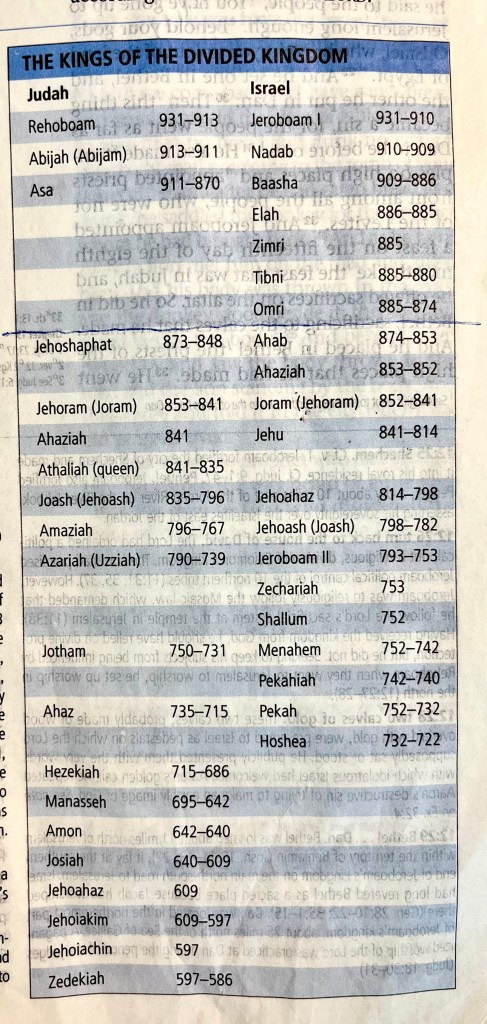
Read today’s scriptures. Refer to “Kings” chart to keep the names straight!

2 Kings 15.

In the middle of Jeroboam II’s reign in Israel (north), Azariah/Uzziah became king in Judah (south).  (We will call him Uzziah, because that how Isaiah refers to him.)

  • He was 16 when he began to reign.
  • He reigned 52 years.
  • He did what was right in the eyes of the LORD (until right at the very end).   (Verse 5 says that the LORD touched him with leprosy at the end of his life.  Don’t worry, we will read the details in 2 Chronicles!)

At the end of Uzziah’s life and after after he died, his son Jotham reigned in his place. (More in 2 Chronicles.)

.

Meanwhile in Israel (north), Jeroboam II died and his son Zechariah became king … for six months.  Shallum (the son of nobody” according to the Assyrians), killed Zechariah and took his crown. 

And that was THE END OF THE PROMISE THAT GOD GAVE TO JEHU FOR HIS HUMOUNGUS BLOODY WORK OF ANNILIATING THE HOUSE OF AHAB. (Read 2 Kings 10:30 for that promise that 4 of his sons would reign as king).

Shallum (Mr. Nobody) reigned for ONE MONTH.  Menahem, the military commander under Zechariah, came and killed Shallum, and took the crown of Israel. (This guy did some horrible things because some cities did not accept him. Menachem reigned ten years.

During his reign, Pul, the new, evil, and growing in power, king of Assyria (form Nineveh – remember Jonah?) came down on Israel.  Menachem assessed 50 talents of silver from all the rich men and gave it to Pul, and the King of Assyria went home …… for a time. 

After ten years, Menachem’s son, Pekahiah became king. (Uzziah was still king in Judah to the south).

Pekahiah reigned two years.  Pekah (no not his son, but the son of his army captain), along with 50 men conspired against king Pekahiah and killed him in Samaria, in the citadel of the king’s house. 

And so, Pekah became king in Israel in the last year of Judah’s king (Uzziah)’s reign.  Pekah reigned twenty years, and did evil in God’s sight.  During his 20-year reign, another King of Assyria, Tiglath-Pileser, stronger and crueler than Pul, came and captured a northern chunk of Israel, including all of the territory of Naphtali, Gilead, and Galilee.   He carried all the people there away into captivity … they did not return.  

Then the Assyrian king made this area into three provinces of Assyria.  The Assyrian king was probably involved in the conspiracy of Hoshea that ended in Pekah’s death.

Israel’s LAST KING, Hoshea, killed Pekah and became king in his place. HIS DAYS WERE NUMBERED!  

We will see the sad final end of Hoshea and ISRAEL, in our study NEXT TUESDAY.

Meanwhile, back to the South………

.

2 Chronicles 26.

Ah, the beginning of the mostly good King Uzziah, crowed by the people of Judah at age 16, he — 

  • “set himself to seek God in the days of Zechariah (an unknown prophet) who instructed him in the fear of God. As long as he sought the LORD, God made him to prosper.”
  • God helped him in the war against the Philistines, and the Arabians, and the Ammonites.
  • His fame spread even to the border of Egypt because he became very strong.
  • He built and fortified towers in Jerusalem and in the wilderness.
  • He built cisterns for his many herds.
  • He had a huge army, fit for war, and made shields, spears, helmets, coats of mail, bows, and slings for them.
  • He made “engines” invented by skillful men to be on the towers to shoot arrows and great stones.
  • He became STRONG.

BUT … WHEN he was strong, he grew proud, to his destruction.  (He was unfaithful to the LORD his God  and “entered the temple of the LORD to burn incense on the altar of incense.”)   WHAT!!!

Oh, such a warning to me and to you!

Of course, the priests stopped him before he could do it, but he had the censor IN HIS HAND!  

(Oh, my goodness, remember Aaron’s sons who tried to do that?  A blast of fire from God’s holiness consumed them!!)

The priests – all eighty of them – managed to get King Uzziah OUT of the Temple. But the KING WAS VERY ANGRY and struggled.  And the LORD struck him with LEPROSY.  The priests could see it on his forehead, but it could have been elsewhere too.

And King Uzziah was a leper to the day of his death. He lived in a separate house and was excluded from the House of the LORD.  (Oh, my! and after all the good he did!)

His son, Jotham took over governing the people.  When Uzziah died he was buried outside the city in the field belonging to the kings.  And Jotham then reigned as king.

.

Isaiah prophesied during the time of Uzziah, Jotham, (and Ahaz and Hezekiah), kings of Judah. Isaiah 1:1

He had an amazing vision, recorded in chapter 6.  Isaiah 6:1 – “In the year that King Uzziah died, I saw the LORD sitting upon a throne, high and lifted up, and His GLORY filled the temple………..”  WOW! 

We will see what Isaiah’s reaction was to this – so different from Uzziah’s pride.


Journaling through the Bible Chronologically in 2025, Day 185

Day 185 – Reading – 2 Kings 9 – 11

Read today’s Scriptures. Whoa! The prophesied Jehu. What do you learn about him?

2 Kings 9.

God had previously told Elijah, way back at Mt Horeb, that Jehu would become king over Israel, and he would kill all those involved in the worship of Baal (1 Kings 19:17).  The time had come for Elisha to see to Jehu’s anointing. He sent one of the young prophets to Ramoth-Gilead (that Eastern border town with Syria) to find Jehu and privately commission him.

Say, “I anoint you king over Israel.” THEN OPEN THE DOOR AND FLEE. DO NOT LINGER!”

The young prophet-student did just that … adding, “AND … you shall strike down the house of Ahab your master, so that God may avenge on Jezebel the blood of His servants the prophets of the LORD.”  “AND, the dogs shall eat Jezebel in the territory of Jezreel and none shall bury her.”

“Then he opened the door and fled.”

Jehu came out and told his fellow servants, “Well, the LORD says I am anointed king over Israel.” 

And all those men threw down their garments, blew the trumpet, and proclaimed, “JEHU IS KING!”

FIRST THING:  Jehu plotted to kill Israel’s king Joram. He told the servants who’d proclaimed HIM king to keep quiet and tell no one of this.  Then Jehu mounted his chariot and went to Jezreel, because Joram (injured in the battle) lay there.  King Ahaziah of JUDAH was also visiting him. 

The king saw him coming and sent messengers (who did not return). But a servant exclaimed, “The driving is like the driving of Jehu, for he drives furiously!”

Both the king of Israel and the king of Judah got into their chariots and went out to meet Jehu. They came together at the property of Naboth. (Remember, he was the righteous vineyard keeper whom Jezebel killed so Ahab could make a veggie garden.)

“Is it peace?” asked the king of Israel.

What peace can there be, so long as the whorings and the sorceries of your mother Jezebel are so many?”

King Joram saw the situation, turned his chariot around, and fled.  Jehu shot an arrow into his back, clear to his heart, and killed him.  “Throw his body onto Naboth’s land, as the LORD had prophesied.’

Judah’s king Ahaziah also fled, and Jehu shot him too.  Ahaziah’s servants carried him back to Jerusalem for burial.

When Jehu came to Jezreel, where the kings lived, Jezebel heard he was coming. She put on her makeup and fixed her hair.  Then she leaned out her window to watch his approach. “Is it peace, your murderer of your master?”

Jehu looked up and asked, “Who’s on my side?”  Several of her eunuch servants nodded.

“Throw her down!” commanded Jehu.  And they did.

She fell splat, for the window was way up high. Some of her blood splattered on the wall and on the horses and they trampled on her.

Jehu and his party went inside, ate, and drank.  Finally, Jehu said that they should see about burying that “cursed woman.”  But outside, only her skull, the bottoms of her feet, and the palms of her hands could be found.  The dogs had totally consumed her.

Ah,” said Jehu. “This fulfills the word of the LORD that Elijah spoke.” (1 Kings 21:23)

.

2 Kings 10.

Jehu continues to fulfill the prophecy and commands of the LORD.  He conspired and succeeded in killing all 70 of Ahab’s sons. He also killed all of Ahab’s great men, close friends, and priests. He left none standing.  He even killed a group of Ahaziah’s (the dead king of Judah) relatives as they came to visit Israel. Jehu struck down all who remained of Ahab in Samaria.

THEN, he tricks the worshippers of Baal into attending a big celebration for Baal.  Not one was to miss this.  And when they all assembled in the house of Baal, and while they were sacrificing, Jehu’s 80 soldiers went in and killed them all.  They brought out the statue of Baal and burned it. Then, they demolished the house of Baal and burned it too …and made it a latrine (toilet) to this day. 

BUT, he did not destroy the golden calves that were in Dan and Bethel.

Nevertheless, because he had obeyed God’s command about the house of Ahab and the worshippers of Baal, He promised King Jehu that his sons would reign on Israel’s throne for four generations.

.

But the Syrians under King Hazael began to “cut off parts of Israel,” starting on the east side of the Jordan River, taking all the land of the three tribes of Israel who lived there (Gad, Reuben, 1/2 tribe of Manasseh).

Jehu reigned 28 years in Samaria. When he died his son Jehoahaz reigned in his place.

.

2 Kings 11.

This is a repeat telling of the wicked Queen Athaliah (2 Chronicles 22 – 23) when she saw that her son was dead (killed by the second arrow of Jehu). She killed all his children living in Jerusalem and set herself up as Queen in Judah (no one believed her). But she missed the baby Joash, who was hidden with his wet-nurse by a priest and his wife for seven years. At that time, the priest arranged for him to be anointed, crowned, and hailed as king … and for Athaliah to be killed.

The boy-king reigned and did what was right in God’s eyes.

.

(WHOA. This was a bloody day of reading. Evil is wiped out, and good (mostly) triumphs.  For a while.

Oh, LORD, I know our hearts are desperately wicked.  How can you love us and forgive?  Thank you for Jesus, the pure, sinless Son who sacrificed his life in our wicked place, so we could be forgiven!)

Journaling through the Bible Chronologically in 2025, Day 184

Day 184 – Reading – 2 Kings 5 – 8

Read today’s Scriptures.  Do you see connections?

2 Kings 5.

The setting:

  • Syria
  • Samaria
  • the Jordan River

Characters:

  • Elisha the prophet,
  • Gehazi, Elisha’s servant,
  • Ben-Hadad II, King of Syria,
  • Naaman, supreme commander of the Syrian army, 
  • a young Jewish servant girl
  • King Jehoram/Joram, (2nd son of Ahab to rule Israel),

Naaman (meaning gracious and fair) was highly regarded by the king of Syria, DESPITE having leprosy. (Lepers didn’t seem to be shunned and isolated as they were in Israel.)  He had conducted many successful raids into Israel on behalf of Ben-Hadad II, and on one of them had brought back a young Jewish girl to be servant to his wife. 

One day, this little girl was brave enough to tell her mistress that Naaman could be healed if he went to the prophet in Samaria.  The wife told Naaman. The Syrian king gave him permission, and sent Naaman to Samaria with a letter to King Jehoram.  He also took looks of gold, silver, and fancy clothes to pay for the healing.

King Jehoram  was shocked and thought Naaman’s request was a way to quarrel with him. But Elisha heard about it and told the king of Israel to send Naaman to him, “That he may know that there is a prophet in Israel.”

Naaman goes, but is insulted that Elisha’s servant gives him the prescription for healing.  Not only does Elisha not come out to mee him, but he says to dip in the Jordan River seven times and he’ll be healed.

I’m not doing that! Aren’t there better rivers in Syria?  And the guy didn’t even come out to talk to me in person. Doesn’t he know who I am?”   And Naaman gathered his company and his gifts and began to leave.  But…. one of his men asked if it wasn’t “worth a try” since they’d come all this way? 

Naaman relented and dipped in the muddy Jordan 1, 2, 3, 4, 5, 6, and 7 times … and his flesh was restored like the flesh of a little child. He was “clean.”

He went back and tried to pay Elisha with all the treasure, but the prophet of God refused. GOD had healed Naaman, not Elisha. He was only the messenger.  And so Naaman headed back to Syria, a changed man, praising and worshipping the God of Israel.  Until…..

Greedy Gehazi, thought HE could use some of that loot.  On his own, he ran to Naaman, told him a lie (the master changed his mind because unexpected guests had come), was greedy and accepted two silver talents and two changes of extravagant clothing. Then Gehazi deceived his master and hid his loot from Elisha (who could see through walls and across miles) and then lied to him right to his face.  Of course Elisha confronted Gehazi about it, and in the end, the servant (and his descendants) got Naaman’s leprosy.

(UGH!  What lessons learned!!)

  • A lesson about “instant” and “far-reaching” results to greed, lying, and deception (Gehazi)!
  • A lesson about humility and obedience (Naaman). 
  • A lesson learned about boldness to speak out for the LORD, no matter where you live (the slave girl)

.

2 Kings 6 and 7.

The Setting:

  • By the Jordan River
  • Syria and Samaria
  • Dothan, north of Samaria

The Characters:

  • Elisha
  • “Sons of the Prophets”
  • Ben-Hadad II, King of Syria
  • King of Israel
  • four lepers

The group of student prophets came to Elisha and wanted to build a bigger lodging place down by the Jordan.  Elisha agreed and went with them.  While chopping wood, on young man heaved a mighty blow with his “borrowed” axe, and the head came off. The piece of iron went flying right out into the Jordan River.  Oh, no!  OH, NO! cried the man. 

NOTE: The man was responsible for the axe he borrowed. Moses’ Law said that if an item was LOST, the borrower would have to make full restitution. (Exodus 22:7-15)  The poor student prophet had no money for an axe, that’s why he borrowed it. He could NOT pay the price of a new one.  .

Elisha took pity on him, asked where it had gone in, then cut off a stick and threw it into the water.  THE IRON AXEHEAD FLOATED!.  The young prophet dashed into the water to get it.  A Miracle!

.

Now this is kind of funny.  Wherever the Syrian King planned to attack Israel, God gave Elisha a “heads-up” and he told the king of Israel so they could be ready, or move away.  This happened again and again until the Syrian king was pulling his hair out.  “There must be a spy among us!”

But one of his servants said, “No, m’lord. It is Elisha, the prophet in Israel. HE tells the king of Israel the words you speak in your bedroom.

The king ordered, “Go, see where he is that I may seize him.

“Behold, he’s in Dothan,”

So the Syrian army with horses and chariots surrounded the city. Elisha went out early that morning and saw them.  But his servant was terrified. “WHAT SHALL WE DO???”

“Don’t worry,” said the prophet of God. “Those who are with US are more than those who are with THEM.  And he prayed that the LORD would open the servant’s eyes. 

When the LORD did, the eyes of the young man saw, and behold, the mountain was FULL of horses and chariots of fire all around Elisha.

When the Syrian army attacked, Elisha prayed that God would strike them with blindness.  Then Elisha went to the Captain and said, ” You are going the wrong way. Follow me and I’ll take you to the man whom you seek.”

And he led them right into the middle of Samaria.  Then he prayed that their eyes were opened, and they were.  EEK!!  And King Jehoram came out and said, “SHALL I KILL THEM ALL?”

“No,” cried Elisha.  “Set bread and water before them and then talk to their leader.”  King Jehoram went over and above. He served them a great feast.  And when they were full and drunk, he sent the away to their master.

And… (get this) “The Syrians did not come again on raids into the land of Israel.”

(That’s what comes from obey God and loving (being kind) to your enemies. HA!!  (a good lesson learned!)

.

2 Kings 8.

Remember the Shunammite woman? Elisha came and restored her young son to life after he died of an illness.  Elisha had also said that she was to move away because a famine was coming for SEVEN years.  She listened to him and moved to the land of the Philistines. Now she was back after those years. She asked the king to have her land restored.  And, what do you know!  Elisha’s servant Gehazi just happened to be there talking to the king.  The king had asked to hear of some miracles of Elisha, and BEHOLD there was the woman and her son.  And so, the story told, the king restored the woman’s land to her, PLUS all the crops that had grown in the last 7 years.

.

The Elisha went to Damascus the capital of Syria.  King Ben-Hadad II was sick.  The king sent Hazael, his servant, to ask Elisha if he would live or die. (He sent 40 camel-loads of goods along too.)

Hazael asked for the king, “Will he recover from this sickness?”

Well, Elisha knew the sad truth.  YES, Hazael would recover from the illness, but this messenger, Hazael, would kill him and become king in his place.  Elisha saw with grief all the horrible things that the new king Hazael would do to Elisha’s people, Israel. (Set fortresses on fire, rip open bellies of pregnant women, dash the little ones to pieces.)

“WHAT?” cried Hazael.  “Am I but a dog to do such a thing??”

“The LORD has shown me.”

Back in the king’s chamber, Hazael told Ben-Hadad he would recover … then suffocated him to death. He then became king of Syria.

,

Next, we see a repeat of the story in Judah (2 Chronicles 21:4-20). Jehoshaphat dies and Jehoram his son becomes king in Judah (south).  He was evil like Ahab (Jehoram’s wife was the daughter of Ahab), but God did not destroy him for the David’s sake and the “promised Lamp” to come.

He died and Ahaziah his son reigns for one year. His mother was the wicked Athaliah. He got sick and died.

.

The history of the kingdoms of Israel and Judah is so discouraging. Israel has only wicked kings, but because of the intermarriage with the house of Ahab, the evil invades Judah too, until the wicked Athaliah is killed (Chapter 11).


Journaling through the Bible Chronologically in 2025, Day 182

A NEW MONTH! We are halfway through the year!

Day 182 – Reading – Obadiah 1 and Psalms 82 & 83

Read today’s Scriptures.  Do you see connections?

Obadiah 1.

Did the appearance here of this minor prophet surprise you? It did me. 

We are still reading about the divided nation = Israel vs Judah, both still living in the land God gave them.  So why the prophet Obadiah??

Obadiah is probably a contemporary of Elijah and Elisha, who prophesied mostly to the northern kingdom of Israel. Obadiah spoke only to the southern kingdom of Judah.

Now remember when Edom (Esau) along with Ammon and Moab came around the southern end of the Dead Sea to attack Judah?  (2 Chronicles 20). The Bible calls them “a great multitude” and “a horde.”  The people (and Jehoshaphat the king) were terrified of them.   Then, remember Jehoshaphat’s wonderful prayer to the LORD, reminding and claiming His promises of help?

  • If disaster comes upon us, we will stand before this House and before You, and cry out to You in our affliction, and You will hear and save.  Execute judgment on them now, for we are powerless against this great horde that is coming against us.

And remember the LORD’s reply.

  • Do not be afraid and do not be dismayed at this great horde, for the battle is not yours but God’s. You will not need to fight in this battle.  Stand firm, hold your position, and SEE the SALVATION of the LORD on your behalf. 

And Jehoshaphat appointed singers to sing to the LORD, and to praise Him as they went. And as they began to sing and praise Him, the LORD set an ambush, so that Ammon, Moab, and MOUNT SEIR were routed, so that none escaped alive.

..

Obadiah is now prophesying against this Edom (Esau, Mt. Seir)  for the ill treatment of God’s beloved Judah.  He says,

  • The pride of your heart has deceived you, you who live in the clefts of the rock, in your lofty dwelling, who say in your heart, ‘Who will bring me down to the ground?”  Though you soar aloft like the eagle, though your nest is set among the stars …. from there I will bring you down, declares the LORD.
  • Your mighty men shall be dismayed … so that every man from Mount Esau will be cut off by slaughter. Because of the violence done to your brother Jacob, shame shall cover you, and you shall be cut off forever.

Obadiah prophesies of the time when Judah will be carried off into captivity by Babylon.  At that time Edom helps their captors, by catching runaways, and killing them!  God roughly calls them out.

  • “Do not GLOAT over the day of your brother, in the day of his misfortune; do not REJOICE over the people of Judah in the day of their ruin; do not BOAST in the day of distress. 
  • Do not ENTER THE GATE of my people in the day of their calamity; do not GLOAT over his disaster in the day of his calamity; do not LOOT his wealth in the day of his calamity.
  • Do not stand at the crossroads to CUT OFF HIS FUGITIVES; do not HAND OVER his survivors in the day of distress.”

But in that day, that’s just what Edom did, and God punished them for it.  “As you have done, it shall be done to you; your deeds shall return on your own head.  There shall be no survivor for the house of Esau,” for the LORD has spoken. 

(Hey, you don’t mess with God’s chosen people! HE may discipline them, but not YOU!)

.

Psalm 82.

This psalm speaks NOT of persecuting the helpless, but RESCUING them. (It’s almost like this is sent ahead to Edom!)

  • Give justice to the weak and the fatherless, maintain the right of the afflicted and the destitute. Rescue the weak and needy; deliver them from the hand of the wicked.

.

Psalm 83.

This psalm is also very like Obadiah’s message to Edom (and to all who would persecute His Chosen… even TODAY)

  • O God, do not keep silence; do not hold Your peace or be still, O God.


  • They lay crafty plans against your people; they consult together against your treasured ones.


  • They say, ‘Come, let us wipe them out as a nation; let the name of Israel be remembered no more!”

(Have you heard this mentioned about Israel today in the news???)


  • For they conspire with one accord; against You they make a covenant, the tents of Edom and the Ishmaelites, Moab, and the Hagrites, Gebal and Ammon and Amalek, Philistia with the in habitants of Tyre; Asshur also has joined them; they are the strong arm of the children of Lot.

(Yes, Israel is surrounded to day by those who hate them and want to destroy them!)


  • O my God, make them like whirling dust, like the chaff before the wind. As fire consumes the forest, as the flame sets the mountains ablaze, so may You pursue them with Your tempest and terrify them with Your hurricane!


  • Let them be put to shame and dismayed forever; let them perish in disgrace, that they may know that YOU ALONE, whose name is the LORD are the Most High over the  earth.”


Oh, my goodness.

This SO reminds me of recent affairs in the Middle East.

And the hate threats towards Israel.

(Oh, God!)


Journaling through the Bible Chronologically in 2025, Days 180 & 181

Sundays and Mondays studies are posted together on Mondays

Day 180. Reading 1 Kings 22 and 2 Chronicles 18

Day 181.  Reading 2 Chronicles 19 – 23

Read Today’s Scriptures.
What insight or comfort do you receive?
 

Day 180 – 1 Kings 22.

After that ill-advised truce between King Ahab’s Israel (north) and King Ben-Hadad’s Syria (farther north), there were three years without war. Each country was trading in the other’s bazaars.  

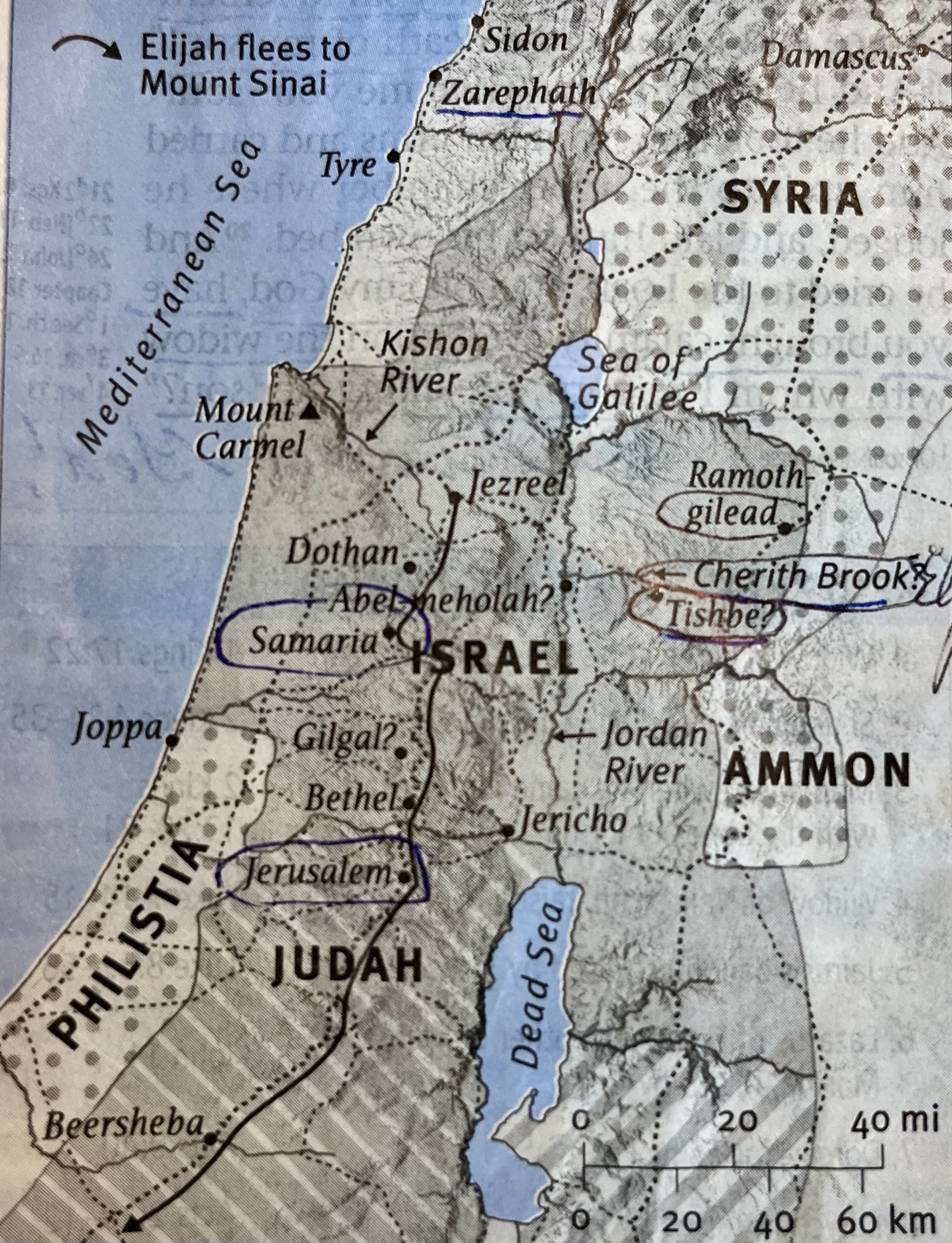
But, there was a sore spot between the two kings. It was the town of Ramoth-Gilead.  Officially, it was in Israel’s territory, way east, across the Jordan River and right up next to Syria. (See map on yesterday’s post.) Syria was gradually “taking” the town, and Ahab didn’t like it.

So… when King Jehoshaphat of Judah (south) came to visit Ahab, Ahab asked him if he would go with him and battle for it and try to settle the dispute with Syria.

“Sure,” Jehoshaphat said. “My people are yours and my horses are yours. But … hey, let’s inquire of the the LORD first.”

King Ahab gathered his 400 prophets and inquired if they should go up against Syria at Ramoth-Gilead.

They ALL said, “Go up, for the LORD will give it into your hand.”

This seemed a little fishy to King Jehoshaphat, and he asked if there was ANOTHER prophet of the LORD that they could ask.

King Ahab grumbled, but finally said, yes, there was ONE, but Ahab didn’t like him because he ALWAYS prophesied against him.  Jehoshaphat pressed him, and Micaiah was called.  After a bit of messing around this real prophet of God said, “I saw all Israel scattered on the mountains, as sheep that have no shepherd.

“SEE!!! I told you.  He never says anything nice about me!” bemoaned Ahab.  And Ahab promptly put Micaiah in prison with meager food rations.

But, the Word of the LORD which Micaiah spoke came true.  The two Jewish kings went up to battle with the king of Syria, who had told his men to “fight with neither small or great, but with the King of Israel (Ahab) only.”

King Jehoshaphat (Judah) rode out in his chariot in regal clothing and a crown on his head.  But wily King Ahab disguised himself as a lowly soldier.  The Syrians of course, went after Jehoshaphat, who cried out to the LORD for help.  When the Syrian captains saw that he was not King Ahab they turned away.  

Then ,,, a random soldier drew his bow and randomly shot an arrow into the air.  “Oops!” That deadly missile flew right to the disguised King Ahab and entered his body through the crack separating his breastplate from his chain mail.  A scream.  And, “TURN AROUND AND CARRY ME OUT OF THE BATTLE FOR … I … AM … WOUNDED!  And troops fled every man to his city.

In the evening, King Ahab died.  His blood flowed into the bottom of the chariot. His body was brought to Samaria and buried.  

“And they washed the chariot by the pool of Samaria, and the dogs liked up his blood.”  Just as Elijah had prophesied.

Ahaziah, his son reigned in his place. He did what was evil in the sight of the LORD and walked in the way of his father, King Ahab, and in the way of his mother, Queen Jezebel. He served Baal and worshiped the pagan gods. He provoked the LORD, the God of Israel to anger in every way that his father did.

.

Meanwhile, in the south, King Jehoshaphat continued to reign over Judah. (We’ll learn some good things about him tomorrow from 2 Chronicles 19-23.  He continued to clean up the pagan worship that his father King Asa had begun.)

Jehoshaphat eventually died and HIS son, Jehoram reigned in his place. Jehoram was exceedingly wicked, and you will find out why (below) and how (tomorrow’s reading).  

.

2 Chronicles 18.

Here are a few interesting details on the story above about King Ahab in the north, and King Jehoshaphat in the south going to battle together for Ramoth-Gilead.

Jehoshaphat had GREAT RICHES and honor.  He – STUPIDLY!!! – made a marriage alliance with king Ahab.  (Ah ha! … now we see why the southern king was willing to go to war with Ahab against the Syrians.)  Jehoshaphat had arranged for his son, Jehoram, to marry Athaliah, the daughter of Ahab & Jezebel.

And the fall out of this union nearly wiped out the godly line of David through whom the Messiah Jesus would come!!! We’ll see that tomorrow.

.

###

.

Day 181 – 2 Chronicles 19.

When King Jehoshaphat returned to Judah after that narrow escape with the Syrians and the death of Ahab, he was met by Hanani, a prophet of God, for a thorough scolding

Should you help the wicked and love those who hate the LORD?”  (Yes, it did seem strange that he would help the wicked King Ahab fight the Syrians … until we learned that his son had married Ahab’s daughter.  There was a political obligation there.)

Hanani told the king of Judah that he SHOULD be punished … but that, “some” good had been found in him. He’d gotten rid of the pagan Asherah poles, and … MORE IMPORTANTLY, Jehoshaphat had “set his heart to seek the LORD.”  After that …

  • He went out to the people in his land and “brought them back to the LORD, the God of their Fathers”.
  • He appointed judges in all the fortified cities and reminded them that the LORD was watching them. They should make sure there was no injustice or bribery.
  • He appointed special Levites in Jerusalem to decide disputed cases.

.

2 Chronicles 20.

And then, a threat of war came to Judah (south). The descendants of Israel’s old relatives: (Moab & Ammon, both from Abraham’s nephew Lot) and Edom (descended from Jacob’s twin, Esau) joined together. They came around the south end of the Dead Sea, with the plan to de-throne Jehoshaphat.

Thankfully, the king did not call on the wicked kings in the north to help him, but “set his face to seek the LORD.” He proclaimed a fast for all his people. And prayed this prayer;

  • “O LORD, God of our fathers, are You not God in heaven?  You rule over all the kingdoms of the nations. In your hand are power and might, so that none is able to withstand You.  Did You not, our God, drive out the in habitants of this land before Your people Israel, and give it forever to the descendants of Abraham, Your friend?
  • “And they have lived in it, and have built in it a sanctuary for Your Name, saying, “If disaster comes upon us (the sword, judgment, pestilence, or famine), we will stand before this house and before You (for Your Name is in this house) and cry out to you in our affliction, You will hear and save!
  • And now behold, the men of AMMON, MOAB, and MOUNT SEIR, whom Your would not let Israel invade when we came up from Egypt – Behold, they “reward us” by coming to drive us out of Your possession.
  • O our God, will you not execute judgment on them?  For WE ARE POWERLESS AGAINST THIS GREAT HORDE that is coming against us. “WE DO NOT KNOW WHAT TO DO!  But our eyes are on You.”

**** (Oh, my goodness, what a prayer!  What if WE should pray this way, with such dependence on God!  What if modern Israel would pray this way, in total dependance on the LORD, their God! How would YOU respond, O LORD our God?)

As all Israel, with the little children and women, stood before the LORD, the Spirit of the LORD came on Jahazel, a descendent of Asaph, the Levite. And he said,

  • “LISTEN, all Judah, inhabitants of Jerusalem, and king Jehoshaphat. Thus says the LORD. “Do not be afraid and do not be dismayed at this great horde, FOR THE BATTLE IS NOT YOURS BUT GOD’S.”
  • “Tomorrow go down against them.  YOU WILL NOT NEED TO FIGHT IN THIS BATTLE.  Stand firm, hold your position, and see the salvation of the LORD, on YOUR behalf, O Judah and Jerusalem.
  • “DO NOT BE AFRAID AND DO NOT BE DISMAYED.  Tomorrow go out against them, and the LORD will be with you!”

Jehoshaphat, all Judah and Jerusalem fell down before the LORD, worshiping Him. They praised the LORD, the God of Israel with a very loud voice.

And they arose early in the morning and went out to meet the horde. Jehoshaphat stood and encouraged them. “Hear me, Judah and Jerusalem! Believe in the LORD your God, an you will be established. Believe the prophet and you will succeed.

AND THEN … Jehoshaphat appointed singers to sing and praise the LORD, as the went before the army.

Give thanks to the LORD, FOR His steadfast love endures forever.”

And when they BEGAN to sing and praise, the LORD set an ambush against the men of Ammon, Moab, and Mount Seir, so that they were routed.  They each destroyed one another!!!!!  Dead bodies all around. None escaped.

WOW!

Jehoshaphat and the people came to take the spoil and found GREAT NUMBERS of goods, clothing, precious things – which they took for themselves until they could carry no more.

They returned to Jerusalem with GREAT JOY for the LORD had made them rejoice over their enemies. 

And the fear of God came on all the kingdoms of the countries when they heard that the LORD had fought against the enemies of Israel.  So the realm of Jehoshaphat was quiet … for his God gave him rest all around.

.

At the end of his life, King Jehoshaphat joined in a venture to build a shipping fleet to Tarshish – with Israel’s wicked King Ahaziah (north).  But God destroyed all the ships because of this ungodly alignment.

Eventually Jehoshaphat died and was buried in the City of David (the southern part of Jerusalem, below the Temple Mount and palace).

.

2 Chronicles 21.

Jehoshaphat’s first-born son, Jehoram (the one he’d arranged a marriage with wicked Ahab/Jezebel’s daughter, Athaliah), ascended the throne.  HE WAS NOTHING LIKE HIS GODLY FATHER!  Immediately, he killed all his brothers, six in all, plus some of the princes of Israel (north), to assure his place in the kingdom.  (These men, were the lineage of “the house of David” through whom God had promised the reigning Messiah. Jehoram killed them all!) 

And yet God did not destroy him, even though he did what was totally evil in His sight, for God was not willing to destroy the house of David because of the Covenant He’d made with David. God had promised “a lamp to him and to his sons forever.”  But what about this totally evil man of darkness???

Do not fear. God is Sovereign over all.

But meanwhile Jehoram grew worse. He made high places for pagan worship. He led Judah into whoredom and made them go astray.

Elijah the prophet sent him a letter from the north. “Because you have walked in the ways of the kings of Israel (north) and have enticed Judah into whoredom, and killed your brothers, I, the LORD, will bring a great plague on your people, children, wives, possessions and YOU YOURSELF will have a severe sickness of your bowels, until them come out of your body.”

WHOA! (Leave it to Elijah to terrify!)

God stirred up the Philistines against Jehoram, and the Arabians, and they came and invaded Judah and carried away Jehoram’s possessions, his sons, and his wives. (Only Jehoahaz, his youngest son remained.)

Then God struck him with that dreaded bowel disease, an incurable disease.  In two years’ time all his bowels came out and Jehoram died IN GREAT AGONY. 

No one regretted his departure. He was buried in the city of David, BUT NOT IN THE TOMBS OF THE KINGS.

.

2 Chronicles 22.

So, Ahaziah/Jehoahaz, Jehoram’s youngest son reigned. He walked in the ways of his grandfather, King Ahab (north), for his mother was his counselor in doing wickedness. 

God ordained his downfall through His appointed Jehu, whom God had appointed to destroy the house of Ahab. (Remember, that was one responsibility the old prophet, Elijah had, to anoint Jehu.)  And Jehu did that – he killed Ahaziah/Jehoahaz and all the remaining princes of Ahab.

Now, there was no one able to rule the Kingdom of Judah.  

Why?  Because the wicked mother (daughter of Ahab) destroyed all the royal family of Judah. She proclaimed herself queen – but nobody took her reign seriously.

WAS JUDAH WIPED OUT?

WAS THERE TO BE NO SEED OF DAVID LEFT TO COME AS MESSIAH?

WHAT ABOUT GOD’S PROMISES?

But … there was a woman named Jehoshabeath, the daughter of the king, and the wife of the priest, Jehoiada.  She went into the “nursery” and carried away the very youngest son of the king, less than 1-year-old Josiah, AND HID HIM FROM HIS WICKED GRANDMOTHER. 

Josiah, the SEED OF DAVID, the “lamp of Israel,” lay hidden in a cradle. He stayed with the godly couple for six years, while Athaliah “reigned” over the land.   

****(Doesn’t this remind you of how God kept the baby Jesus safe from King Herod when he sent Joseph and Mary to Egypt?)

.

2 Chronicles 23.

Finally the time had come.

Josiah was seven years old.

He’d been trained by the priest, who now took courage.

Jehoida gathered the commanders of the army. They went through Judah and gathered the Levites from all their cities, as well as the fathers of the houses of Israel.

Jehoida showed them the boy-king, Josiah and said, “Behold, the king’s son! Let him reign as the LORD spoke concerning the sons of David.”

Then Jehoida revealed his carefully-though-out plan.  All the Levites and priests who had come off duty were divided into thirds and placed around the House of the Lord at the gates. “NO ONE MAY ENTER EXCEPT THE MINISTERING PRIESTS.” 

“Surround the king, each with his weapon in his hand.  Anyone approaching shall be killed.  Be with the king at all times.”

THEN, he brought out Josiah, the king’s son and placed the crown on his head.  “Long live the king!”

.

YIKES!  When Queen Athaliah heard the noise, she went to see what was happening and saw the young king. 

She tore her clothes and cried, “TREASON! TREASON!”

Jehoida commanded the captains to seize her. “Take her out of the court of the House of the Lord, and kill her!”  They led her through the horse gate of the king’s house and… did the deed.  The end of that wicked Ahab/Jezebel line … except for Josiah, whom the LORD had chosen to carry David’s seed.  WHEW!

.

Jehoida made a covenant between himself, the people, and the young king, that they ‘should be the LORD’s people.   He saw to it that the altars and images of Baal were destroyed. He reinstituted the sacrifices and offerings that Moses wrote about in the LAW.

Then he took the young boy king from the house of the LORD to the king’s house.  They set him on the ROYAL THRONE.  All the people rejoiced, and the city was quiet after Athaliah had been killed.

.

****(WOW. What a long tale of evil and good.  God is ALWAYS in control. HE is sovereign. He will fight for His people.  He will see that not a word of his prophecy EVER fails. His covenants are sure. HE IS GOD, and KING, and the LORD of Hosts forever and ever. Glory be to His name!)



Journaling through the Bible Chronologically in 2025, Day 179

Day 179.  Reading 1 Kings 20-21

 
Read today’s Scriptures.

1 Kings 20….

…tells a surprisingly good story about the wicked King Ahab.  Until the last part, that is.

We see King Ben-Hadad, king of Syria, again in this chapter. (Syria is the country just north-east of Israel, with Damascus as the capital.) (This map also shows the two places Elijah stayed during the drought, and Mt. Carmel, where the great “showdown” happened. Samaria is the capital of Israel, where Ahab lives.) 


Remember, in Chapter 15, King Asa (south) had paid Ben-Hadad a large amount of gold and silver from the temple, to harass King Basha (north) so he’d stop fortifying the border. The Syrian King had agreed. Now, it seems, Ben-Hadad was sure King Ahab could also be easily defeated.

Hey, King Ahab, give me your silver and gold and the best of your wives and children.” 

“Okay, sure,” said Ahab.

Then Ben-Hadad got greedy. “I will send my servants to you tomorrow, and they will search your house and take whatever pleases them.”

Um, no! The gold and silver and best wives and kids I will do, but NOT THAT,” sent back King Ahab.

Okay, then. It’s war!”

“Make my day!” replied Ahab.

Now, here is the strange part.  A prophet of God came to Ahab and told him that he would get the victory, “So you will know that I am the LORD.”  Ahab got some military instructions from the prophet, and at noon they went out to confront King Ben-Hadad’s army.

The Syrian king was drunk, however, and commanded, “If they come in peace, TAKE THEM ALIVE!  But if they come out for war …. TAKE THEM ALIVE!”  (Huh?)

Ben-Hadad didn’t have the chance to do either, because King Ahab struck his forces a “very great blow!” The Syrians fled and Ben-hadad escaped on a horse.

The prophet of God told King Ahab to rest up, for in the Spring the king of Syria would be back.  (Now, the Syrians believed that Israel’s God was only a god of the hills. That’s why they were defeated.  Next time they would bring lots of chariots and fight on the plains.  The Jewish God would be defeated there.)

Oh, Syria.  You’ve a lot to learn!!

So, in the spring Ben-Hadad mustered the Syrians and went up to fight against Israel … in the plains. The army of Israel that encamped before them was as “two little flocks of goats” compared to the Syrians who filled the country.  (Hahaha. Oh, Ben-Hadad, did you never hear of David and Goliath??)

The prophet of God came to Ahab and said, “BECAUSE the Syrians claim the LORD is only a god of the hills, I will give all this great multitude into your hand, and YOU SHALL KNOW that I am the LORD.”

And the people of Israel struck down of the Syrians 100K foot soldiers in one day.  When the rest fled to a town, the wall fell on them and 27K more were killed.  Ben-Hadad hid deep in the town and sent a message to King Ahab, “Please let me live.

AND HERE IS WHERE KING AHAB WENT WRONG.  God had “devoted the Syrian king to destruction,” meaning he was to be killed.  But King Ahab thought it would be cool not to kill him.

He’s alive? He’s “my brother!” he said.

Yes! Your brother, Ben-Hadad!”

Go, bring him out.”

When the Syrian king was brought out, King Ahab invited him up into his own chariot. And the two kings made a trade deal between their countries. And …. Ahab let him go.

LATER…

The prophet of God came to King Ahab with a bit of play-acting, but then told him.  “Because you have let go the man whom I had devoted to destruction, therefore YOUR life shall be for HIS life, and YOUR people for HIS people.”  Dire news indeed.  Instead of the Syrians and their king under this law, now Ahab and Israel would be “devoted to destruction.”

Ahab, went home, vexed and sullen.  

.

1 Kings 21.

King Ahab’s boredom caused him to sin.  He saw a lovely vineyard that he coveted for himself. It belonged to another, but he WANTED it, and the obsession grew. 

(Oh, my goodness, this reminds me of our favorite King David. 

Idleness is a TERRIBLE sin.

It leads to much worse sin. 

Desire and lust and a flame in the belly, which James 1:14-15  says leads to death.

Watch out for it!!)

Ahab at first proposed to Naboth, the vineyard’s owner, that he give it to the king, in exchange for a “better vineyard.”  Or… he could sell it to Ahab, who would give him the vineyard’s value in money.” 

Reasonable, right?  NOT!

What Ahab neglected to realize in his coveting, is that the men of Israel had their land as a divine allotment from God.  They were not to sell/give it to someone outside their tribe.  He said “The LORD forbid that I should give you the inheritance of my fathers.”

Ahab “lay down on his bed and turned away his face and would eat no food.”  

Really??  What a spoiled-brat!!

Enter his wicked wife, Jezebel.  “Hey, Hubby.  What’s wrong?”

“Naboth won’t give me his vineyard!”

“ARE YOU NOT THE KING OF ISRAEL!” she said.  “Get up, eat some bread, be happy!  I’ll get the vineyard for you!’

And the wicked Jezebel set into motion her wicked plan.  She defamed Naboth before of the town council, and tricked them into condemning the innocent vineyard owner. They killed him and sent a sweet note to the Queen.

Naboth has been stoned. He is dead.”

And so, she skipped into King Ahab’s room with the news, “Arise, take possession of the vineyard for Naboth is not alive, but dead.”   And quickly, without any questions, Ahab got dressed and went down and took possession of it.

Sick!  And after all God had done for the king!

And God sent His top man, Elijah, to condemn the king.  “Arise, Elijah, go down and meet Ahab king of Israel in the vineyard of Naboth.

With this gruesome prophecy.

  • Thus says the LORD: ‘In the place where dogs liked up the blood of Naboth, shall dogs lick up YOUR blood.”

Oh, my enemy!  You have found me!” said Ahab to Elijah.

And the LORD’s message continued.

  • I have found you because you have sold yourself to do what is evil in the sight of the LORD.
  • I will bring disaster upon you. I will utterly burn you up, and will cut off from Ahab EVERY MALE, bond or free in Israel.   
  • And….. of Jezebel, the dogs shall eat Jezebel within the walls of Jezreel.
  • Anyone belonging to Ahab who dies in the city, the dogs shall eat, and anyone of his who dies in the country the birds of the heavens shall eat.”   

(And oh, wow, you will read about this happening in 2 Kings 9:10, 30-37.)

(“There was none who sold himself to do what was evil in the sight of the LORD like Ahab, whom Jezebel his wife incited.  He acted very abominably in going after idols.”)

And here’s another VERY INTERESTING DEVELOPMENT. Ahab tore his clothes, put on sackcloth and fasted. (This was not his usual pouting.)  In the Old Testament, this is a sign of REPENTANCE.  Was it sincere? 

God saw this evil, weak, man’s heart. “Because he has humbled himself before me,” said the LORD. “I will not bring this disaster in his days, but in his son’s days I will bring the disaster on his house.”

.

(Wow. There is hope for you and me.  God sees a person’s heart. He knows if repentance is real. He knows if we truly will humble ourselves before Him.  O, my heart, fall on your knees before the all wise, living God. He is merciful to save.)


Journaling through the Bible Chronologically in 2025, Day 137

Read Today’s Scriptures.
  • Remember where we left off?   With a lot of conniving, Absalom, David’s son, who would naturally have assumed the throne when David died in “the normal order,” doesn’t want to wait.  He goes to Hebron to “pay a vow,” but really to perform a coup. (It’s where David was crowned king.) He takes 200 unsuspecting guests to the celebration, instructing them to say “Absalom is King” when the trumpet is blown.
  • Absalom even entices David’s chief counselor, Ahithophel, who happens to be Bathsheba’s grandfather, to come along. A messenger is sent to David saying, “The hearts of the men of Israel have gone after Absalom!
  • Does David gather an army to fight the coup?  No!  And perhaps he feels it is simply a part of God’s discipline for his sin, and he accepts it.
  • Anyway, David quickly gathers his things (leaving his ten concubines behind to keep the house), and leaves town.  Many of his faithful leaders and men follow him, including Abiathar and Zadok, the priests, bringing the Ark of the Covenant. David tells them to take it back into the city, hoping he’ll one day return. Before they leave, he sets up a way for their sons to get messages to him about what Absalom is doing.
  • Hushai, David’s second counselor, and truly loyal, shows up to flee with David. But the King sends him back, saying to pretend to be with Absalom too, so he can “mess up” all Ahithophel’s advice. “Whatever you hear from the king’s house, tell it to Zadok and Abiathar, who will send it to me via their sons.
  • Just as Hushai came into the city …. Absalom was entering Jerusalem

.

2 Samuel 16.

Okay, as if this is not enough bad news, Ziba the servant of Mephibosheth met him along the road. (Remember, Mephibosheth is Jonathan’s crippled son, whom David is caring for like a son.)  Ziba brings saddled donkeys (for the king to ride), bread, raisin cakes, summer fruit, and wine for his followers to eat and drink.  HUH?

“Where is Mephibosheth?” David asks.

“Um, he’s staying in Jerusalem. He thinks it’s a good time for the house of Saul to give him back the kingdom.”

Shocked, David replies, “All that belonged to Mephibosheth is now yours.”

Ziba answers, “I pay homage; (grovel, grovel) let me ever find favor in your sight, m’lord, the king.”

Then, just east of Jerusalem, Shimei, a distant relative of Saul, comes out cursing continually at David, throwing stones at him as he passes, and calling, “Get out, you man of blood, you worthless man!  The LORD is avenging you for all the blood of the house of Saul. Your evil is upon you, you are a man of blood!!”

Joab’s brother, Abishai, offered to “take off his head,” but David would not allow it. “My own son seeks my life, how much more this Benjamite! Leave him alone. Let him curse.”

So Shimei cursed and threw stones and dirt at David all the way to the Jordan River.

Meanwhile…

Absalom and all the people of Israel came to Jerusalem and Ahithophel with him.  Hushai shuffles up to him and says, “Long live the king!  Long live the king!”  Absalom is suspicious, but Hushai convinces him that it’s Absalom he wants to serve.  “Who but the king’s son shall I serve!”  (He was convincing.)

“Give counsel. What shall we do?” Absalom askes Ahithophel.

Go into your father’s concubines, and all Israel will hear that you have made yourself a stench to your father.  The hands of all who are with you will be strengthened.”  The creep advised. But this is what was done, to prove the new man was the conqueror.

So they pitched a tent on the roof, and that’s what Absalom did …in the sight of all Israel.

And so the fourth of the four consequences of David’s sin that God had spoken to him took place, (2 Samuel 12:11)

.

2 Samuel 17.

Next comes the battle of Absalom’s counselors: Ahithophel vs Hushai. What is Absalom’s next step, they are asked?

AHITHOPHEL:  “Let me choose 12K men and I will arise and pursue David tonight, while he is weary and discouraged.  He’ll be in a panic, he’ll flee, and I can strike him down.”

(Actually, for a war aspect, this is sound advice.)

HUSHAI: “Your father and his men are mighty men, and they are enraged, like a bear robbed of her cubs in the field.  He is an expert in war; he will not spend the night with the people but will hide himself somewhere. Then when the first soldiers fall, a sound will go out that there has been a slaughter among Absalom’s men, and your men’s hearts will melt.  EVERYONE knows that your father is a mighty man….

“My advice is that you gather a multitude of men from “Dan to Beersheba” and go to battle IN PERSON and there will be no place for him to hide. You will easily catch him.”

.

(***NOTE: ABSALOM WAS NOT A MILITARY MAN. We have seen NO INSTANCES where he has been in battle.  He was a PARTY MAN. See 2 Sam. 13:26-29 and 2 Sam. 15:10-12 and probably had no idea what happened in a war situation.)

.

Absalom’s brain went back and forth. (“If I go with Ahithophel’s counsel, HE will get the credit. If I go with Hushai’s counsel, “I” will get the credit.“)

ABSALOM:  “The counsel of Hushai is better than the counsel of Ahithophel.

Quickly, after the meeting, Hushai goes to the priests and gives a message to be sent to David.  “Tell David not to stay the night this side of the River, but cross it.”  The priests’ sons were waiting at En-Rogel. A female servant was sent to tell them the message.

BUT!!!!  A young man saw them and quickly told Absalom.  The priests’ sons hurried off to Bahurim and hid in a well. The woman there covered the opening and spread some grain on it. (Doesn’t this remind you of Rahab hiding the Israeli spies in Jericho under some grain??)   When Absalom’s men came, she said they had gone on over the brook already.  They couldn’t find the two sons and went back.

David got the message and did what Hushai said.  At daybreak, not even one had not crossed.

Ahithophel saw “the writing on the wall.”  He went home, set his house in order, and hung himself.

And so… Absalom took the army with Amasa as commander (Joab had gone with David) and crossed over the Jordan River after David. They camped in Gilead.

Meanwhile, three faithful men – Shobi, Machir, and Barzillai – brought supplies: beds, basins, vessels, wheat, barley, flour, parched grain, beans, and lentils, honey and curds, sheep and cheese for David and his men to eat.   WHAT A BLESSING THESE MEN WERE!!

.

2 Samuel 18.

The Deadly Battle

Refreshed, David gathered his army and then divided it into three companies.  Joab commanded one, his brother Abishai, commanded the second, and Ittai took the third. (Remember Ittai, who stayed faithful to David as he was leaving the city?  (1 Samuel 15:19-22)

David wanted to go out with them, but the men all said, “YOU SHALL NOT GO OUT!”  They feared for his safety, so he stayed back at the gate of the well-fortified town of Mahanaim.  His last words to the three commanders before sending them off was, “Deal gently for my sake with the young man Absalom.”  And all the people heard him say it.

The battle mostly took place in the forest of Ephraim. Absalom’s men were defeated by David’s, 20K of them.

  • Then Absalom came riding his mule through the forest.
  • The mule went under a low-hanging branch, and Absalom’s massive head of hair was caught in it.
  • The mule continued on, leaving the king’s son, dangling.
  • A soldier saw him and told Joab.
  • Joab was furious. “Why didn’t you kill him?  I’d have given you 10 pieces of silver!”
  • The soldier said, “Even for a thousand pieces of silver, I would not kill the king’s son.”
  • Exasperated, Joab took three javelins and thrust them into Absalom’s heart.
  • (This would be “strike three” for Joab.)

Then Joab blew the trumpet, and the troops came back.  The men took Absalom’s body down, threw it in a pit, and covered it with a huge pile of stones.

The son of Zadok asked to carry the news to the King, that the LORD had delivered him from the hand of his enemies.  But Joab would not let him.  Instead, he sent the Cushite to tell the king what he had seen.

Zadok’s son asked to run too, but Joab said he would get no reward for bringing that news.  Nevertheless, the boy wanted to go.  So Joab let him.

And Zadok’s son outran the Cushite, coming to David first.

  • David waited at the gate for news.
  • The watchmen said he saw a man running alone.
  • “If he is alone, there is news in his mouth.
  • Then the watchman saw another man running alone.
  • He also brings news.”
  • The watchmen recognized the son of Zadok.
  • “He is a good man and comes with good news.”
  • ALL IS WELL! said the boy, panting. “Blessed be the LORD your God, who has delivered up the men who raised their hand against my lord the king.”
  • “Is it well with the young man, Absalom?”
  • “When I left I saw a great commotion, but I don’t know what it was.”

Then the Cushite arrived and told him the good news that the LORD had delivered him from the hand of all who rose against him.

“Is it well with the young man, Absalom?”

May all your enemies be like that young man.

“And the king was deeply moved and went up to the chamber over the gate and wept. “O my son Absalom, my son, my son Absalom! Would that I had died instead of you, O Absalom, my son!”

Journaling through the Bible Chronologically in 2025, Day 135

 
Read Today’s Scriptures.  Consequences.
 

       And now the trouble begins. God forgave David of his gross sins because he truly repented and confessed. But remember how David raged at the rich man in Nathan’s story, and said he owed the poor man four-fold of what he’d stolen?  Now, God tells David FOUR consequences of his sin. (2 Samuel 12:5-6 and 10-14)

  1. The “sword will not depart from his house; death and division in his family.
  2. His wives will be taken away in a humiliating way.
  3. Enemies will rise against him in his own household.
  4. His baby with Bathsheba will die.

We’ve seen ONE of them fulfilled already. (the baby died)  And now the next one – death and division in his own family.


2 Samuel 13.

David’s FIRST son, Amnon inherited some bad traits of his father. (Perhaps he watched all that his father hand done, and saw that no punishment was meted out. He WAS king, after all.) 

Amnon lusted for a woman too, his 1/2 sister, Tamar. He called for his cousin Jonadab, who gave him evil advice on how to lure Tamar and take her. Amnon followed that, and although Tamar cried “NO!” he raped her, ruining any prospects she might have had. Then he cast her out.  

Now Tamar was a full sister to Absalom, David’s third-born (but second living) son. (His mother was the daughter of the Syrian king, Talmai.)  Tamar ran to her brother and stayed in his house for the rest of her life.

David heard about the incident and got angry, but it doesn’t seem he did anything about it.  (Was he seeing himself in his son, hating and feeling guilty for what his own sin had caused, and paralyzed to respond?)

Absalom hated his brother Amnon and would not talk to him. Instead, he plotted a slow-burning revenge that would end Amnon’s life at a party Absalom held two years later for all his half-brothers.  (Absalom had also invited his father. Did he plan to kill HIM as well?  But David declined.)

At first, David thought the gruesome news was that ALL his sons were dead, but his slimy nephew, Jonadab came to him and said “Let not m’lord suppose that they have killed ALL the king’s sons, for Amnon ALONE is dead.  Absalom determined this from the day he violated his sister Tamar. (A pause, perhaps?) Don’t take it to heart. Only Amnon is dead.”  (David had said a similar thing to Joab after Uriah’s death.)

Soon all the other sons of David who were at the party appeared, weeping and wailing for Amnon. (“See, I told you,” said Jonadab.)  And David also wept bitterly for Amnon.  REALLY!!

And Absalom fled to his grandfather, Talmai, in Geshur, in the territory of Syria.  Maybe Tamar went along since he was her grandfather as well. They stayed for three years.

Having committed pre-meditated MURDER, the “avenger of blood” (another son? the king?)  had the right to stalk and kill Absalom if he stayed in Israel. (Numbers 35:21).


2 Samuel 14.

(The spirit of King David longed to go to Absalom, but he did not.)

Action-man, Commander Joab thought it time to do something about the breach in the house of David.  He devised a plan (Boy, David’s nephews were always planning sneaky things!)  Joab paid a woman to tell a story to the king – much like Nathan had, but not a story from God.

She was to say SHE, a widow and had two sons. One had killed the other and now the first son was being chased by the avenger of blood.  She didn’t want to lose BOTH her sons. (She’d be a helpless widow.) “Please, let the king invoke the LORD your God, that the avenger of blood kill no more, and my son is not destroyed.”

David falls for the story. “As the LORD  lives, not one hair of your son shall fall to the ground.” (A king’s pardon.)

Then like Nathan, she tells the true story, about Absalom. “The king convicts himself since he does not bring his banished son home.”

Again David catches on. “Is the hand of Joab with you in all this?”

It was your servant Joab who commanded me. It was he who put all these words in my mouth.”

Then David told Joab to bring Absalom home. Thrilled, Joab went to Geshur and brought back Absalom, but….. David said, “Let him live in his own house. He is not to come into my presence.”

Absalom simmered at this treatment, and he began plotting (for two years again).  He sent for Joab TWO TIMES, but the Commander wouldn’t respond.  So he told his servant, “Go, set Joab’s barley field on fire.”  And of course, Joab now shows up, burning up himself.  “WHY???”

Go ask the king why he brought me from Geshur if I am to be so treated.  I want an audience with him.  Make it happen!

Joab did.

Absalom went.

David kissed Absalom.

(Another son NOT judged for his wrong. Did David blame himself?)


2 Samuel 15.

David did as he’d answered in the woman’s false story.  Not one hair** on Absalom’s head fell to the ground….he was not punished in any way for murdering Amnon!!!   There was now a murderer in the court. He’d done it once, he could do it again.

(** Whoa! did Absalom HAVE HAIR!!  He cut it every year, and it weighed TWO POUNDS! And Absalom was vain about his hair.)

Absalom now began the process to de-throne his father, King David. 

  1. He got himself a chariot, horses, and 50 men to run before him.
  2. He rose early and stood at the gate of the city diverting people who came with problems to solve, FROM going to the King, and TO himself, saying he was on THEIR side.
  3. Whenever a man would come near to pay homage to him, Absalom would raise him up and kiss him. And so he STOLE the hearts of the men of Israel.
  4. He asked permission and got it from David, to go pay a “vow to the LORD” in Hebron, meaning to stage a coup there. He even enlisted David’s prime advisor, Ahithophel.
  5. He enticed 200 men to go with him and sent messages to all Israel saying that when they heard the sound of the trumpet, they were to say, “Absalom is king at Hebron!  (Where David started out.)

Well, finally a messenger comes to David saying, “The hearts of the men of Israel have gone after Absalom.”

Did David, call for Joab?

Did he raise an army to quell this uprising?

Did he even enquire of the LORD??

No.  He gathered all his servants and said, “Arise and let us flee, or else there will be no escape for us from Absalom.  Go quickly!”

BUT THE KING LEFT TEN CONCUBINES TO KEEP THE HOUSE. (These were considered his wives … remember the #2 consequence (above) that God spoke of because of his sin? The fulfillment is coming.)

The king’s bodyguard filed out with him (the Cherethites and Pelethites, led by Benaiah). Also, came 600 armed Gittites from Gath (Philistines) led by Ittai, who had sworn allegiance to David. For his faithful service, David later made Ittai commander of a third of his army. And the king passed the brook Kidron towards the wilderness.

  • (Can you picture this? David is in Jerusalem, the capital city, where the Tent and the Ark of God are. He and the crowd in front and following him leave through the Eastern Gate, and cross the Kidron Brook and Valley and up the Mount of Olives. This is where Jesus entered on Palm Sunday, from Bethany, riding on a donkey. David might have passed a young olive orchard and olive press (Gethsemane) on his way.)

Abiathar and Zadok the priest, and the Levites came after, bearing the Ark of God on their shoulders!  But David told them to take the Ark back into the city.  “If I find favor in the eyes of the LORD, He will bring me back and let me see both it and His dwelling place.  But, if not, behold here I am, let Him do to me what seems good to Him.”

David is remembering and accepting the consequences of his great sin, weeping as he goes.

  • David also sets up a spy link with Zadok and his two sons to send him news of what is happening in the city. 
  • Then he hears about his chief counselor going over to Absalom!  He prays that God would “turn his counsel into foolishness.” 
  • Then David sends Hushai, his second counselor back to the city,  pretending to be another helper to Absalom, to “defeat the counsel of Ahithophel.”  Hushai is to send any news to David, via Zadok’s sons.  

So Hushai, David’s friend, came into Jerusalem, just as Absalom was entering……..