Archives

Journaling through the Bible Chronologically in 2025, Day 176

Day 175.  Reading 1 Kings 15 and 2 Chronicles 13 – 16

 
Read Today’s Scriptures.
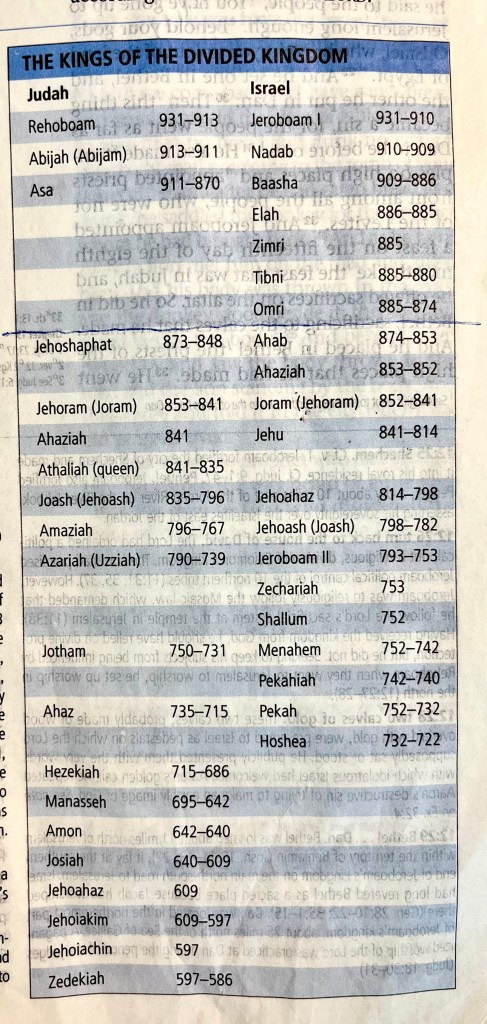
We now begin to read through the history of the reigning kings of the North and South. It can be confusing. Here are two helps.
1.) Check out (and maybe print) the list I posted yesterday of the kings and when they reigned.
2.) If you mark in your Bible, use a colored highlighter to mark the kings of the North, and a different color for the Southern kings.

1 Kings 15.

In the eighteenth year of King Jeroboam (north), King Abijah/Abijam began to reign over Judah (south).  He reigned for three years. He walked in the sins of his father before him – his heart was not wholly true to the LORD, as the heart of David.

  • “Nevertheless, for David’s sake, the LORD gave him a ‘lamp’ in Jerusalem, setting up his son after him, and establishing Jerusalem, because David did what was right in the eyes of the Lord.”  (I love this promise!)

.

2 Chronicles 13.

Now there was war between Abijah (south) and Jeroboam (north). Abijah, with 400K soldiers VS Jeroboam with 800K (who were positioned in front and behind Judah in an ambush stance.

But, although Abijah was not a good king, he had some good words to the Northern army that day.

  • Hear me, O Jeroboam and all Israel. Ought you not to KNOW that the LORD God of Israel gave the kingship over Israel forever to David and his sons? Yet Jeroboam – a servant of Solomon – rebelled and, because Rehoboam was young and irresolute, took the northern tribes to reign over them. 
  • “And NOW you think to withstand the kingdom of the LORD in the hand of the sons of David?  Because you are more in number and have golden calves???   AS FOR US, the LORD is OUR God, and we have not forsaken Him. We have priests ministering to Him, the sons of Aaron, and the Temple of God.
  • Behold, God is with us at our head.  O sons of Israel, do not fight against the LORD, the God of your fathers, because you cannot succeed.”

A bold proclamation, for sure, but then Judah noticed the 400K soldiers in front of them and the 400K behind them, ready to ambush. They “cried to the LORD, and the priests blew the trumpets, and the men of Judah raised the battle shout.”  And when Judah shouted, GOD defeated Jeroboam and all Israel before Abijah and all Judah!  WHOA! And the men of Israel fled before Judah, who struck down 500K of Israel.

Why this massive victory?  “Because they relied on the LORD, the God of their fathers.”

Jeroboam (north) did not recover his power in the days of Abijah (south). And the LORD struck him down, and he died.  But Abijah (south) grew mighty.

.

2 Chronicles 14.

Abijah (south) died and was buried in the City of David. His son, Asa, reigned in his place, and the land had rest for ten years.  “Asa did what was good and right in the eyes of the Lord his God,”  taking away the foreign altars, the high places, and the Asherim pillars. He also commanded the people of Judah to “seek the LORD, the God of their fathers, and keep the law and commands.”

The kingdom had rest under him. He had no war in those years, for the LORD gave him peace.

But then…

  • Zerah, the Ethiopian, came out against them with an army of a million men and 300 chariots!  WHOA!
  • And Asa cried to the LORD his God.  “O LORD, there is none like You to help between the mighty and the weak. Help us, O LORD our God, for we rely on You, and in Your Name we have come against this multitude. O LORD, You are our God; let not man prevail against You.”
  • So the LORD defeated the Ethiopians before Asa and Judah. And they fled.  Asa and Judah pursued them as far as Gerar, and the Ethiopians fell … until NONE remained alive. (a million!!!)  And Judah carried MUCH PLUNDER back to Jerusalem.

.

2 Chronicles 15.

Then the Spirit of God came on the prophet Azariah, and he took a message from God to King Asa (south), to Judah, and to Benjamin.

  • “The LORD is with you while you are with Him. If you seek Him, He will be found by you, but if you forsake Him, He will forsake you.”  “But you, take courage! Do not let your hands be weak, for your work shall be rewarded.”

And what was the “work” they had to do?  Clean out the land of all the detestable idols.  And as soon as Asa heard the prophet’s message, he took courage and put away the idols from Judah and Benjamin.

He also gathered those people from the northern tribes of Ephraim, Manasseh, and Simeon who were residing with them, for great numbers had deserted to him from Israel (north) when they saw that the LORD was with him.

All these, and Judah entered into a covenant to seek the LORD the God of their fathers, with all their heart and with all their soul.  They rejoiced over the oath, for they had sworn with all their heart and had sought him with their whole desire … and He was found by them, and the LORD gave them rest all around.

And King Asa removed his mother, Maacah, from being queen mother, because she had made a detestable image for Asherah.   The heart of Asa was wholly true all his days. 

And there was no more war …. until the thirty-fifth year of his reign.

.

2 Chronicles 16.

In the 36th year of Asa’s reign (south), the (northern) king Basha went up against Judah.  He built a fort so no more of his people could leave him and go to King Asa. 

NOTE: Instead of crying to the LORD his God, King Asa took money (gold and stuff from the treasuries of the LORD) to Ben-Hadad, king of Syria in Damascus, and paid him to fight King Basha (north) so he would withdraw from King Asa (south).

Ben-Hadad agreed and sent commanders of his armies against the cities of Israel (north), and they conquered Dan, other cities, and all the territory of Naphtali. The northern king Basha heard of it and withdrew from building the fort against Judah. 

But…

This was NOT what King Asa should have done. The prophet Hanani said to him,

  • Because you relied on the king of Syria and did not rely on the LORD your God, the army of Syria has escaped you. (He could have battled them and won!)  
  • Were not the million Ethiopians a huge army, yet because you relied on the LORD, he gave them into your hand. The eyes of the LORD run to and fro throughout the whole earth, to give strong support to those whose heart is blameless toward Him. 
  • YOU HAVE DONE FOOLISHLY IN THIS. From now on, you will have wars.

Well, that did not make King Asa (south) happy.  In a furious rage, he took Hanani and put him in stocks in the prison!

“Did that help, Asa???  I think not.  Accept your sin! Repent! Ask forgiveness!!  But he didn’t. In fact, “he inflicted cruelties on some of the people at the same time!”

Three years later, “King Asa (south) was diseased in his feet (did he think about those prison stocks??) and his disease became severe. EVEN THEN, he did not seek the LORD, but went to doctors.  Sheesh!

He died two years later and was buried in a tomb that he’d cut for himself in the city of David.  Curiously, the people filled his casket with various kinds of spices prepared by the perfumer’s art.  (YIKES, did his feet smell THAT bad???)  They made a very great fire in his honor.

(17:1 – And Jehoshaphat, his son, reigned in his place.)

Journaling through the Bible Chronologically in 2025, Days 131 & 132

(Sundays and Mondays studies are both posted on Monday.)

Day 131. Reading 2 Samuel 10, 1 Chronicles 19, and Psalm 20

Read Today’s Scriptures.

Day 131.

2 Samuel 10 and 1 Chronicles 19  (These two chapters tell the same story with very few differences.)

It started with a good deed. The friendly king of the Ammonites died, and David wanted to show his loyalty to the new king, Hanun, so he sent a company of his servants to console him.  Like many young and pompous advisors to new youthful kings, Hanun’s guys filled his mind with suspicion about David’s servants. They whispered in Hanun’s ear that King David had sent them to search the city, spy on it, and overthrow it. 

Really?  With bouquets of lilies?

The young (and foolish king – he reminds me of Solomon’s son Rehoboam & his foolish advisors – took David’s servants and humiliated them.  Half their beards (a symbol of manhood) were shaved off, and their robes were cut off at hip level, leaving them exposed.  They were greatly ashamed!

David heard about it, sent men to meet them (presumably with decent clothes), and told them to remain in Jericho until their beards grew out.

Young King Hanun, sensing he’d made a mistake and seeing how he now “stunk” in the eyes of Israel, got together an army, added some neighboring soldiers then fanned out for war. (second mistake)

David sent Joab and the host of his mighty men. (The empire strikes back!)

Joab and his co-commander brother Abishai spit up to fight the Syrians and Ammonites. Joab encouraged his brother and men with a great declaration.

  • Be of good courage, and let us be courageous for our people, and for the cities of our God, and may the LORD do what seems good to Him.

Way to go, Joab!

The Syrians fled.  When the Ammonites saw them running away, they fled too.  HA!  Joab and Abishai and their men returned to Jerusalem. 

Now the Syrians were embarrassed and returned with a new, powerful commander to fight again. (third mistake.)  This time DAVID himself, gathered all Israel together, led them across the Jordan River, and fought them.

The Syrians fled again. This time David and the company went after them, killing many thousands. And also, that great commander died too.  When the Syrians saw they were defeated they surrendered and became subject to Israel.

So the Syrians were not willing to save the Ammonites anymore.  (Let that be a lesson learned!)

Psalm 20.

This psalm is titled, “Trust in the Name of the LORD our God.” It’s a song most often sung before going out to battle.

That’s just what Joab and Abishai, and then King David did, and they won the day. All glory to God.

  • May the LORD answer you in the day of trouble! May the Name of the God of Jacob protect you!
  • May He send you help from the sanctuary and give you support from Zion!
  • May He remember all your offerings, and regard with favor your burnt sacrifices!
  • May He grant you your heart’s desire and fulfill all your plans!
  • May WE shout for joy over your salvation, and in the Name of our God set up our banners!
  • May the LORD fulfill all your petitions!
  • Now I know that the LORD saves His anointed; He will answer him from His holy heaven with the saving might of His right hand. 
  • SOME trust in chariots and SOME in horses, but WE trust in the Name of the LORD our God!

###


Day 132. (5 more psalms)

Psalm 65.

This psalm is a PRAISE psalm (to the MAX).  It’s hopeful, confident, and enthusiastic in response to God’s goodness.  It’s a celebration at the Tabernacle, probably at one of Israel’s Feasts.

  • Praise is due to you, O God, in Zion
  • O YOU WHO HEAR PRAYER, to You shall all flesh come.
  • Blessed is the one You choose and bring near to dwell in your courts! We shall be satisfied with your goodness and holiness.
  • By awesome deeds You answer us with righteousness, O God of our salvation.
  • You make the going out of the morning and the evening to shout for joy.
  • You crown the year with Your bounty; Your wagon tracks overflow with abundance!

Psalm 66.

Another psalm of praise titled “How Awesome Are Your Deeds”

  • Shout for joy to God, all the earth; sing the glory of His Name; give to Him glorious praise!  Say to God, “How awesome are Your deeds!”  So great is Your power that Your enemies come cringing to You.
  • Come and see what God has done; He is awesome in His deeds toward the children of man.
  • Bless our God, O peoples; let the sound of His praise be heard, who has kept our soul among the living and has not let our feet slip.

And then, a personal testimony;

  • Come and hear all you who fear God, and I will tell you what He has done for my soul.
  • I cried to Him with my mouth, and high praise was on my tongue.
  • If I had cherished iniquity in my heart, the LORD would not have listened. 
  • But truly God HAS listened, He has attended to the voice of my prayer.
  • BLESSED be God, because He has not rejected my prayer or removed His steadfast love from me!

Psalm 67.

This psalm shows that God’s desire is to save and bless ALL nations of the earth as they come to Him and fear him! But first a “benediction.”

  • May God be gracious to us and bless us and make His face shine on us.…..
  • that Your way may be known on the earth, Your saving power among all NATIONS.
  • Let the PEOPLES praise You, O God: let all the PEOPLES praise you!
  • Let the NATIONS  be glad and sing for joy; for You judge the PEOPLES with equity and guide the NATIONS upon the earth.
  • Let the PEOPLES praise You, O God; let all the PEOPLES praise you. 
  • …let all the ends of the earth fear Him!

Psalm 69.

This psalm is a prayer of desperation, titled “Save Me, O God.”   In it David realizes that he might be shortly killed. He begs for rescue.

This psalm also has inferences concerning the coming Messianic kingdom when God’s enemies are dealt with.  Much of it was applied to Christ in the New Testament – you will catch those parts as you read.  But any believer being ridiculed will identify too.

Read the whole thing.  It shows David’s intimacy with God that he can pray such personal prayers.  It shows US that we can cry out to God, no matter what our heartache or need.  No matter how desperate we are or what sin we have done.   

Psalm 70.

A short psalm, almost identical to Psalm 40.  David prays against his enemies, asking God to turn them back and be brought to shame.

But then he prays that ALL who WILL turn and seek God might be saved!

  • May ALL who seek You rejoice and be glad in You!  May those who LOVE YOUR SALVATION say evermore, “God is Great!”

.

Tomorrow, sadly, we will see the great king fall. 


Journaling through the Bible Chronologically in 2025, Day 130


Read Today’s Scriptures. Psalms, songs, prayers to read and savor.
 

Psalm 50.

This psalm is quite different. It quotes God Himself throughout. And so, it’s like a prophetic writing or an oracle. It tells the difference between true and false worship. First, God is introduced, then the different kinds of false worship are shown, and finally, the very last verse reveals true worship

1-6 – Who God is.

  • The Mighty One, God the LORD, the perfection of beauty, before Him a devouring fire, around Him a mighty tempest …
  • The heavens declare His righteousness, for God Himself is judge.

7-15 – Ritualism as worship, no!

  • Not for your sacrifices do I rebuke you; your burnt offerings are continually before me.
  • (But it’s for their attitude in sacrificing. As if they were giving to God what HE needs.) I will not accept your bulls … your goats.  EVERY BEAST of the forest (already) is MINE. 
  • I own the cattle on a thousand hills.  I know all the birds of the hills, and all that moves in the field is MINE.
  • If I were hungry, I would not tell YOU, for the world and its fullness are MINE. 
  • NO!  Offer to God a sacrifice of thanksgiving, perform your vows, and call on Me in the day of trouble: I will deliver you, and you shall glorify me.

16-21 – Rebellion as worship, no!  To the wicked —

  • What right have you to recite my statutes or take my covenant on your lips?
  • You hate discipline. You cast My Words behind you. You are pleased with thieves. You keep company with adulterers. 
  • You give your mouth free rein for evil. Your tongue frames deceit. You speak against your brother. You slander your own mother’s son. 
  • You’ve done these things, and I’ve been silent. But now I rebuke you and lay the charge before you.

22-23 – Right approach to God.

  • The one who offers thanksgiving as his sacrifice glorifies me; to one who orders his way rightly, I will show the salvation of God!”


Psalm 53.

This psalm is very much like Psalm 14, which we’ve already read. 

  • The fool says in his heart, “There is no God.” They are corrupt, doing abominable iniquity; there is none who does good.


Psalm 60.

Now this is unusual. David actually tells when he wrote this psalm. Remember yesterday, when we read of all the ways God helped him to defeat his enemies?  Zorbah, plus the thousands of Edom in the Valley of Salt? 

David here seems discouraged before God gives him victory in both the extreme North (Syria) and South (Edom) of Israel.  Then, David sees the victories.  

  • O God, You have rejected us, broken our defenses; You have been angry; oh, restore us!
  • God has spoken in his holiness, “Moab is my washbasin; upon Edom, I cast my shoe; over Philistia, I shout in triumph!”  (Talk about God getting into the fray enthusiastically!)
  • And David, “With God we shall do valiantly; it is He who will tread down our foes.”

Don’t you love reading these psalms in their proper places in Israel’s history?


Psalm 75.

Note, that the writer, Asaph, says this psalm is to be sung to the tune of “Do not destroy” as he wrote on Psalm 57.  Don’t you wonder what that tune sounded like?

  • “We give thanks to You, O God; we give thanks, for Your Name is near. We recount your wondrous deeds.

If you have read through the Book of The Revelation recently, much of this psalm sounds similar.

  • At the set time that I appoint I will judge with equity.
  • When the earth totters, and all its inhabitants, it is I who keep steady its pillars.
  • For in the hand of the LORD there is a cup with foaming wine, well mixed, and He pours out from it, and all the wicked of the earth shall drain it down to the dregs.

WOW!

  • But I will declare it forever; I will sing praises to the God of Jacob.
  • All the horns (power) of the wicked I will cut off, but the horns (strength) of the righteous shall be lifted up. 

Yea, and amen!


Journaling through the Bible Chronologically in 2025, Day 121

Beginning a new MONTH.

Read Today’s Scriptures about Israel’s new King.

(Did you know that David is the only king mentioned in Hebrew 11’s list of mighty men?

  • (As we study both 2 Samuel and 1 Chronicles (and Kings), there will be overlaps.  Chronicles, written 500 years later, will contain things not included in the present-day text of 2 Samuel.)

2 Samuel 5.

Finally, all the northern tribes come together and take David as the King of all Israel.  They said, “When Saul was king over us, it was YOU who led out and brought in Israel. The LORD said to you, ‘You shall be Shepherd of my people Israel, and you shall be Prince over Israel.'”

So all the elders came to the king at Hebron and King David made a covenant with them before the LORD, and they anointed him king.  David was 30 years old. (15 years after old Samuel had anointed him.)

David had had his eye on Jerusalem for a long time, so now he fought against the Jebusites to take the city.  They laughed and said, “Oh, the blind and the lame could ward you off!”

HA!

They didn’t know that the LORD also had HIS eye on Jerusalem, that He had loved it from of old (Psalm 87:1-3).  It would be the place where He would set His NAME, and where He would dwell among His people.  It would be the place where the greater Son of David would walk and teach, and eventually be crucified outside its walls.  And then be resurrected.

Jerusalem, the City of God, the City of David. 

And so David sent his best soldiers up the water channel into the city and beat all those “blind and lame” Jebusites.

He lived in the stronghold (fortress) of the city and built it up all around.

And David became greater and greater, for the LORD, the God of hosts, was with him.”  The king of Tyre, Hiram, sent cedar trees, carpenters, and masons to David so he could build his house in the “City of God.”

The philistines.

When the Philistines (who thought David was with THEM) heard that he’d become King of Israel, they spread out in the Valley of Rephaim, ready for war.

David inquired of the LORD. “Shall I fight? Will you give them into our hands?”  And the LORD said, “Yes” to both.”   And so it happened.

Then the Philistines come up again and spread themselves out for war in the same valley.

David inquired again of the LORD.  “Shall I fight? Will you give them into our hands?”  But this time the LORD said, “No. You shall go behind them. When I cause the leaves of the balsam trees to rustle, THEN, go from behind and strike them down.”  And so it happened.  The Philistines went running.

  • Here, I have to confess, that I WISH my prayers for direction would be answered as quickly and in such detail as David’s were in these verses.  But I know the Holy Spirit dwells in believers today, and that His voice is quiet. We have to ask in faith, and then listen, and search His word.

1 Chronicles 11.

(Chapter 10 ends with, “Therefore the LORD … turned the kingdom over to David the son of Jesse.”)

In this passage, the people of all Israel who want David to be their king, say, “Behold, we are your bone and flesh,” aligning themselves as one to him. David made the covenant, and they anointed him king over Israel …. “according to the word of the LORD by Samuel.”

And then the taking of the City of Jerusalem.  The man who was David’s commander went up first, becoming chief of his men … Joab.

David’s Mighty Men

These men gave the new king, strong support in his kingdom. There were 300, thirty of which were super-duper mighty men. Three were the Most Mighty, two of them killing 300 at one time, each!

Another, named Benaiah, went down and killed a lion in a pit … on a day when the snow had fallen(???), and also killed a 7.5-foot Egyptian giant, yanking his beam-like spear out of the giant’s hand and killing him with it. (David set this mighty man as head of his bodyguard detail.)

One day, when David was still hiding in the cave of Adullam, with the Philistines below, he mentioned how sweet he remembered the cool water from a well in his hometown of Bethlehem.  Unbeknownst to him, three of the chief men in his army went down, through the Philistines, to the well at Bethlehem, got a flask of the water, and brought it back to their Commander-in-chief.  (Oh, wow!)

David was so astounded and humbled, that he would not drink it and poured out the water before the LORD.  “Far be it for me before my God that I should do this. Shall I drink the lifeblood of these men?  For at the risk of their own lives, they brought it.”  

This is why his army loved him so much.

The list of mighty men goes on.  One name should stand out to us, sadly.  In verse 41, Uriah the Hittite, is listed. He was the righteous man whom David had killed after committing adultery with his wife who turned up pregnant.  Ah, David! How could you fall so low with one of these faithful men?

1 Chronicles 12.

This chapter describes more about David’s mighty men, telling how they came with him when he was still being pursued by Saul.  They were bowmen who could shoot arrows and sling stones – either with their right or left hands from the tribe of Benjamin.

Men from the tribe of Gad also joined with David when he was in the wilderness.  They were experienced warriors, experts with the shield and spear, “swift as gazelles on the mountains”.  They became officers in the army.

Then the Spirit “clothed Amasai,” chief of the thirty who said this blessing, “We are yours, O David, and with you, O son of Jesse! Peace, peace to you, and peace to your helpers! For your God helps you.”

Some from the tribe of Manasseh came and helped David against the Philistine raiders.  Also, some came to David from other tribes after Saul died, Simeonites, Ephraimites, those from Issachar, Zebulun, Naphtali, Dan, Asher, and from the east side, Reuben, and Manasseh: 120,000 men armed with weapons of war.

(Also, the relatives of the soldiers came from the tribes, bringing food on donkeys, camels, mules, and oxen, for a big celebration, “for there was joy in Israel.“)

  • I love this portion of scripture, when David is at his height, honoring and seeking God with all his might, loyal to a fault to his men, with a heart to please and serve the LORD.  I’ll “savor” these chapters because I know David falls, and, though forgiven by God, his life and his kingdom are ruined.
  • Maybe I dislike it so much because I see how we, ourselves, sin and ruin our lives, although our God loves and forgives us.
Read today’s scriptures.  How are you challenged by these passages today?

2 Samuel 5.

Journaling through the Bible Chronologically in 2025, Days 110 & 111

(I post Sunday’s and Monday’s studies together.)
 
Day 111. Reading 2 Samuel 1 – 4.
 

Read today’s scripture passages.

What specific thing encourages you in these Psalms?

EASTER SUNDAY.  What a wonderful way to begin this day – with Psalms of praise – what good timing.

Psalm 121.

  • I lift up my eyes to the hills.
  • From where does my help come from? 
  • My help comes from the LORD, who made heaven and earth.

Psalm 123.

  • To You I lift up my eyes, O You who are enthroned in the heavens!

Psalm 124.

  • If it had not been the LORD who was on our side when people rose up against us, then they would have swallowed us alive…
  • Blessed be the LORD, who has not given us as prey to their teeth!
  • Our help is in the Name of the LORD, who made heaven and earth.

Psalm 125.

  • Those who trust in the LORD are like Mount Zion, which cannot be moved but abides forever.
  • Peace be upon Israel!

Psalm 128.

  • Blessed is everyone who fears the LORD, who walks in His ways!
  • May you see your children’s children! Peace be upon Israel!

Psalm 129.

  • The blessing of the LORD be upon you! We bless you in the name of the LORD.

Psalm 130.

  • O Lord, hear my voice! Let your ears be attentive to the voice of my pleas for mercy!
  • If You, O LORD, should mark iniquities, O Lord, who could stand?
  • But with You there is forgiveness that you may be feared.
  • I wait for the LORD, my soul waits and in His word I hope; my soul waits for the Lord, more than the watchman for the morning.
  • O Israel, hope I the LORD. For with the LORD, there is steadfast love, and with Him is plentiful redemption.
  • And He will redeem Israel from all his iniquities.

.

###

Day 111.

To set the scene for what has happened thus far —

  1. The Philistines planned to march on Israel, focusing on Saul’s hometown.
  2. The Philistine commanders refused to let David and his men accompany them.
  3. David returns home only to find his town burned and all the families kidnapped.
  4. An abandoned slave tells them about the Amalekites and shows David where they are.
  5. David & men defeat them all and bring back their families.
  6. Meanwhile Saul is quaking in his sandals and hears no word from God about what to do. He goes to a witch, who calls up the dead Samuel.
  7. Samuel asks WHAT SAUL IS DOING and says he and his sons will all die the next day.
  8. The Philistines attack. Jonathan and Saul’s other two sons die. He finally dies too at his own hand after being badly wounded.
  9. All the rest of Israel run away and the Philistines live in their towns.

2 Samuel 1.

Two days after David returns home to Ziklag, a messenger, a young Amalekite (Israel’s enemy!), comes from Saul’s camp. He falls to the ground in homage (a hint of the news to follow) and tells David, that the people have fled from the battle and many of them died.

“Saul and his son, Jonathan are dead.”

How do you know that Saul and his son, Jonathan are dead??”

Here the Amalekite fabricates, saying he found Saul mortally injured. The king asked him to kill him “for anguish has seized me and yet my life lingers.”

“So I killed him because I was sure he was going to die anyway.  Oh, and by the way!  Here are his crown and amulet.  I have brought them here to m’lord.”  (You can bet he was expecting a reward.)

David tore his clothes, mourned, and wept, and fasted until evening for Saul, and Jonathan, and Israel.

Then he called back the young Amalekite. “How is it you were not afraid to put out your hand to destroy the LORD’s anointed?” Then, David called one of his own men, “Go, execute him!

And so the enemy liar paid with his own blood for killing the LORD’s anointed.

Then David wrote a lamentation over Saul and Jonathan and said it should be taught to the people of Judah. Here it is in part.

  • Your glory, O Israel, is slain on your high places. How the mighty have fallen! 
  • Tell it not in Gath, publish it not in the streets of Ashkelon, lest the daughters of the Philistines rejoice.
  • You mountains of Gilboa, let there be no dew or rain on you nor your fields of offerings.
  • For there the shield of the mighty was defiled, the shield of Saul.
  • From the blood of the slain, from the fat of the mighty, the bow of Jonathan turned not back, the sword of Saul returned not empty.
  • Saul and Jonathan, beloved and lovely! In life and in death they were not divided; they were swifter than eagles; they were stronger than lions.
  • How the mighty have fallen; and the weapons of war perished!

2 Samuel 2.

David inquired of the LORD.  And the LORD told him to go up to Hebron. So David and his two wives, Abigail and Ahinoam, plus all his men and their families lived in the towns of Hebron.  The men of Judah came, and there they anointed David King over the house of Judah.

When David was told that it was the men of Jabesh-Gilead who had buried Saul, David sent messages of blessing to them, praying that the LORD would show mercy and faithfulness to them. He too would show them goodness as King of Judah.

However…..

Abner, the commander of Saul’s Army, took Ish-bosheth, another son of Saul, and made HIM king over Gilead, the Ashurites, Jezreel, Ephraim, Benjamin, and the rest of Israel. He reigned two years.

Soon there was a clash between Abner and Joab, commander of the army of David. Abner and Joab sat down on either side of a pool. Abner suggested a contest between some of his men and some of Joab’s men to decide the conflict – instead of the whole army fighting.  Joab agreed.

However, the two sides were so closely matched, they killed each other, and nothing was settled.  And so… a battle royal ensued.  A younger brother of Joab chased Abner. As they ran, Abner told him three times to turn aside, but young Asahel persisted. Abner finally turned and killed the young man. (Joab would never forget this!!!

Abner made it home and the Benjaminites surrounded him.  He called to Joab. “Shall the sword devour forever? The end will be bitter! How long will it be before you tell your people to turn from the pursuit of their brothers?”

Joab thought it over, then blew the trumpet for his men to stop. They did not fight Israel anymore that time.

2 Samuel 3.

There was a long war between the house of Saul and the house of David, and David grew stronger.  Meanwhile, sons were born to David from his now six wives. (Remember Amnon, Absalom, and Adonijah.)

And there was a fight between Ish-Bosheth and Abner because Saul’s son accused the loyal Abner of treason.  Fed up, Abner said he was defecting to David and sent messages to the King of Judah.  Abner told David he could bring all Israel to David.

David agreed with one provision, that Abner bring Michel, Saul’s daughter and David’s first wife to him. (Saul had given her to another man.)  Abner agreed.  The new husband tagged along after Michel, weeping for his wife until Abner told him to go back. 

So David made a feast for Abner with his twenty men. Abner said he’d go and bring all Israel to David. They left each other in peace.

Just then Commander Joab and his men arrived with loot from a raid they’d come from. He was angry with David for making a deal with Abner. “Don’t you know Abner came to deceive you???” 

Joab sent men to bring Abner back on some pretense, and when Abner was back in Hebron, Joab killed him.  “For his brother, Asahel,” and NOT out of concern for David. 

David was furious and full of guilt. He cursed the house of Joab.

And David made Joab and all the people put on sackcloth and mourn before Abner. David wept and lamented Abner, saying,

  • “Should Abner die as a fool dies?
  • Your hands were not bound; your feet were not fettered, 
  • As one falls before the wicked you have fallen.”

And David fasted till the sun went down.  And all the people and all Israel understood that day that it had NOT been the king’s will to put to death Abner.

2 Samuel 4.

Ish-Bosheth’s courage failed.  Two of Saul’s men came into his house in pretense and killed him. They beheaded him and brought the head to David at Hebron!  Well, you know what happened —- the same thing as what happened to the Amalekite who brought news of Saul’s death.  Yep. They were killed. David buried the head of Ish-Bosheth. 

David wanted NO BLOOD on his hands from the house of Saul.  It was God who had chosen him King.  David would not “take” the throne from any of the LORD’s anointed.  Period.

David did not know it yet, but there was one descendant of Saul left, a son of Jonathan named Mephibosheth.  Back when Saul was killed, the little boy’s nurse grabbed him and rushed him to safety from the Philistines.  HOWEVER…. the little guy fell in her haste and became lame from then on. 

(Stay tuned about this guy.)


Journaling through the Bible Chronologically in 2025, Day 102


Read today’s scripture.

How do you see God’s faithfulness, despite man’s failures, today?

1 Samuel 15.

Chapter 14 ended with the summary, “There was hard fighting against the Philistines all the days of Saul” (and Israel’s army has yet to encounter Goliath).  But Saul needs to deal with another people whom God had vowed to destroy – the Amalekites.

Why?  The Amalekites were descendants of Esau. Esau and Jacob/Israel were twin brothers, but there was no family love between the original men and none between their descendants.  When God brought the Israelites out of Egypt and they were still untried and weak, the Amalekites attacked them. God helped Israel to push back the attack with Joshua and a rag-tag, quickly-assembled army, and Moses holding up his staff over the scene (with the help of Aaron and Hur). But God cursed them.

  • Deuteronomy 25:17-19. (Moses speaking) “Remember what Amalek did to you on the way as you came out of Egypt., how he attacked you on the way when you were faint and weary, and cut off your “tail,” those who were lagging behind, and he did not fear God. THEREFORE when the LORD your God has given you rest from all your enemies around you, in the land that [He} is giving you for an inheritance to possess, you shall blot out the memory Amalek from under heaven; you shall not forget.”

The time had come. Israel’s first king is charged with the task.

Samuel told Saul, “Go and strike Amalek and devote to destruction ALL that they have. Do not spare them, but kill both man and woman, child and infant, ox and sheep, camel and donkey.”  

So Saul took 210K men and defeated the Amalekites in nearly all of their territory.  YAY!!

And he took Agag the king of the Amalekites ALIVE and devoted to destruction of all the people with the edge of the sword. And Saul and the people spared Agag and the best of the sheep, oxen, fattened calves, lambs….and all that was good, AND DID NOT UTTERLY DESTROY THEM (the Amalekites).” 

Wait, Saul didn’t kill the king?  (And he missed a few hundred others, according to later incidents.)

Samuel heard about it and he was mad. “I regret that I have made Saul king.”  He cried to God all night, then arose in the morning and went to Saul’s camp at Gilgal.

  • Saul: “Blessed be you to the LORD. I have performed the commandment of the LORD.”
  • Samuel: “What then is this bleating of sheep in my ears, and the lowing of oxen I hear?
  • Saul:  “They brought them from the Amalekites, for the people spared the best of the sheep and oxen … to sacrifice to the LORD your God.
  • Samuel:  “STOP! I will tell you what the LORD said to me this night.”
  • Saul: “Speak.
  • Samuel: “The LORD anointed you king over Israel. The LORD sent you on a mission.  Why then did you NOT OBEY THE VOICE OF THE LORD. Why did you pounce on the spoil and do what was EVIL in the sight of the LORD?”
  • Saul:I HAVE obeyed. I HAVE gone on the mission. I have brought Agag the king of Amalek and devoted the rest to destruction.  BUT THE PEOPLE took spoil to sacrifice to the LORD your God.”
  • Samuel: “Has the LORD as great delight in burnt offerings and sacrifices, AS IN OBEYING?  Behold, to obey is better than sacrifice.  Because you have rejected the word of the LORD, He has also rejected YOU from being king.”
  • Saul: “I have sinned and transgressed the commandment of the LORD … because I feared the people.  Now, please pardon my sin.
  • Samuel: You have rejected the word of the LORD, and the LORD has rejected you from being king.” Then, when Saul ripped a piece of Samuel’s robe in trying to get him to stay,
  • Samuel said: “The LORD has torn the kingdom from you this day and given it to another, one better than you.”

After that, Samuel called for King Agag and hacked him to pieces. (Yes, that old man had the strength and will to do what Saul had not.)  Then Samuel left.  He did not see King Saul until the day of his death. (But, Samuel grieved over Saul … his “beautiful, tall and handsome man” the one HE had anointed prince of Israel….)

1 Samuel 16.

God remonstrated His prophet.

How long will you grieve over Saul.  I will send you to Bethlehem to Jesse, for I’ve chosen a king for myself from his sons.  Take a heifer and tell him you’ve come to make a sacrifice to the LORD.  Then anoint FOR ME the one I show you.”

Samuel obeyed.

At the sacrifice celebration, Samuel looked at Jesse’s oldest son, Eliab. Perhaps he was tall and handsome too, for God spoke sharply to His prophet. “Do not look on his appearance or on the height of his stature, because I have rejected him. For the LORD sees not as man sees. Man looks on the outward appearance, but the LORD looks on  the heart.”

And so it happened to all of Jesse’s son brought to Samuel from the oldest downward.  God rejected all seven.

Samuel was confused. He was SURE this was the family.  He was SURE God had rejected all the sons. Hmm.

Are ALL your sons here, Jesse?” 

Well, there remains only the youngest, but behold he’s a lad and he out tending the sheep.”

Send and get him,” charged Samuel and they did.  This boy was ruddy (rosy-cheeked), had beautiful eyes, and was handsome (with blond curls, the Jews say). (Not like Saul at all.)

“This is the one. Anoint him,” said the LORD.

So Samuel anointed the lad in the presence of his family. And the Spirit of the LORD rushed onto David from that day forward.  After the sacrifice, Samuel got up and went home.

MEANWHILE, back at Gilgal, the Spirit of the LORD departed from Saul, and a harmful spirit from the LORD tormented him.   His servants began looking for a musician who could play soft music on a lyre to calm him.

One of them mentioned that he’d seen such a man, the son of Jesse, the Bethlehemite, who was skilled at playing the lyre.  He was also a man of valor, prudent in speech, a man of good presence, and the LORD is with him.

Saul sent messengers to Jesse to get David from watching the sheep.  So David came to Saul and entered his service. Saul loved him greatly, and he became his armor-bearer.  Whenever the harmful spirit was upon Saul, David came, took up the lyre, and played.

So Saul was refreshed and was well, and the harmful spirit departed from him. (temporarily)

1 Samuel 17.

You know it, right? The story of David and Goliath?

The Philistines were back (after that awful defeat begun by young Jonathan).  They were back in Judah. And Saul gathered his army in line of battle against the Philistines.  But the invaders had brought a secret weapon: one of their giants from their city of Gath.  Goliath was 9.5 feet tall.  He was clothed in armor weighing more than 150#.  And he stood arrogant and shouted to the army of Israel.

Am I not a Philistine and are not you servants of Saul? Choose a man and let him fight me. If he can kill ME, we will be your servants. (hahaha)  But if “I” kill him, YOU shall be OUR servants.  I DEFY THE RANKS OF ISRAEL THIS DAY.  GIVE ME A MAN THAT WE MAY FIGHT.”

Okay, you guessed it. The army of Saul was terrified. (Hopefully, by then they had more than two swords among them!!)  For forty days, the giant came forward and took his stand, morning till evening. And Israel stood frozen in their lines. (Forty days is significant. Forty = testing.)  Saul promised his beautiful youngest daughter to the man who would come out and defeat the giant.  But no one stepped up.

Meanwhile, back in Bethlehem, old Jesse was worried about his sons in the army.  He sent David with a donkey loaded with goodies, to check on them.  He arrived at the camp just as Goliath was shouting his challenge. 

David asked, “What shall be done for the man who kills this Philistine and takes away the reproach of Israel?”  The soldiers told David about King Saul’s offer of his daughter.  Maybe David was familiar with the beautiful girl from the times he was called to court to play the lyre for the king.

His brothers scolded David, saying he’d only come to gawk at the giant. But David responded, “Who is this uncircumcised Philistine, that he should defy the armies of the living God?”

News of this got back to King Saul and he sent for David. (Saul didn’t recognize him as the lyre player.) 

David:  “Don’t be afraid. I will go and fight with this Philistine.”

Saul: “You are not able for you are but a youth.”

David:  “I used to keep sheep for my father. When a lion or a bear came and took a lamb from the flock, I went after him and struck him and saved the lamb.  I’ve struck down both lions and bears, and this Philistine shall be like one of them … for he has defied the armies of the living God.  The LORD who delivered me from the paw of the bear and the lion will deliver me from the hand of the Philistine.”

Saul:  “Go, and the LORD be with you.”  (Saul tried to make David wear his armor, but it was way too big and clumsy. And David had never moved about in armor before.  He took it off.)

You know the story.

The challenge. The one stone of five into the sling. The fall of the giant. The final coup de gras with the giant’s head rolling and David holding the giant’s heavy sword high.

And it all happened, “that the earth may KNOW that there is a God in Israel, and that all this assembly may KNOW that the LORD saves not with sword and spear. For the battle is the LORD’s and He will give you [enemies] into our hand.”

Of course, then, the men of Israel rose and pursued the Philistines all the way to Gath and the gates of Ekron.

Saul, seeing it all, asked his commander, Abner, “Whose son is that?’

Abner: “I don’t know.”

Saul: “Well, find out!’

When David returned from killing the giant, Abner brought him to the king.

Whose son are you?”

“I‘m the son of your servant Jesse, the Bethlehemite.” (The one who has been coming to play the lyre for you when you go crazy!  But he probably didn’t say that.)

(Sounds to me like Saul was conscripting David into his army.)

(Hey, didn’t David’s daring-do, and his confidence in God remind you of Jonathan in yesterday’s reading? Jonathan had said, “the LORD is able to deliver by many or by a few. Let’s go!”  These two young believers in the LORD and His strength will meet in tomorrow’s reading.  And a godly, tight bond will form.)

  • O LORD, that I might trust in You so completely that all fear is gone.  I also pray that I will be obedient in all you ask.  You are a great God!


Journaling through the Bible Chronologically in 2025, Day 91


BEGINNING THE MONTH OF APRIL

Continuing with the judges of Israel and the repeating cycles of sin.

What truth can help you TODAY?

Judges 6.

Oh, no! It’s happening again!

“The people did what was evil in the sight of the LORD.”

And the LORD gave them into the hand of Midian for seven years. (Those people who had corrupted Israel by the hand of Balaam when Moses was alive. Israel had declared a holy war against them and defeated them soundly, killing all except the young girls. Now they were back to repay Israel.)

The Midianites overpowered them. Israel hid in caves and dens. The Midianites stole and destroyed all their crops and produce, so food was scarce. Midian came like locusts with their camels (not chariots) and laid waste to the land. 

Israel was brought VERY LOW. 

And the cried out for help to the LORD.

The LORD sent a prophet saying, “I led you up out of Egypt and drove out all in this land and gave it to you. I said I am the LORD your God, you shall not fear the gods in the land you dwell. But you have not obeyed my voice.”

Nevertheless, God raised up another judge, one fearful little man who was threshing his meager grain at night so as not to be seen.

The Angel of the LORD: “The LORD be with you, O mighty man of valor!

Gideon: “Huh? If the LORD is with us, why has all this happened?  Where are all God’s wonderful deeds that our fathers talked about? The LORD brought us out of Egypt, but now He has forsaken us,” 

The Angel of the LORD: “Go in this might of yours and save Israel from Midian. I’m sending YOU.”

Gideon: “Seriously??? My clan is the weakest in Manasseh, and I am least in my father’s house!”

The Angel of the LORD: “I will be with you, and you shall strike the Midianites as one man.”

Gideon. “Show me a sign! Oh, wait, if it’s really you, stay here and I’ll bring you a present.”

The Angel of the LORD: “I will stay till you return.”

This was an extraordinary conversation!  But amazingly, the Angel remained till Gideon brought back some food. The Angel zapped the meat and broth and unleavened bread that Gideon brought with His staff and consumed it. 

Whoa! Now I know I’ve seen the Angel of the LORD!

The LORD gave Gideon the task of destroying the local alters of Baal and Asheroth that night, and Gideon obeyed. The whole town was angry and wanted to kill Gideon, but his father mocked.  “Do YOU defend the gods? Why don’t they defend themselves?”

Then the Midianites came. And the Amalekites. And the people of the East. They crossed the Jordan and camped in the plain of Jezreel. And all Israel quaked.

BUT… not Gideon because the Spirit of the LORD clothed him.  He sent messages to his tribe of Manasseh, and to Asher, Zebulun and Naphtali to meet him and they did, all 30K of them.  Then Gideon got the shakes. 

God, if you will save Israel by my hand – as you have said – behold I’m laying a fleece of wool on the floor. If there is dew on it and not the surrounding area in the morning, I WILL KNOW YOU WILL SAVE US.

It happened as Gideon asked.

But he was still shaking.  “God, this time, let the fleece be dry and the surrounding floor be wet.”  Yep. It happened.  

Convinced yet, Gideon?  

Judges 7.

And so, Gideon and his 30K set themselves in array camped by a spring, ready for battle.

The LORD:  “The people with you are too many for me to give the Midianites into their hand, lest Israel boast over me saying, ‘My OWN HAND HAS DONE IT.’  So, tell all who are afraid to go home.”

And 22,000 left Gideon!!!

Still too many, Gideon.  Give them the water lapping test.”  

Gideon did, and there were but 300 men left to fight the hoard of Midianites.

With the 300 men I will save you and give the Midianites into your hand.”

And it seems that Gideon believed God.

Later that night God sent him to spy out the Midianite camp, and he heard one of the soldiers recounting a dream he’d had about a simple disaster.  But the other soldier declared, “It’s none other than the sword of Gideon, a man of Israel. God has given us into his hand, the whole camp.”

Whoa!  Prophecy from the mouth of the enemy, no less. And Gideon worshiped God.

Get up, men, the LORD has given the host of Midian into your hand!”

And so, Gideon and the 300, with only empty jars with torches inside and their trumpets, attacked at the sound of Gideon’s trumpet. “THE SWORD OF THE LORD AND GIDEON,”  they shouted and blew their horns.

And all of Midian fell into chaos, turning, spinning, falling, killing their own. Gideon called the other tribes to chase and capture them before they got to the Jordan River.  They did and also captured the two princes of Midian and killed them.  

Whew.

  • LORD, encourage my little faith as you did with Gideon. Help me to remember that YOU are a majority. YOU have the power to defeat any enemy in my life. O may I trust you!


Journaling through the Bible Chronologically in 2025, Days 89 & 90


Read today’s scripture.

What do you find encouraging or challenging today?

Judges 1.

It seems that after Joshua died, the people of Israel tried to finish the conquest of the Land.  The LORD had Judah lead the charge, along with Simeon, who was positioned inside Judah.  They were successful with God’s help in several campaigns.

Interestingly, the descendants of Moses’ father-in-law also fought with Judah, south into the Negev. Judah and Simeon went west and captured three Philistine cities, Gaza, Ashkelon, and Ekron. 

  • They cleared out and settled in the hill country, but they could not drive out the inhabitants of the plain because those people had chariots of Iron.
  • Benjamin could not drive out the inhabitants of Jerusalem. 
  • The house of Joseph (dual tribes) captured  Bethel with the help of a man of the city. They protected him and his family for the help – much like Israel had with Rahab and her family.  But Manasseh could not drive out the inhabitants in some of their cities, putting them instead to forced labor. And Ephraim did not drive out the Canaanites who lived in Gezer.
  • Zebulun did not drive out the inhabitants of several areas but put them into forced labor.
  • Asher did not drive out the inhabitants of Acco, Sidon, and other cities.
  • Naphtali did not drive out the inhabitants in their area.
  • The Amorites pressed the people of Dan back into the hill country and did not let them come down to the plain.

Joshua 2.

The Angel of the LORD came to the people at Gilgal.  “I brought you up from Egypt and into this land, I swore to give to your fathers. I told you I would never break my covenant with you, and YOU SHALL MAKE NO COVENANT with the inhabitants of this land. Instead, you shall break down their altars!”

BUT, you have not obeyed my voice.  What is this you have done?  So, now I will not drive them out before you. They shall become thorns in your sides, and their gods shall be a snare to trap you.

And all the people wept.

  • And the people of Israel did what was EVIL in the sight of the LORD and served Baals.
  • They abandoned the LORD the God of their fathers, who brought them out of Egypt.
  • They went after other gods, from among the gods of the peoples who were around them, and bowed down to them.
  • And they provoked the LORD to anger.
  • They abandoned the LORD and served the Baals and the Ashtaroth.

So the anger of the LORD was kindled against Israel and he gave them over to plunderers. And He sold them into the hands of their enemies, so they could no longer withstand them. And whenever they marched out, the hand of the LORD was against them.

And they were in terrible distress.

And then …. like a pitying Father … the LORD raised up judges (military leaders) who saved them out of the hand of those who plundered them.

Yet they DID NOT LISTEN to their judges, for the whored after other gods and bowed down to them. 

Whenever the LORD raised up judges for them, the LORD saved them from the hand of their enemies.  He was moved to pity for their groaning.

But when the judge died, they turned back and were more corrupt than before, going after other gods, serving them, and bowing down to them.

(The book of Judges follows those SEVEN CYCLES OF SIN, each worse than the one before.

  • LORD, help me to be more mindful of the important instructions you have given me (for YOUR glory and MY good). Let me not get so involved with “MY” desires and plans that I forget what You have told me to do FIRST. Clean out the enemy! After all, You have promised to help me do it.

.

Judges 3.

Here’s what the LORD did to test His people.  After those who fought and conquered Canaan under Joshua’s leadership died, the next generation seemed content to simply settle down in comfort. (Not a good plan!)

God wanted to teach “war” to those who had not known it before, so He left some of the pagan nations undefeated inside the Promised Land. Would young Israel obey the commandments of the LORD and drive them out?

Here are the nations: five lords of the Philistines, all the Canaanites and Sidonians and the Hivites who lived on Mount Lebanon.  (It looks like they didn’t make war on those.)  Instead the people LIVED AMONG the Canaanites, Hittites, Amorites, Perizzites, Hivites and Jebusites. 

They not only did NOT make war against them, they settled among them, intermarried, and served their gods.

Disgusting!

  • But wait….  Doesn’t the LORD also tell believers to cast off our old sin nature and cast down every evil thought against Him, and resist the devil? Hasn’t He given believers a suit of Armor to protect us, and the mighty Sword of the Spirit with which to stand and defeat the devil? Hasn’t He given us His Spirit to strengthen us?  So why don’t we make use of it all?  

1) “The people of Israel did what was evil in the sight of the LORD. They forgot the LORD their God and served Baals and the Asheroth.” 

  • This angered God and He “sold them into the hand of the king of Mesopotamia for EIGHT YEARS.
  • They cried out to Him.  
  • The LORD raised up a deliverer who saved them – Othniel, Caleb’s younger brother from Judah. The spirit of the LORD was on him and he went to war and defeated that king.
  • So the land had rest for 40 years.
  • Then Othniel died.

2) The people of Israel again did what was evil in the sight of the LORD. 

  • He strengthened King Eglon, the king of the Moabites, plus the Ammonites and Amalekites. They defeated Israel and took the area around Jericho, and served him EIGHTEEN YEARS.
  • They cried out to the LORD.
  • The LORD raised up a deliverer – Ehud, a left-handed Benjamite.  When Israel sent “tribute” to King Eglon, Ehud went too, and stealthily killed the king with an 18″ double-edged sword. (A kind of funny story – read verses 16-26a.) 
  • Then Ehud ehud and the Israelites killed 10L Moabites, so they were subdued.
  • So the land had rest for 80 years.
  • And Ehud died.

3) The next judge was a converted Canaanite, Shamgar, who killed 600 Philistines with an ox goad and saved Israel.

Judges 4.

4) Again the people of Israel did what was evil in the sight of the LORD.

  • God sold them into the hand of Jabin, king of Canaan who reigned at Hazor.  The commander of the army was the cruel Sisera. And he had 900 iron chariots. He oppressed the people for TWENTY YEARS.
  • The the people of Israel cried out to the LORD for help.
  • And the LORD raised up Deborah, a prophetess who judged Israel. She sent Commander Barak with 10K men from Naphtali and Zebulun, for the LORD had promised to give Sisera into his hand. He went and he LORD routed them all before Barak, pressing until they had killed the Canaanite king as well. 
  • Barak obeyed, knowing a woman would get credit for the battle’s win.  Not Deborah, but the wife Heber the Kenite, who fed the escaped Sisera some warm kefir and then pounded a tent stake through his skull while he slept.  YIKES!!
  • And the land had rest for 40 years.

Judges 5.

And they sang a song that Deborah wrote, all about the victory on that day, ending with, “So may all your enemies perish, O LORD! But your friends be like the sun as it rises in its might.”


  •  

Journaling through the Bible Chronologically in 2025, Day 88


Now … into the History of Israel – post-Moses.

Will the new leadership change the Nation?

What did you learn today about God’s faithfulness?

Joshua 22.

 A BIG MISUNDERSTANDING! nearly causes war.

The war is over, the land in conquered, the eastern tribes turn toward home. They have fulfilled their promise to help their brothers. All is well.

Joshua sends them off with this word, “You have not forsaken your brothers. They have rest, so return to the land the LORD gave you.  ONLY … be very careful to OBSERVE the commandment and the law that the LORD commanded -‘to LOVE the LORD your God, and to WALK in all His ways and to KEEP His commandments and to CLING to Him and to SERVE Him with all your heart and with all your soul.’ 

Then Joshua blessed them.

Then they build a big, imposing alter at the Jordan River.

WHAT?  Why?

The western tribes wanted to know too.  Were these eastern tribes turning already to worship the idols of the pagans?  If so, surely the LORD would punish them ALL.  And the whole assembly of the western tribes gathered “to make war against them.”

Whoa, whoa, whoa!   

Loyal and zealous priest, Phinehas, son of Eleazar the high priest, went to them.  “What is this breach of faith that you have committed against the God of Israel? If you don’t like your portion, come back and take yourselves a portion in the LORD’s land where the tabernacle stands. Only do not rebel against the LORD by making an alter other than the alter of the LORD your God!

“WAIT!” the eastern tribes cried.

Then they explained.  That huge alter was not for sacrifice or offerings. It was a MEMORIAL, “to be a witness between us and you and our generations after us, that we DO perform the service of the LORD in His presence.  Far be it from us that we should rebel against the LORD and turn away this day from following Him.”

Phinehas and the chiefs of the congregation then stood down. “It is good in our eyes.” And the good report spread to all the people of Israel, and they blessed God.  It was an alter of “witness” not of pagan worship. 

Whew!

Joshua 23.

A LONG TIME AFTERWARD,  when the LORD had given rest to Israel from all their enemies, and Joshua was “old and well advanced in years,” Joshua summoned all Israel (elders and heads, judges and officers) and spoke to them. 

The LORD has done all He promised you. “Therefore, be very strong to keep and to do all that is written in the Book of Moses, turning aside from it neither to the right or the left, that you may NOT mix with these nations remaining among you, or make mention of the names of their gods or swear by them, or serve them or bow down to them.  BUT YOU SHALL CLING TO THE LORD YOUR GOD JUST AS YOU HAVE DONE TO THIS DAY. Be very careful to love the LORD your God.”

Joshua knew it was his time to die.  He warns them of God’s goodness and the curses He could bring. You can LIVE, or you can PERISH.

Joshua 24.

Then Joshua gathered all the tribes together at Shechem.  There he retells the story of the people of God, from when Abraham was called out of the land beyond the Euphrates, God’s promises of a people, a land, and His presence to him and his descendants. He recalls their long stay in and rescue from Egypt, and their 40-year stay in the wilderness. He reminds them of how God helped them defeat all their enemies on the east of the Jordan, Jericho, and the westside of the Jordan River.  Now they are eating of the plenty they did not plant.

So.  And I think Joshua looked them straight in the eye to say, “If it is evil in your eyes to serve the LORD, CHOOSE THIS DAY WHOM YOU WILL SERVE, whether the gods your fathers served in Egypt.  BUT FOR ME AND MY HOUSE —- WE WILL SERVE THE LORD”

And the people answered, “Far be it from us that we should forsake the LORD to serve other gods.  “Therefore we also will serve the LORD, for He is our God.”

Then Joshua said an unusual thing. He challenges their pledge.

You are not ABLE to serve the LORD, for he is a holy God. He is a jealous God; He will not forgive your transgressions or your sins. IF YOU FORSAKE THE LORD and serve foreign gods, then He will turn and do you harm and consume you, after having done you good.”

No, but we WILL serve the LORD!”

You are witnesses against yourselves that you have chosen the LORD, to serve Him.”

We are witnesses.”

Then put away the foreign gods that are among you, and incline your heart to the LORD, the God of Israel.”

The LORD our God we will serve, and His voice we will obey.”

And Joshua made a covenant with the people, wrote it on a large stone and set it up under a terebinth tree there in Shechem.  “Behold this stone shall be a witness, for it has heard all the words.” 

###

And there at Shechem, on land that his father, Jacob, had purchased from Hamor for 100 pieces of money, THEY BURIED THE BONES OF JOSEPH which the people had brought up from Egypt. (See Genesis 50:24-25 and Exodus 13:19)   It became an inheritance of the descendants of Joseph. 

###

And JOSHUA, THE SON OF NUN, the servant of the LORD, died, being 110 years old. And they buried him in his own inheritance at Timnath-serah, in the hill country of Ephraim.  

Israel served the LORD all the days of Joshua, and all the days of the elders who outlived Joshua and had known all the work the LORD did for Israel. (Sadly, only ONE generation.)

Then ELEAZAR, THE SON OF AARON died. They buried him at Gilbea, the town of Phinehas his son.


Journaling through the Bible Chronologically in 2025, Day 87


Now … into the History of Israel – post-Moses.

Will the new leadership change the Nation?

What did you learn today about God’s faithfulness?

Joshua 19.

Another land distribution, with the last six tribes getting their portions.

  1. Simeon – in the middle of Judah because they were small
  2. Zebulun – a small portion near the Sea of Galilee
  3. Issachar – a slightly larger portion to the south of Zebulun
  4. Asher – runs along the Great Sea and includes Tyre, with Zebulun and Naphtali on the east
  5. Naphtali – boarders Asher on the West, and touches the Sea of Galilee, then North up to Mount Hermon  (Jesus’ Galilean ministry largely took place in Naphtali. (See Matthew 4:13-17)
  6. Dan – a small territory on the Great Sea coast at Joppa and touching Ephraim and Judah. Later they lose this land and settle on the far north edge of the Eastern Manasseh territory, which they also lose except for the city they named Dan. (See Judges 1:34-36, and 18:27-29)

Then, finally and last of all, Joshua took the territory saved for him. “By command of the LORD,” they gave him the city he asked for – Timnath-serah in the hill country of Ephraim.  He rebuilt it and settled there.

Joshua 20.

Next, the LORD told Joshua to appoint the Cities of Refuge, where any who had accidentally killed someone without malice aforethought, could flee and live in safety from the “avenger of blood,” a family member of the deceased who sought vengeance. 

The cities were equally distributed in the Land, three east of the Jordan River, and three on the west side. 

KEDESH in Naphtali, SHECHEM in Ephraim, and HEBRON in Judah were on the west. 

BEZER in Reuben, RAMOTH in Gad, and GOLAN in Manasseh were east of the Jordan. 

Joshua 21.

And lastly, special cities within the tribes were given to the Levites, so they would be closer to the people to minister judgements of the law.

  • The direct descendants of Aaron the Priest were given cities in Judah, Simeon, and Benjamin (13 cities)
  • The rest of the Kohathites got cities from Ephraim, Dan, and the western 1/2 tribe of Manasseh (10 cities)
  • The Gershonites received cities from the tribes of Issachar, Asher, Naphtali and also the 1/2 tribe of Manasseh (13 cities)
  • The Merarites received cities from Reuben, Gad, and Zebulun (12 cites)

All the cities included pasturelands. (The rest of the chapter names the cities that each clan of the tribe of Levi received, 48 in all.)

And … “Thus the LORD gave to Israel all the land that He swore to give their fathers. And they took possession of it, and they settled there. And the LORD gave them rest on every side just as He had sworn to their fathers. Not one of all their enemies had withstood them, for the LORD had given all their enemies into their hands. Not one word of all the good promises that the LORD had made to the house of Israel had failed, all came to pass.