Archives

#2024GOAL – Reading Through The Bible Chronologically, day 125

    Day 125—We have begun our FIFTH month of Bible reading.   What insights have you gained about God and yourself through reading so far?  Share in the comments section.

    Day 125 – Psalm 1, 2, 15, 22, 23, 24, 47, 68. – (Psalms of David and others.)

Today’s reading contains several familiar Psalms.

Psalm 1 describes the difference between the righteous and the wicked. Basically, the righteous delight themselves in the LORD and in His Word. The wicked, sinners, and scoffers do not.  The righteous are like a fruitful tree planted near water, while the wicked are like the chaff of wheat that blows away in the wind. 

Psalm 2 speaks about wicked nations standing in array against the LORD’s anointed, meaning either the newly crowned King David, or the coming Messiah (or both). Either way, God “laughs” at them. 

Psalm 15, by David, describes the person who will abide with the LORD. He is blameless, does what is right, speaks truth, does not slander, does no evil, honors the LORD, and doesn’t charge exorbitant interest or take bribes.  This man, David declares, shall never be moved.

Psalm 22 is often associated with the Messiah because Jesus quoted from it on the cross. It was written by David, and “could” also refer to him. (Read it with both ideas.) Verses 14-18 seem especially to picture Jesus being crucified. 

Most of us who have been to Sunday School can quote Psalm 23. It’s often also prayed by people facing death or deep trouble.  It is comforting. 

"The LORD is my shepherd; I shall not want.
He makes me lie down in green pastures.
He leads me beside still waters.
He restores my soul.
He leads me in paths of righteousness
for his name's sake.
Even though I walk through the valley
of the shadow of death,
I will fear no evil
for you are with me;
your rod and your staff
they comfort me.
You prepare a table before me
in the presence of my enemies;
you anoint my head with oil;
my cup overflows.
Surely goodness and mercy shall follow me
all the days of my life,
and I shall dwell in the house of the LORD
forever."

Psalm 24 is also a psalm of David about  “The King of Glory,”   WHO IS the King of Glory? he asks, It is the LORD, strong and mighty, the LORD, mighty in battle, and the LORD of hosts.  HE is the King of Glory. 

Psalm 47 is another psalm of rejoicing and praise.  You can almost see the crowd singing, dancing, praising God – perhaps when the Ark of the Covenant is brought into Jerusalem.  “Clap your hands, all you people! Shout to God with loud songs and joy! Sing praises to God, sing praises! Sing praises to our King, sing praises! For God is the King of all the earth; sing praises…. He is highly exalted!”

Psalm 68, also by David, is similar to the song we read in 1 Chronicles 16 when David led the procession before the Ark of God into Jerusalem. Singing and joy, praise and exaltation to the LORD and His attributes. 

And you, ladies, look at verse 11. “The Lord gives the word; the women who announce the news are a great host.”  (See also verse 12 and chuckle!)

Blessed be the Lord, who daily bears us up; God is our salvation. Our God is a God of salvation, and to God, the Lord belongs deliverances from death.”

These verses reminded me of the God who looks on and protects Israel today, too.

“Ascribe power to God, whose majesty is over Israel, and whose power is in the skies. Awesome is God from his sanctuary; the God of Israel is the one who gives power and strength to his people. Blessed be God.” 

#2024GOAL – Reading Through The Bible Chronologically, day 124

    Day 123—We have begun our FIFTH month of Bible reading.   What insights have you gained about God and yourself through reading so far?  Share in the comments section.

    Day 124 – 1 Chronicles 13 – 16 – (David’s attempts to bring the Ark to Jerusalem.)

(As we read through the history books, some things will seem repeated, but we will get more details of the whole picture.)

Ever since the Philistines captured the Ark of the Covenant and returned it to Israel when God plagued them, the Ark has been sitting in the house of Abinadab (and his two sons, Uzzah and Ahio) in Kiriath-Jearim. Now that David has been crowned king of Israel and captured Jerusalem as his capital city, he wants to bring the “Ark of God” to the City of David.

.

1 Chronicles 13. King David consults with all his commanders, the people, and the Levites and priests. All of them agree that it would be a good thing. So, King David and all the people go to the house of Abinadab. They build a new cart for it and hitch it to a team of oxen. Uzzah (and Ahio) walk on either side of the cart, presumably to “protect” it.

And King David, with all the people, rejoice before God with songs, lyres, harps, tambourines, cymbals, and trumpets as the Ark on the cart makes its way north.  UNTIL IT DOESN’T.

At one point, the oxen stumble (not the cart, not the Ark), and Uzzah puts out his hand to take hold of the Ark!

Uzzah tries to keep THE THRONE OF THE PRESENCE OF THE LIVING ALMIGHTY GOD from falling!!!! As if God depended on him! On any man. At all.  And Uzzah is stricken dead on the spot.

Why, you may ask? Wasn’t he doing a good thing?  What if the Ark had fallen to the ground and gotten dirt on it? What if a piece of the golden border had broken off?  —REALLY???—

Let’s remind ourselves that the God who created Heaven and Earth and all that is in them does not need man for anything.

Also, there is this “small” law in Numbers 4:15.  “And when Aaron and his sons have finished covering the sanctuary and all the furnishings of the sanctuary, as the camp sets out, after that the sons of Kohath shall come to carry these, but they must not touch the holy things, lest they die.”  These top Levites were to carry the Ark of the Covenant on their shoulders by the golden poles that were put through the rings on the bottom four corners of the Ark. THIS is how the Ark of the Covenant should have been transported to Jerusalem.

(Note: besides this setting the things of God apart as holy, carrying the Ark in this way would put the Mercy Seat (the lid) and the golden Cherubim, where the presence of God would dwell, ABOVE the heads of the Levites and all the people. On the cart, the people’s heads would have been higher than the “presence of God.” They would look down on it.)

King David was ANGRY about what God had done.  And he was AFRAID of God that day too.  “How can I bring the ark of God home to me?” he cried.  (Go read the law, Davie.  See how it’s supposed to be done.)  And so, the Ark of God is once more housed in a house of an Israelite, Obed-Edom, for three months. And God blessed the man and his household.

1 Chronicles 14 is a repeat of 2 Samuel 5 and 1 Chronicles 3.

1 Chronicles 15 – After King David prepared a place for the Ark of God (the tent of meeting), he decided to again bring the symbol of God’s presence to Jerusalem.  Now, however, he said, “No one but the Levites may carry the Ark of God, for the Lord had chosen them to carry the ark and to minister to Him forever.”  (It seems that our boy has consulted the scriptures!)

Along with the sons of Kohath, he gathered the priests and all the Levites. He told them all to consecrate themselves so that they “may bring up the Ark of the LORD, the God of Israel to the place that I prepared for it. Because you did not carry it the first time, the LORD our God broke out against us, because we DID NOT SEEK HIM ACCORDING TO THE RULE.”

King David confessed his sin and did it right this time.  The chosen Levites “carried the Ark of God on their shoulders with the poles, as Moses had commanded according to the word of the LORD.”

There was more singing and musical instruments playing, to “raise the sounds of joy.”  They sacrificed bulls and rams, and then all Israel brought up the Ark of the Covenant of the LORD with shouting to the music of the instruments.

But………. David’s first wife, Michel, the daughter of Saul, “looked out of the window and saw King David dancing and rejoicing, AND SHE DESPISED HIM.”  Whoa! What was that about? Perhaps it was because David had torn her away from the second man her father Saul had given her to, way back when, to spite David. Maybe she LOVED that man and had children with him.  He certainly had cried all the way as she was taken to David and he had begged for her. 2 Samuel 6.

1 Chronicles 16 tells of the Ark of God being set inside the tent, and of the many burnt offerings and peace offerings they made to God. After that, David distributed to all the people loaves of bread, portions of meat, and cakes of raisins. What a party!!

The next 18 verses tell of David commanding Asaph & his brothers to sing a beautiful psalm of thanksgiving to the LORD. Be sure to re-read this song of worship!!  Bookmark it and read it often. Whenever you want to read the book of Psalms, don’t forget this one. It is marvelous.

King David then left the Levites and priests in charge of the tent and the Ark to “regularly do all that is written in the Law of the Lord that He commanded Israel” and he went home to bless his household.

#2024GOAL – Reading Through The Bible Chronologically, day 123

    Day 123—As we begin our FIFTH month of Bible reading, pause and reflect.   What insights have you gained about God and yourself through reading so far?

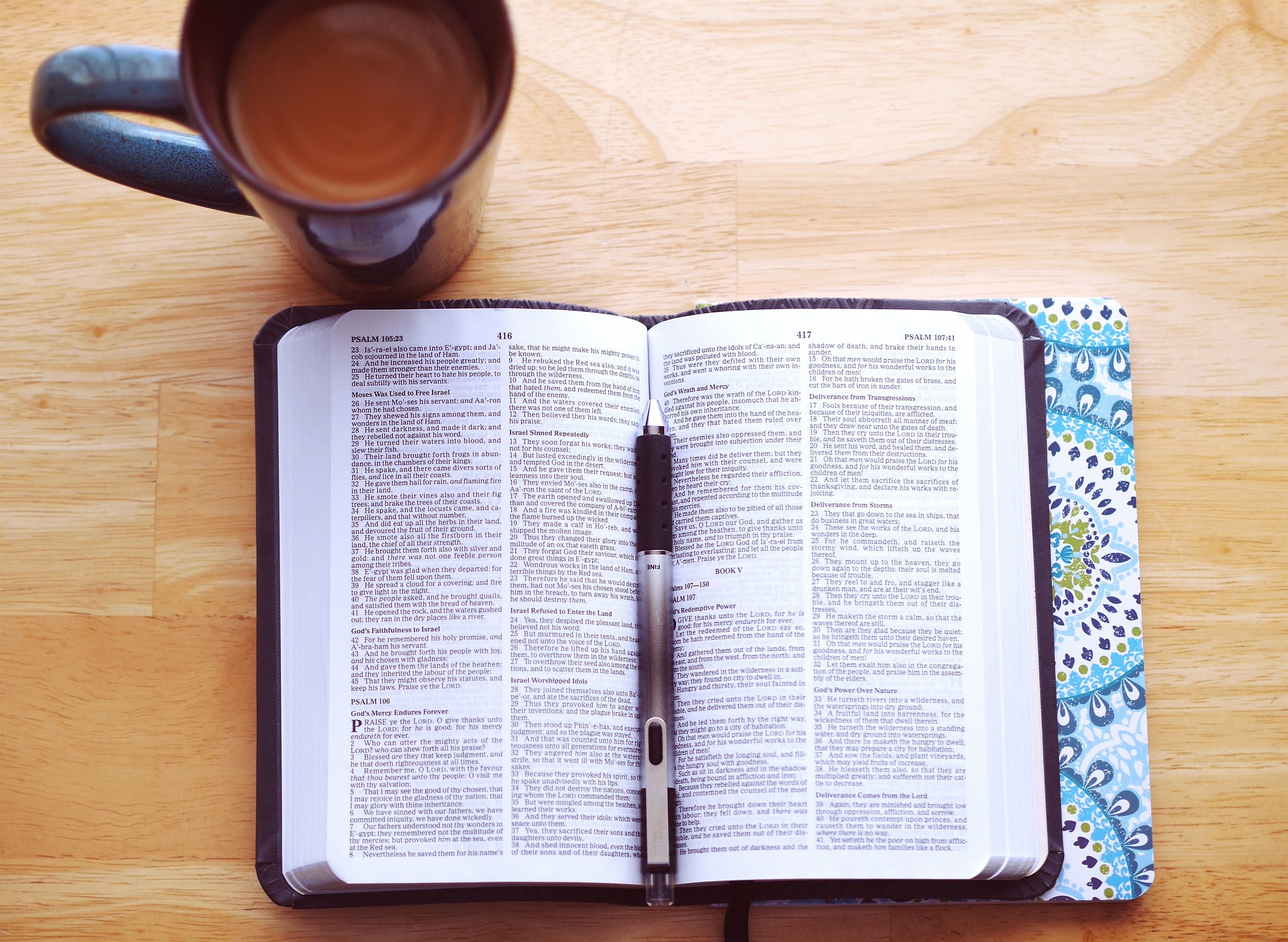
Day 123 – Psalm 106 – 107 – (Praising God despite His people’s unfaithfulness.  Thanking God for His faithfulness in His people’s sins.)
These are two wonderful psalms that I recommend you read several times today and later. They mirror our failings as believers who sin often and our merciful, loving, forgiving GOD who disciplines but never breaks His promises to us.
Psalm 106 begins by calling Israel (and us) to praise and thanksgiving, and it tells us why: because the LORD is good and because His love and mercy toward them (and us) are forever. Wow.
Over and over, the psalmist confesses their sin.
Verse 5: “Both we and our fathers have sinned; we have committed iniquity; we have done wickedness.”
Verses 14-15: “…they soon forgot His works; they did not wait for His counsel. But they had a wanton craving in the wilderness, and put God to the test in the desert.”
Verses 20-21: “They exchanged the glory of God for the image of an ox that eats grass. They forgot God their savior…”
Verses 24-25: “Then they despised the pleasant land, having no faith in His promise. They murmured in their tents, and did not obey the voice of the LORD.”
Verse 28-29: “Then they yoked themselves to the Baal of Peor, and at sacrifices offered to the dead; they provoked the LORD to anger with their deeds…”
Verses 32, 34, 37-39:  “They angered Him at the waters of Meribah…”   “They did not destroy the peoples as the LORD commanded…”   “They sacrificed their sons and their daughters to the demons; they poured out innocent blood, the blood of their sons and daughters whom they sacrificed to the idols of Canaan.”   “…they became unclean by their acts and played the whore in their deeds.”
****The details are different, but we, too, have sinned, disobeyed, and flaunted God’s loving commands.
But… over and over, the psalmist (almost in amazement) records how God forgave and saved them. Verse 8: “,…for His name’s sake, that He might make know His mighty power.”   And verses 44-45: “He looked upon their distress when He heard their cry. For their sake, he remembered His covenant, and relented according to the abundance of his steadfast love.”
“Blessed be the LORD, the God of Israel, from everlasting to everlasting! And let all the people say; “Amen!” Praise the LORD!” Verse 48
##
.
Psalm 107 begins with a call to thank the LORD and gives reasons.  “Oh give thanks to the LORD, for He is good, for His steadfast love endures forever.”  “Let the redeemed of the LORD say so, whom He has redeemed from trouble…”
Verses 4 – 32 contain four sections describing four types of people or situations. They show how God helped these people when they cried to Him and what their response should be. These sections begin with the word “some…”
Verses 4-9.  “Some wandered in desert wastes…” “…hungry and thirsty; their soul fainted within them.” 
“They cried to the LORD… and He delivered them from their distress…”
“Oh, that men would praise the LORD for His goodness and mercy to the children of man!”
“For He satisfies the longing soul and the hungry souls he fills with good things.”
Verses 10-16.  “Some sat in darkness and in the shadow of death, prisoners in affliction and in irons…” 
  “Then they cried to the LORD in their trouble, and he delivered them in their distress.”
“Oh, that men would praise the LORD for His goodness and mercy to the children of man!”
“For He shatters the doors of bronze and cuts in two the bars of iron.”
Verses 17-22.  “Some went down to the sea in ships, doing business on the great waters.”   “(He) commanded and raised the stormy wind, which lifted up the waves of the sea. They mounted UP to heaven; they went DOWN to the depths; their courage melted away in their evil plight; they REELED and STAGGERED like drunken men and were at their wits’ end.”  
“Then they cried to the LORD in their trouble, and He delivered them from their distress.”
“He made the storm be still and the waves of the sea were hushed….”   “… He brought them to their desired haven.”
“Oh, that men would praise the LORD for His goodness and mercy to the children of man!”
In verses 33-42, the psalmists list more of the LORD’s mercies and His care for His own and end with this:
“Whoever is wise, let him attend to these things; let them consider the steadfast love of the LORD.”
****Oh, may you and I do that every day of our lives, for it is only by his love and mercy that we exist!  Thanks be to our God.

#2024GOAL – Reading Through The Bible Chronologically, day 121

    Day 121—We have been reading the Bible daily for a third of the year.   What have you learned about God? About yourself?

Day 121 – 2 Samuel 5, 1 Chronicles 11-12 – (David is crowned king of all Israel. His mighty men are listed, as are some battles.)

God had said, “You shall be shepherd of my people Israel, and you shall be prince over Israel.”

Now, both Samuel and Chronicles tell how David is finally anointed King of all Israel, including three-quarters of the tribes that had followed Saul. The first thing King David does is lead a battle against the Jebusites, defeating them and claiming Zion (Jerusalem) as “The City of David,” his capital. The mighty man who led that battle was Joab, whom King David chose as the commander of his army.

Unlike Saul, King David inquired of the LORD before going to battle. He was given instructions to go or stay and once to conquer them by listening for noise in the tops of balsam trees.

The chapters in Chronicles (11-12) list King David’s leaders, his mighty men and their accomplishments, and the number of soldiers coming to him from the northern tribes and those on the east side of the Jordan River.  King David met them saying,

“If you have come to me in friendship to help me, my heart will be joined to you; but if to betray me to my adversaries, may the God of our fathers see and rebuke you.”

In answer, the chief man of his top thirty men, who was “Spirit-clothed” said,

“We are yours, O David, and with you, O son of Jesse!  Peace, peace to you, and peace to your helpers! For your God helps you,”

After that, King David received them.  And all met in Hebron to celebrate for three days eating and drinking, for those from Issachar, Zebulun, and Naphtali came bringing the food on donkeys, camels, mules, and oxen – abundant provisions of four, cakes of figs, clusters of raisins, wine, oil, oxen, and sheep.

For, there was joy in Israel.

#2024GOAL – Reading Through The Bible Chronologically, day 119 & 120

    Day 119 & 120—We have been reading the Bible daily for a third of the year.  What have you learned about God? About yourself?

(Note: SUNDAY’s and MONDAY’s readings are combined.)

1 Chronicles 7 – 10 (Genealogies of Benjamin [2] others, duties of Levites, Death of Saul & sons)

This is the last of the genealogies in 1 Chronicles. Remember they were important to the returning Jews from exile to claim their portions of land, assure the messianic line of David, and place Levites in temple management. (This book was probably written by Ezra about 500 years after the time of Saul and David when the Jews returned to the land.

Chapter 7 lists the descendants of Issachar, Benjamin, Naphtali (only one verse), Manasseh, Ephraim, and Asher.

Chapter 8 Lists the genealogy of Benjamin again, centering on King Saul.  It also foretells a possible “mini-split” in the tribe, after the time of David.

Chapter 9 summarizes why Israel was taken captive in Babylon – “because of their breach of faith.”  And since the Levites were the “first to dwell again in their possessions in their cities, they and their duties are listed again. Some of their duties were as 1) gatekeepers, keepers of the thresholds of the tent, and keepers of the entrance. (David and Samuel had established these in their duties). Others 2) had charge of the service utensils, to count them; some were appointed over the furniture; 3) some were over the flour, wine, oil, incense, and spices; 4) some prepared the mixing of spices and the baking of the showbread. There were 5) singers, free from other services, day and night.

Saul’s genealogy is also repeated; in chapter 10, the story of his death is repeated: how he was mortally wounded, his armor bearer refused to finish him off, and how he “fell on his sword.”

Verses 13-14 are his final, sad epitaph.  “So Saul died for his breach of faith.  He broke faith with the LORD in that he did not keep the command of the LORD, and also consulted a medium, seeking guidance. He did not seek guidance from the LORD. There, the LORD put him to death and turned the kingdom over to David, the son of Jesse.”

 .

Day 120 – Psalms 102 – 104 – (A psalm of complaint, and two psalms of praise)

I’m so thankful that both types of prayers/songs are listed in the Bible. I can praise and worship God, and I can also pour out my troubles and depression. He heals all of them.

Psalm 102 is a song by someone depressed and in despair about what is happening to him and his people. He begs God to hear and answer him. He feels that his enemies and God Himself are too harsh with him.

“My days pass away like smoke, and my bones burn like a furnace.”   “My days are like an evening shadow; I wither like grass.” 

But still, the writer acknowledges God’s supremacy and begs him to regard his people and act on their behalf. “But You, O LORD, are enthroned forever; you are remembered throughout all generations.”  He asks God to look down from heaven and help his people, “so that a people yet to be created may praise the LORD.”

David writes Psalm 103 and blesses the Lord in scores of ways. Many have memorized it as a way to praise God:

“Bless the LORD, O my soul, and forget not all his benefits, who forgives all your iniquity, who heals all your diseases, who redeems your life from the pit, who crowns you with steadfast love and mercy, who satisfies you with good so that your youth is renewed like the eagles.”    

The LORD is merciful and gracious, slow to anger and abounding in steadfast love. He will not always chide nor will he keep his anger forever. He does not deal with us according to our sins, nor repay us according to our iniquities.”    “For He knows our frame, he remembers that we are dust.”   “Bless the LORD, O my soul!”

Psalm 104 is 35 verses of praise to God for His glory in CREATION.

“Bless the LORD, O my soul! O Lord my God you are very great. You are clothed with splendor and majesty, covering yourself with light as with a garment, stretching out the heavens like a tent.”

“He set the earth on its foundations so that it should never be moved. You covered it with the deep as with a garment.”

“You cause the grass to grow for livestock and plants for man to cultivate that he may bring forth food from the earth and wine to gladden the heart of man, oil to make his face shine and bread to strengthen man’s heart.”

“He made the moon to mark the seasons; the sun knows its time for setting.”

“O LORS, how manifold are your works! In wisdom have you made them all; the earth is full of your creatures.”

“I will sing to the LORD as long as I live; I will sing praise to my God while I have being. May my meditation be pleasing to him, for I rejoice in the LORD.

#2024GOAL – Reading Through The Bible Chronologically, day 117

    Day 117—We have been reading the Bible daily for a third of the year.   What have you learned about God? About yourself?

Day 117 – 1 Chronicles 6 – (the genealogies of the priestly tribe of Levi)

Reading all these unusual-sounding names may be difficult and boring, but the lists were crucial to Israel. After they were exiled to Babylon for 70 years (verse 15) and returned, they needed to know where their portion of land was located. They needed to keep track of the kingly line in Judah, through which the Messiah would come. And the Levites needed to know their portion of work in the newly built temple.

The three priestly clans of Levi are listed: Kohath, Gershom, and Merari. From Numbers 4, we read about each having their work in the Tabernacle service and in the packing up and carrying of the parts of it when they “wandered in the wilderness.”

It’s interesting to see that the prophet Samuel was a Kohathite. By God’s specific choice, he was able to offer sacrifices even though he was not a descendant of Aaron. (Verses 22-28)

Also interesting are the men David chose to be in charge of “the service of song” in the house of the LORD after the Ark rested there. He chose one from each of the Levite clans: Herman, a Kohathite, Asaph, of Gershom, and Ethan of Merari. (Verses 31-48) Yesterday we read three of the songs written by Asaph. Asaph wrote twelve in all (Psalms 50, 73-80).  Herman wrote Psalm 88, and Ethan wrote Psalm 89.

#2024GOAL – Reading Through The Bible Chronologically, day 116

    Day 116—We have been reading the Bible daily for a third of the year.   What have you learned about God? About yourself?

Day 116 – Psalms 73, 77, 78. (Psalms of Asaph)

Psalm 73 – Asaph begins by acknowledging that God is truly good to Israel, to all who are pure in heart. But then he admits that in his own heart there is envy for the prosperity of the wicked. But when his heart turns to God, his attitude changes.

“Whom have I in heaven but you? And there is nothing on earth that I desire besides You.  My flesh and my heart may fail, but God is the strength of my heart and my portion forever.”

Psalm 77 – Asaph again begins writing about the day of his trouble, how he prays and weeps all night, but there is no comfort. But again his attitude changes when his thoughts turn to God.

“Then my spirit made a diligent search: Will the LORD spurn forever, and never again be favorable?  Has his steadfast love forever ceased?  Are His promises at an end for all time?”  “I will remember the deeds of the LORD; yes I will remember Your wonders of old. I will ponder all Your work and meditate on Your mighty deeds. Your way, O God, is holy. What god is great like our God?”

Psalm 78 has 72 verses and describes God’s wonderful love and care for Israel and what Israel should tell the coming generations about Him.

“I will utter puzzling sayings from of old, things that we have heard and known, that our fathers have told us. We will not hide them from their children but tell to the coming generation the glorious deeds of the LORD and His might and the wonders that He has done…. that the next generation might know them, the children yet unborn, and arise and tell them to their children, so that they should set their hope in God and not forget the works of God, but keep His commandments.”

Then, Asaph writes about the glorious (and horrible) history of God and Israel. He tells how God gloriously rescued and provided for Israel repeatedly, how Israel sinned, doubted, complained, tested, and rebelled, provoking God’s righteous judgments on them. Over and over Israel spurned the Holy God.

“Yet He, being compassionate atoned for their iniquity and did not destroy them; He restrained His anger often and did not stir up all His wrath. He remembered that they were but flesh.”

Asaph tells about God rejecting Israel during the turbulent times of the Judges when they looked to pagan idols and their enemies battled with them continuously.  And he tells of God choosing Judah and setting His presence in Zion.

“He chose David, his servant, and took him from the sheepfolds; for following the nursing ewes He brought him to shepherd Jacob His people, Israel his inheritance. With an upright heart he shepherded them and guided them with his skillful hand.

(Oh for leaders like that today!)

#2024GOAL – Reading Through The Bible Chronologically, day 115

    Day 115—We have been reading the Bible daily for a third of the year.   What have you learned about God? About yourself?

Day 115 – 1 Chronicles 3 – 5. (Genealogies in David’s line, Judah, Simeon, Reuben, Gad, and Manasseh.)

1 Chronicles 3 chronicles King David’s line until the Babylonian captivity. We see the sons and the daughter whose actions will cause David severe problems. Solomon, David’s tenth son, is mentioned as well.

1 Chronicles 4 chronicles the line of Judah, the Messianic line, and the diminishing tribe of Simeon, which is eventually swallowed up in Judah’s territory.

1 Chronicles 5 chronicles the line of Reuben, Israel’s firstborn who forfeited the birthright. The double-portion birthright then passed to the firstborn of Israel’s other wife, Rachael, Joseph. This chapter also gives the lineage of the Gadites and the 1/2 tribe of Manasseh which settled east of the Jordan River.

In both chapters 4 and 5, we see God answering prayer. In 4:9-10, Jabez “called upon the God of Israel, asking for more land, blessings, and safety for himself. And “God granted what he asked.”

In 5:18-20, the East Jordan tribes waged war against several pagan nations. Even though there were less than half the enemy’s number, when they “cried out to God in the battle, He granted their urgent plea, because they trusted Him.”

#2024GOAL – Reading Through The Bible Chronologically, day 114

    Day 114—We have been reading the Bible daily for a third of the year.   What have you learned about God? About yourself?

Day 114 – Psalms 43, 44, 45, 49, 84, 85, 87. (Psalms of David, prayers for help and praises.)

Psalm 43 – “Why are you cast down, O  my soul, and why are you in turmoil within me?  Hope in God; for I shall again praise Him, my salvation and my God!”

Psalm 44 – “You are my King, O God; ordain salvation for Jacob! Through You we push down our foes; through Your name we tread down those who rise up against us. For not in my bow do I trust, nor can my sword save me. But You have saved us from our foes and have put to shame those who hate us! In God we have boasted continually, and we will give thanks to your name forever.”

Psalm 45 – “Your throne, O God, is forever and ever, the scepter of your kingdom is a scepter of uprightness, You have loved righteousness and hated wickedness.”

Psalm 49 – “Truly no man can ransom another, or give to God the price of his life, for the ransom of their life is costly and can never suffice, that he should live on forever and never see the pit.”    “But God will ransom my soul from the power of Sheol, for he will receive me.”

Psalm 84 – “My soul longs, yes, faints for the courts of the LORD; my heart and flesh sing for joy to the living God.”    “For a day in your courts is better than a thousand elsewhere. I would rather be a doorkeeper in the house of my God than dwell in the tents of wickedness.”    “O LORD of hosts, blessed is the one who trusts in you!”

Psalm 85 – “You forgave the iniquity of your people; you covered all their sin. You withdrew all your wrath; and turned from your hot anger. Restore us again, O God of our salvation, and put away your indignation toward us!”

Psalm 87 – “On the holy mount stands the city He founded; the LORD loves the gates of Zion more than all the dwelling places of Jacob. Glorious things of you are spoken, O city of God.  Among those who know me, I mention RAHAB and BABYLON; behold, PHILISTIA and TYRE, with CUSH — ‘This one was born there,” they say. And of Zion it shall be said, ‘This one and that one were born in her;’ for the Most High himself will establish her.  The LORD records as He registers the PEOPLES, ‘This one was born there.’

#2024GOAL – Reading Through The Bible Chronologically, day 112 & 113

    Day 112 & 113—We have been reading the Bible daily for a third of the year and have begun reading the 12th book. What have you learned about God? About yourself?

(Note: SUNDAY’s and MONDAY’s readings are combined.)

Day 112 – Psalms 6, 8, 9, 10, 14, 16, 19, 21. (Psalms of David)

Psalm 6 – “O LORD, rebuke me not in your anger, nor discipline me in your wrath. Be gracious to me, O LORD, for I am languishing; heal me, O LORD, for my bones are troubled.”   “The LORD heard my plea; the LORD accepts my prayer.”

Psalm 8 – “O LORD, our Lord, how majestic is your name in all the earth! You have set your glory above the heavens.”    “When I look at your heavens, the work of your fingers, the moon and the stars, which you have set in place, what is man that you are mindful of him, and the son of man that You care for him?”

Psalm 9 – I will give thanks to the LORD with my whole heart; I will recount all of your wonderful deeds. I will be glad and exult to you; I will sing praise to your name, O Most High.”    “The LORD is a stronghold for the oppressed, a stronghold in times of trouble. And those who know your name put their trust in you, for you, O LORD, have not forsaken those who seek you.”

Psalm 10 – “Why O LORD, do you stand far away? Why do you hide yourself in times of trouble?”    “Arise, O LORD; O God, lift up your hand; forget not the afflicted.”

Psalm 14  “Why O LORD, do you stand far away? Why do you hide yourself in times of trouble?”    “In the pride of his face the wicked does not seek Him; all his thoughts are, ‘There is no God.'”    “Arise, O LORD; O God, lift up your hand; forget not the afflicted.”

Psalm 16 – “I say to the LORD, ‘You are my Lord; I have no good apart from you.'”    “I bless the LORD who gives me counsel; in the night also my heart instructs me.”    “I have set the LORD always before me; because he is at my right hand, I shall not be shaken. Therefore my heart is glad, and my whole being rejoices; my flesh also dwells secure.”    “You make know to me the path of life; in your presence there is fulness of joy; at your right hand are pleasures for evermore.”

Psalm 19 – “The heavens declare the glory of God, and the sky above proclaims his handiwork.”    “The law of the Lord is Perfect, reviving the soul; the testimony of the LORD is sure, making wise the simple; the precepts of the LORD are right, rejoicing the heart; the commandment of the LORD is pure, enlightening the eyes, the fear of the LORD is clean, enduring forever; the rules of the LORD are pure and righteous altogether.  MORE to be desired are they than gold, even much fine gold; sweeter also than honey and drippings of the honeycomb.”     “Let the words of my mouth and the meditation of my heart be acceptable in your sight, O LORD, my rock and my redeemer.”

Psalm 2 – “O LORD, in your strength the king rejoices, and in your salvation how greatly he exults!  You have given him his heart’s desire and have not withheld the request of his lips.”    “Be exalted, O LORD, in your strength! We will sing and praise your power.

Day 113 – 1 Chronicles 1-2 (Genealogies in the kingly line & others)

1 Chronicles 1 tells the genealogy of the Jewish people (with sidelines included) from Adam to Abraham’s grandson, Jacob/Israel.

1 Chronicles 2 gives the genealogy of Israel’s twelve sons (tribes) to David who would become king, along with a lists of his relatives., who would become king, along with a list