Archives

Reading the Gospels in 2026: (1/9) Mark 3:1-12

A 5-day per week study.

January 9 – Reading Mark 3:1-12.

Read and believe in Jesus.

“Is it lawful on the Sabbath to do good or to do harm, to save a life or to KILL?”  Mark 3:3b 


The Gospel according to Mark 3:1-12

In today’s study, we saw the religious leaders again carefully watching Jesus. They had grumbled at and questioned His teaching, but it was the miracle healings He did on the Sabbath that really stirred up their ire.

Healing or helping someone in need (even an animal) on the Sabbath was not against the Mosaic Law. But it offended the rules (all 39 of them), the rabbis had invented to “protect” what God had said!  (As if!)


Vss 1-2.

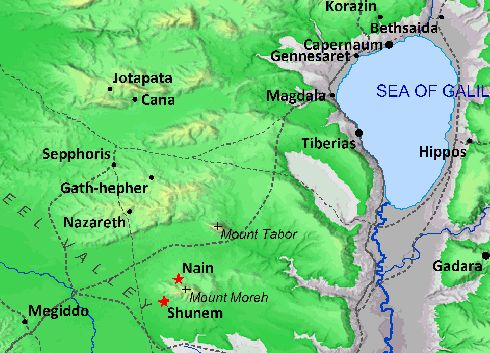
We see Jesus back in the synagogue on the Sabbath, where any good Jewish man would be.  It was probably the same synagogue in Capernaum where Jesus had released the demon-possessed man in chapter one. That miracle had caught the religious leaders off guard, but now they were “watching Jesus” to see if they could “accuse Him.” 

(I wouldn’t put it past them to have arranged the crippled fellow to be there that day.)

.

Vss 3-6.

Jesus saw the man as soon as He entered, and beckoned him to come near. I can see Jesus laying his arm across the man’s shoulders, assuring him. Then Jesus turned to the “super-sanctified” Pharisees and said, “Is it lawful on the Sabbath to do good or to do harm, to save a life or … to KILL?” 

They were silent.

Jesus looked into the eyes of each man, angry and grieved at their hardness of heart. Angry at their lack of compassion, and grieved at how they treated the Word of God.  Then he turned to the man, his face now showing kindness.

Stretch out your hand.”  

The man obeyed, and his hand was instantly restored.  Can you imagine his joy? What had for some time kept him from uselessness was now healed!  The pain was gone. He could support his family again.

What happened next?  It was really scary. 

The Pharisees went out immediately and held counsel with the Herodians (!!) against Jesus, on how to kill Him.  KILL Jesus!  The Man who brought hope and healing to many … but also correction and even embarrassment to these teachers of the Law. 

.

NOTE: The Herodians were a Jewish political party named after Herod Antipas (who ruled Galilee). The Herodians strongly supported Rome (and Herod’s rule) and opposed the Pharisees on nearly every issue.  But they were willing to join forces with them now, because they also wanted to destroy Jesus. (For more insight on this sect, see Matthew 22:15-22 and Luke 13:31-32.)

.

Vss 7-8.

Regardless of what the Pharisees thought of Jesus, ordinary people came to Him en masse for healing and to hear Him teach. The crowds from all the surrounding areas grew so large that Jesus could no longer stand along the beach or docks to teach.  He asked His fishermen-disciples to have a boat ready, so he could escape the “crush” if needed. 

Jesus healed all those with various diseases and those possessed by demons, and yet more and more needy folk came and tried to touch Him. The unclean spirits KNEW Jesus was the Son of God, and voiced this, but Jesus always told them to “SHUT UP!”  He did not want the testimony of an imp from Hell. 


These crowds, or mobs, seem wild to us, but imagine you had a horrible affliction or disfigurement, or that you were in pain or totally shunned, like the lepers.  Imagine being both mentally and physically tormented day and night by unclean spirits.  You would do anything to touch Jesus and be healed. 

I know I would!

But these diseases only “pictured” the sad spiritual state of mankind.  Jesus had come, ultimately, to heal them from their SIN.


Reading the Gospels in 2026: (1/7) Mark 2:13-17

A 5-day per week study.

January 7 – Reading Mark 2:13-17.

Read and believe in Jesus.

“I came not to call the righteous, but sinners”  Mark 2:17b


The Gospel According to Mark 2:13-17

Vss. 13-14.

Jesus is again beside the Sea of Galilee (it was near Peter’s home).  The crowd was coming to him, and He was teaching them. (Standing by the water and speaking up the sloping land made for great acoustics. Many people were able to hear Jesus’ voice clearly.) 

Then, Jesus continued along a certain path, but this time He wasn’t looking at the boats.  He knew where He was going and who He would find there. And as he’d specifically called the two sets of fishing brothers to Himself, Jesus now spoke to a Tax Collector sitting at his tax booth.  

Follow me,” Jesus said, looking into the man’s eyes.  (I almost expected Him to say, “…and I will make you a ‘Collector of Men’,” but of course He didn’t say that.)  The tax collector, Levi, got up, left his coveted Roman franchise booth, where he’d become a rich man at the expense of his fellow Jews, and followed Jesus.  

Don’t you wonder what Peter, Andrew, James, and John were thinking?  Levi had probably extorted money from their family’s fishing businesses many times. And Jesus was calling… him?  How did the richly ornate robe of the Publican blend with the simple attire of local fishermen?  

(I’m so glad that Jesus calls all types of people to follow Him.)

Like with the fishermen, I believe Levi had heard Jesus speak before as He made his way along the shore of Galilee.  Perhaps he’d witnessed miraculous healings too, as he watched from inside his booth.  Whatever he’d seen and heard, Levi’s heart was now toward Jesus.  The instant the Master called, Levi was out of the booth – leaving the quills, ledgers, and piles of coins behind – and walking with Jesus.

(By the way, this man’s other name was Matthew.  And this careful calculator wrote the wonderful Gospel by his name, specifically to the Jews about their Messiah.)

.

Vss. 15-17.

Peter had invited Jesus to headquarter in his home. Now, Levi asked Jesus (and disciples) to a feast at his house. He also invited a bunch of other tax collectors (and “sinners”) that he knew. 

(Another tax collector – Zacchaeus – did the same thing in Luke 19.  This is SO like what happens to a person who has truly been converted. They want to share “the good news” with others. They want friends and family to know Jesus, too.)

Jesus, of course, accepted the invitation. He is comfortable with anyone who truly seeks Him.  Did other “sinners” there believe in Him and follow His way too?  

Outside, the Scribes (probably the same ones who’d observed the paralytic man being healed) had sour faces.  “Why does He eat with tax collectors and sinners?”  (THEY would never do that!)

Jesus heard what they said as He left Levi’s house.  He looked these self-righteous men in the eyes and said, “Those who are well have no need of a physician, but those who are sick do. I came not to call the righteous, but sinners.” 

Did they understand what Jesus meant?  What DID Jesus mean? 

.

Did He truly see these Jewish rulers as “righteous,” not needing forgiveness and salvation?  Absolutely not.  Psalm 14:2-3 says, “None is righteous (good), no, not one.”  Jesus was speaking about the “self-righteous” who “think” they don’t need a savior.

Later, in Luke 18, we will see that Jesus tells a parable about a Pharisee and a Tax Collector. Was He thinking of Levi and these men?   He told this story “to some who trusted in themselves that they were righteous and treated others with contempt.”

In the story, the Pharisee stood and bragged of all his good works and accomplishments, and how he had never done such sinful things as the extortioners, adulterers, the unjust, or even… the tax collector…

The Tax Collector, on the other hand, could say nothing but, “God, be merciful to me a sinner.”  (Were those Levi’s words that Jesus quoted?)   Jesus told his audience that the Tax Collector went to his house JUSTIFIED, while the braggadocio Pharisee did not.

.

Here, in Capernaum, the Jewish leaders were just beginning to spar with Jesus.  It would get worse. Would any of them recognize their lack of true righteousness before it was too late?


Reading the Gospels in 2026: (1/6) Mark 2:1-12

A 5-day per week study.

January 6 – Reading Mark 2:1-12.

Read and believe in Jesus.

“When Jesus saw their faith, He said to the paralytic, “Son, your sins are forgiven.”  Mark 2:5


The Gospel According to Mark 2:1-12.

Vss 1-2.

Jesus, and a few disciples, had been away preaching and casting out demons throughout all Galilee for several weeks or months. Then, after the glorious healing of the leper, Jesus had gone into seclusion for a bit because of the crowds thronged Him. 

Now, He had returned to Capernaum, to Peter’s house, and after a few days … it was reported that He was back.  Immediately many came to hear and be healed. They pushed into Peter’s house till it was packed like sardines, and they crowded around the door to try and hear Him. 

In that crowd, were some Scribes who had mananged to come inside. They were “sitting” and watching Jesus with hawk eyes.  And Jesus preached “the word.”  (The Gospel of grace, faith, and forgiveness.)

.

Vss 3-5.

In Capernaum, there lived a man who was paralyzed in his legs. We aren’t told if this was an injury or a birth defect.  But this man was very fortunate. He had four friends, perhaps former co-workers, who cared about him deeply. They heard that Jesus, the miracle-healer, was back in town.  They got a stretcher for their friend and jogged (double-time) to Peter’s house. 

But before they got close enough to even hear Jesus speaking inside, they saw the crowds straining and pushing around the door. 

Perhaps they stopped, took in the situation, speaking among themselves. What to do?  Should they wait outside till Jesus came out?  Did the paralytic tell them to just take him home, that maybe later….

But no!  One had spied the steps leading to the roof of Peter’s house. (It was a flat place where the family could sit or sleep when it got too hot inside.)  The friends nodded. They went around the house and carefully carried their friend up the steps.  Once there, they began removing the roofing material, surely laying it aside neatly so they could later repair it.

Inside, Jesus was aware of their efforts.  Soon everyone was, as an opening appeared in the ceiling. Gasps? Dismay? Outrage? 

But Jesus saw something else.  He saw THEIR FAITH.  And as they let down the paralyzed man, Jesus said to him, “Son, your sins are forgiven.” 

(Was there joy on the man’s face?  Was THIS his main problem, the one that haunted him even more than his useless legs? What joy he must have felt!

.

Vss 6-9.

Ah, but those Jewish scribes.  What were they thinking?  You could tell by their faces they weren’t happy. 

One was thinking, “Why does this man speak like this?

The second one, “He is blaspheming!”

The third one, “Who can forgive sins but GOD alone??”

Just like Jesus could see into the paralytic’s heart, he saw the darkness in these men’s hearts.

Why do you question these things in your hearts? Which is easier to say to the paralytic, ‘Your sins are forgiven,’ or to say, ‘Rise, take up your bed and walk?’  But, that you man KNOW that the Son of Man has authority on earth to forgive sins…Jesus turned to the paralyzed man and said, I say to you, rise, pick up your bed, and go home.”

The man, whose sins were forgiven, rose and immediately, picked up his bed, and went out before them all.  The parting crowd was amazed and they glorified God.  They said, “We never saw anything like this!’


(And of course, the friends of the man ran down the steps two at at time. The embraced him and joined in glorifying God. 

Yes, I think later they returned and repaired the roof.)

###

.

(Back to the question Jesus asked the Scribes.  “Which is easier TO SAY?”  This is different from, “Which is easier TO DO?”  Anyone could say anything, but did that make it true?   Jesus had backed up His words with actions. The Scribes didn’t believe their EARS, but they had to believe their EYES.

The paralyzed man of course believed his ears at both things Jesus said. And so did his friends.  He was forgiven.  He was healed.   And he had acted on both. He got up and went home, a forgiven man.

Oh, Lord! for FAITH to believe ALL You say to us in Your Word! Like You said to Thomas, ‘Blessed are those who don’t see and yet believe!’)                                       


Reading the Gospels in 2026: (1/5) Mark 1:29-45

A 5-day per week study.

January 5 – Reading Mark 1:29-45.

Read and believe in Jesus.

Let us go on to the next towns, that I may preach there also, for that is why I came out.” Mark 1:38


The Gospel According to Mark 

Vss. 29-31. 

In the last reading/study I wondered if Peter & Andrew and James & John had gone into the synagogue with Jesus, heard his teaching and witnessed the casting out of demons from the man.  Well, here, it seems that the four new “fishers of men” disciples had indeed been there, for after the service, they “left the synagogue and entered the house of Simon and Andrew.”

(Hmmm, brother Andrew lives there too?)

Peter’s mother-in-law (probably a widow) lived with them, and when they came in from the Sabbath Day’s service, they found her in bed and sicker than they left her. (Luke’s gospel [4:38] said it was a “high” fever, maybe life-threatening, and Luke WAS a doctor after all). 

Peter and/or his wife immediately told Jesus about her, and Jesus went to her bedside.  He took her by the hand and lifted her up. At the sight and touch of Jesus, the fever fled, and she was restored to health…so much so that she began to serve them. (A cold Sabbath meal, perhaps?)

.

Vss. 32-34. 

Later, after sundown when the Sabbath was over and the people were released from the prohibition of “carrying” anything, they began to bring to the door of Peter’s house, ALL who were sick of various deseases and conditions or were demon-possessed.

Jesus went outside and began healing them (as He had Peter’s mother-in-law).  He met the needs of the people of Capernaum long into the night.

.

Vs. 35. 

Very early in the morning, Jesus got up, dressed and left Peter’s home.  In the cool, quiet morning, he walked to a desolate place. There he prayed to His heavenly father. 

In this time of communion with God, Jesus was strengthened, assured, and directed to His next tasks.  He felt joy, and again yielded himself to all God’s plans for Him.

(I imagined that part, but isn’t it what WE feel when we take time, early in the morning, to pray, worship, read the Bible, and commit ourselves anew to the Lord?)

.

Vss. 36-38. 

When everyone in the house got up, they found Jesus missing. (Was there a bit of fear in their heart? Where was He? Had he deserted them?)   The four “fishers of men” searched everywhere for Him, and evenually found him in that lonely place.

Everyone is looking for you!” said Simon.  (Did that mean only those in Peter’s home, or were the needy again lining up at his door, looking for the great Healer?)

Jesus had compassion on the sick and demon possessed.  But sin was at the core of this suffering.  He had come to deal with sin, and He wanted to get to preaching and teaching about his mission, and turning HEARTS to Himself. 

Let us go on to the next towns, that I may preach there also, for that is why I came out,” He said. 

.

Vss. 39.   

So that is what He did.  And the four men followed Him.  (Did they go back to pack a lunch and get a cloak?  Did Jesus first heal those who had come in the morning?  We don’t know.

But we DO know that from there and at that time, “Jesus went throughout all Galilee, PREACHING in their synagogues and casting out demos.”  (This is but a short verse, but the time frame was probably weeks or even months.) 

.

Vss. 40-45.  

Mark records one incident that happened during this time of travel.   It was an astounding healing showing Jesus’s heart and pity for the lost and sick.  It also shows the problem they faced when Jesus did such miraculous healings. 

A leperous man aprroached Jesus.

(Since leprosy was contageous, lepers were required by the Law to stay 50 paces away from other people and constantly call out “unclean, unclean” to warn them.)

But this man, came close to Jesus, kneeling right infront of Him and begging.  “If You will, you can make me clean.”  The man did not doubt Jesus ability, only His willingness to do it.  

Jesus was “moved with pity.”  He reached out and ….. touched the Leper.  He TOUCHED the diseased man!!  And instead of the vile disease passing to Jesus, clean wholeness passed to the leper.  “I will, Jesus said. Be clean.

And immediately the leprosy left him.

Now listen,” Jesus warned him sternly. “See that you say nothing to anyone. Go show yourself to the priest, then give the offerings Moses commanded as “proof” of your cleansing.” (See Leviticus 14:1-32)

But, and who can actually fault him, the joyous man began proclaiming far and wide the miracle of cleansing Jesus had done for him.  “I’m clean!  Look at me!  Jesus cleansed me!  Clean!  No more leprosy!  I’m cleannnnnn…..”

And the lepers massed to Jesus, their desperate eyes full of hope. 

No more could He teach or preach in the towns for the lepers and sick crowded and called for healing and pleaded for mercy and tried to touch Him.  (Sigh.)  And so Jesus was forced to go out into desolate places until the excitement died down.  

But some good came of it. It was “alone” time with those few disciples.  And there were sweet times of prayer to His Father. (See Luke 5:16)

.

(NOTE: This section reminded me of the stress – body and spirit – that our own ministers and pastors experience in serving and teaching us. There are lots of expectations, needy people, “things to do.”   They can get rung out, desperate for that alone time with God.  Do we allow and foster that for them?  And do we pray for them?  Let’s do that his week.)


Reading the Gospels in 2026: (1/2) Mark 1:16-28

A 5-day per week study.

January 2 – Reading Mark 1:16-28.

Read and believe in Jesus.

And Jesus said to them, “Follow me, and I will make you become fishers of men.”  Mark 1:17

.

The Gospel According to Mark.

Verses 16-20.  As Jesus walked along the shoreline of the Sea of Galilee, He saw four fishermen.  Two were casting a net into the sea and two were in their boat mending nets.  Nets need mending before they can be thrown out to catch fish. 

Jesus said, “Follow me, and I will make you become fishers of men.”  Jesus was going to teach these four fishers of fish how to mend and cast out the kind of nets that would bring in a harvest of men (and women) for the Kingdom of God.  It would take three years of training, but these four (two sets of brothers) were willing.  They “immediately” left both their nets and their “boss” (father) and fellow workers to follow Jesus.

Now this wasn’t an out-of-thin-air call to follow a stranger.  John, one of Zebedee’s sons, had been with John the Baptist when he’d pointed to Jesus and said, “Behold, the Lamb of God, that takes away the sin of the world.”  Simon’s brother, Andrew, had also heard the announcement. These two had followed the Baptist’s pointing finger.  They walked after Jesus, and when the Savior turned and asked who they were seeking, they responded, “Teacher, where are you staying?” 

Come and you will see,” Jesus had said mysteriously.  So they went, saw where, and stayed with Jesus the whole day. Andrew and John knew who was asking them to follow Him.

So did Peter.  When Andrew realized the treasure he and John had found, he ran to Peter, shouting, “We have found the Messiah!” and brought him to Jesus.

So, you are Simon, bar Jonah,” Jesus had said to the big fisherman.  “You shall be called Cephas (or Peter).”

.

Verses 21-22.  And they went to Capernaum….  This was Peter’s hometown.  He had a house (and a wife and mother-in-law) living with him.  It must have been a good sized house because Jesus made it His headquarters while in Galilee.

There was also a prominant synagogue in Capernaum. 

“Immediately” on the Sabbath, Jesus entered it and began teaching.  (Any Jewish man who could read the Scriptures was allowed to read and “give a word” from them. He would stand to read, then sit to teach.)

Jesus, well, He not only knew the Scriptures, He had basically (via His Holy Spirit) authored the entire Old Testament. He knew what was “meant” by them, and did not have to quote other famous Rabbi’s to prove His point like the scribes did.  He taught with “authority.”  His listeners were astonished at his teaching. 

.

(Remember when Jesus was twelve and had stayed behind in Jerusalem after the Passover celebration? (Luke 2:41-51)  His earthly parents were worried about Him, thinking He was “lost.” When they found him, they scolded Him, but Jesus told them, “Didn’t you know that I must be in my Father’s house?”  

And what had the boy Jesus be doing?  He was in the temple, sitting AMONG the teachers (Pharisees), listening to them and asking them (profound) questions. “All who heard Him were amazed at His understanding and answers.”)

.

Verses 23-28.  “Immediately” (after Jesus’ authoritative teaching) a demon-possessed man in the synagogue cried out, “What have You to do with us, Jesus of Nazareth?  Have You come to destroy us?  I know who You are – the Holy One of God.”

It was like the man had been sitting there quietly before this. Perhaps no one knew that he was demon possessed.  But in the presence of “the Holy One of God” the demons inside him could not be restrained.

What a shock that must have been to the other people in the synagogue!  Eyes stared. Jaws dropped!

Be silent, and come out of him,” Jesus commanded.

The unclean spirit, convulsing the man and crying out with a loud voice, came out of him.

Wide eyed and aghast, the congregants sat amazed.  Then they turned and whispered among themselves, questioning just WHO this Jesus was?  A new teaching with authority!  He commands and unclean spirits obey Him!!

And at once Jesus’ fame spread everywhere in the surrounding region of Galilee. 

.

Were the four fishermen who “followed Jesus” there when this happened? The Bible doesn’t specifically say. They had followed Jesus on a “work day,” and this was the Sabbath.  Would they normally have attended this synagogue?  Perhaps. 

Peter must have heard about, or actually witnessed this, and later told it to Mark.


Journaling through the Bible Chronologically in 2025, Day 344

Day 344 – Reading – Romans 11 – 13
Read and believe in Jesus!

Romans 11.

Paul continues  his thoughts on his own people, Israel, being saved.

“Has God rejected His People?  By no means!  I myself am an Israelite, a descendant of Abraham, a member of the tribe of Benjamin. God has NOT rejected His people whom He foreknew. At the present time there is a remnant, choses by grace.”

Then Paul says the most amazing thing.  Yes, Israel stumbled, but they have not fallen.  Rather, because of there trespass, salvation has come to the Gentiles.  And if their trespass means riches for the world, and if their failure means riches for the Gentiles … how much more will their full inclusion mean!

Paul says he emphasizes his calling to minister to the Gentiles, in order to make the Jews jealous and perhaps save some of them.  For if their rejection means the reconciliation of the world … what will their acceptance mean but life from the dead!

He tells Gentiles not to be arrogant of their place in salvation. They were grafted into the TRUE vine of Israel.  If THEY were, surely Israel can also be re-grafted in.  (Don’t be proud!)

A partial hardening has come upon Israel, until the fullness of the Gentiles has come in.  And in this way all Israel will be saved.”

Right now, Paul says, “they are enemies of God for YOUR sake.  But as regards election,  they are beloved for the sake of their forefathers.  For the gifts and the “calling” of God are irrevocable.”

Then Paul bursts into a doxology!

“Oh, the depth of the riches and wisdom and knowledge of God!  How unsearchable are His judgments and how inscrutable His ways!  For from Him and through Him and to Him are all things.  To Him be the glory forever!”

.

Romans 12.

And in response to his final words of doxology (To Him be the glory forever!), Paul urges his Roman readers to:

  • Present your bodies as a living sacrifice, holy and acceptable to God, which is your spiritual worship.
  • Don’t be confirmed to this world.
  • Be transformed by the renewal of your mind.
  • And by testing, discern what is the will of God, what is good and acceptable and perfect.

And also, “Don’t think of yourself more highly than you ought. Think with sober judgment, each according to the measure of faith that God has assigned.  And he lists the gifts God has given the church for their building up.

  • “Prophecy
  • Service
  • Teaching,
  • Exhortation,
  • Generous Contributing
  • Zealous Leadership
  • Cheerfully performing acts of Mercy

Besides the Holy Spirit-given gifts, Paul lists other marks of TRUE Christianity

  • Let your love be genuine.
  • Hate what is evil
  • Hold fast to what is good.
  • Love one another with brotherly affection.
  • Outdo one another in showing honor.
  • Don’t be slothful, but zealous.
  • Serve the Lord.
  • Rejoice in hope.
  • Be patient in tribulation.
  • Be constant in prayer.
  • Contribute to the needs of the saints.
  • Seek to show hospitality.
  • Bless those who persecute you (bless, and don’t curse!)
  • Rejoice with those who rejoice (and weep with those who weep).
  • Live in harmony with one another.
  • Don’t be haughty, (associate with the lowly).
  • Never be wise in your ow sight.
  • Repay no one evil for evil (do what is honorable).
  • If possible, as much as it depends on you, live peaceably with all.
  • Never avenge yourselves (leave that to God).
  • Do not be overcome by evil, (overcome evil with good).


This list is pretty inclusive, but remember, doing these things (or abstaining from some) does NOT buy your salvation!  NOT BY WORKS OF RIGHTEOUSNESS THAT WE HAVE DONE, but by God’s grace are we saved.

.

Romans 13.

Paul continues his list of good Christian lifestyle, pertaining to authorities.

  • Be subject to the governing authorities. (and he gives reason why to do so is wise).
  • Pay to all what is owed to them: taxes to whom taxes are owed, revenue to whom revenue is owed, respect to whom respect is owed, and honor to whom honor is owed.
  • Owe no one anything (except to love each other).  Love does no wrong to a neighbor; therefore love is the fulfilling of the law.

.

REMEMBER:  Salvation is nearer to us now than when we first believed.  The night is far gone and the day is at hand.  Let us walk properly as in the daytime. Put on the Lord Jesus Christ, and make no provision for the flesh to gratify its desires.

Journaling through the Bible Chronologically in 2025, Day 343

Day 343 – Reading – Romans 8 – 10

Read and believe in Jesus!

Romans 8-10 is a tough section of scripture for us mortals to understand. Paul does a good job, but we need the Holy Spirit’s help more than ever.

Chapter 8 begins with a heart-swelling statement.

  • “There is therefore now no condemnation for those who are IN Christ Jesus. For the law of the Spirit of life has set you free IN Christ Jesus from the Law of sin and death. (Praise God!)

Here’s how God did it.  It’s the Gospel.

  • “By sending His own Son in the likeness of sinful flesh and for sin, He condemned sin in the flesh, in order that the righteous requirement of the law might be fulfilled in us,”

Then he puts forth some serious considerations.

  • “Those who are in the flesh cannot please God. You, however, are not in the flesh but in the Spirit IF in fact the Spirit of God dwells in you. (Anyone who does not have the Spirit of God does not belong to Him.)
  • “But if the Spirit of Him who raised Jesus from the dead dwells in you, He who raised Christ Jesus from the dead will also give life to your mortal bodies through the Spirit who dwells in you.”
  • “IF you live according to the flesh you will die, but IF by the Spirit you put to death the deeds of the body, you will live.
  • “For all who are led by the Spirit of God are sons of God.
  • “The Spirit Himself bears witness with our spirit that we are children of God, and if children, then heirs … provided we suffer with Him in order that we may also be glorified with Him.”

And not only does the Holy Spirit of God witness that we are God’s children, He also intercedes for us when we attempt to pray.  And He intercedes according to God’s will.

Then Paul lists the order of our salvation, which is ALL God’s doing. This is hard to understand, and often hard to WANT to understand.

  • “For those whom He FORENEW, He also PREDESTINED to be conformed to the image of His Son.  And those whom He predestined He also CALLED, and those He called He also JUSTIFIED, and those whom He justified He also GLORIFIED.”  

Then Paul asks these questions, “If God is for us, who can be against us?  Who shall bring any charge against God’s ELECT?  Who is to condemn?  Who shall separate us from the love of Christ? 

And he answers them. “I am sure that neither death nor life, nor angels nor rulers, nor things present nor things to come, nor powers, nor height nor depth, nor anything else in all creation, will be able to separate us from the love of God in Christ Jesus our Lord.

.

Romans 9.

Here, Paul bares his heart and soul about his fellow countrymen, the Jews.  He grieves for them for their hardness of heart and rejection of Jesus.  He says they have had and still do have so many privileges, like the adoption, the glory, the covenants, the law, the worship, the promise of the Messiah.  They have the patriarchs, and from their own race, they have the CHRIST.

Paul knows that not all Jews belong to “Israel.” Not all the offspring of Abraham are his “children.”  God elects only SOME of them.  It depends NOT on human will or exertion, BUT ON GOD, who has mercy (on whomever He wills, and hardens whomever He wills).

Okay. Say it.  That doesn’t seem fair.

Aha!  It’s as if Paul has heard your response.

Who are you, O man, to answer back to God? Will what is molded say to its molder, ‘Why have you made me like this?’  Has the potter no right over the clay to make… (what He wants, vessels of wrath and vessels of mercy, both of which will be for His glory)?  

.

Romans 10.

Paul – whom God has sent to bring the Gentiles into His kingdom – has a heart aching for his own people too… another reason why he takes the message to the Jews first in any new town he visits.

My heart’s desire and prayer to God for them is that they may be saved!”

He says they (like so many today) have a ZEAL for God, and they are seeking RIGHTEOUSNESS.  But NOT the way God demands – by faith.  They strive by their own effort, their own strength, and do not seek or submit to God’s Way. Pride is the culprit.

God says that the “righteous shall LIVE by faith.”

  • The word (of faith) is near you, in your mouth and in your heart; because if you confess with your mouth that Jesus is Lord and believe in your heart that God raised Him from the dead, you will be saved.”
  • For with the heart one believes and is justified, and with the mouth one confesses and is saved.  EVERYONE (Jew or Gentile) who calls on the name of the Lord will be saved.”

Then he asks these progressive questions that put an urgency on us today to go and preach the gospel.

  • How will they call on Him in whom they have not believed?
  • How are they to believe in Him of whom they have never heard?
  • How are they to hear without someone preaching?
  • How are they to preach unless they are sent?

(How beautiful are the feet of those who preach the good news!)

And then Paul adds his sad conclusions:

  1. But they have not all obeyed the gospel.
  2. “But of Israel, Isaiah says, ‘All day long I have held out my hands to a disobedient and contrary people.”

.

Chapter 11 will go on with this thought, speaking of a REMNANT of ISRAEL. 


Journaling through the Bible Chronologically in 2025, Day 339

The LAST Month of 2025’s Reading!

Day 339 – Reading – 2 Corinthians 5 – 9

Read and believe in Jesus!

 2 Corinthians 5.

Paul continues to exhort the church at Corinth on the importance of the Gospel, despite the accusations of the false apostles. Paul is not eloquent or glamorous but lowly and common. He had the “treasure” (Gospel) of God in “a clay jar.” It was God’s surpassing power that enabled him.  They were to keep in view the “things that were unseen,” the eternal weight of glory awaiting them.

Our Heavenly Dwelling

Paul, so familiar with tents because of his “day job,” compares this earthly body to a tent that will eventually be destroyed, as opposed to the “building” from God, a “house” not made with hands, eternal in heaven.  Alive in this body, we walk by faith, not sight.  But one day we will be “at home with the Lord.”

The Ministry of Reconciliation

Either way, Paul says our aim should be to “please Him” and persuade others.

  • For the love of Christ controls us, because we have concluded this: that one has died for all, that those who live might no longer live for themselves but for Him, who for their sake died and was raised.
  • “Therefore, if anyone is in Christ, he is a new creation. The old has passed away; behold, the new has come.  All this is from God, who through Christ, reconciled us to Himself and gave us the ministry of reconciliation. We are ambassadors for Christ, God making His appeal through us.
  • Be reconciled to God. For our sake, He made Him to be sin who knew no sin, so that in Him we might become the righteousness of God.”

Paul continues in the urgency of the message.

Behold, NOW is the favorable time; behold, NOW is the day of salvation.”

Either way, Paul says our aim should be to “please Him” and persuade others.

  • For the love of Christ controls us, because we have concluded this: that one has died for all, that those who live might no longer live for themselves but for Him, who for their sake died and was raised.
  • “Therefore, if anyone is in Christ, he is a new creation. The old has passed away; behold, the new has come.  All this is from God, who through Christ, reconciled us to Himself and gave us the ministry of reconciliation. We are ambassadors for Christ, God making His appeal through us.
  • Be reconciled to God. For our sake, He made Him to be sin who knew no sin, so that in Him we might become the righteousness of God.”

.

2 Corinthians 6.

No Fault in Our Ministry

Then Paul provides a list of experiences he’s endured that might “prove” or “confirm” the validity of his character as a true apostle.

  • Great endurance in afflictions, hardships, calamities, 
  • Beatings, imprisonments, riots,
  • Labors, sleepless nights, hunger,
  • By purity, knowledge, patience, kindness, the Holy Spirit, genuine love,
  • By truthful speech, and the power of God,
  • With the weapons of righteousness for the right hand and the left,
  • Through honor and dishonor,
  • Through slander and praise.
  • We are treated as impostors, and yet are true;
  • As unknown, and yet well known;
  • As dying and behold, we live;
  • As punished, and yet not killed;
  • As sorrowful, yet always rejoicing,
  • As poor, yet making many rich,
  • As having nothing, yet possessing everything.

He spoke very freely to the Corinthians, “Our heart is wide open, widen your hearts also.”

.

The Temple of the Living God

  •  “Do not be unequally yoked with unbelievers!
  • What partnership has righteousness with lawlessness?
  • What fellowship has light with darkness?
  • What accord has Christ with Belial (Satan)?
  • What portion does a believer share with an unbeliever?
  • What agreement has the temple of God with idols?
  • FOR WE ARE THE TEMPLE OF THE LIVING GOD.

“And since we have these promises, let us cleanse ourselves from every defilement of body and spirit, bringing holiness to completion in the fear of God.”

.

2 Corinthians 7

Paul’s Joy

Paul loves those rascals!  “Make room in your hearts for us.  We have wronged no one.”  “I have great pride in you; I am filled with comfort. In all our affliction, I am overflowing with joy.”

Then he tells them about the anxiety he had for them after his harsh letter.  How he yearned for news back from Titus.  How could he not stay in Troas, but sailed to Macedonia.  And then Titus came with news of their mourning, and their zeal for him, and he rejoiced. Their grief was a godly grief that led to repentance and salvation without regret.  

.

2 Corinthians 8.

Encouragement to Give Generously

Now on to practical things.  He reminds them of the offering they are to lay aside each week for the needy in Jerusalem and tells them of the good work the Macedonians have done. “In their affliction and extreme poverty, they gave according to their means, and BEYOND their means, begging Paul for a part in the relief of the saints.

So now, it was the Corinthians’ turn.  He urges them to complete the offering they began a year ago, so it would be ready when he came.

For you know the grace of our Lord Jesus Christ, that though He was rich, yet for your sake He became poor, so that you by His poverty might become rich.”

.

Commendation of Titus

He recommends to them Titus (Paul’s partner and fellow worker), another well-known brother/preacher, as well as one more “tested” and earnest brother (messengers of the churches), for these will be taking the money to Jerusalem.

So give proof before the churches of your love and of our boasting about you to these men.”

.

2 Corinthians 9

The Collection for Christians in Jerusalem

Paul admits that he is encouraging them now to be ready.  If they come to get the money and the Corinthians are NOT prepared with it, it would be humiliating to all concerned.

.

The Cheerful Giver

  • The point is this: whoever sows sparingly will also reap sparingly, and whoever sows bountifully will also reap bountifully. 
  • Each one must give as he has decided in his heart, not reluctantly or under compulsion, FOR GOD LOVES A CHEERFUL GIVER.
  • And God is able to make all grace abound to you, so that having all sufficiency in all things at all times, you may abound in every good work.
  • You will be enriched in every way to be generous in every way, which through us will produce thanksgiving to God.

.

Journaling through the Bible Chronologically in 2025, Day 338

The LAST Month of 2025’s Reading!

Day 338 – Reading – 2 Corinthians 1 – 4.

Read and believe in Jesus!

2 Corinthians

SECOND Corinthians is probably the third letter Paul sent to Corinth, although we don’t have access to the missing one(s).  God oversees His Word, and these two letters are what WE are meant to read.

There was a letter FROM the Corinthians, then a “painful” visit by Paul to Corinth, and finally Paul’s “severe” letter back to Corinth carried by Titus. Paul probably wrote 2nd Corinthians from Philippi, after leaving Ephesus, and finally hearing good news from Titus.

The Corinthians were a carnal, cantankerous bunch, but Paul was determined to set his “spiritual children” right. (Have any of you ever had a child like that?)

.

2 Corinthians 1.

The God of All Comfort

After greeting the Corinthians and saints in all of Greece, Paul turns to praising “the God and Father of our Lord Jesus Christ.”  He calls Him “the Father of mercies” and “the God of all comfort.  He says that God comforts HIM in HIS affliction, so he can in turn comfort the Corinthians as they suffer for Christ.

Then Paul explains a bit of the affliction he experienced in Asia. He says he “despaired of life,” thinking that surely this time he would die for the Gospel and cut short his ministry. His hope that God could raise him from the dead was the only hope of rescue he had.

(Too bad we don’t know what this horrible experience for Paul was.)

Paul tells them that God “delivered him from a deadly peril” and he trusts He will do it again.  But he tells the Corinthians, “You must help us by prayer.

Paul’s Change of Plans

Paul had wanted to go to Corinth again after his “painful” visit and “severe” letter, to bring a blessing of GRACE. But for some reason his plans changed and he went straight to Macedonia. Some false apostles took advantage of his change of plans, telling the Corinthians who “untrustworthy” he was. And they tried to discredit him in other ways, saying his yes didn’t mean yes, and his no didn’t mean no.

Paul counters by saying that it was for THEIR benefit that he didn’t come. To spare them.  He even calls God as his witness to this.

.

2 Corinthians 2.

Forgive the sinner

Paul then brings up the incidence mentioned in his first letter about the gross sin they were allowing in the church – a man living with his mother in law, and their not correcting him. (1 Corinthians5:4-13) It seems they had obeyed and followed the correct process of discipline and punishment. Now, since the man had repented, they were to allow him back into fellowship in an act of forgiveness.  Forgiving a repentant sinner is just what God had done for them. Let the man experience joy again.

If they remain unforgiving and unwelcoming, they might be “outwitted by Satan’s designs,” which are to destroy unity in the church. God forbid.

.

Triumph in Christ

Then Paul confesses his distraught feeling for them before he heard how things were in Corinth.  He’d arrived in Troas from Ephesus intending to preach the Gospel there.  But – even though a door was opened for him in the Lord – his spirit was not at rest, because he hadn’t heard news of them. (Titus hadn’t arrived yet.)  So, even with a door open to ministry in Troas, Paul sailed over to Macedonia, where he finally met up with Titus and rejoiced when he heard the good news.

  • But thanks be to God, who in Christ always leads us in triumphal processions and through us spreads the fragrance of the knowledge of Him everywhere.  For we are the AROMA of Christ to God among those who are being saved and among those who are perishing, to one a fragrance from death to death, to the other a fragrance from life to life.

And then a “slam” to those false apostles who were trying to discredit Paul while he was away,

  • For we are not – like so many (the majority of) peddlers of God’s word – but as men of sincerity, as commissioned by God. In the sight of God we speak in Christ.

.

2 Corinthians 3.

Ministers of the New Covenant

The false apostles attacked Paul’s competency as a minister of the Gospel – he was not eloquent, he was poor and had to work for a living, he didn’t have the “right” documents of authority (from Jerusalem).

Paul answered that last accusation with,

  • YOU yourselves are our “letter of recommendation,” written on our hearts, to be known and read by all. You are a letter from Christ delivered to us, written not with ink, but wit the Spirit of the living God, not on tablets of stone, but on tablets of human hearts.”

Paul claimed that his “sufficiency” came not from men, but from God, “who has made us competent to be ministers of a new covenant, not by LETTER but by the SPIRIT.”

Paul relates a story of the OT Israelites whose minds were hardened and to this day also when they read the Law. They did not grasp the glory then, nor now, because of their UNBELIEF.  But when a person comes to Christ, the veil is lifted and his spiritual perception is no longer impaired.  With the veil of unbelief lifted, believers are now able to see the glory of God revealed in Christ.

.

2 Corinthians 4.

The Light of the Gospel

Paul continues from chapter 3, saying they have THIS MINISTRY by the mercy of God.  In comparison to those fake apostles, “We have renounced disgraceful, underhanded ways.  We refuse to practice cunning or to tamper with God’s word, but by the open statement of the truth, we commend ourselves in the light of God.

If our Gospel is veiled, it is veiled only to those who are perishing.  The god of this world has blinded the minds of unbelievers to keep them from seeing the light of the Gospel of the glory of Christ, who is the image of God. 

For what we proclaim is NOT ourselves, but Jesus Christ as Lord, and ourselves as your servants for Jesus’ sake.

.

Treasures in Clay Jars

Paul continues,

  • “But we have this treasure in jars of clay, so show that the surpassing power belongs to GOD and not to US.
  • We are afflicted in every way, but not crushed;
  • Perplexed, but not driven to despair;
  • Persecuted but not forsaken;
  • Struck down, but not destroyed;
  • Always carrying in the body the death of Jesus, so that the life of Jesus may also be manifested in our bodies.
  • Death is at work in us, but life in you.

It is all for your sake (o you Corinthians), so thanksgiving may increase to the glory of God.

  • “So we don’t lose heart.
  • Though our outer self is wasting away, our inner self is being renewed day after day.
  • This light, momentary affliction is preparing for us an eternal weight of glory beyond all comprehension. 

Journaling through the Bible Chronologically in 2025, Day 325

Day 325 – Reading – Acts 13-14

Read and believe in Jesus!

Acts 13 – 14

These two chapters tell of Paul’s first Missionary Journey.

Note the circumstances of his name change in 13:1-13.

In the Antioch church, there were five main prophets/teachers. Barnabas, Simeon (a black man), Lucius from Cyrene, Manaen (of Herod Antipas’s court), and Saul, the ex-persecutor of Christians. (Wow, what an eclectic group!)  A perfect combo to lead and grow the Gentile church at Antioch.

During one worship service, the Holy Spirit set apart Barnabas and Saul for missionary work. The group prayed and fasted, and then laid their hands on these two men to send them off.  Barnabas took along his young cousin, John Mark, even though the Holy Spirit did not call the young man. 

The Holy Spirit leading them, the men went down to the port of Seleucia and sailed to Cyprus, Barnabas’ homeland. 

In the town of Salamis, SAUL proclaimed the word of God in the synagogues of the JEWS.  When the men had visited synagogues throughout the island, they came to Paphos and happened upon a certain magician or sorcerer. He is described as “a Jewish false prophet named Bar-Jesus.”  It seems he may have been an adviser to the Roman Proconsul, Sergius Paulus. 

The Proconsul summoned Barnabas and Saul, because he wanted to hear the word of God. However, the sorcerer opposed them, seeking to turn Sergius away from the faith. 

SAUL, now called by his Roman name, PAUL, looked sternly at the man and proclaimed, “You son of the devil, you enemy of all righteousness, full of all deceit and villainy, will you not stop making crooked the straight paths of the Lord?  Now, the hand of the Lord is upon you, and you will be blind and unable to see the sun for a time.”

Immediately, darkness fell on the man, and he went around seeking people to lead him by the hand.

Then the Proconsul BELIEVED the message of salvation, being astonished at the teaching of the Lord.

.

Now Paul and his companions set sail from Paphos and came to Perga.  (Did you notice that now Paul is leading the group and not Barnabas?)  Also, this “missionary business” with all the travel, and maybe especially the cursing of sorcerers, was too “heavy” for the young John Mark, and he left the team at Perga and went home to Jerusalem. 

(This could be a warning that believers are to wait for the definite calling of the Lord in their lives before starting out. Jesus had told his followers to “count the cost.”)

.

From the port town of Perga, Paul and Barnabas went on to Antioch in Pisidia.  There, they attended a synagogue service. And as was the custom, after the reading of the scriptures, they were invited to give a “word of encouragement” for the people.  So Paul stood up and began … preaching.

He started with the history of Israel (like Stephan had).  The patriarchs, the time in Egypt, the wilderness wanderings, conquering the Promised Land, the time of the judges, the prophet Samuel, and the first king. He ended with King David, a man after God’s heart. THEN came the “main point.”   

Of this man’s offspring God has brought to Israel a Savior, Jesus, as He promised.”  And then, “Brothers, sons of the family of Abraham, and those among you who fear God, to us has been sent the message of this savior/salvation.”

Paul goes on to describe that, although He was sinless, Pilate executed him. And this was according to the scriptures.  And how this Jesus rose from the dead on the third day, again according to the scriptures.

And we bring you the Good News that what God promised to our fathers, this He has fulfilled to us, their children, by raising Jesus.”  “Let it be known to you, brothers, that through this man forgiveness of sins is proclaimed to you, and by Him, everyone who believes is freed from everything from which you could not be freed by the Law of Moses.”

Whoa, Paul!! 

But as they left the synagogue, the people begged that these things might be told them again the next Sabbath.  And after the meeting, the Jews and devout converts to Judaism followed Paul and Barnabas.

.

The next Sabbath, almost the whole city gathered to hear the word of the Lord. BUT… when the Jews saw the crowds… they were FILLED with jealousy and began to contradict what Paul said.

Paul enraged them more by saying, “It was necessary that the word of God be spoken to you FIRST.  But since you thrust it aside, you judge yourselves unworthy of eternal life.  Behold, we are turning to the Gentiles.”

At this, the Gentiles rejoiced and glorified the word of the Lord. As many as were appointed to eternal life believed.  And the Word spread through the whole region. 

BUT THE JEWS incited devout WOMEN of high standing, and the leading MEN of the city, who stirred up persecution against Paul and Barnabas and drove them out.  At the city line, the missionaries shook off the dust of the city of Antioch in Pisidia from their feet (as Jesus had instructed his apostles)  and went on to Iconium.  

And, the disciples were filled with joy and with the Holy Spirit.

.

Acts 14.

In Iconium, they again FIRST entered the synagogue and spoke “in such a way” that a great number of both Jews and Greeks believed.

But again, the unbelieving Jews stirred them up and poisoned their minds against the brothers.

However, Paul and Barnabas stayed there a long time, speaking boldly for the Lord, who granted them signs and wonders to be done by their hands. 

Eventually, the unbelieving Jews stirred up some people to attempt to stone the apostles.  They learned of it and fled to Lystra and Derbe, and the surrounding country. And … they continued to preach the Gospel.

.

Now at Lystra, a crippled man who had NEVER walked, listened to Paul speaking, and faith was built up in him.  Paul looked at him, seeing the faith, and said aloud, “Stand upright on your feet.”  The man, crippled from birth, sprang up and began walking! 

WHOA!

When the crowds saw this miracle, they immediately thought Paul and Barnabas were the Greek gods, Zeus and Hermes, come to visit them.  The priest of Zeus brought out garlands and oxen and wanted to offer sacrifices. 

Whoa! Whoa! Whoa! 

When Paul and Barnabas saw what they were about to do, they tore their garments and rushed out into the crowd, saying.Men, why are you doing this? WE are men like you, and have brought the Good News that you should turn from these things to THE LIVING GOD, Creator of Heaven and Earth.”

But even with these words, they were scarcely able to restrain the people from offering sacrifices to them!

About then, the men from Antioch and Iconium came and persuaded the roused crowds to stone Paul.  They did!!!  And they dragged him out of the city as dead.

But, when the new believers gathered about him (did they pray?), Paul rose up and entered the city again.  (FEARLESS!)  

The next day, Paul and Barnabas went on to Derbe.  They preached the Gospel there and many were made disciples. 

Then the pair circled back through Lystra, Iconium, and Antioch of Pisidia, strengthening the new disciples, encouraging them to continue in the faith, and saying that, “Through many tribulations we must enter the kingdom of God.”  Paul also appointed elders for them in every church, with prayer and fasting.

Then the missionaries continued back through Pisidia, and to Pamphylia, and Perga.  There, they caught a boat back to the home church in Antioch, where they had been commissioned.

And, as missionaries do today, they gathered the church together and told them all that God had done with them, and how He had opened the door of faith to the Gentiles. 

Then they rested for a while.

.