Archives

Reading the Gospels in 2026: (3/25) Luke 5:12-26

A 5-day per week study.

March 25 – Reading Luke 5:12-26

Read and believe in Jesus.

“Lord, if You will, you can make me clean.” “I will. Be clean.”  Luke 5:13

.

The Gospel according to Luke 5:12-26

Review – In the last study, we saw Jesus in an empty, cleaned fishing boat.  He taught the crowd, then told Simon Peter to “catch some fish.”  But they’d fished all night with not a sardine! Nevertheless, Peter pushed out into deep water and threw the freshly washed nets over the side.

And fish!!! So much so that, even with the help of other boats, they couldn’t hold them all. A picture of evangelism in Jesus’ Kingdom, when obedience is before human wisdom.  You will be “fishers of men,” Jesus told them.

.

Vss. 12-16.

Jesus is now teaching in another town. A leper approaches Him, saying,“If You will … You can make me clean.”

Those with leprosy in that day had to stay far away from healthy people.  They had to cry out, “Unclean, unclean!” whenever people passed by as a warning of their contagion.  Dr. Luke describes this man as being “full of leprosy,” so this was an advanced case. 

The man had been suffering for a long time. He was desperate.  He’d heard one of the “reports” about Jesus, how He was healing ALL diseases and casting out demonic spirits.  A glimmer of hope had sprung up.  And then He SAW Jesus.

He didn’t run to Him; perhaps his feet were so diseased that he couldn’t.

He simply fell … on his (mutilated) face … and begged.

“Lord! IF YOU WILL, You can make me clean.”  There was no doubt of Jesus’ ability. Leprosy was no match for this Healer.  But WOULD He? Would He have mercy? 

And then came the TOUCH.  Jesus TOUCHED the fully leprous man.

“I will,” Jesus said.“Be clean.”

Four words, and the leprosy was gone.  Such power in the WORDS of Jesus.

Leprosy (a picture of sin in the world) did not infect Jesus. His cleanness “infected” the man.

Oh, what grace! Oh, what deliverance! Oh, what joy!

(This is such a vivid picture of a sinner coming to Jesus. He’s heard that He CAN save sinners, that He DOES save sinners, but WILL He save this one?  Will He save me?  [See Romans 10:9-13, John 3:16-19, Acts 16:30-31)

Jesus instructed the man to do what the Law of Moses demanded when a person was healed/cleansed of leprosy. They were to go to a priest, show their “clean” skin, wait a period, and be examined again. And if the priest declared it so, they would offer a sacrifice. (Leviticus 13:1-46)

Luke doesn’t say that the man didn’t tell everyone he knew that he was healed.  But they could SEE. The formerly leprous man had clean, whole skin. He again had fingers and toes, ears and nose.  Amazement abounded.

And the “report” of Jesus’ teaching, healing, and casting out demons expanded to include the cleansing of leprosy.  Great crowds of needy, hurting people gathered to hear Him and be healed.

And Jesus withdrew to desolate places to pray.

(Wow. If the perfect, powerful, sinless Son of God found the time, place, and opportunity (and the NEED) to quietly pray to His father … how much more should this be true of us.)

,

Vs. 17.

On another occasion, as Jesus was teaching … Pharisees and teachers of the law were sitting there.  They’d come from every village of Galilee, Judea, and even Jerusalem to “check Him out.” The reports of Jesus were spreading. These “hawks” were watching Him critically.

We don’t know exactly where Jesus was, but He was inside a building, maybe someone’s house, large enough to hold such a “convocation” of Jewish hierarchy.

And the power of the Lord was with Him to heal.”

.

Vss. 18-20.

And still, the needy crowds flocked to Jesus.  A group of men, friends of a paralyzed man, heard where Jesus was and loaded up their friend on a stretcher-like mat.  The house was crowded, and people massed outside, listening to Jesus teach.  How would they reach Him with their friend?

  • Four sets of eyes raised to the roof, and the stairs leading to the “outdoor” room behind the parapet.
  • They carried their helpless friend up, laid him down, and began dismantling the roof.
  • Tiles were pried up and carefully laid aside, exposing the wood rafters.
  • Eventually, dust and pieces of “grout” filtered down inside the house.
  • All inside looked up, and the men lowered their friend’s mat, JUST IN FRONT OF JESUS.

Jesus looked UP and saw THEIR faith, and said to THE MAN, “Your sins are forgiven.”

.

Vss. 21-26.

Of course, the hyper-religious Pharisees jumped on these words. In their hearts, they were condemning Jesus of blasphemy. WHO can forgive sins but God?  Is this man saying He is … GOD??

“Why do you question in your hearts?” Jesus knew their thoughts.

“Which is easier, to say, ‘Your sins are forgiven you,’ Or to say, ‘Rise and walk’?

But so that you may KNOW that the Son of Man HAS authority on earth to forgive sins…”  Jesus turns to the man who was paralyzed and says, “I say to you, rise, pick up your bed, and go home.”

Immediately, the formerly paralyzed man rose up, picked up what he’d been lying on, and went through the door and home, glorifying God (with his four friends, I’m sure). 

(Yes, I believe that later, they returned and, when the house was empty, repaired the roof.)

And amazement seized all who witnessed and heard of this miracle, and they glorified God, and were filled with awe, saying,We have seen extraordinary things today.”

.

(Did the religious leaders also glorify God?  Or did they feel outrage at Jesus’ words and actions? Was the darkness of murder already filling their hearts and minds? This was only the beginning of clashes between Jesus and those who were supposed to lead Israel in holiness.)

 

Reading the Gospels in 2026: (3/23) Luke 4:31-44

A 5-day per week study.

March 23 – Reading Luke 4:31-44

Read and believe in Jesus.

“I must preach the good news of the kingdom of God to the other towns as well, for I was sent for this purpose.” Luke 4:43

.

The Gospel according to Luke 4:31-44

Review – In the last lesson, Jesus announced His ministry and Messiahship by reading and claiming Isaiah 61 in His hometown synagogue.  At first, the men of Nazareth were amazed, but then they remembered that Jesus was “just Joseph’s son” and did not believe Him.  They even tried to kill Jesus, but He escaped.

Jesus traveled about 50 miles to Capernaum and established His headquarters there.

.

Vss. 31-37.

On the next Sabbath, Jesus taught in the synagogue in Capernaum. The men were astonished at His teaching, “for His WORD possessed authority.”

While they were there, a man who had the spirit of an unclean demon yelled out, “Ha! What have you to do with us, Jesus of Nazareth?  Have you come to destroy us? I know who you are – the Holy One of God.”

But Jesus rebuked him, saying, “Be silent and come out of him!”  The demon twisted the man and came out of him.

All who were there were amazed and said to one another, “What is this WORD? For with authority and power He commands the unclean spirits, and they come out!”

And reports about Jesus went out into every place in the surrounding region.

(The Words of Jesus were powerful and came with His authority.  Just as the Word of God, our Bible, also has power and authority.  It was “breathed out” by God Himself. (2 Timothy 3:16-17) and can teach, correct, scold, train, and equip us for every good work.  It’s true. We can believe it, trust it, teach it, and share it with confidence.  THANK YOU, Lord, for Your Word!  Oh, let us not neglect so great a gift.)

.

Vss. 38-39.

After attending synagogue, Jesus and a few early followers went to Peter’s home. Peter’s mother-in-law was sick with a “high” fever, and he and his wife appealed to Jesus to heal her.  Jesus stood over her and “rebuked” the fever.  And it left her. (Just like the demon in the man that Jesus rebuked. There is authority in Jesus’ words.)   It was such a complete healing that Peter’s mother-in-law immediately got up and served them a simple Shabbat meal.

(As we study through the Gospel of Luke, watch how Luke describes illnesses and healings.  Matthew and Mark both tell of Peter’s mother-in-law, but only Luke says it was a HIGH (dangerous) fever.  And only Luke tells how Jesus healed her.  Remember, Luke is a doctor.)

.

Vss. 40-41.

When the Sabbath was over (at sundown), “all those who had any who were sick with various diseases brought them to Jesus.  He laid his hands on every one of them and healed them. And demons also came out of many, crying, “You are the Son of God.”  But Jesus would not allow them to speak.”

(Yes, Jesus is the Son of God.  Yes, He is the Christ.  But who needs demons to testify for him?  Let those who are healed, and we, who are saved, be the ones to testify.)

.

Vss. 42.

“When it was day, Jesus departed and went into a desolate place.”

Mark tells us that it was “very early in the morning,” and that Jesus went there “to pray.”

(If the Son of God desired a quiet time with His Father, shouldn’t we, His children, yearn for this too?  Healing power went out from Jesus over and over that last evening.  He spiritually battled demonic spirits many times.  Jesus needed the refreshing, restoring communication with His God. Don’t we?  Jesus wanted to thank and praise God, and pray for direction, all things we can do in prayer, too. 

Lord, wake me “early in the morning” to meet with you. What a privilege.

.

Vss. 43-44.

Peter and some others looked for Jesus and finally found Him. They wanted Jesus to stay in Capernaum to teach, minister, heal, and cast out demons. His audience was growing.  The sick and oppressed needed Him.

But Jesus told them, “I must preach the good news of the kingdom of God to the OTHER towns as well; for I was sent for this purpose.” 

Yep, He had surely received direction from His Father while He prayed.  He was to go to other places too.  And, so He did, preaching in the synagogues.


Reading the Gospels in 2026: (3/13) Luke 2:22-40

A 5-day per week study.

March 13 – Reading Luke 2:22-40

Read and believe in Jesus.

“…my eyes have seen Your salvation that You have prepared in the presence of all peoples.”  Luke 2:30

.

The Gospel according to Luke 2:22-40

(Review)  In the last study, we read the familiar story of Jesus’ nativity. Everything pointed to a lowly birth, except for one thing that happened in the middle.  It began with the long trip from Nazareth to Bethlehem, then no room to lodge in the usual places, and finally settling in a stable, where Jesus’ first “crib” was a feed trough.  Afterwards, the group of sheep-smelling men came to ooh and aah over the baby and tell their tale of a vision.

But right in the middle, Heaven couldn’t contain itself.  Jesus, the second person of the Trinity, who sat at the Almighty’s right hand, had made it safely to earth and mankind.  The glorious work of salvation – stolen from man in the Garden of Eden – was about to take place.  And… a Heavenly Host burst out in a song of praise, “Glory to God in the Highest!”

.

Vss. 22-24.

At the end of yesterday’s study, the first “rite” of babyhood took place. At eight days old, Jesus was circumcised (initiated into the Community of Israel) and given His name. (which Gabriel has told Mary)

Now, at about 6 weeks, there were two more Jewish rites written in “the Law of the Lord” that had to be fulfilled.

  1. The Rite of Purification. (Leviticus 12:2-4)  When a woman had a baby boy, she was considered “ceremonially unclean” for 40 days. After that, she was to bring a lamb and a pigeon or dove (or two pigeons or 2 doves, if she was poor) to the priest, who would make an offering for her, and then she would be “ceremonially clean” and able to worship, fellowship, and partake in marital relations.  (Mary and Joseph’s offering was two birds.)
  2. The Dedication (and Redemption) of the Firstborn Son.  (Exodus 13:2, 12-15 and Numbers 18:16)  Because the LORD freed the Israelites from slavery with the death of Egypt’s firstborn sons, He claimed all the firstborn males of Israel to be HIS (man and beast). The animals would be sacrificed, but the baby boys were to be ‘redeemed’ or bought back.  The amount was five silver shekels.

Joseph and Mary faithfully performed these rituals according to “the Law of the Lord.”  Right from His beginning, Jesus fulfilled ALL the Law perfectly – for us – so He would be the perfect “spotless” Lamb of God sacrifice.

.

Vss. 25-35.

Simeon, a special old man (not a priest), who was righteous, devout, and waiting (longing) for “the consolation of Israel” (a messianic title derived from the O.T., like in Isaiah 40:1-2).   The Holy Spirit had revealed to Simeon that he would not die until he saw the Messiah with his own eyes.

(Wow!  Can you imagine a promise like that?)  What hope and expectation he must have had!)

On that day, when Mary and Joseph brought Jesus to the temple to “redeem” Him, Simeon “just happened” to be there. The Spirit of God indicated somehow that THIS BABY was the Messiah Simeon had been looking for.  Simeon walked over to the couple, took baby Jesus up in his arms, and praised God.

“Lord, now you are letting your servant 

depart in peace,

According to Your word;

For my eyes have seen Your salvation

that you have prepared in the Presence

of all peoples;

a Light for revelation to the Gentiles,

and for Glory to your people Israel.”


Mary and Joseph stood there and marveled at what Simeon said about Jesus.  Then this dear old man blessed them.  He also warned Mary that “a sword will pierce through your own soul.”

.

Vss. 36-40.

There was also an eighty-four-year-old prophetess named Anna in the Temple that day.  She had been married only seven years before becoming a widow.  Now, she didn’t leave the Temple area, but worshiped with fasting and prayer night and day.

When she saw the parents and Jesus, she began to give thanks to God and to speak of Him to all who were “waiting for the redemption of Jerusalem.” (Those who looked forward to the Messiah)

.

(What a wonderful thing that God included these two old people early in the life of Jesus.  Yes, God still has a use for seniors.  Just think how grandparents and great-grandparents can have a godly influence on our children today!!  Thank You, Lord!)

.

(NOTE:  Luke omits the visit of the Magi when Jesus was around 2-years old, and the flight to Egypt for a time, and picks up when they are heading back home.  Finally.)

The family travelled to Nazareth after years away.  They were a family now. Did anyone remember when Mary left in disgrace as an unwed mother?  (Well, yes. Some did.)   They settled back into the familiar patterns, and Jesus grew up.  He became strong and filled with wisdom.  And the favor of God was upon Him.

.

Jesus fulfilled everything according to the Law, even when He was an enfant and couldn’t do it Himself.  He did what WE never could do – not sin, EVER.  And all that God required in the Law, it was done. Jesus lived sinless, in perfect harmony with His Father in Heaven.  Then He died – the spotless Lamb of God – to take away the sin of the world.  He paid sin’s debt = death.  For us.  THANK YOU, Jesus.


.

Vss.

Reading the Gospels in 2026: (3/12) Luke 2:1-21

A 5-day per week study.

March 12 – Reading Luke 2:1-21

Read and believe in Jesus.

“Behold, I bring you good news of great joy that will be for all people.”  Luke 2:10

.

The Gospel according to Luke 2:1-21

In the last study, we saw the birth and naming of John (the Baptist) and Zechariah’s voice returning. Immediately after confirming his son’s name, the old priest was filled with the Holy Spirit.  He praised God for the salvation He was sending and His great mercy. Zechariah also prophesied his son’s future ministry as a prophet and the herald of the Messiah.

Then we saw John grow and become strong in spirit, and retreat into the wilderness until God would call him to appear in Israel and begin his ministry.

.

Vss. 1-7.

And now we return to Mary and follow the details of Jesus’ birth.

          (This chapter is very familiar to believers. We’ve probably heard it read many, many times at Christmas.  Some can probably recite it by heart.  But let’s read it with “fresh eyes” if we can.)

.

The Roman ruler of the “world” said everyone had to be registered.  This was so Augustus wouldn’t miss anyone when levying taxes.  And at least for the Jews, who kept records of their genealogies, their ancestors’ birthplaces were mostly known to them. For both Mary and Joseph, the place was the same because both were of the “house and lineage of King David.”  And David was born in Bethlehem.

.

(NOTE:  Luke records Jesus’ lineage back from Mary’s line, through King David’s son Nathan (3:31), to Adam.  Matthew records the lineage from Abraham down through King David’s son Solomon (Matt. 1:6) to Joseph, the husband of Mary.  BOTH these lineages were important.

           The line that came through Solomon was eventually cursed because of the last despicable king who reigned until Jerusalem fell. (See Jeremiah 22:30.) Jesus had no genetic connection to this line (other than title) because of His virgin birth.   Jesus, born of Mary, came through the line of Nathan, which had no curse.  Jesus, called the Son of David, would inherit the kingdom from his earthly ancestor David, through the “uncursed” line.)

.

Okay, back to the account of Jesus’ birth.

Even though Mary was due to give birth very soon, she and Joseph were forced to travel to Bethlehem (more than 70 miles).  Were Joseph and Mary remembering Micah 5:2, which says the Messiah would be born in that little town … or were they just concentrating on the grueling trip and Mary’s condition?

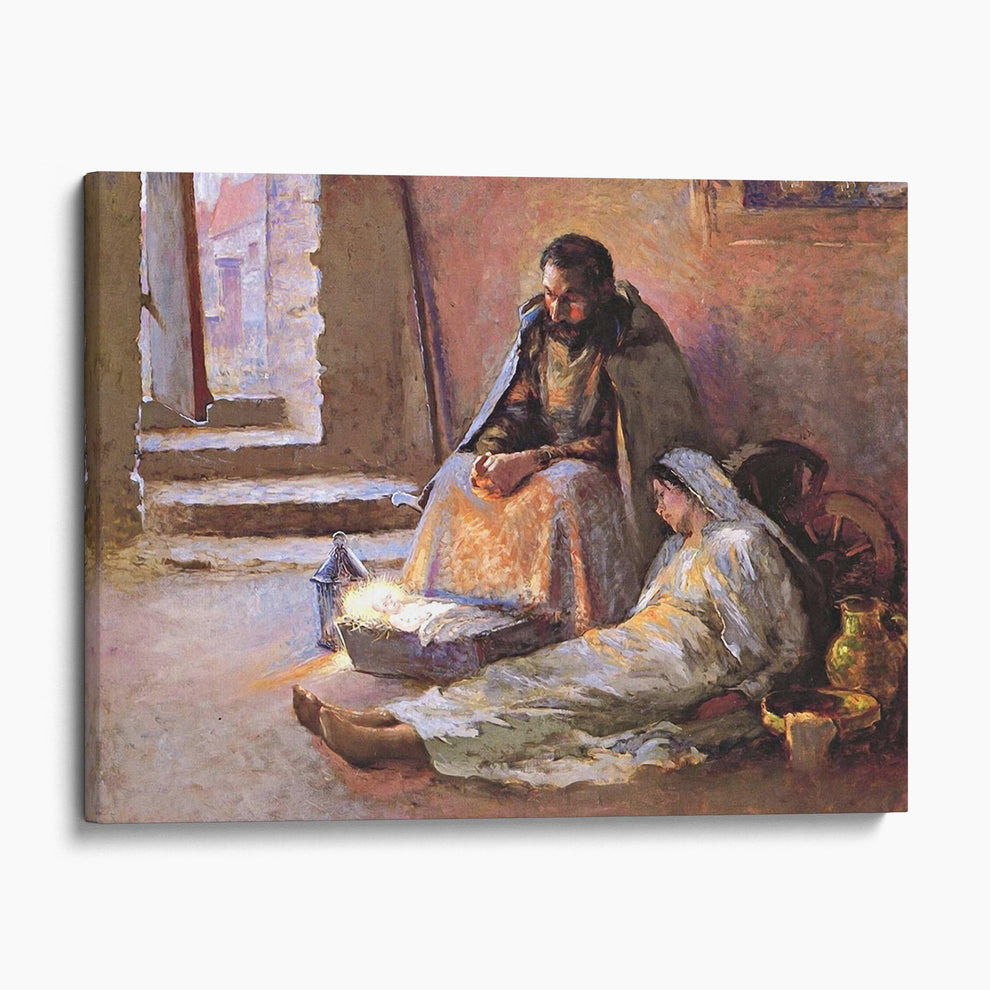
They finally made it, and while they were there, she gave birth to Jesus in a lowly stable. (All the inns were full by then.)  She wrapped baby Jesus in swaddling cloths and laid him in an animal’s feed trough.

I love this painting by Gari Melchers, which is probably closer to how it was than our traditional nativity scenes…

Vss. 8-20.

Meanwhile, in the hills outside Bethlehem, there was a group of shepherds watching their sheep.  The animals were probably all snuggled down together, sleeping, while the men sat around a campfire that was fast going out.

THEN AN ANGEL APPEARED!

THE GLORY OF THE LORD SHONE AROUND THE SHEPHERDS!

They were VERY afraid.

But the angel (could it have been the messenger, Gabriel?) told them,

  • “Fear not, for behold, I bring you Good News of great joy that will be for all people.  For unto you is born this day in the city of David, a Savior who is Christ the Lord. And THIS will be a sign for you: you will find a baby wrapped in swaddling cloths and lying … in a manger.”

And then, more wonderfully terrifying, a multitude of heavenly hosts appeared, praising God and saying,

  • “Glory to God in the highest, and on earth peace among those with whom He is pleased!”

And then they were gone, and again it was a dark, silent night.

“Let’s go to Bethlehem and see this thing that has happened which the Lord has made known to us!”

And so they did.  They didn’t search inns, but looked for a stable. (After all, the angel said the baby would be in a feed trough.)  And they FOUND Mary and Joseph and the baby … lying in the manger, just as the angel had said.  They told the couple what had happened out on that hillside.  And Mary treasured up all these things, pondering them in her heart.

And then the shepherds returned to their duties, glorifying and praising God for all they’d seen and heard, as it was told to them.  And everybody who heard their story was in wonder about it.

.

Vs. 21.

And at eight days, Jesus was circumcised and officially named JESUS, the name that Gabriel had given to Mary before He was conceived.

.

.

“For God so loved the world that He gave His only begotten Son, that whosoever believed on Him, would not perish but have eternal life.” John 3:16


Reading the Gospels in 2026: (3/11) Luke 1:67-80

A 5-day per week study.

March 11 – Reading Luke 1:67-80

Read and believe in Jesus.

“And you, child, will be called the prophet of the Most High.”  Luke 1:76

.

The Gospel according to Luke 1:67-80

In the last study, we saw Elizabeth giving birth to a baby boy. Since Zechariah was still mute (and possibly deaf), SHE announced his name at the circumcision ceremony.  He would be JOHN.  Of course, the family objected, saying he should be Zechariah Jr.  Nope!

The old priest took a notepad and clearly wrote out “His name will be called John.”  And immediately Zechariah’s speech returned.  Everyone was excited and eagerly listened to his account of all that had happened in the Temple with the angel, Gabriel.

.

Vss. 67-75.

And now, the old priest is filled with the Holy Spirit and begins to speak forth God’s words and prophesy.  (Zech is really happy to be speaking again, I think.)

First, he praises the Lord God of Israel.  He recalls all the promises of God from Abraham onward and tells how God has now fulfilled them.  The LORD God has redeemed His people and raised up a “horn of salvation” in the house of His servant David… just as the prophets foretold.

Then Zecharia looks towards his son, perhaps laying his hand on the baby boy’s head, and by the Holy Spirit says, “And you, child, will be called the prophet of the Most High, for you will go before the Lord to prepare His ways, to give knowledge of salvation to his people in the forgiveness of their sins.”

And then, “The sunrise (Messiah) shall visit us from on high to give Light to those who sit in darkness and in the shadow of death,  and to guide our feet into the way of peace.”

What a benediction!  What a way to end ten months of inability to utter one word!

.

Verse 80.

“And the child (John) grew and became strong in spirit, and he was in the wilderness until the day of his public appearance to Israel.”

Out in the danger and loneliness of the desert, filled with the Holy Spirit from birth, John probably prayed long prayers and recalled the scriptures he’d learned as a youth in a priest’s house. Like Elijah, he was tough and lived on what the desert could supply.

.

How did John know when he would begin his ministry and start baptizing and preparing the people for the Messiah?   

We will get into that in Chapter Three, but if you want to peek, see Luke 3;1-3.


Reading the Gospels in 2026: (3/10) Luke 1:57-66

A 5-day per week study.

March 10 – Reading Luke 1:57-66

Read and believe in Jesus.

“What then will this child be? For the hand of the Lord was with him.”  Luke 1:66

.

The Gospel according to Luke 1:57-66

Last time we saw Mary, who was barely pregnant, going to visit Elizabeth, who was already six months along. The baby in Elizabeth’s womb jumped for joy when Mary greeted her. And on hearing that, Mary burst out in a song of praise to the Lord.  What fellowship the women must have had!  Both were being used by God to carry out the “hope of the ages.” Strengthened in the Lord, Mary returned home.

John would be born first and prepare the way.  Then Jesus would come, be baptised by His cousin, and be identified as the Lamb of God.  Both John and Jesus would die at the hands of evil men.  Jesus would rise as Savior of the world.

Elder Elizabeth & teenage Mary; John, a prophet like Elijah, and Jesus, the Son of God. The Messiah!

.

Vss. 57-61.

The time finally came for Elizabeth, and she gave birth to a son. All her neighbors and relatives heard that the Lord had shown mercy to the aged couple and rejoiced with them.

On the 8th day, when a baby boy would be circumcised and named, Elizabeth broke tradition and said, “He shall be called John.” All the couple’s friends and neighbors were shocked.  First, it was the father’s privilege to name his son; second, the firstborn should be named after his father.  But, remember, Zecheriah had been mute since that time inside the Temple when he’d disbelieved angel Gabriel’s good news.

.

Vss 62-66.

Still, the family couldn’t believe Elizabeth’s choice and “made signs” to Zechariah. (Whoa!  Does this mean he was also deaf???)   The old priest called for a notepad and wrote “John.”  And immediately his voice returned and he blessed God!  All were amazed and filled with holy fear.

And these things were talked about through all the hill country of Judea.  All who heard the story, “laid them up in their hearts,” saying, “What then will this child be?” for the hand of the Lord was with him.

What indeed will John be?  The next study is Zechariah’s “benediction.” He will tell of the Son of David, and of John, the prophet of the Most High.


Reading the Gospels in 2026: (3/9) Luke 1:39-56

A 5-day per week study.

March 9 – Reading Luke 1:39-56

Read and believe in Jesus.

“My soul magnifies the Lord,” Luke 1:46

.

The Gospel according to Luke 1:39-56

The last scripture we looked at told us how Gabriel’s message to the young betrothed Mary about becoming the mother of the Messiah was accepted with humble grace.   “Let it be to me according to Your word,” although Mary had to know the problems that would arise in explaining her pregnancy to her family, and especially Joseph. (As an unwed mother, she could have been deemed an adulteress and stoned to death!)  The news of Elizabeth’s miracle pregnancy cheered her and assured her that “NOTHING will be impossible with God.”

.

Vss. 39-45.

As soon as it could be arranged – probably as a big help for Elizabeth – Mary travelled in a group south into the hill country of Judea, where Zechariah and Elizabeth lived.

As she entered the house and called out a greeting to Elizabeth, something wonderful happened.  Elizabeth’s unborn baby – John – “leaped in her womb!”  And Elizabeth herself was filled with the Holy Spirit.

Her loud words revealed a knowledge that no one had told her.

“Blessed are you (Mary) among women, and blessed is the fruit of YOUR womb!  Why is it granted to me that the mother of my Lord should come to me?  For behold, when the sound of your greeting came to my ears, the baby in my womb leaped for joy.  Blessed is she who believed that there would be a fulfillment of what was spoken to her from the Lord.”

How wonderful for the Lord to encourage Mary in this way.  If she’d had any doubts (and I don’t think she did), they were gone after Elizabeth’s prophecy.  How comforting to be able to talk it over with this “grandma-type” woman.  Mary had probably not told anyone of the angel Gabriel’s visit.

.

Vss. 46-55.

In response to Elizabeth’s praise, Mary’s own heart soars.  The verses that follow are almost a song.  Can you imagine that?  Her words are full of praise to the Lord, and many Old Testament allusions and quotations.   Even as a woman in Jewish society where only the men studied, she knew the Word of God.  There are allusions to the Law, the Psalms, and the Prophets.  What sweet words to the “ears” of God.

  • “My soul magnifies the Lord,
  • and my spirit rejoices in God my Saviour,
  • for He has looked on the humble
  • estate of his servant.
  • For behold, from now on all generations,
  • will call me blessed;
  • for He who is mighty has done
  • great things for me,
  • and Holy is His Name.
  • And His mercy is for those
  • who fear him.
  • From generation to generation,
  • He has shown strength with His arm.
  • He has scattered the proud 
  • in the thoughts of their hearts;
  • He has brought down the mighty from their thrones
  • and exalted those of humble estate.
  • He has filled the hungry 
  • with good things,
  • and the rich,
  • He has sent away empty.
  • He has helped His servant Israel
  • in remembrance of His mercy,
  • as He spoke to our fathers,
  • to Abraham and to his offspring forever.”


(Perhaps Mary sang songs like this as lullabies to her baby Jesus, too.)

.

Vs. 56.

I wish I knew more about the three months Mary spent with Elizabeth. They must have encouraged each other in the Lord.  Perhaps Elizabeth gave her advice or counsel about her family and Joseph, for when she returned home, “showing” her pregnancy.  Was she there when John was born? Did she hear (when Zecharia could finally speak again) how John would open the way for ministry for her own son, Jesus?

Regardless of our speculation, Mary finally returned to Nazareth “to face the situation.”  WHO would believe her?


Reading the Gospels in 2026: (2/19) Mark 12:35-43

A 5-day per week study.

February 19– Reading Mark 12:35-43.

Read and believe in Jesus.

The Lord said to my Lord, Sit at my right hand…”  Mark 12:36a

.

The Gospel according to Mark 12:35-43

After butting heads with the three major religious sects in Jerusalem, then speaking with one sincere scribe who was “near to the Kingdom,” Jesus continued teaching in the Temple area.  He was the true Shepherd of Israel, the one who loved the “flock” and would soon “lay down His life for them.”  Those rulers of Israel, “false shepherds” who had no thought or care for the “sheep,” had to be exposed for the hypocrites they were.

.

Vss. 35-37 with (Matthew 22:41-42).

The religious leaders had tested Jesus with their questions. Now, it was His turn to give them a “test question.”

“What do you think about the Christ (Messiah)?  Whose son is He?” He asked.

“The son of David,” they answered.

Now the people recognized this as the title for the Messiah.  And that’s how their leaders referred to him.  But by calling the Messiah “the son of David,” these pious rulers meant he would be a mere man.  Yes, the descendant of the great King David, but man … not God.

Jesus referred to the Scriptures that they claimed to know so well and revere so highly with His question. (Psalm 110:1)

“How is it then that David, in the Spirit, calls him LORD, saying, ‘The LORD said to my Lord, ‘Sit at my right hand, until I put your enemies under your feet?’  If then David calls him LORD, how is He his son?”

The ‘great throng’ who witnessed this showdown between Jesus and the Pharisees (scribes) were glad to hear Jesus.  The Jewish leaders, however, were totally miffed and “from that day on, no one dared to ask Him any more questions.”

.

Vss. 38-40.

Jesus, turning to the crowd, then issued a warning. “BEWARE of the scribes (and Pharisees)…”

Why?

  • “They like to walk around in long robes…
  • They like greetings in the marketplaces…
  • (They like to) have the best seats in the synagogues…
  • And the places of honor at feasts.”

Jesus was exposing them as hypocrites, seeking the favor and praise of man rather than God.

  • They “devour widows’ houses…
  • And “for show” pray long prayers.”

NOTE: Scribes often served as ‘estate planners‘ for new widows, and would give these grieving women the chance to “serve God” by supporting the Temple work (or the scribe’s own work) with their deceased husband’s money.   In doing this, these wily religious leaders would be “robbing the widows.”

NOTE: And, we know about their “long, showy prayers” from Jesus’ parable of the Pharisee and the Tax Collector. (Luke 18:9-14)

—- Pharisee: “God, I thank you that I am not like other men, extortioners, unjust, adulterers, or even like this tax collector.  I fast twice a week, and I give tithes of all that I get.

—- Tax Collection: “God, be merciful to me a sinner.”

—- Jesus taught (Matthew 5:20), “For I tell you, unless your righteousness exceeds that of the scribes and Pharisees, you will never enter the kingdom of heaven.”

.

Vss. 41-44.

And then, Jesus sat opposite the treasury in the Temple area and watched people put in their offerings.

NOTE: These “offering boxes” were 13 trumpet-shaped receptacles on the walls of the court of women, where offerings and donations to the temple were dropped in.

As Jesus watched, a very poor widow  (who had perhaps been cheated out of her husband’s legacy by those conniving scribes) came to give her offering. She quietly dropped in two small copper coins, which equaled one penny.  (These copper coins were the smallest denomination of Roman coins, equal to 1/64th of a day’s wages.)   And Jesus commended her.

WHY, we ask.  What could so little do to support the Temple?

It wasn’t the Temple that Jesus was concerned with.  He was looking at the HEARTS of the offering givers. Many wealthy people dropped in large amounts, making sure everyone saw them do it.  But even those “princely sums” didn’t hurt their wealth. (They made sure of that.)

The poor widow quietly dropped in those two coins so no one could see. But Jesus saw them, and more importantly, saw her heart.  She had given EVERYTHING SHE HAD.  Now this poor woman would have nothing to live on.  What love compared to what hypocrisy! And she is honored even today for her sacrifice by being in the gospel story.

(In my heart, I believe God saw her faith and honored it, and then supplied her needs in perhaps amazing ways.  But if not, she was content to give her all.)

What do “my” offerings reveal about my heart?


Reading the Gospels in 2026: (2/11) Mark 11:1-11

A 5-day per week study.

February 11– Reading Mark 11:1-11

Read and believe in Jesus.

“Hosanna!  Blessed is He who comes in the name of the Lord! Blessed is the coming kingdom of our father David!  Hosanna in the highest!”  Mark 11:9b-10

.

The Gospel according to Mark 11:1-11

Last time, we saw Jesus and His disciples moving from east of the Jordan River, through Jericho, stopping to heal blind Bartimaeus, and then going “on the way.”  This means “towards Jerusalem” (and His death, which He’s been foretelling to His disciples for months).  The crowds are still with Him, and many others are heading towards the Holy City too for the upcoming Passover Celebration in less than a week.

.

Vss. 1-3

Bethphage and Bethany (where Mary & Martha lived) were on the east slope of the Mount of Olives, which stands just before Mt Zion, on which Jerusalem is built.   Jesus tells two of his disciples to go into “the village in front of you,” (probably Bethphage).  (I wonder which two He sent…)

Anyway, they would immediately find a colt tied up. (Matthew mentions that its mother was also there.)  They were to untie it (them) and come back to Jesus.  If anyone asked what they were doing, they were to say simply, “The Lord needs it.”

And so it happened.

.

Vss 4-10.

Many of the crowds witnessed this and wondered.  What was Jesus doing?  Some began thinking of, and maybe quoting, the scriptures, especially when a cloak was thrown over the back of the colt, and Jesus mounted it.

.

  • Zechariah 9:9 – “Rejoice greatly, O daughter of Zion! Shout aloud, O daughter of Jerusalem!  Behold, your king is coming to you; righteous and having salvation is He, humble and mounted on a donkey, on a colt, the foal of a donkey!”
  • Isaiah 62:11 – “Say to the daughter of Zion, ‘Behold, your salvation comes; behold, His reward is with Him, and His is recompense before Him.'”
  • Psalm 118:25b-25a – “Save us (Hosanna), we pray, O LORD!  O LORD, we pray, give us success!  Blessed is He who comes in the name of the LORD!”

.

They began cutting palm and other branches, waving them and laying them down with their cloaks, on the road before Jesus: a colorful, leafy green path to the Holy City.  (Jesus, with the steady hands of its creator, calmed the young colt in this chaos.)

The whispered verses from before were said aloud, then shouted with joy.  He IS the king!  THEY KNEW IT from when He fed the multitude in Galilee! And here He was entering the city to be crowned… to free Israel from oppression!  Hallelujah!  “Blessed is the coming kingdom of our father David!” Hosannah!  Hosanna in the Highest!”

.

(Luke 19:39-40 tells of some Pharisees coming to Jesus as he approached the city and demanding that He stop the crowds from saying these things. Jesus answered, “I tell you, if these were silent, the very stones would cry out.”)

(Luke 19:41-44 also mentions Jesus weeping as He nears Jerusalem. He foresees the time when the Holy City is destroyed, it and its people… “because you did not know the time of your visitation.”)

.

Vs. 11.

Inside the city, Jesus dismounted and sent the donkeys back to their owner.  The crowds watched or went their own way.  With kingly authority, He went to the temple, “and looked around at everything.”  

Jesus inspected the buildings and the grounds, missing nothing…. including the noisy moneychangers and merchants, the loud animals and birds, and their messes… in the Temple.

It was late, so He and the disciples went back to Bethany.  But He would be back the next day… and they had better watch out.


Reading the Gospels in 2026: (1/21) Mark 5:35-43

A 5-day per week study.

January 21 – Reading Mark 5:35-43.

Read and believe in Jesus.

“Do not fear, only believe.” Mark 5:36b

.

The Gospel according to Mark 5:35-43.

Synagogue ruler, Jairus, had come to Jesus for help. He was in desperate need.  His 12-year-old daughter was deathly ill, at death’s door. “Please come and lay hands on her that she may live,” he had begged Jesus.  And Jesus went with him.

But there was a delay.

Another amazing healing.

A woman released from a daily “death.”

And while Jairus waited, anxious and fearful… his daughter faded.

.

Vs. 35.

While Jesus was still speaking (to the woman), there came from the ruler’s house someone who said, “Your daughter is dead. Why trouble the Teacher any further?”

Imagine the pain in his heart. The grief that almost caused him to collapse. The wistful questions, “If only I’d come sooner. If only that woman hadn’t interrupted.”

.

Vs. 36.

Jesus overheard the message, although it was probably spoken in a low voice for Jairus’s ears only.  He looked right at Jairus and said, “Do not fear, only believe.”

Jairus had a choice at that moment.  He was to believe.  But whom?  The servant from his own house, or the Teacher-healer, Jesus?

.

Vss 37-40a.

When Jesus and His inner three disciples (Peter, James, and John) began walking quickly towards Jairus’ house, the synagogue ruler followed, hope rising in his heart. 

But at his house, the mourners they’d hired (in case) had already begun their loud dirge, weeping and wailing, fists to the sky.  Perhaps Jairus’ hope plunged.  It was true. His little girl was dead. It was too late…

Then Jesus spoke, “Why are you making a commotion and weeping?  The child is not dead but sleeping.”  Jairus’s heart beat wildly. Sleeping?  Not dead? 

But the mourners laughed at Jesus. They were professionals. They had seen death many times. They knew the girl was dead. 

Jesus put them all outside.  Then, taking His three disciples and Jairus and his wife, He entered the room where their daughter lay.  Taking her by the hand He said to her, “Talitha cumi.” (Little girl, I say, arise.)  And immediately the girl got up and began walking!   Everyone (except Jesus) was overcome with amazement!

I can imagine her parents hugging her, running their hands through her hair and down her arms. Yes. YES! She was alive. O praise, God, she is alive!  Our daughter, who was dead, is now ALIVE!” Such joy and celebration. They wanted to tell the world.  

But Jesus strictly charged them not to let anyone know this.  Then, to keep her parents busy and also to help their daughter, He told them to get her something to eat.  (She’d probably gone days or more without food when she was sick.)  

Mark doesn’t tell us, but it’s likely that Jesus quickly dispersed the mourners. They were wrong. She is okay and eating a meal. 

Mark’s next chapter has Jesus leaving Capernaum and going to his hometown of Nazareth.  It seems the miracle of resurrection WAS kept a secret.  Or maybe that’s why Jesus and his disciples left Capernaum for a while. We’ll see what’s next tomorrow.

.

( Ponderings:  It’s interesting that this little girl was twelve years old, and the woman with the discharge had suffered her affliction for twelve years. Her illness had begun the year the girl was born, and now it was near the time for the girl to begin her monthly issue.  In a society that honored boys and men, Jesus lovingly took time to touch and heal an “unclean” woman and the “unclean” body of a dead little girl. Another picture of why Jesus came … to ultimately heal our fatal sin problem and give us new spiritual life in Him.  Thank You, Jesus!)

 Now, if I were a historical fiction writer, I would write this story as a book and connect these two “women” in some way.